


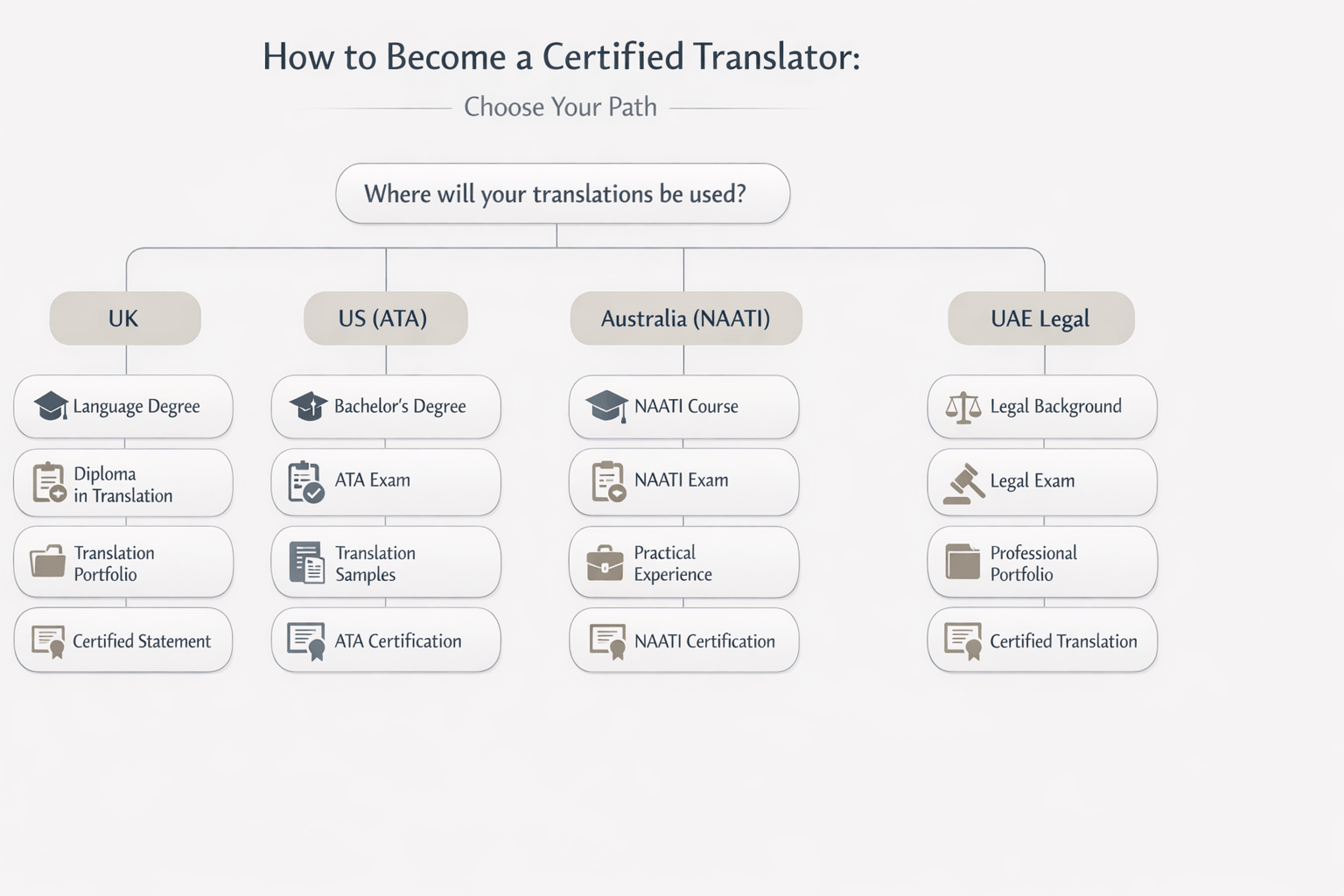
If you’re searching how to become a certified Spanish translator, the first thing to know is this: the path depends on where you plan to work and who will accept your translations. In the UK, “certified translation” usually means a qualified professional or agency provides a signed certification statement. In the US, many professionals pursue ATA certification. In Australia, NAATI is the key pathway. In the UAE, legal translator accreditation is the relevant route for certain official work.
That difference is exactly where many articles fall short.
This guide gives you a practical route to become a trusted professional in Spanish or Arabic translation work, including the UK route, the US/ATA route, and the UAE/Australia pathways if your clients need those standards. It also covers how to build credibility fast, how to specialise, and how to avoid the mistakes that stop talented bilinguals from becoming paid translators.
If you want to understand the document side of the job while you train, start with our guide to certified translation certificate wording and examples and then review our Gov.uk certified translation requirements guide.
What “Certified Translator” Actually Means in Practice
Before choosing courses or exams, clarify the model you’re aiming for.
The UK model (most common for UK document work)
In the UK, there is no single government-issued “certified translator” licence for general document translation. What matters is whether your translation is prepared by a competent professional and includes the required certification details (accuracy statement, date, signature, contact details, credentials).
That means your credibility comes from:
- language mastery
- translation training
- recognised qualifications
- strong document formatting
- consistent, acceptance-ready certification wording
For a UK-focused breakdown, read our full guide on how to become a certified translator in the UK.
The US model (ATA route)
If you want to know how to get certified as a Spanish translator in the US, the most recognised route is ATA certification (for supported language directions). This is a professional credential, not just a course certificate, and it is a strong credibility signal for legal, immigration, and official document work.
The Australia model (NAATI route)
For Australia, NAATI certification is the main professional route for translators, and it matters heavily for official submissions and public-sector use.
The UAE model (legal translator route)
If you are asking how to become a certified Arabic translator for court/legal use in the UAE, you are often looking at the Ministry of Justice legal translator registration route (not just general translation experience).
The Best Career Path for Spanish and Arabic Translators
Here is the path that works in the real market, whether you want to become a freelance translator, work with agencies, or build your own certified-translation client base.
1) Pick Your Language Direction and Market First
This is where professionals separate themselves from hobby translators.
Do not start with “I translate both ways.” Start with:
- your strongest target language (usually your native or near-native language)
- one main pair (for example, Arabic → English or Spanish → English)
- one market (immigration, legal, academic, medical, corporate)
Good starting examples
- Spanish → English for UK immigration, certificates, legal docs
- Arabic → English for immigration, contracts, civil records
- English → Spanish for certified packs used abroad (only if your writing quality is genuinely professional)
- English → Arabic for jurisdiction-specific legal or business use (especially UAE-related workflows)
If you’re building a service around official documents, it helps to study accepted formats. Our passport certified translation guide and certified translation services page show the types of submissions clients actually need.
2) Build Professional-Level Fluency (Not Just Conversation Fluency)

Many people can speak Spanish or Arabic. Far fewer can produce accurate, formal, submission-ready translations.
To get paid for certified document work, you need:
- excellent grammar and punctuation in the target language
- strong reading comprehension of formal source documents
- legal and administrative vocabulary
- formatting discipline (names, dates, stamps, seals, notes)
- consistency across multi-page packs
What this means for Spanish translators
Spanish certified translation work often includes:
- civil status documents
- police certificates
- court records
- academic transcripts
- immigration files
You must be able to handle:
- regional terminology (Spain vs Latin America)
- surname structures
- date formats
- official abbreviations
What this means for Arabic translators
Arabic work adds extra complexity:
- Modern Standard Arabic vs dialect differences
- transliteration consistency for names
- legal phrase equivalence
- handwritten or stamped source content
- right-to-left formatting considerations (depending on target layout)
A common mistake is being fluent in Arabic but weak in English legal writing (or vice versa). Certified work is judged on both.
3) Learn Translation as a Skill (Not Just Language Knowledge)
Being bilingual is not the same as being a translator.
You need to train for:
- accuracy under time pressure
- terminology research
- ambiguity handling
- faithful rendering (without “rewriting” the source)
- translator notes (when necessary)
- confidentiality and file handling
Core skills to practise weekly
- Sight translation drills (short official documents)
- Terminology building (legal, civil, academic)
- Parallel text comparison (approved wording patterns)
- Formatting practice (stamps, signatures, tables, seals)
- Revision discipline (self-edit + final QA pass)
If your goal is client-facing certified work, study how a finished certified pack is structured. Our What Is a Certified Translation? Certificate, Wording, Examples guide is a good template reference while you build your own practice materials.
4) Get a Recognised Qualification (Especially for UK Credibility)
If you want serious agency work or better-paying direct clients, a recognised qualification helps a lot.
Strong UK routes
- CIOL DipTrans (Diploma in Translation) — widely respected, strong signal for professional competence
- Translation Studies degree / Master’s — useful for training, theory, and portfolio building
- Specialist legal translation training — excellent if you want immigration/court document work
Why this matters
Clients and agencies buying certified translations are not buying “language talent.” They are buying:
- reliability
- formatting accuracy
- authority acceptance
- lower risk
Qualifications reduce perceived risk.
If you’re serving overseas document use as well, learn the differences between UK-certified, notarised, and sworn routes. These two pages help:
5) Choose Your Certification Path by Country (Spanish / Arabic / Korean)
This is the section most people search for — and most blogs oversimplify.
UK: How to become a certified English Spanish translator
If you’re searching how to become a certified english spanish translator in the UK, the practical route is:
- Build near-native written English (or Spanish, depending on direction)
- Train in translation techniques and legal/admin document handling
- Gain a recognised qualification (CIOL DipTrans is a strong route)
- Build a portfolio of real-world document types
- Use proper certification wording and professional credentials on every certified job
- Build trust through consistency, not just speed
In the UK, authorities and institutions usually care more about the translation package quality and translator credentials than a single government-issued “translator licence.”
US: How to get certified as a Spanish translator
If you’re asking how to get certified as a spanish translator in the US, the ATA route is usually the key goal.
A practical US path looks like this:
- Pick your direction (for example, Spanish → English)
- Join ATA
- Check the current exam language availability
- Practise with official-style passages and error marking
- Take the exam when your revision quality is already consistent
- Use the credential in your profiles, proposals, and signatures
Important: ATA language availability can change by direction, so always check the live exam schedule before planning your preparation calendar.
Australia: NAATI route (also relevant for Korean and Arabic)
For Australia, NAATI is the route to aim for if you want official credibility.
This matters for:
- how to become a certified arabic translator (Australia-focused route)
- how to become a certified korean translator
- Spanish and many other community languages
If you serve clients moving between the UK and Australia, it’s smart to understand both UK certified translation formatting and NAATI requirements. Our NAATI certified translation guide is a good comparison starting point.
UAE: How to become a certified Arabic translator for legal use
If your goal is UAE court or official legal work, the relevant route is usually legal translator accreditation/registration through the UAE Ministry of Justice pathway (not just freelance translation experience).
This is a different career track from general document translation because it is tied to:
- legal authority acceptance
- formal registration
- eligibility requirements
- process and fees
- approved language/legal workflows
If you work with UAE-bound documents, it also helps to understand when clients need certified translation vs sworn/notarised/legalised packs. Our guide to sworn translation in other languages helps explain the cross-border side.
6) Build a Portfolio That Looks Like Real Certified Work

A portfolio gets translators hired faster than a long CV.
What to include (even if anonymised)
Create sample packs (with placeholders) for:
- birth certificate
- marriage certificate
- police certificate
- passport page
- degree certificate
- transcript
- court order
- company incorporation document
Each sample should show:
- source layout awareness
- clean target formatting
- notes for seals/stamps
- consistent names/dates
- certification statement page
This is where new translators win work: clients can see you understand official document translation.
If you want to benchmark structure and wording, review:
- certified translation certificate wording and examples
- Gov.uk certified translation requirements guide
- Germany sworn translation guide
7) Learn the Certification Statement and Compliance Details
This is the part that makes a translation “usable” for official submissions.
Your certified translation workflow should include a final check for:
- translator/agency name
- accuracy statement
- date
- signature
- contact details
- credentials / professional affiliation
- reference number (optional but helpful)
- page numbering
- PDF quality and readability
The career shortcut most new translators miss
Don’t wait until you get your first client to learn certified formatting.
Practise this now.
Translators who master document packaging early often get better reviews and repeat business faster than translators who are stronger linguistically but weaker operationally.
If you want to see how clients compare providers, our guide on certified translation reviews and what to check is useful for building your own quality standard.
8) Join Professional Bodies and Keep Developing
Professional membership helps with:
- credibility
- CPD
- referrals
- networking
- standards awareness
For a career in certified documents, your edge is not “I can translate.”
Your edge is “I’m a professional who delivers accurate, acceptance-ready work every time.”
A strong professional stack
- Recognised qualification (e.g., DipTrans / equivalent route)
- Professional body membership
- Specialism (legal/immigration/academic)
- Style guides and glossaries
- QA process
- Secure file handling process
- Clear turnaround and pricing policy
9) Set Up Your Business Like a Professional Translator
You can be excellent at translation and still struggle if your workflow is messy.
Minimum setup checklist
- Professional email + domain
- Quote template
- Invoice template
- Certification statement template
- File naming standard
- Secure storage policy
- Revision checklist
- Turnaround rules
- Terms and privacy notice
Pricing tip (for new translators)
Don’t compete on “cheap.”
Compete on:
- acceptance-ready formatting
- subject expertise
- clarity of communication
- reliability
- turnaround discipline
If you’re unsure how clients evaluate value vs price, our certified translation cost guide is a useful benchmark.
A 90-Day Plan to Become Job-Ready
Here’s a practical roadmap you can actually follow.
Days 1–30: Foundation
- Choose your language direction and specialism
- Start terminology glossary (legal + civil docs)
- Build 5 sample translated documents
- Learn certified statement formatting
- Review UK acceptance requirements for official documents
Days 31–60: Credibility
- Join at least one professional body or training network
- Begin formal qualification prep (DipTrans / ATA / NAATI route)
- Build portfolio page + PDF sample pack
- Practise revision on timed translations
- Create your quote/certification templates
Days 61–90: Market entry
- Apply to specialist agencies (legal/immigration first)
- Publish a clear service page (Spanish or Arabic certified translation)
- Offer sample-based capability (not unpaid full jobs)
- Collect your first 3 testimonials
- Refine turnaround and pricing process
This plan works whether your goal is:
- freelance work
- agency work
- in-house translation
- building your own certified translation brand
Common Mistakes That Delay Your Career
1) Calling yourself “certified” without understanding the jurisdiction
This causes client confusion and rejection risk. Always match the credential to the country and authority.
2) Translating both directions too early
Professionals usually perform best into their strongest written language.
3) Focusing only on language, not document formatting
Certified work is part translation, part compliance.
4) Using inconsistent name spellings across documents
This is a major issue in immigration and legal files.
5) Ignoring specialisation
Generalists struggle to command better rates. Legal/official document specialists usually progress faster.
Final Word: The Fastest Route to Becoming a Trusted Certified Translator
If you’re serious about how to become a certified Spanish translator or how to become a certified Arabic translator, focus on this sequence:
language mastery → translation training → recognised pathway → certified formatting → specialisation → reputation
That is the real path.
And if you want to accelerate your learning, study real certified document formats while you train. Start with our certified translation services page, review the certificate wording examples, and use our contact page when you’re ready to discuss professional standards, format expectations, or collaboration opportunities.
FAQs
How to become a certified Spanish translator in the UK?
In the UK, there is no single government-issued licence for general certified translation work. The usual route is to build professional language skills, train in translation, gain a recognised qualification (such as DipTrans), and deliver certified translations with proper wording, signature, contact details, and credentials.
How to get certified as a Spanish translator in the US?
The most recognised route is usually ATA certification (for supported language directions). Start by choosing your language direction, joining ATA, checking live exam availability, and preparing with professional-level practice before taking the exam.
How to become a certified Arabic translator for UAE legal work?
For legal/court use in the UAE, the relevant route is typically legal translator registration/accreditation through the UAE Ministry of Justice process. This is different from general freelance translation and involves formal eligibility and registration steps.
How to become a certified English Spanish translator if I already speak both languages?
Speaking both languages is a strong start, but you still need translation training, a portfolio, and an acceptance-ready workflow. Focus on one direction first (for example, Spanish to English), learn document formatting, and build certified statement templates.
How to become a certified Korean translator using the same pathway?
The same framework applies: choose direction, train professionally, specialise, and follow the right country pathway. For example, NAATI and ATA pathways may be relevant depending on where your clients will use the translations.
Do I need a degree to become a certified translator?
Not always, but recognised qualifications and professional credentials significantly improve trust, agency acceptance, and pricing power. In official document translation, credibility matters as much as language ability.