


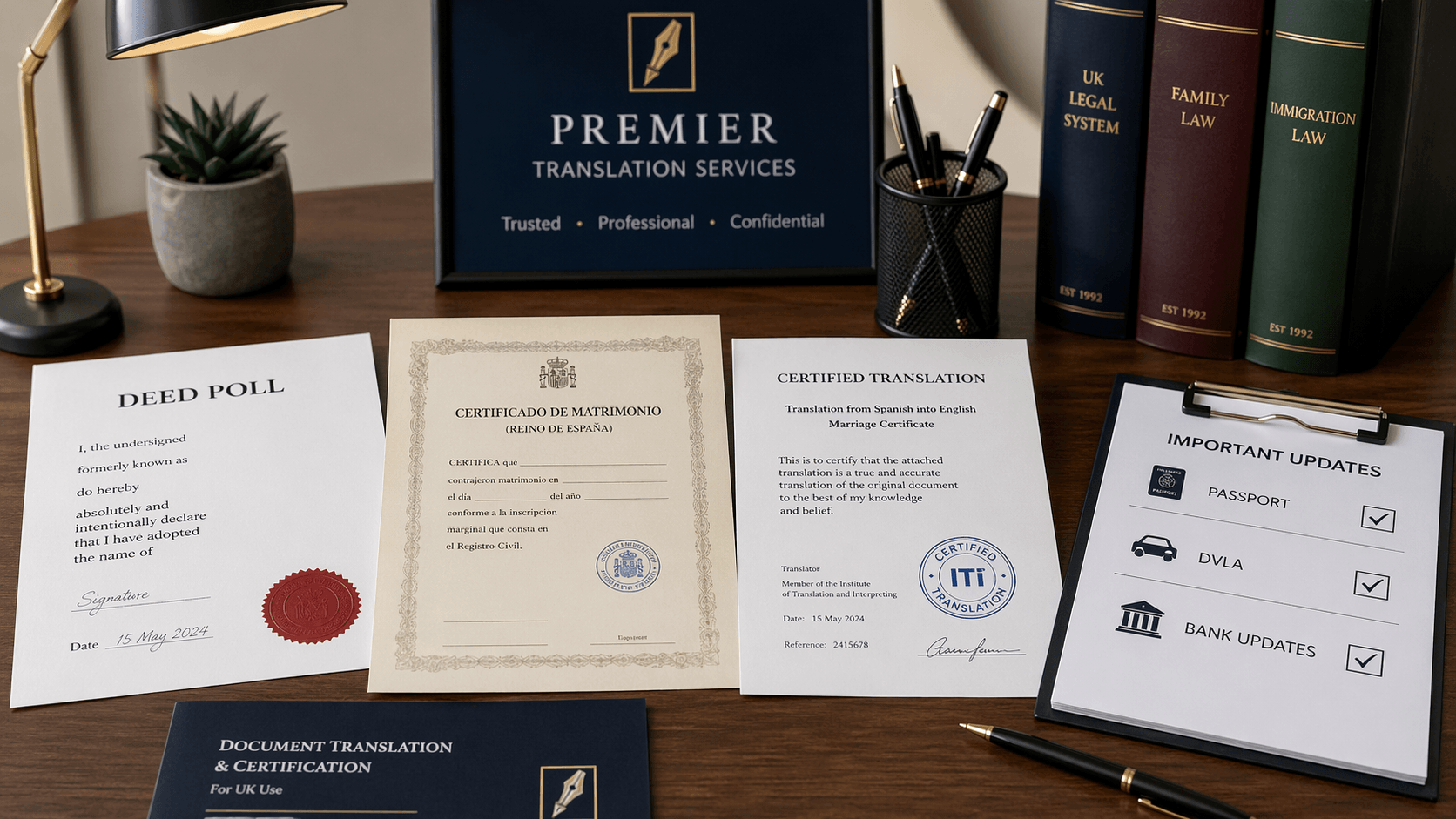
If you need deed poll translation UK support, the first thing to know is this: in many cases, the deed poll itself is not the real problem. A UK deed poll is usually already in English and can be used to prove your name change. The delays usually happen when the rest of your supporting documents are in another language and the organisation reviewing them cannot clearly connect your old name, your new name, and the reason for the change.
That is why name change cases can become more complicated than a standard document translation. You may be dealing with a foreign-language birth certificate, marriage certificate, divorce judgment, adoption record, or previous identity document at the same time as UK bank updates, DVLA updates, or HMPO updates. If even one document in that chain is incomplete, mistranslated, or not properly certified, the whole application can stall.
A faster, safer approach is to build a name-change file that proves three things at once:
- Identity — who you are.
- Change — what changed and when.
- Continuity — how your old and new records connect.
That is the standard this guide follows. It will show you when a translation is needed, what a compliant translation usually includes, how requirements differ across HM Passport Office, DVLA, and banks, and how to avoid paying for the wrong level of certification.
If you already know which documents are involved, you can start with a certified translation service and get the right format confirmed before submission.
How to get a deed poll translation accepted by UK authorities
To give a translated name-change file the best chance of acceptance, make sure the reviewing body can see the full chain from your old name to your new name without having to guess. In practice, that usually means providing the deed poll or other name-change evidence, the original foreign-language supporting document, and a full certified English translation of every non-English document that explains the name history.
For most UK cases, acceptance does not turn on translating the deed poll in isolation. It turns on whether the full file is complete, consistent, and easy to verify. If the deed poll is already in English, the more important task is usually translating the foreign-language birth, marriage, divorce, adoption, or court record that connects the names across time.
A translated name-change file is more likely to be accepted when it includes:
A full translation rather than a summary
Matching spellings of names across every document in the bundle
Dates, places, document numbers, stamps, seals, and handwritten notes where relevant
A certification statement confirming the translation is true and accurate
The translator or translation company’s full name, signature where required, date, and contact details
The original document or official copy alongside the translation where the receiving body expects it
For HMPO cases, it also helps if the file clearly shows any previous name changes and includes evidence that you are already using the new name. For DVLA cases, it helps if the application pack is complete and the supporting evidence is original where required. For banks and other organisations, the main issue is usually whether the staff member can safely match the old and new records without escalating the case.
In short, the safest route is usually:
Use the English deed poll if it is already valid and readable
Translate the non-English supporting records, not just the obvious name-change page
Submit the original document and certified translation together where required
Keep spellings and dates consistent across the whole bundle
Only add notarisation or legalisation if the receiving body specifically asks for it
Deed poll translation UK: what it usually means in practice

Most people search for deed poll translation UK when they are trying to solve one of these situations:
- They changed their name in the UK and now need to update foreign-language supporting documents for a UK authority.
- They changed their name abroad and need certified English translations for UK record updates.
- They are updating several institutions at once and need one complete, consistent set of translated documents.
- They have a tight deadline and want a fast service that will not create avoidable rejections.
The key distinction is simple:
- If your deed poll is already in English and you are using it in the UK, it usually does not need translation.
- If the supporting documents that explain the name history are not in English or Welsh, those documents usually do need translation.
This is where many applications become stuck. People focus on the deed poll because it is the obvious “name change” document, but the reviewing officer often needs to understand other records too. That may include an overseas marriage certificate showing the surname change, a foreign divorce record showing a return to a previous name, or a birth certificate in another language confirming the original identity details.
Quick answer: when the deed poll itself does and does not need translation
If the deed poll was issued in the UK and is already in English, the deed poll itself will usually be submitted as evidence of the change of name, not as a document needing translation. The translation need usually sits elsewhere in the file.
If the name-change evidence was issued overseas or the key supporting records are in another language, the safer approach is to translate every non-English document that explains the identity history, not only the page that mentions the new name.
That distinction matters because many delays happen when the decision-maker can read the deed poll but cannot read the certificate or court record that proves how the old and new names connect.
The documents most commonly translated in a name change file
A name change file often includes more than one document. The most common translation requests are:
- Foreign birth certificates
- Foreign marriage certificates
- Foreign civil partnership certificates
- Divorce decrees or final orders issued outside the UK
- Adoption records
- Overseas court orders
- Previous passports or identity documents
- Academic, payroll, pension, or employer records where the name history must match
In other words, the translation is often not only about the deed poll. It is about the documents that prove the link between names across time.
The quickest way to judge whether you need a translation
Use this practical rule:
If the person updating your record cannot read every key document in the file and trace the name history from start to finish, you probably need a certified translation of the non-English documents.
That rule is especially useful when you are updating several organisations in parallel. One body may accept a deed poll and one supporting document. Another may want proof that you are already using the new name. Another may need the record that explains why your current passport, licence, bank card, and civil records do not all match yet.
What a certified translation for a name change should include
A compliant name change document translation should do more than convert words from one language into another. It should make the evidence usable.
A strong certified translation pack usually includes:
- A full translation of the original document, not a summary
- Clear reproduction of names, dates, places, and document numbers
- Notes for stamps, seals, signatures, and handwritten text where relevant
- A signed certification statement confirming the translation is true and accurate
- The translator or provider’s name, date, and contact details
- Consistent spelling across all documents in the bundle
If you want to see what that certification wording normally looks like, this guide to certificate of accuracy examples is a useful companion.
What UK authorities usually expect a certified translation to contain
For UK name-change submissions, the practical question is what makes a certified translation complete and easy for the receiving organisation to verify.
A practical answer is this: a translation is usually easier for UK authorities to accept when it contains:
A statement that it is a true and accurate translation of the original document
The date of translation
The full name of the translator or translation company
Contact details that allow the translation to be independently checked
A signature where the receiving body expects one
A complete rendering of the original document, including stamps, seals, and handwritten annotations where relevant
A stamp can be helpful, but the more important point is whether the translation is complete, professionally presented, and independently verifiable. That is why a good translation provider focuses on the full acceptance standard, not only on adding a stamp to the page.
Why consistency matters more than people expect
Name change cases are rarely rejected because one dramatic mistake appears. More often, they fail because the file contains small inconsistencies:
- A middle name appears on one document but not another
- A transliterated surname is spelled differently across records
- A translator modernises a place name in one document but not the next
- A marriage certificate uses one surname format while the passport uses another
- A scanned page is cropped, hiding a stamp or notation
These details matter because name-change reviews are really linkage reviews. A decision-maker must be able to see that all documents belong to the same person and that the change is documented properly.
That is why a specialist passport certified translation guide can be especially helpful when the translation will be part of a wider identity update.
HMPO updates: what usually matters most
For HM Passport Office, the critical issue is not only that your name changed, but that the evidence supports the change and connects your previous and current identities.
In practice, a passport update case often needs:
- A valid deed poll, statutory declaration, or affidavit where relevant
- Proof of any earlier name changes
- Evidence that you are using the new name
- Certified translations of any supporting documents that are not in English or Welsh
A common HMPO scenario
You changed your surname in the UK, but your supporting marriage certificate was issued abroad in another language. Your deed poll may be in perfect order, but the application can still be delayed if the certificate that links your former and current surnames is unreadable to the caseworker or not properly translated.
What makes HMPO cases slower
- Missing proof of name use
- Inconsistent spelling between the passport application and translated records
- Foreign-language documents submitted without a full certified translation
- Old name changes not accounted for in the file
If your case involves multiple historical documents, it is often worth sending the whole pack for review together rather than translating one page at a time.
How to make a translated name-change file easier for HMPO to accept
For HMPO, a translation is most useful when it supports the full name-change story rather than standing alone. A strong HMPO submission usually does three things clearly:
It shows the legal or documentary basis for the change
It shows any earlier name changes
It shows that the new name is already being used in real life
That means a translation often works best when submitted as part of a bundle that includes the name-change evidence, the translated supporting record, and proof of current name use. If the case involves a foreign marriage certificate, divorce order, or overseas civil record, translating that link document accurately is often more important than focusing only on the deed poll itself.
DVLA updates: where people lose time unnecessarily
DVLA updates are usually more process-driven. The issue is less about legal theory and more about whether the application pack is complete, original where required, and easy to process.
A typical DVLA name-change pack may involve:
- Your current photocard or paper driving licence
- The correct DVLA application form
- Original supporting evidence of the new name
- Certified translations of any supporting foreign-language documents that explain the name history
A common DVLA scenario
You have a UK deed poll but your original birth or civil-status record is from abroad. If the supporting evidence is in another language and DVLA needs it to confirm the record trail, a clear certified translation can remove a preventable bottleneck.
Practical tip for DVLA submissions
Do not treat a DVLA update as “just an admin task.” If your supporting documents are multilingual, the quality of the document pack still matters. Poor scans, missing reverse pages, or inconsistent names can create the same delays you would expect in a more formal passport process.
How to make a translated name-change file easier for DVLA to accept
For DVLA, acceptance usually depends on whether the application is straightforward to process. That means the translation should be paired with the correct form, the existing licence where required, and the original supporting evidence of the name change or identity history.
Where applicants lose time is not always the translation itself. It is often the combination of photocopies instead of originals, incomplete scans, missing reverse pages, or a translated document that does not clearly match the rest of the file. A good translation reduces friction only when the whole pack is submission-ready.
UK bank updates: the rules vary more than most people realise
Banks do not all handle name changes in exactly the same way. Some updates are completed in branch, some by post, and some require certified copies rather than originals through the mail. What they usually have in common is this:
- Proof of the name change
- Supporting ID or evidence linking the previous and current name
- Extra caution where documents are foreign-language or issued overseas
That is why name change document translation often becomes part of UK bank updates even when the customer assumed the deed poll alone would be enough.
Why banks can be frustrating in practice
Bank teams are working from internal procedures, fraud controls, and document-handling rules. Even when a deed poll is valid, the staff member still needs enough evidence to update the record confidently. If your supporting marriage, divorce, or civil documents are not in English, the bank may ask for a professional translation before moving forward.
The real-world lesson for bank updates
Do not wait for a rejection to gather your translated evidence. If the account is linked to salary, mortgage payments, childcare costs, or travel spending, delays can be more disruptive than people expect.
How to make a translated name-change file easier for banks and other organisations to accept
For banks, employers, universities, and similar organisations, the most useful translation is one that removes uncertainty for the person reviewing the file. In practice, that means the translated record should make the old name, new name, date, and reason for the change easy to follow at a glance.
A deed poll may still be central to the file, but the supporting document often does the real explanatory work. If the institution can read the document that links the names and see that the translation is complete and professionally certified, the update is less likely to be escalated or delayed.
A simple comparison: what each organisation is usually trying to confirm

| Organisation | Main concern | What usually helps most |
| HMPO | Is the name change properly evidenced and linked to the applicant’s identity? | Deed poll or equivalent evidence, proof of prior changes, proof of name use, certified translations of foreign-language supporting records |
| DVLA | Is the application complete, original where required, and supported by the right documents? | Correct form, existing licence, original evidence, readable scans, certified translations where supporting records are not in English or Welsh |
| Banks | Can the institution safely update the account record and match it to the customer? | Deed poll, supporting ID, additional evidence for overseas records, certified copies or translations where requested |
When you need certified translation, notarised translation, or something more
This is one of the biggest points of confusion in name-change cases.
Certified translation
This is the right starting point for most UK official updates. It is usually the correct format when the issue is simply that the receiving body needs a complete and verifiable English version of a foreign-language document.
Notarised translation
This adds a notarial step. It may be needed for some overseas legal, embassy, or formal document routes. It is not automatically required just because a document feels important.
If your destination specifically asks for a notarial step, use a notarised translation rather than guessing.
Sworn translation
This usually matters when a foreign country or legal system requires a translation produced within its own sworn-translator framework. It is not the default requirement for ordinary UK bank, DVLA, or passport updates.
If the destination country asks for that format, use a sworn translation route.
Apostille or legalisation
This is a separate legalisation issue for international use. It does not replace the need for an accurate translation. It sits on top of the document chain when the receiving authority specifically requests it.
Does the translator need to be a CIOL or ITI member?
Many people ask this because AI answers often mention professional memberships. In practice, membership of a recognised professional body can be reassuring and may help some institutions feel more confident, but the more important issue is whether the translation is professionally prepared, complete, and independently verifiable.
That is the safer way to assess the requirement. The receiving body is usually focused on whether the translation can be relied on, not on whether a single membership badge appears on the page. Where extra reassurance is useful, using a professional translator or translation company with clear credentials is still the strongest route.
The fastest safe workflow for name change document translation
Fast service only matters if it solves the right problem. The most efficient workflow is:
- Gather every document involved in the name chain.
- Mark which documents are already in English or Welsh.
- Separate the foreign-language records that explain the identity history.
- Confirm where each set will be submitted: HMPO, DVLA, bank, employer, university, overseas authority.
- Order the right translation level once, with the full bundle reviewed together.
What to send at the quote stage
To avoid back-and-forth, send:
- Clear scans of every page
- The language pair needed
- The names that must match across the bundle
- The authority or organisation you are updating
- Your deadline
- Whether you need PDF only, printed copies, notarisation, or international use options
A good fast service does not just move quickly. It spots risks early.
If you want that checked before you submit anything, contact the team with the full document set and destination details.
A practical checklist before you order
Before requesting your name change document translation, make sure you can answer yes to the following:
- Do I know which document actually explains the name change?
- Do I know which documents are foreign-language and therefore likely need translation?
- Do all names, dates, and places line up across the full file?
- Do I know whether the destination asks for certified, notarised, sworn, or legalised format?
- Do I have full scans, including stamps, seals, back pages, and handwritten notes?
- Do I need one institution updated first so the others become easier afterwards?
Common mistakes that create avoidable delays
Translating the wrong document first
People often rush to order a deed poll translation when the real issue is the untranslated marriage or divorce record behind it.
Ordering the highest certification level without checking
Notarisation and legalisation can be useful, but they are not default upgrades for every UK update.
Sending cropped or low-resolution scans
If a stamp, margin note, or registry entry is partly hidden, the translation may still be incomplete.
Ignoring spelling decisions across the bundle
The same surname must not drift between different transliteration styles unless the original records genuinely differ and that difference is explained.
Updating institutions in a random order
Sometimes the smoothest sequence is passport first, then bank and payroll, then other records. In other cases, the bank or employer record may be the easiest way to generate proof of current name use.
Why UK authorities reject or delay translated name-change evidence
A translated name-change file is more likely to be delayed when:
The translation is attached without the original document
Only one document is translated even though the full name chain depends on several records
Names are spelled differently across the application, the deed poll, and the translated certificate
The translation leaves out stamps, seals, handwritten amendments, or registry notes
The file proves the name changed, but not that the old and new identities belong to the same person
A higher level of certification is ordered too early, while the core evidence remains incomplete
The practical lesson is simple: acceptance problems are usually document-chain problems, not purely language problems.
Two case-style examples
Example 1: Marriage abroad, passport update in the UK
A client changed surname after marriage overseas and executed a UK deed poll to standardise how the new name would appear across British records. The marriage certificate was not in English. The solution was not to translate the deed poll alone. The effective bundle was:
- UK deed poll
- Certified translation of the overseas marriage certificate
- Supporting identity evidence
- Proof that the new surname was already in use
This is the kind of case where translating the link document matters more than translating the name-change document itself.
Example 2: Divorce record, bank and DVLA updates under time pressure
Another common scenario is a person reverting to a previous surname after a divorce recorded overseas. The bank needs usable evidence. DVLA needs a complete application pack. The translation priority becomes the foreign divorce record and any linked civil-status evidence, prepared in a format that can be submitted quickly and consistently.
Why this service matters when the deadline is real
Name changes affect more than formal records. They affect payroll, travel bookings, tenancy checks, banking access, university enrolment, insurance, mortgages, and routine identity checks. That is why speed matters — but only when the translation is prepared in a format that decision-makers can verify without extra questions.
Clients regularly value the same things in this kind of work:
- Clear upfront advice on what level of certification is actually needed
- Fast service without last-minute surprises
- Consistent spelling across bundled documents
- Transparent pricing
- A straightforward point of contact from quote to delivery
For time-sensitive name-change files, the useful service checks are a confirmed scope, consistent spelling across the bundle, clear certification wording, transparent pricing and a delivery date agreed before work begins.
If you need a translation for a deed poll-related update, the safest next step is to get a free quote with the full set of supporting documents, not just the most obvious page.
Need help choosing the right route?
Start with the simplest question: which document in your file explains the name link that the reviewer cannot currently read?
That is usually the document to translate first.
For most UK updates, a certified translation service is the right starting point. If the receiving authority later asks for a higher level of formality, it is much easier to upgrade a well-prepared file than to rebuild a flawed one from scratch.
For a fast review of your documents and the right submission format, upload your file and request a quote here.
Frequently asked questions
Do I need a deed poll translation in the UK if my deed poll is already in English?
Usually, no. If the deed poll is already in English, the more likely translation need is the foreign-language supporting documents that explain your identity history, such as a birth, marriage, or divorce record.
What documents are most often translated for a deed poll name change case?
The most common documents are marriage certificates, birth certificates, divorce decrees, adoption records, court documents, and other identity records issued in a language other than English or Welsh.
Will a certified translation be enough for HMPO, DVLA, or UK bank updates?
In many UK cases, yes. A certified translation is often the correct starting point when the issue is that the supporting document is not in English or Welsh. If a destination specifically asks for notarisation, sworn format, or legalisation, that requirement should be added separately.
Can I use one translated document for both HMPO updates and DVLA updates?
Often yes, provided the translation is complete, accurate, and properly certified. The bigger issue is whether the full document bundle satisfies each body’s own process, not whether you ordered separate translations for each institution.
How fast can name change document translation be completed?
Fast service depends on the language, document quality, page count, and whether you need certified, notarised, or international-use formatting. Simple records can often move quickly, but a full bundle review is usually the best way to avoid delays later.
What is the biggest mistake people make with name change document translation?
They translate the obvious document rather than the critical link document. In many cases, the real issue is not the deed poll itself but the foreign-language record that explains how the old and new names connect.
How do I get a deed poll translation accepted by UK authorities?
The safest approach is to submit the full name-change chain, not only the translated page. In most cases, that means the deed poll or other change-of-name evidence, the original foreign-language supporting document, and a full certified English translation that clearly shows names, dates, places, numbers, stamps, seals, and any handwritten notes.
For acceptance, the key question is usually not “Has this page been translated?” but “Can the authority follow the old and new names from start to finish and verify the file without extra questions?” That is why consistency across the whole bundle matters so much.
Will UK authorities accept a translated deed poll on its own?
Sometimes, but often not. A translated deed poll on its own may still leave the reviewer unable to understand the supporting record that explains the identity history. In many real cases, the authority needs the translated marriage, divorce, birth, adoption, or court document that links the old and new names.
If the supporting evidence remains unreadable, translating only the deed poll may not solve the real problem.
Do I need to submit the original foreign-language document with the translation?
In many official processes, yes. The translation is there to make the original document usable, not to replace it. That is why it is usually safer to submit the original document or official copy together with the certified translation unless the receiving body has told you to use a different format.
Will HMPO accept an overseas deed poll or foreign name-change document?
An overseas name-change document can often form part of an acceptable file if it is genuine, readable, and properly supported. The main issue is whether the identity chain is clear and whether any non-English evidence is translated in a full certified format.
Where the overseas document sits alongside other supporting records, it should be reviewed as part of the full bundle rather than in isolation.
Does my deed poll need to be enrolled to be accepted?
Usually, no. Many name-change cases do not depend on enrolment. The more important question is whether the deed poll or change-of-name document has been properly executed and whether the rest of the evidence supports the change clearly.
In practice, applicants lose more time through incomplete supporting records than through the enrolled-versus-unenrolled issue.
Does a certified translation need a stamp?
A stamp can be useful, but it is not the only thing that makes a translation persuasive. A translation is usually stronger when it is full, accurate, professionally presented, and includes the certification wording, date, translator details, and anything needed for independent verification.
That is why a stamp should be treated as a helpful feature, not as a substitute for a complete translation.
Do I need notarisation or an apostille for a UK name-change update?
Not usually as a default. For many UK updates, certified translation is the correct starting point. Notarisation or apostille should usually be added only when the receiving authority, embassy, or overseas destination specifically asks for it.
Ordering a higher certification level too early can add cost without solving the real acceptance issue.