


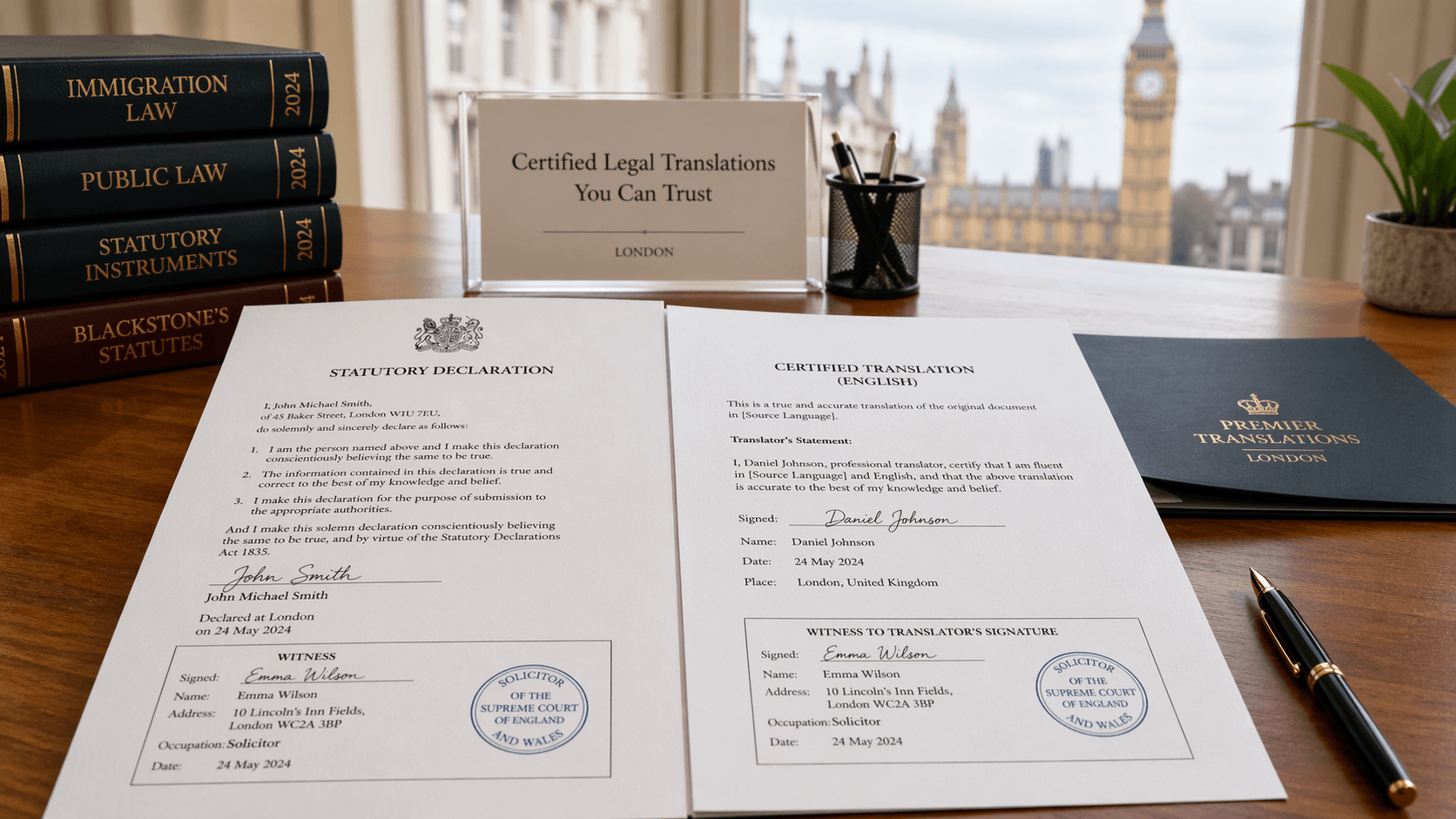
A statutory declaration translation is not just a language task. It is a legal-document task where wording, witness details, formatting, and certification all matter. If your declaration is being used for a UK authority, solicitor review, court matter, immigration file, overseas marriage process, or an embassy submission, the translation must be complete, clearly certified, and presented in an accepted format.
This is where many people lose time. They assume the important part is only the main statement. In reality, the parts most likely to trigger questions are often the witness block, exhibit labels, stamps, handwritten notes, dates, names, and the certification wording attached to the translation.
If your deadline is tight, the safest move is to send a clear scan of every page and say exactly where the document will be used. That one step usually determines whether you need a standard certified translation, a sworn translation, a notarised translation, or an apostille route.
What is a statutory declaration?
A statutory declaration is a formal written statement of fact. It is commonly used when someone needs to confirm something is true for an official purpose, such as identity, marital status, address history, document loss, company matters, or legal proceedings.
Typical examples include:
- single status declarations for marriage abroad
- declarations supporting immigration or visa matters
- declarations used in probate, family, or property matters
- court-related statements
- declarations confirming facts where no standard certificate exists
When the declaration is not in English, a full English translation is usually needed before the UK recipient can assess it properly.
The point many people miss: witnessing and translation are separate things
This is the most important practical distinction.
A solicitor or commissioner for oaths does not certify the translation itself just by witnessing the declaration. Their role is to witness the person making the declaration. The translator’s role is different: to produce a true and accurate translation of the original document.
That means there are usually two separate forms of trust in the final pack:
- The declaration is formally made and properly witnessed.
- The translation is complete and accurate.
A translation cannot fix a declaration that was not correctly witnessed. And a properly witnessed declaration can still be rejected if the translation is incomplete, unclear, or missing certification details.
That is why a strong statutory declaration translation process checks three things before submission:
1. Original legal validity
The original declaration must already be in valid form for its purpose. If it needs to be signed before a solicitor, commissioner for oaths, notary, or court officer, that step has to be done properly.
2. Full legal wording translation
The translation must cover all visible content, not just the main body text. That includes:
- title of the declaration
- formal declaration wording
- names and addresses
- dates
- witness block
- signatures noted in brackets where needed
- stamps and seals
- exhibit references
- handwritten annotations
- attachments referred to in the declaration
3. Destination format
The receiving authority may want:
- a signed PDF
- a hard-copy certified pack
- notarisation
- an apostille
- a sworn translation
- supporting contact details for independent verification
This is why asking “Will a translation be enough?” is not the right first question. The better question is: “What exact format will the receiving body accept?”
When do you need a statutory declaration translation in the UK?
You may need declaration translation UK services when a foreign-language declaration is being submitted to:
- a UK solicitor
- a court or tribunal
- the Home Office or another public body
- a bank, insurer, or compliance team
- a university or professional regulator
- a local authority
- a foreign embassy asking for English supporting papers prepared in the UK
In practical terms, you usually need a translation whenever the recipient cannot work from the original language and needs the text in English to make a legal or administrative decision.
What an accepted format usually includes
An accepted format is rarely complicated, but it must be complete.
A submission-ready statutory declaration translation will usually include:
- the full translated document
- clear layout matching the original structure as closely as possible
- translations of stamps, seals, signatures, and handwritten notes
- the translator’s certification statement
- the translator’s full name
- signature
- date
- contact details
- reference to source and target languages
- page numbering where appropriate
A clean presentation matters more than many people think. The reviewer should be able to see, quickly and without guesswork, what was translated, by whom, when, and how to verify it.
A useful rule for legal wording translation
If a caseworker, solicitor, or reviewer can ask “What does this stamp say?” or “Who signed this section?” and the answer is missing from the translation, the document is not complete enough.
That is why legal wording translation for statutory declarations should never skip:
- marginal notes
- witness wording
- official stamps
- registry references
- handwritten corrections
- exhibit markers
Certified, sworn, notarised, or apostilled: which one applies?

People often use these terms interchangeably, but they are not the same.
| Type | What it does | When it is usually used |
| Certified translation | Confirms the translation is true and accurate | Most UK official submissions |
| Sworn translation | Adds a more formal court-recognised element where required | Some court or foreign-jurisdiction matters |
| Notarised translation | A notary authenticates the signature on the certification or related document | Overseas authorities, embassies, higher-formality uses |
| Apostille | Legalises the signature or seal for international recognition | Cross-border legal use where the destination requires it |
In many UK cases, a certified translation is enough. But for some overseas marriage files, foreign court matters, or embassy submissions, notarisation or apostille may be required as well.
The safest approach is simple: do not pay for upgrades too early, but do not assume a basic translation will always be enough.
Statutory declaration translation for a solicitor-witnessed statement
A solicitor-witnessed statement creates a common source of confusion.
If the original declaration has already been witnessed by a solicitor, the translation still needs its own certification for the translated version. The witness signature confirms the declaration was made before an authorised person. It does not by itself confirm that the English text is an accurate translation.
For solicitor review, the translation should usually make the witness area easy to follow by clearly showing:
- the declarant’s details
- the declaration wording
- the place and date
- the solicitor or authorised witness details
- any stamps, seals, or exhibit references
For high-stakes legal use, it is often worth asking for the finished pack in a format that is easy to file, print, and verify.
Common real-world scenarios
1. Marriage abroad
One of the most common uses is a single-status or marital-status declaration prepared for a marriage outside the UK. In these cases, the process can involve several layers:
- the declaration is drafted and witnessed
- the declaration is translated
- the translation may be notarised
- the pack may need apostille or embassy legalisation
The translation must be especially careful with names, dates, places of birth, nationality, and marital-status wording.
2. Immigration or Home Office support
Where a declaration supports a visa or immigration matter, the translation should be full, verifiable, and professionally certified. Partial translations and vague translator details are where delays often start.
3. Court bundles and legal submissions
If the declaration forms part of a broader legal file, consistency becomes critical. Names, dates, reference numbers, and terminology must match the rest of the bundle. If the matter sits closer to formal court evidence, additional legal steps may apply depending on how the document is being relied on.
4. Overseas property, inheritance, or probate
These matters often involve more than one authority. A declaration may be accepted in English by one party but still require notarisation or apostille for use in another jurisdiction. That makes the order of steps important.
The safest process from first scan to final submission

A reliable statutory declaration translation workflow usually looks like this:
Step 1: Send a clear scan of every page
Do not crop out witness blocks, stamps, back pages, handwritten notes, or attachments.
Step 2: State exactly where the document is going
Say whether the destination is:
- a UK authority
- a solicitor
- a court
- a foreign embassy
- a marriage registry abroad
- an overseas lawyer or notary
This determines the service level.
Step 3: Confirm the certification route
Before work starts, confirm whether you need:
- certified only
- sworn
- notarised
- apostille-ready handling
Step 4: Translate the full document
The translation should preserve meaning, structure, and formal tone, while also making all non-body elements visible and understandable.
Step 5: Prepare the final pack in the right format
That may be:
- signed PDF
- hard copy
- notarised pack
- apostille-ready version
If your deadline is close, ask for urgent turnaround at the quote stage rather than after the translation has started. It is far easier to plan the job correctly from the start than to accelerate it halfway through.
The seven rejection triggers to avoid
If you want first-time acceptance, avoid these common mistakes:
- Only translating the main body
Stamps, handwritten notes, exhibits, and witness sections are left out. - Using the wrong service type
A certified translation is ordered where notarisation or sworn handling was actually required. - Name mismatches
Different spelling appears across passports, declarations, and supporting documents. - Unclear scans
The translator cannot read the witness stamp or handwritten correction properly. - Missing translator details
The certification statement does not provide enough information for verification. - Poor formatting
The translation is hard to match to the source document. - Late questions about destination requirements
The file is translated first, then upgraded later at extra cost and delay.
A practical framework: the First-Time Acceptance Check
Before you submit, check these five questions:
- Is every visible element translated?
- Is the declaration wording clear and formal in English?
- Is the witness section fully represented?
- Does the translation include a signed certification statement?
- Have you confirmed whether certified, sworn, notarised, or apostilled format is required?
If the answer to any one of these is no, fix it before filing.
Why specialist handling matters for statutory declarations
Statutory declarations are short enough to look simple and formal enough to become risky. That combination is exactly why they need specialist handling.
A general translation may sound fluent and still fail because it does not reflect the structure of the declaration properly. A legal-document translation should do more than convert words. It should preserve:
- the formal tone of the declaration
- the legal relationship between statement and witness block
- the documentary trail around seals, signatures, and exhibits
- the presentation standards expected in official use
That is especially true where the declaration will be reviewed by solicitors, courts, registries, or public authorities.
Why clients usually want this done fast
Most people ordering statutory declaration translation are not browsing casually. They are working to a deadline: a marriage appointment, a legal filing date, a visa submission, a compliance request, or an embassy instruction.
That is why urgent turnaround matters. But speed only helps if the format is right.
A fast translation that omits the witness block or uses weak certification wording can create more delay than a slower, correctly prepared pack. The better outcome is controlled speed:
- clear document review at the start
- the right certification level
- a fixed delivery format
- no last-minute surprises
If your file is ready, upload it for a fixed quote and say where it will be submitted. That usually gets you to the right route faster than asking for “the quickest translation” in the abstract.
Why UK Certified Translation is a strong fit for this kind of work
For statutory declaration translation, what matters is not only language skill. It is document judgement.
UK Certified Translation positions this work around the things that official users actually care about:
- certified translations accepted for UK official use
- sworn translation support for legal and court-related documents
- notarised translation for overseas and embassy use
- a network of accredited linguists
- handling for legal documents, affidavits, witness statements, and formal submissions
- direct quote and contact route for time-sensitive files
That matters because statutory declarations often sit right on the border between standard certified translation and more formal legal authentication.
For time-sensitive statutory declarations, stronger trust signals are a complete scope check, clear handling of witness details and exhibits, the correct certification route, transparent pricing, secure document transfer and a delivery deadline confirmed before work begins.
If your declaration is already drafted, the smartest next step is to send the file with the destination and deadline so the correct route can be confirmed before any work begins.
Final word
A statutory declaration translation for UK use needs more than accurate language. It needs the right legal-document logic.
The strongest result is a pack that does four things at once:
- reads clearly in English
- preserves the original formal meaning
- shows the witness and document structure properly
- arrives in the exact format the receiving body expects
That is what reduces follow-up questions, prevents expensive rework, and gives your document the best chance of being accepted first time.
If you are working to a deadline, send a clear scan now and request a fixed quote with the destination named. That is the fastest route to the right format.
FAQs
Do I need a certified statutory declaration translation for UK use?
Usually, yes, if the declaration is in a language other than English and is being submitted to a UK authority, solicitor, court, employer, or regulated body. The translation should be full, professionally prepared, and accompanied by a certification statement.
Is a solicitor-witnessed statement the same as a certified translation?
No. A solicitor-witnessed statement confirms the declaration was made before an authorised person. A certified translation confirms the English translation is true and accurate. In many cases, both are needed for the pack to be usable.
What should a statutory declaration translation include in an accepted format?
An accepted format should include the full translated text, witness details, dates, signatures noted where relevant, stamps, seals, exhibit references, handwritten notes, and a signed certification statement with translator details.
Can I get urgent turnaround for declaration translation UK work?
Yes, in many cases. The best results come when urgency is mentioned before work starts, along with the destination and required format. That allows the provider to confirm whether certified, sworn, notarised, or apostille-ready handling is needed.
Do I need notarisation for statutory declaration translation?
Not always. Many UK uses only need a certified translation. Notarisation is usually required only if the receiving authority, embassy, overseas registry, or foreign lawyer specifically asks for it.
What is the difference between legal wording translation and normal translation?
Legal wording translation focuses on formal meaning, structure, and documentary precision. With statutory declarations, that includes the declaration wording, witness block, exhibits, seals, and every visible element that could affect how the document is interpreted or accepted.