


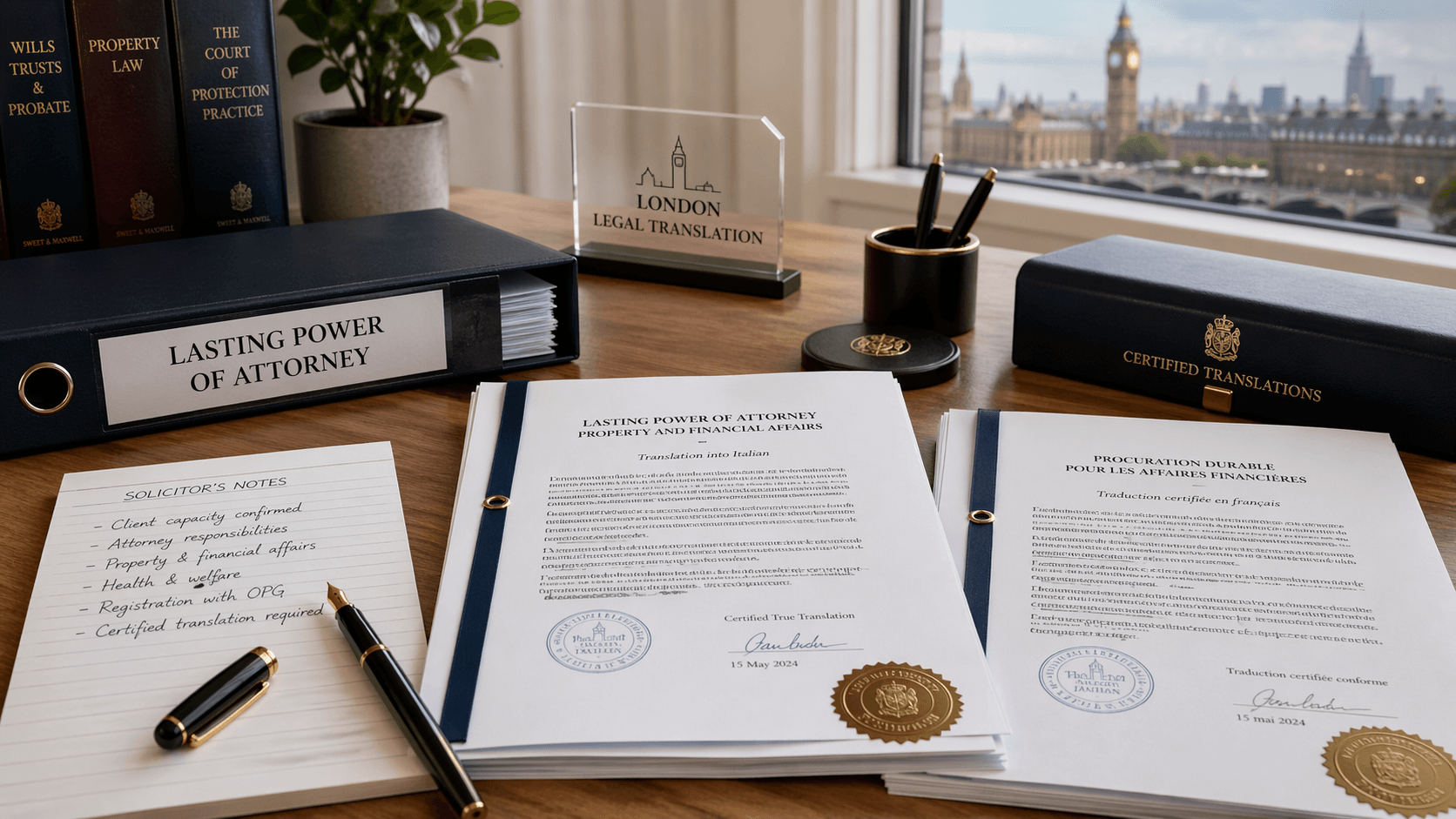
Lasting power of attorney translation is rarely just about converting words from one language into another. It is about preserving legal meaning, matching names and signatures accurately, keeping every page and annex in order, and making sure the final pack is acceptable for the solicitor, bank, court, notary, embassy, or overseas authority that will review it.
That is why LPA-related documents need a different standard of care from ordinary translation. Small wording errors can create uncertainty about powers granted, dates, identity details, or whether the translation is complete. When the document will be used in a time-sensitive legal or family matter, accuracy and fast delivery both matter.
If you need help with an urgent or high-stakes file, our certified translation services team can review the document first and confirm the right format before work begins.
How do I get a lasting power of attorney document translated officially?
If you are asking, “How do I get a lasting power of attorney document translated officially?”, the safest route is to start with the receiving authority’s exact requirement.
In practice, the process usually looks like this:
Confirm what the recipient wants. They may ask for a certified translation, notarised translation, sworn translation, apostille, or a combination.
Send the full document set, not just the main LPA pages. This can include registration pages, continuation sheets, official stamps, signatures, witness details, and any supporting documents the reviewer must read.
Use a professional legal translator or translation provider that can issue a signed certification statement confirming the translation is complete and accurate.
Make sure the translation matches the actual version being submitted. If the recipient needs a certified copy of the registered LPA, that is the version the translation should correspond to.
Only add notarisation or apostille if the recipient specifically asks for it. In many UK matters, a certified translation is enough. In some overseas matters, additional authentication is needed.
Check the final format before delivery. Some organisations accept a digital PDF, some require a hard copy, and some want both.
In UK practice, an “official translation” of a lasting power of attorney usually means a properly certified translation unless the receiving body has asked for a more formal step such as notarisation, sworn translation, or apostille.
Why LPA-related documents need extra care
A lasting power of attorney often sits at the centre of a wider legal pack. The translation may be reviewed alongside:
- a certified copy of the registered LPA
- ID documents for the donor or attorney
- solicitor letters
- bank or care provider correspondence
- property or probate paperwork
- notarisation or apostille paperwork for overseas use
In other words, the translation has to work as part of a full submission, not as a standalone text.
Three things usually decide whether an LPA translation is accepted smoothly:
- Legal meaning is preserved exactly
- The certification level matches the receiving body’s requirement
- The translated pack is complete and easy to verify
That sounds simple, but it is where most delays happen.
First, identify which LPA you are dealing with
In England and Wales, there are two main types of LPA, and the translation should reflect the correct scope of authority from the start. (GOV.UK)
Property and financial affairs
This version covers matters such as:
- bank and building society accounts
- bills and ongoing payments
- pensions and benefits
- property sales or purchases
- managing investments and other financial decisions
This is the version most often involved in cross-border banking, conveyancing, inheritance, and solicitor use.
Health and welfare
This version can relate to:
- care arrangements
- daily routine and living arrangements
- medical treatment decisions
- moving into care
- life-sustaining treatment decisions where applicable
These files can become especially sensitive when hospitals, care providers, or family members in different countries need clear, fast access to the meaning of the document.
When lasting power of attorney translation is usually needed
The need for lasting power of attorney translation typically arises in one of four situations.
1. A UK LPA is being used abroad
A family may need to present an English LPA to a foreign lawyer, notary, bank, land registry, or local authority. In that case, the receiving body may ask for:
- a full translation
- notarisation
- apostille or legalisation
- translation of supporting documents as well
If a foreign authority has asked for legalisation, that is a separate step from translation. In the UK, the Legalisation Office adds an apostille to qualifying UK documents when required for overseas use. (GOV.UK)
2. A foreign power of attorney is being used in the UK
Sometimes the document is not a UK LPA at all. It may be a foreign power of attorney that must be translated into English for:
- solicitor review
- court-related matters
- banking compliance
- property transactions
- probate or estate administration
In that case, the translation needs to read naturally in English while still tracking the original legal structure closely.
3. A solicitor needs a reliable English version for review
For solicitor use, the key issue is rarely just “Can you translate this?”
It is more often:
- Is the translation complete?
- Are the powers granted stated clearly?
- Are names, addresses, dates, and ID details consistent?
- Are stamps, signatures, seals, and handwritten notes accounted for?
- Is the certification statement suitable for the intended submission?
That is why legal document translation UK work benefits from translators who understand both documentary structure and legal risk.
4. Supporting documents must travel with the LPA
Many submissions fail because only the main document is translated while the supporting pages are left behind. A reviewer may still need to understand:
- registration pages
- continuation sheets
- witness details
- official seals
- annexes
- identity pages
- covering letters
- notarial certificates
A translation pack is only as strong as its weakest missing page.
What to include in a complete LPA translation pack
A strong submission usually includes more than the translated body text.
For most LPA-related matters, the safest pack includes:
- the source document in full
- the full translation of every relevant page
- translation of stamps, seals, annotations, and signatures where applicable
- a certification statement
- the translator or provider’s details
- date and signature
- any extra layer requested, such as notarisation
If the translated document will be sent to a UK authority, it is often safest to follow the same practical standards used for other official supporting documents: a full translation, a clear statement of accuracy, a date, signature, and contact details. (GOV.UK)
The most common mistake: ordering the wrong certification level

One of the biggest sources of wasted time and money is upgrading the job too early or not upgrading it when necessary.
Certified translation
This is often the right starting point for UK submissions and many solicitor reviews. It is usually appropriate when the receiving body asks for a certified translation and does not specifically request a notary or sworn format.
If you want the clearest overview of what this means in practice, see what is a certified translation.
Notarised translation
This adds a notarial authentication step. It is often requested for overseas authorities, formal legal procedures, or documents that may later need apostille.
If your LPA will be used internationally, review our notarised translation services option before you order.
Sworn translation
This term is often used in civil-law countries and foreign court contexts. It is not the default requirement for most UK submissions, but some foreign destinations specifically want sworn work or a court-recognised format.
For that route, our sworn translation services page explains when it makes sense.
What counts as an official translation of an LPA in the UK?
Many people search for an “official translation” of a lasting power of attorney, but that phrase does not always mean one single legal format.
In many UK contexts, it usually means a certified translation with a signed statement confirming that the translation is a true and accurate rendering of the source document. If the LPA is being used abroad, the receiving authority may instead require notarisation, sworn translation, apostille, or more than one of these.
The safest way to understand “official” is this: it means the exact format the receiving organisation will accept, not a one-size-fits-all label.
A simple rule that avoids delays
Start with the receiving authority’s wording, not assumptions.
Ask:
- Do you require certified, notarised, sworn, or apostilled translation?
- Do you need the entire document or selected pages?
- Do you need a digital PDF, hard copy, or both?
- Do you need the original LPA, a certified copy, or both?
That one check can save days of back-and-forth.
LPA supporting documents that may also need translation

People often search for the main document and forget the rest of the bundle. In practice, LPA supporting documents can be just as important.
Depending on the matter, you may also need translation of:
- donor passport or national ID
- attorney passport or national ID
- proof of address
- marriage certificate or birth certificate for name matching
- deed poll or name-change documents
- registration confirmation
- solicitor covering letters
- bank correspondence
- medical letters or care documentation
- property documents
- notarial certificates
- apostille page if the receiving authority wants the full file in one language
A useful rule is this: if the reviewer must read it to understand or accept the LPA, it may need translation too.
Original insight: the “acceptance chain” for LPA translations
The easiest way to think about lasting power of attorney translation is as an acceptance chain:
Document accuracy → correct certification → complete submission pack
Most problem jobs break at one of those three points.
Breakpoint 1: Document accuracy
Typical risks include:
- a mistranslated authority to sell, manage, sign, or represent
- inconsistent spelling of names
- missed handwritten notes
- omitted annexes or continuation pages
- unclear rendering of seals, stamps, and official marks
Breakpoint 2: Correct certification
Typical risks include:
- ordering certified when notarised was required
- ordering notarised when a standard certified translation would have been enough
- missing signature or contact details
- unclear certification statement
Breakpoint 3: Complete submission pack
Typical risks include:
- translating only selected pages
- leaving the certified copy untranslated
- excluding supporting documents
- poor scan quality
- mixing multiple versions of the LPA in one submission
When clients understand this acceptance chain early, rework drops sharply.
What solicitors and legal teams usually care about most
For solicitor use, the strongest translations tend to share the same characteristics:
- completeness — no missing pages, schedules, or continuation sheets
- traceability — clear source-to-translation correspondence
- accuracy — legal meaning preserved without loose paraphrasing
- consistency — names, addresses, reference numbers, and dates match across the file set
- presentation — a clean pack that is easy to review and forward
A solicitor does not want a “nicely written summary.”
They want a translation they can rely on.
That is why LPA work benefits from a provider that treats the job as document control as well as translation.
Certified copies and why they matter
If the original LPA is not being submitted, the copy itself may need to be properly certified before translation or submission. GOV.UK explains that a registered LPA copy can be certified by the donor while they still have capacity, and copies can also be certified by a solicitor or a person authorised to carry out notarial activities. (GOV.UK)
This matters because people sometimes translate an ordinary photocopy and only later discover that the receiving organisation wanted a certified copy of the underlying LPA as well.
Translation cannot fix the wrong underlying document.
Do I need to translate the original LPA, a certified copy, or both?
This is a common point of confusion. The translation should match the version of the document that will actually be submitted.
If a bank, solicitor, court, notary, embassy, or overseas authority wants a certified copy of the registered LPA, the translated version should correspond to that certified copy, including any certification wording, seals, annotations, and page order.
Translating the wrong version can create delays even when the translation itself is accurate.
Fast delivery without cutting corners
Urgent LPA matters are common. A bank freeze, property deadline, medical issue, or overseas signing appointment can mean the translation is needed fast.
But fast delivery should never mean:
- partial translation when full translation is needed
- rushed terminology choices
- skipped name checks
- missing certification details
- no review of annexes or signatures
The safest urgent workflow is:
- send a clear scan of every page
- say where the document will be used
- confirm the deadline
- flag whether notarisation or apostille may be needed
- ask for the final format required
If you are up against a deadline, contact us today with the file and intended use. A quick pre-check usually prevents the most expensive mistakes.
Three practical examples
Example 1: UK LPA for a property matter in Spain
A client needs a property and financial affairs LPA translated into Spanish so an overseas lawyer can handle a sale. The main document is not enough on its own. The lawyer may also ask for:
- a certified copy of the registered LPA
- ID documents
- notarial authentication
- apostille
- translated covering documentation
In this kind of case, the translation is only one part of the legal pathway.
Example 2: Foreign power of attorney for a UK solicitor
A UK solicitor receives a foreign power of attorney from a client handling family finances in another jurisdiction. The solicitor needs an English version that clearly shows:
- who granted authority
- who received authority
- what powers exist
- whether the authority is limited or broad
- relevant dates, witnessing, and official marks
Here, precision and readability for solicitor use are more important than decorative formatting.
Example 3: Urgent banking issue involving an elderly parent
A family needs a translated LPA and supporting documents urgently so an institution can understand who may act on behalf of the donor. In fast-moving situations like this, the best results come from sending the full pack at once rather than one document at a time.
That gives the translator a better chance to keep names, dates, terminology, and document references consistent across the entire submission.
How to prepare your documents for the cleanest result
Before you order, do these five things:
1. Send every page
Do not crop out “blank” pages, stamps, or continuation sheets. They may matter.
2. Say exactly where the translation will be used
For example:
- UK solicitor
- bank
- care provider
- land registry lawyer abroad
- notary
- embassy
- overseas court
3. Include any requirements you have already received
Forward the email or list the wording exactly. “Certified translation required” and “notarised translation required” are not the same instruction.
4. Add reference documents for names
Passports, prior translations, or official ID can help keep spelling consistent.
5. Mention the deadline early
A realistic timeline helps the provider plan review and certification properly.
If this is your first time ordering, our guide on how to get a certified translation is a useful companion read.
Why clients choose UK Certified Translation for LPA-related documents
LPA work is sensitive by nature. The provider matters.
UK Certified Translation is built for official-document workflows, including certified translation services, notarised translation services, and sworn translation services. The site highlights UK-accredited linguists, native subject-matter review, an ISO-compliant QA process, and fast turnaround options across official document types. (UK Certified Translations)
For LPA-related files, that matters because the real standard is not “Can someone translate this?” but “Will this hold up when it is actually used?”
You can also review certified translation certificate examples if you want to understand what a well-prepared final pack should look like.
A simple checklist before you upload your LPA
Use this before sending your documents:
- I know whether the document is a UK LPA or a foreign power of attorney
- I know where the translation will be submitted
- I have included all pages, annexes, and supporting documents
- I have checked whether the recipient wants certified, notarised, sworn, or apostilled translation
- I have added any passports or ID documents needed for name consistency
- I have stated whether this is for solicitor use, banking, property, care, or court-related review
- I have mentioned the deadline
- I have asked for the final format required
If you can tick those boxes, the project moves faster and with fewer surprises.
Need help with a lasting power of attorney translation?
If you need lasting power of attorney translation for solicitor use, overseas property matters, banking, probate, or urgent family situations, the safest next step is to send the full file set for review before ordering the final certification level.
Request a free consultation if you want us to check the document type and intended destination first. If you are ready to proceed, start your project, and we will confirm the right route for accuracy, format, and fast delivery.
FAQs
Do I need a certified translation for a lasting power of attorney?
In many cases, yes. If the LPA or related document is not in the language required by the receiving authority, a certified translation is often the right starting point. The exact level depends on whether the recipient wants certified, notarised, sworn, or apostilled translation.
Which LPA supporting documents should be translated too?
LPA supporting documents may include certified copies, continuation sheets, ID documents, registration pages, solicitor letters, bank correspondence, and notarial paperwork. If the reviewer needs to read it to verify or rely on the LPA, it may need translation as well.
Is lasting power of attorney translation accepted by solicitors in the UK?
Solicitors usually want a complete, accurate, and well-certified translation that clearly reflects the source document. For solicitor use, consistency of names, dates, powers granted, and supporting pages is especially important.
Do I need notarised translation or is certified translation enough?
Certified translation is often enough for many UK uses. Notarised translation is usually only needed when the receiving authority specifically asks for it or when the document is part of an overseas legal process.
How quickly can legal document translation UK services be delivered?
Turnaround depends on length, language pair, scan quality, and whether extra certification is required. Short, clear LPA files can often be handled quickly, but urgent delivery should still include full review and proper certification.
What makes LPA translation different from ordinary legal translation?
LPA translation is unusually sensitive because it deals with delegated authority, capacity-related issues, signatures, registration details, and supporting documentation. The work must preserve legal meaning exactly and fit the submission context.
Can I translate a lasting power of attorney myself?
For official use, self-translation or translation by a relative is usually a poor choice. The receiving body will normally expect an independent certified translation it can rely on. Even where self-translation is not expressly prohibited, it often raises avoidable questions about accuracy, completeness, and impartiality.
Do I need to translate stamps, seals, signatures, and handwritten notes?
Yes, where they affect meaning, verification, or acceptance. A complete LPA translation should account for official stamps, seals, handwritten notes, witness details, registration wording, and signature labels where relevant.
Will a scanned certified translation be accepted, or do I need a hard copy?
That depends on the recipient. Many organisations can review a digital certified translation first, but some legal, notarial, or overseas matters still require a signed hard copy. Always confirm the format before ordering.
What should I send to get the right quote and avoid delays?
Send every page of the LPA, any certified copy wording, continuation sheets, supporting ID or name documents, and the recipient’s exact instructions. That makes it easier to confirm scope, certification level, delivery format, and whether notarisation or apostille may be needed.