


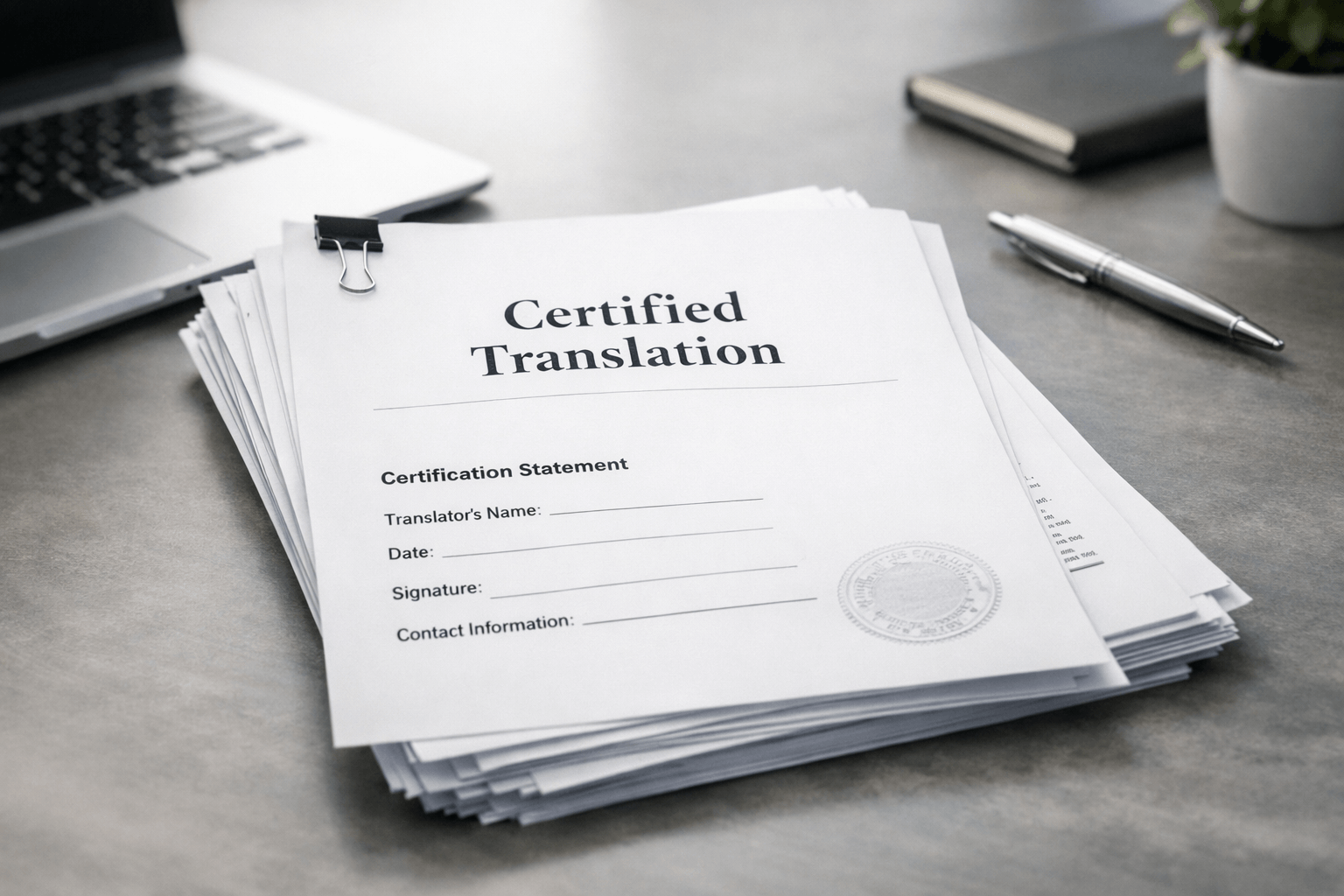
If you’re trying to figure out how to get a certified translation, the process is simpler than most people think — but only if you get the requirements right at the start. The biggest mistakes happen when people order the wrong type (certified vs notarised vs sworn), send poor scans, or use a provider that doesn’t include the certification details the receiving authority expects.
This guide shows you exactly how to get a certified translation of a document step by step, who can certify translated documents, what a compliant certification statement should include, and how to avoid the common problems that cause delays.
Answer: How do I get a certified translation for official documents in the UK?
If you need a certified translation for official documents in the UK, the safest route is to use a professional translator or translation company, send a clear scan of every page, state where the translation will be submitted, and make sure the final translation includes a signed certification statement with the translator’s confirmation of accuracy, the date, full name, signature, and contact details.
For many UK official submissions, the translation must be a full translation that can be independently verified, not a summary or partial translation.
Upload your file and request a fixed quote — we’ll confirm the right certification level before you pay for extras.
This matters because “official” does not always mean the same thing. Some destinations accept a standard certified translation, while others ask for notarisation, a sworn translation, or an apostille/legalisation route.
The fastest way to get a certified translation
Here’s the short version:
- Check where you’re submitting the document (UK authority, USCIS, university, embassy, court, etc.).
- Confirm the level required (certified, notarised, sworn, or apostille/legalisation).
- Prepare a clear scan of every page (including stamps, notes, and back pages if relevant).
- Choose a professional translator or translation company that provides a signed certification statement.
- Tell them the destination and deadline (this matters more than most people realise).
- Review the draft for names, dates, and numbers before certification is finalised.
- Make sure the certificate includes all required details (accuracy statement, date, signature, full name, contact details).
- Submit in the format requested (PDF, hard copy, wet-ink signature, or posted original if required).
If you already have a scan, the next practical step is to upload your file and request a fixed quote so the provider can confirm both the turnaround and the correct certification level.
What a certified translation is — and what it is not
A certified translation is a full translation of your document with a signed statement confirming that the translation is accurate and complete.
A certified translation usually includes
- The translated document
- A certification statement (sometimes called a Certificate of Accuracy)
- The translator’s or company representative’s name
- Signature
- Date
- Contact details for verification
A certified translation is not the same as
- A certified copy of a document (this is a “true copy” process)
- A notarised translation (adds notary authentication)
- A sworn translation (required in some countries/jurisdictions)
- An apostille (legalisation for international use)
This distinction is where many people lose time and money. If a receiving body only asks for a certified translation, paying for notarisation or apostille too early can be unnecessary.
What UK authorities usually expect a certified translation to include
A strong UK-style certified translation should be a full translation of the document, not just selected sections, and the certification should make it easy for the authority to verify who produced it.
In practice, the safest checklist is:
confirmation that the translation is accurate
the date of translation
the translator’s full name
signature
contact details
clear identification of the document and language pair
This is also where people confuse two different processes: certifying a photocopy of an original document is not the same as certifying the translation itself.
How to get a certified translation step by step

Step 1: Check the destination requirements first
Before ordering anything, ask one question:
“Where will I submit this document?”
The answer determines what “official” means in your case.
Common destinations and what they usually ask for
- UK authorities (visa, passport, DVLA, many universities): usually a certified translation with a verifiable certification statement
- USCIS (US immigration): a full English translation plus a translator certification
- Embassies / overseas authorities: may ask for notarised, sworn, or apostilled translations
- Courts and legal filings: may require a specific format or sworn/notarised route
- Universities and credential evaluators: often certified, but they may have extra formatting or submission rules
Pro tip: ask for the wording in writing
If the requirement is vague (“make it official”), ask for one line in writing:
- “Do you require certified, notarised, sworn, or apostilled translation?”
- “Do you accept PDF copies?”
- “Do you require wet-ink signatures?”
- “Is a translation company certificate acceptable?”
That one message can save days of back-and-forth.
Step 2: Prepare the source document properly
A good translation starts with a readable source file. Even a perfect translation can be questioned if the scan is poor.
What to send
- A clear PDF or high-resolution image
- Full page edges visible
- No blur, glare, or heavy shadows
- All pages included (front and back if there are stamps/marks)
- Separate files for separate documents (passport, birth certificate, marriage certificate, etc.)
What to avoid
- Cropped corners
- Photos taken at an angle
- Missing pages
- Low-resolution screenshots
- Edited files with hidden text removed
Do you need the original document or is a scan enough?
A clear scan or photo is usually enough to start the translation order online, but that does not automatically mean the receiving authority will accept a scan at submission stage.
Keep these as two separate checks:
what the translator needs to prepare the translation
what the authority needs you to submit with your application
In practice, many providers can prepare the translation from a good scan, while the authority may still ask you for the original document, an official copy, or a physical submission pack.
Step 3: Choose who can certify a translation
This is one of the most searched questions for a reason: who can certify a translation and can a translator certify documents?
In most cases, the certification is done by:
- The translator
- Or an authorised representative of the translation company
Who can certify translated documents (practical answer)
For most UK and international administrative uses, the certification is accepted when it is:
- Signed
- Dated
- Verifiable
- Produced by a professional translator or translation company
Can a translator certify documents?
Yes — in many common use cases, a professional translator can certify the translation by signing a certification statement confirming accuracy and competence (or on behalf of a translation company, depending on workflow).
Can you certify your own translated document?
This is risky for official use.
Even if you speak both languages, self-translations are often rejected because they are not independently verifiable. If the document is for immigration, legal, academic, or regulatory purposes, use an independent professional provider.
Do you need a solicitor, notary, or professional membership?
Not usually for a standard UK certified translation.
In many cases, the translation is certified by the translator or by an authorised representative of the translation company. A solicitor or notary usually becomes relevant only when the receiving authority specifically asks for notarisation, a notarised translation, or a certified copy of the original document.
Professional membership is not the same thing as notarisation, but it can be a strong trust signal. Many users look for translators or companies with recognised professional affiliations because it reduces the risk of rejection and makes verification easier.
Step 4: Make sure the certification statement is complete

If you’re wondering how to certify a translation document or how to certify a translated document, this is the key part.
A strong certification statement should clearly answer:
- What was translated?
- Which languages were involved?
- Who certified it?
- When was it certified?
- How can they be contacted?
Minimum details to include on the certificate
- Statement that it is a true and accurate translation
- Date of translation/certification
- Translator’s full name
- Signature
- Contact details (email and/or phone, ideally business details)
Stronger (recommended) details
- Source and target language
- Document name/type (for example, birth certificate, diploma, bank statement)
- Reference/order number
- Translator or company role/title
- Page count or attachment reference (useful in bundles)
This is the difference between a translation that “looks okay” and one that is easy for a caseworker to approve quickly.
Example certification wording users often look for
A practical UK-style certification statement can read like this:
“I certify that this is a true and accurate translation of the original document from [source language] into [target language].”
Translator’s full name
Signature
Date
Contact details
Reference or order number
For higher-scrutiny submissions, it is also sensible to show the document name and the language pair clearly on the certificate so the receiving authority can match the translation to the source file quickly.
Step 5: Order the right format (online or in person)
If you need speed, how to get a certified translation online is usually the best route.
How to get a certified translation online
- Upload the document
- State the destination (UKVI, USCIS, university, embassy, etc.)
- Confirm language pair and deadline
- Receive a fixed quote
- Approve the order
- Review the translation
- Receive certified PDF (and hard copy if requested)
For many document types, online delivery is enough. But some authorities still ask for wet-ink signatures or posted originals, so always confirm before ordering.
In-person vs online: which is better?
- Online is usually faster, easier, and more practical for standard official submissions
- In-person may be useful if you need notarisation arranged locally or same-day physical handling
For most people, the deciding factor is not online vs in-person — it’s whether the provider understands the destination requirement.
Does a certified translation need a wet-ink signature?
Not always.
Many applications now accept PDF submission, but some authorities, embassies, or courts still ask for a hard copy or wet-ink signature. The safest approach is to check the receiving body’s wording before paying for postage or notarisation you may not need.
Step 6: Review the translation before submission
A certified translation can still be delayed if the content doesn’t match the source exactly.
Check these items carefully
- Names (including spelling order and transliteration)
- Dates (day/month/year formatting)
- Document numbers
- Addresses
- Stamps, seals, notes, and handwritten text
- All pages included
The 60-second acceptance check
Before you submit, ask:
- Is every visible text element translated?
- Is the certification statement attached?
- Is it signed and dated?
- Are contact details included?
- Does the translation match the source document exactly?
If the answer to any of these is “not sure,” pause and fix it first.
How long does a certified translation take and what affects cost?
Turnaround depends on the document type, page count, language pair, formatting complexity, and whether you need certification only, hard copy delivery, notarisation, or apostille/legalisation.
A one-page birth certificate is very different from a multi-page court bundle, academic transcript pack, or business filing. That is why good providers normally ask for the file first before confirming timing.
Cost is usually shaped by the same factors:
word count or page count
urgency
language availability
specialist terminology
certification format
delivery method
Need this fast? Send your document scan and destination today, and get a clear quote with the correct certification route.
When comparing quotes, check whether the price includes the translation, the certification statement, certified PDF delivery, hard copy options, and any extra fees for notarisation or legalisation.
How to get a certified translation of a document for different scenarios
UK visa, passport, or Home Office use
For UK submissions, the key issue is whether the translation can be independently verified and includes the required certification details.
Typical examples include:
- Birth certificates
- Marriage certificates
- Divorce certificates
- Bank statements
- Police certificates
- Academic documents
If your deadline is tight, send the provider the destination and your submission date in the first message so they can confirm the correct service level immediately.
What this means in practice for UK official submissions
For UK official use, the safest assumption is that every non-English or non-Welsh page should be translated in full and the certificate should make the translator or translation company easy to verify.
Users also often miss this point: the translation requirement and the original-document requirement are separate. A translation can often be prepared from a scan, while the application itself may still require original supporting documents or official copies.
USCIS and US immigration use
For USCIS, the translation must be complete and include a translator certification.
If you’re preparing a US immigration application, don’t use a generic document translator who cannot provide the required certification wording. This is one of the most common reasons people end up reordering the same translation.
The USCIS wording in plain English
USCIS expects a full English translation together with the translator’s certification that the translation is complete and accurate and that the translator is competent to translate into English.
This is slightly different from the way many UK users describe certified translations, so it is important to tell the provider that the document is for USCIS rather than assuming a generic certificate will always match.
University, WES, and professional body submissions
Academic and credential-evaluation submissions often look straightforward, but the requirements can vary.
Watch for:
- Sealed-envelope requirements
- PDF upload rules
- Whether they want the original-language document attached
- Whether they require the translator’s credentials shown
For degree certificates and transcripts, accuracy in names, grades, and institutional terminology matters as much as the certificate itself.
Academic clients frequently ask only about “certified translation,” but the real issue is often the submission method. Always check whether the institution wants the translation uploaded by you, posted physically, or attached to a separate verification or equivalency process.
How to get Spanish translation certified
The process for how to get Spanish translation certified is the same as any other language pair:
- Send a clear scan/photo of the original Spanish document
- Confirm where it will be submitted
- Request a certified English translation
- Make sure the certificate includes the required details
- Review names, dates, and document numbers carefully
Common Spanish document types people certify
- Birth and marriage certificates
- Police certificates
- Academic records
- Notarial documents
- Civil registry documents
Spanish-specific watch-outs
- Double surnames (both family names must be handled consistently)
- Accents and special characters
- Date formats
- Official stamps and margin notes
- Regional terms (especially legal or civil registry wording)
If the submission is outside the UK, check whether the receiving authority requires a sworn or notarised route instead of a standard UK-style certified translation.
This is especially important when the destination country has its own official translator system. A UK-certified translation may be fine for a UK submission, but another country may require a sworn translator, embassy-registered translator, or legalised document pack instead.
Certified vs notarised vs sworn vs apostille
This is the most important decision point if you’re submitting abroad.
Certified translation
Best for most UK administrative, immigration, academic, and business uses.
Notarised translation
Used when a notary must authenticate the identity/signature of the person signing the certification.
Sworn translation
Required in some countries where translators must be court-appointed or officially sworn.
Apostille / legalisation
Used to legalise documents for international recognition. This is usually about the document/signature chain, not the translation quality itself.
If you’re not sure which one applies, start by asking the receiving authority for the exact phrase they require.
One point people often get wrong about apostilles
An apostille does not replace the translation and does not fix the wrong translation route.
Apostille/legalisation is about verifying the signature or seal chain for international recognition. It is separate from the question of whether the translation itself must be certified, notarised, or sworn.
Not sure which one you need? Send the authority’s wording and we’ll match your order to the correct format.
The biggest mistakes that cause delays
Here are the patterns that repeatedly cause avoidable issues:
- Ordering a standard translation instead of a certified one
- Missing signature/date/contact details on the certificate
- Sending incomplete scans
- Not translating stamps or handwritten notes
- Choosing the wrong type (certified when notarised/sworn was required)
- Name mismatches across passport and supporting documents
- Waiting too long to mention urgency
A good provider can catch most of these before delivery — but only if they know where the document is being submitted.
A better way to order: the acceptance-first brief
To avoid back-and-forth, send this in your first message:
- Document type(s): [e.g., birth certificate + marriage certificate]
- Language pair: [Spanish to English]
- Destination: [UKVI / USCIS / university / embassy]
- Deadline: [date]
- Delivery format needed: [PDF / hard copy / notarised / sworn]
- Notes: [name spellings, urgency, any special instructions]
This makes quoting faster and reduces errors because the translator knows the submission context from the start.
Ready to get your certified translation?
If you already have your document, the quickest next step is to upload your file and get a fixed quote with the destination clearly stated. That lets the provider confirm:
- The correct certification level
- The exact turnaround
- Whether a PDF is enough or a hard copy is needed
- Whether notarisation or legalisation is necessary
For urgent or high-stakes submissions, it’s worth using a provider that handles the formatting, certificate wording, and verification details in one workflow — not just the translation text.
Ready to start? Upload your file now and get a fixed quote for a certified translation that’s prepared for your submission route.
Tell us where you’re submitting the document (UKVI, USCIS, university, embassy) so we can prepare the correct certification from the start.
FAQ Section
Who can certify a translation?
In most common UK and international submission scenarios, a certified translation is signed by the translator or an authorised representative of a translation company. The key is that the certification is complete, signed, dated, and independently verifiable.
Can a translator certify documents?
A translator can certify the translation (not the original document) by providing a signed certification statement confirming the translation is accurate and complete, and that they are competent to translate between the languages.
How to certify a translated document correctly?
To certify a translated document, attach a certification statement that includes:
- a statement of accuracy
- the date
- the translator’s full name
- signature
- contact details
You should also identify the document and language pair clearly.
How to get a certified translation online?
To get a certified translation online, upload a clear scan, state the destination (for example UKVI or USCIS), confirm the deadline, approve the quote, review the translation, and receive a certified PDF (plus hard copy if required).
How to get a certified translation of a document for USCIS?
For USCIS, submit a full English translation with a translator certification confirming the translation is complete and accurate and that the translator is competent to translate into English. Use a provider familiar with immigration submissions to avoid rework.
How to get Spanish translation certified?
Send a clear copy of the Spanish document, confirm the submission destination, and request a certified English translation with a signed certification statement. Double-check name order, accents, dates, and official stamps before submitting.
Can I translate my own document and certify it myself?
For official use, self-translation is risky and commonly challenged. Even if you are fluent, many authorities expect the translation to be independently verifiable, which is why an independent professional translator or translation company is usually the safer option.
What should a UK certified translation include?
A UK certified translation should include the full translated document plus a certification statement confirming accuracy, the date, the translator’s full name, signature, and contact details. It should also be clear which document was translated and which languages were involved.
Do I need the original document or is a scan enough?
A scan is often enough to start the translation order, especially online. But the receiving authority may still require the original document, an official copy, or a hard-copy submission when you file the application.
Does a certified translation need a wet-ink signature?
Not always. Many organisations accept a certified PDF, but some authorities still ask for a hard copy or wet-ink signature. Check the exact submission rules before you order extras.
Do I need notarisation or apostille as well as a certified translation?
Only if the receiving authority specifically asks for it. A certified translation, a notarised translation, a sworn translation, and an apostille serve different purposes, so it is important to match the order to the destination requirement instead of assuming the most expensive route is the safest one.