


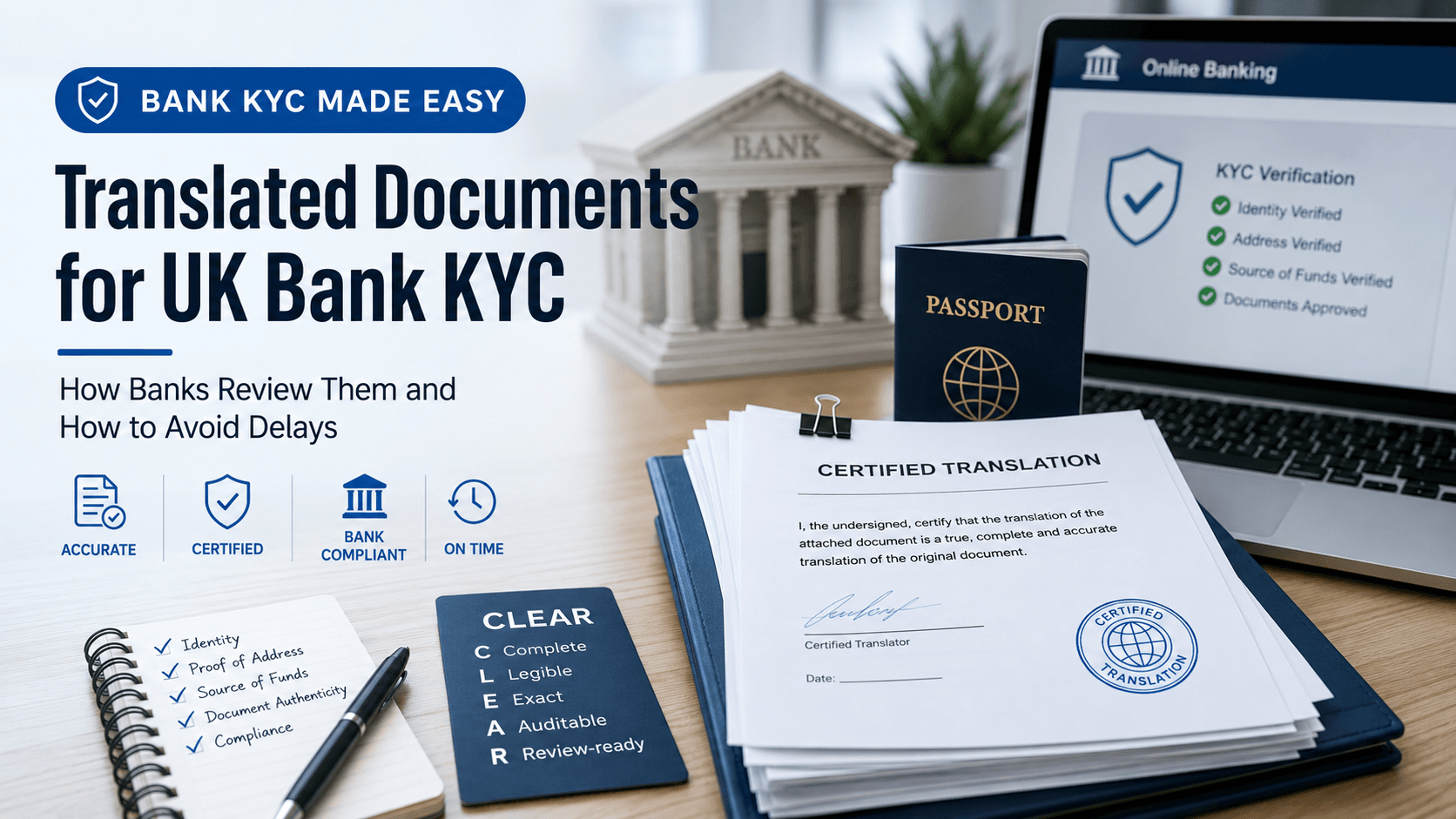
Translated Documents for UK Bank KYC: How Banks Review Them and How to Avoid Delays
If you need translated documents for UK bank KYC, the bank is not judging the English alone. It is checking whether your file helps a reviewer confirm identity, proof of address, source of funds, and document authenticity without extra back-and-forth. That is why the best translation is not simply accurate. It is reviewer-friendly, complete, clearly formatted, and easy to verify.
For most customers, delays happen for one of three reasons: the wrong pages were translated, the translation certificate was too weak, or the source-of-funds story was understandable in your head but not obvious on paper. A strong translation pack fixes all three.
If your deadline is tight, get a quote before you submit anything. A quick pre-check now is cheaper than a rejected file later. Get a quote.
What a Bank Reviewer is Really Trying to Confirm
A KYC team usually wants clear answers to a few practical questions:
- Is this customer the same person named across the ID, bank statement, and supporting documents?
- Does the proof of address match the current residential details on file?
- Can we understand where the money came from?
- Do the dates, account details, and balances make sense together?
- Can we verify who produced the translation if we need to?
That is why translated documents for bank compliance are often reviewed as a pack, not as isolated pages.
The CLEAR Test for Bank-Ready Translations
A useful way to think about KYC-friendly translations is the CLEAR test:
- Complete: every relevant page is included, not just the first page or summary page
- Legible: the layout is easy to compare with the original
- Exact: names, dates, figures, and visible text are translated faithfully
- Auditable: the certification statement, date, and translator contact details are present
- Review-ready: the source-of-funds trail is understandable in sequence
If a document pack fails one of those five checks, the reviewer usually comes back with more questions.
Bank and fintech KYC translation: the same evidence, often a faster review cycle
Fintech onboarding can move faster than traditional bank review, but the underlying evidence problem is the same: the reviewer still needs to understand who owns the account, which institution issued the document, what key transactions represent, whether dates and currencies are clear, and how the translated page maps back to the original.
That makes complete, consistent translation especially important for overseas founders, international contractors, remote workers and customers using foreign personal or company records. For wider corporate, finance and compliance document projects, our business translation services provide the broader commercial route. A fast digital workflow does not make partial translations, cropped statements or unclear transaction descriptions safer.
Which Documents Usually Need Translation for UK Bank KYC
The exact list varies by bank and case, but these are the documents most commonly translated for KYC and AML checks:
Identity Documents
- Passports
- National identity cards
- Residence permits
- Driving licences
Proof of Address Translation
- Utility bills
- Council tax statements
- Official bank statements
- Tenancy agreements
- Government correspondence showing your current address
Source of Funds Translation
- Personal bank statements
- Payslips
- Tax returns or tax notices
- Property sale agreements and completion documents
- Gift letters
- Inheritance paperwork
- Dividend vouchers or business accounts
- Loan agreements
- Remittance receipts or wire confirmations
Supporting Corporate or Ownership Documents
- Company registration extracts
- Shareholder records
- Director registers
- Trust or beneficiary documents
- Board resolutions where business funds are involved
A simple rule helps here: Translate the evidence chain, not just the headline document. A translated gift letter without the donor’s supporting bank evidence often creates more questions, not fewer. The same applies to a translated bank statement that shows a large incoming payment without the document that explains where that payment came from.
Need help deciding what actually needs translating? Start with the guide on how to get a certified translation and then upload your file for a document-by-document check.
How UK Banks Review Source of Funds Translation
Source of funds translation is where most KYC delays happen. A reviewer is usually trying to see a money trail that makes sense from start to finish. That means they are not only looking at the amount. They are looking at the story behind the amount.
What They Want to See
For a clean source-of-funds review, your translated file should make these points easy to follow:
- who owned the funds
- where the funds were held
- how the funds were generated
- when the funds moved
- where the funds went next
- whether any third party was involved
Example: Salary Savings
If the money came from overseas employment income, the strongest pack usually includes:
- translated bank statements showing salary credits
- translated payslips or employer letters if needed
- translated tax documents if the bank asks for extra context
- a simple sequence showing how savings accumulated
Example: Property Sale Proceeds
If the money came from selling property abroad, the strongest pack usually includes:
- translated sale agreement or transfer deed
- translated completion statement or lawyer confirmation
- translated bank statement showing receipt of proceeds
- translated transfer record into the account now being used
Example: Gifted Funds
If family members gifted the money, the reviewer often wants more than the gift letter itself:
- translated gift letter
- translated donor ID if requested
- translated donor bank statements
- translated recipient statement showing the incoming transfer
Example: Business Income
If the money originated from a company, the bank may need enough context to understand ownership and legitimacy:
- translated company registration extracts
- translated business bank statements
- translated accounts, dividend records, or loan documents
- translated director or shareholder evidence where relevant
The biggest mistake is translating only the final bank statement that shows the funds today. Banks often want to understand the earlier steps too. If your file includes multiple statements, transfers, donors, or overseas records, start your project here. Complex source-of-funds files are much easier to approve when the evidence is translated in one consistent pack.
How UK Banks Review Proof of Address Translation
Proof of address translation sounds simple, but it is often rejected for small formatting problems. A reviewer normally checks:
- the full name on the document
- the full residential address
- the issuing organisation
- the issue date
- whether the document is recent enough
- whether the address matches the rest of the application
What Makes Proof of Address Translation Stronger
- Keep the full address exactly traceable to the original.
- Translate every visible line that matters, not just the customer name and address.
- Include the issuer name clearly.
- Preserve statement dates and billing periods.
- Keep page order intact.
- Avoid sending cropped screenshots where the issuer, page number, or date is missing.
Common Proof of Address Problems
- only the address box is translated
- the issue date is unclear
- the translated address is shortened
- building, flat, or postcode details are inconsistent
- the document is too old for the bank’s recency rules
- the original file is unreadable, so even a good translation cannot fix it
For proof of address translation, clear formatting matters just as much as the words themselves. A reviewer should be able to compare the translated text against the original in seconds.
The Compliance Wording and Clear Formatting That Reduce Follow-Ups
Many rejected files are not rejected because of language errors. They are rejected because the translation does not look independently verifiable.
Compliance Wording That Belongs on the Certificate
A strong certified translation should include wording along these lines:
Certificate of Translation Accuracy
I confirm that this is a true and accurate translation of the original document from [source language] into English.
Document: [document name or description]
Date: [date]
Translator / authorised representative: [full name]
Contact details: [email and phone]
Signature: [signature]
That is the baseline. In practice, it also helps to include:
- the language pair
- a clear document description
- page numbering
- company letterhead where available
- reference numbers if the original document contains them
Clear Formatting Banks Appreciate
KYC reviewers value translations that are easy to compare, forward internally, and store on file. The best packs usually:
- mirror the original structure
- preserve tables, balances, and transaction order
- keep account identifiers as shown
- translate stamps, seals, signatures, and handwritten notes in square brackets
- keep names consistent across all translated documents
- use page numbering such as “Page 1 of 3”
- keep the original currency values visible rather than rewriting them into approximations
For financial documents, layout is not cosmetic. It is evidence.
A Quick Before-and-After Example
Weak Version:
- first page only
- no certificate
- flattened transaction table
- inconsistent spelling of the account holder’s name
- large incoming transfer shown, but no translated supporting document
Bank-Friendly Version:
- full statement translated
- certificate attached
- balances and transaction columns preserved
- names aligned across all files
- supporting transfer evidence included in the same pack
Secure Handling Matters More Than Most People Realise
KYC files often contain some of the most sensitive documents a customer will ever share. Secure handling should be part of the service, not an afterthought.
Good practice includes:
- using a secure upload route
- sending full, readable scans rather than compressed screenshots
- avoiding unnecessary re-forwarding across multiple apps or inboxes
- naming files logically so the bank can review them in order
- telling the translation provider where the documents will be submitted
- avoiding redactions unless the bank has confirmed they are acceptable
This is especially important for bank statements, tax papers, donor documents, and anything revealing account numbers or personal financial history.
Why Translated Documents Get Delayed or Rejected
Most KYC rework is predictable. The most common triggers are:
- partial translation instead of full translation
- missing certification statement
- weak compliance wording
- no translator contact details
- inconsistent spelling of names across documents
- unclear dates or unreadable scans
- missing source-of-funds support
- proof of address that is out of date
- self-translated or machine-only files submitted as official evidence
- translations that do not clearly match the source pages
When a reviewer cannot verify the pack quickly, they usually pause the file rather than take the risk.
Do You Need a Notarised Translation for Bank KYC?
Usually, a standard certified translation is the first and most practical step. Notarisation is more likely to come up when:
- the bank specifically asks for it
- the document will also be used for an overseas authority
- the matter is tied to a legal, court, or embassy process
- the case is unusually high risk and the institution wants extra assurance
That is why it is worth checking before you pay for unnecessary extras. If a standard certified translation is enough, there is no reason to over-order. If notarisation is required, move straight to Notarised Translation.
If you are comparing service levels, Certified Translation is the right starting point for most bank KYC files.
A Practical Submission Checklist Before You Send Anything to the Bank

Use this checklist before you upload or email your documents:
- Every relevant page is included.
- The original scan is readable.
- The translation is complete, not selective.
- The certificate includes accurate compliance wording.
- The translator or company contact details are visible.
- Names are consistent across ID, proof of address, and financial evidence.
- Dates and amounts are easy to follow.
- Supporting documents behind the source of funds are included.
- The file order matches the money trail.
- The final PDF is clearly named and easy to review.
That one page of checking can save days of delay. Ready to move? Upload your file and request a fixed quote. If the bank only needs certified translation, you should know that before paying for notarisation or other extras.
What to Check Before Sending KYC-Sensitive Files
For KYC-sensitive documents, the useful checks are whether the full evidence chain is included, names and figures are consistent, the certification can be independently verified, and the file-handling route is appropriate for financial information.
Evidence-chain check: include the documents that explain where funds came from, not only the final statement showing the balance.
Verification check: make sure the translation certificate includes the date, provider details and contact information needed for independent verification.
If you want the fastest route to a reviewer-ready pack, contact the team today.
Final Takeaway
The strongest translated documents for UK bank KYC do not just translate words. They remove doubt. When your proof of address translation is clear, your source of funds translation follows a visible trail, your compliance wording is strong, and the formatting lets a reviewer compare pages quickly, the whole file becomes easier to approve. That is the real goal: fewer questions, faster review, and a document pack that looks trustworthy from the first page to the last.
FAQ
What translated documents for UK bank KYC are most commonly requested?
The most common translated documents for UK bank KYC are passports or ID cards, proof of address documents, bank statements, payslips, tax records, property sale documents, gift letters, inheritance papers, and company ownership records where business funds are involved.
Can I use self-translated documents for UK bank KYC?
In most cases, that is a bad idea. Banks and compliance teams usually want translated documents that can be independently verified, especially where source of funds or proof of address is concerned.
Does source of funds translation need every page?
Usually, yes for the relevant evidence chain. If the statement, transfer record, or supporting document is part of how the money is explained, leaving pages out often creates more questions.
What should a proof of address translation include?
A strong proof of address translation should include the full name, full residential address, issuer name, issue date, billing or statement period where relevant, and a clear translation of the visible text that matters for verification.
Do I need notarised translation for translated documents for UK bank KYC?
Not always. A certified translation is often enough unless the bank or another authority specifically asks for notarisation.
What compliance wording should appear on a certified translation?
At minimum, the certificate should state that the document is a true and accurate translation of the original, and it should include the date, the translator or authorised representative’s full name, and contact details.