


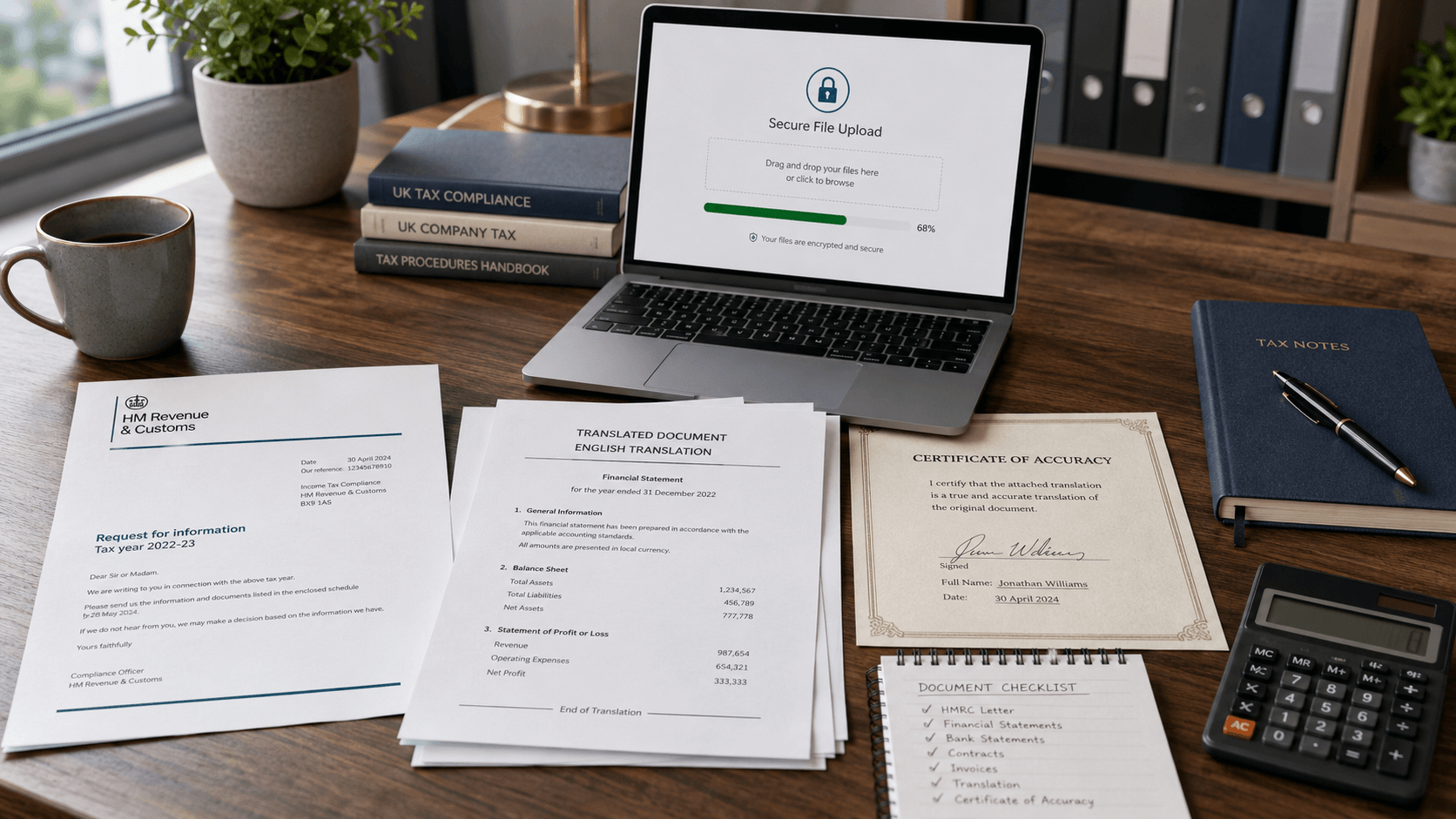
If you need hmrc document translation for a tax letter, compliance document, or self assessment evidence bundle, the real challenge is not simply turning one language into English. It is making sure the translated file is complete, credible, easy to verify, and ready to support whatever HMRC needs to review. That means translating the body text, the dates, the amounts, the stamps, the notes in the margins, and the context that proves where the document came from and why it matters. When that is done well, a translated tax file becomes usable evidence instead of another source of delay.
For individuals, accountants, solicitors, and businesses, this usually comes down to five priorities:
- accuracy
- completeness
- traceability
- secure upload
- fast turnaround
If the translation fails on any one of those, a simple request can turn into back-and-forth emails, follow-up questions, or missed deadlines.
Need your file checked before submission? Start with certified translation services and send clear scans through the contact page so the right certification level can be matched to your deadline.
When HMRC document translation is usually needed
Most people search for hmrc document translation when they are dealing with one of these situations:
Tax letters and notices
These are often the most urgent. A letter may ask for clarification, supporting records, proof of foreign income, or confirmation of tax status. If the supporting paperwork is in another language, the translation must make it easy for a reviewer to follow the issue without guessing.
Typical examples include:
- foreign tax authority letters
- tax assessments issued abroad
- tax residency certificates
- withholding tax statements
- overseas pension or dividend notices
- letters supporting relief claims or status checks
Self assessment evidence
This is where incomplete translation causes the most trouble. HMRC-related evidence packs often include a mix of records rather than one clean document.
Common examples include:
- invoices
- receipts
- bank statements
- rental statements
- dividend vouchers
- accountant summaries
- foreign tax certificates
- proof of overseas income or gains
A good translation does not just convert text. It preserves the logic of the evidence pack so the reader can see what belongs to whom, for which tax year, and for what amount.
Compliance document translation for business matters
For companies and directors, the need may be wider than one tax letter. A compliance document translation may involve financial statements, company records, supporting schedules, or correspondence tied to tax treatment, residency, payroll, or reporting obligations.
Double-taxation and residence paperwork
Where an overseas authority needs proof of UK residence or HMRC needs foreign supporting material, the translation must be especially precise. Even small inconsistencies in dates, names, or tax periods can slow down the process.
What a submission-ready translation should include
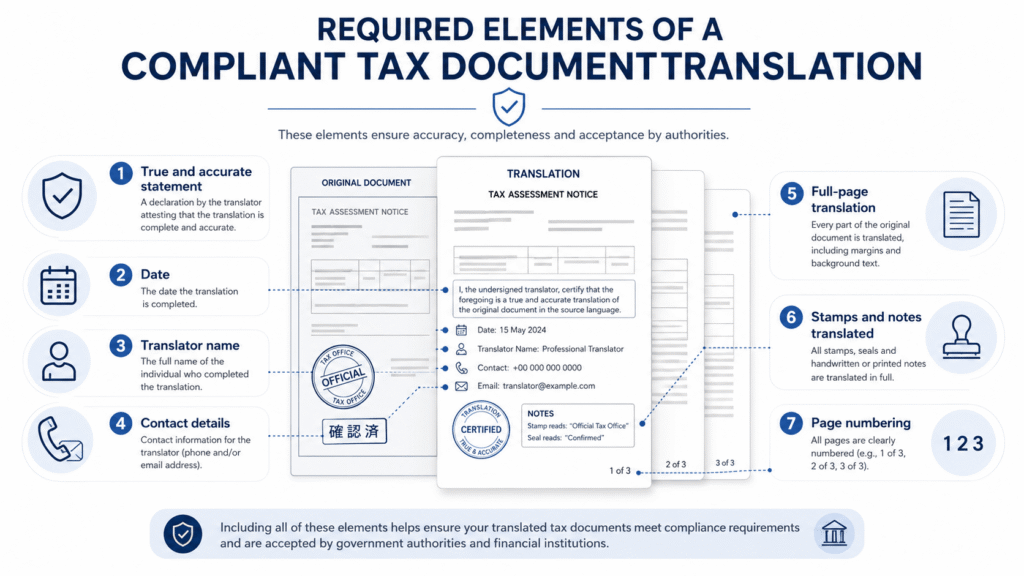
A translation that is meant to support an official tax process should be treated like an evidence document, not a casual language service.
At minimum, the finished pack should usually include:
- a full translation of the document, not selected extracts
- translated headings, tables, notes, stamps, seals, and handwritten additions where relevant
- a certification statement confirming it is a true and accurate translation
- the date of translation
- the translator’s full name
- contact details for verification
- a clear document label so the reader knows what has been translated
What improves acceptance in practice:
- source and target languages stated clearly
- page numbering
- consistent treatment of names and addresses
- translated notes for signatures, stamps, logos, and attachments
- clear formatting that mirrors the original as closely as possible
If you want to see what that looks like in practice, point readers to certificate of accuracy examples and what certified translation means.
The documents that most often need translating for tax matters
The strongest HMRC document translation pages do more than mention “official documents.” They name the actual files people are trying to submit.
| Document type | Why it matters | What must be clear in translation |
| Tax letters and notices | Shows what issue is being raised and what response is needed | full text, dates, reference numbers, deadlines |
| Foreign tax assessments | Supports income, liability, or relief claims | tax year, authority name, amount, currency |
| Withholding tax certificates | Helps prove tax deducted abroad | payer details, percentages, totals, dates |
| Bank statements | Supports self assessment evidence | account holder, transaction dates, running balance |
| Invoices and receipts | Supports business or self-employed figures | supplier, date, amount, VAT details if shown |
| Rental statements | Supports property income evidence | address, period covered, gross/net figures |
| Certificate of residence forms | Used for relief abroad or tax status support | exact identity details, period, official wording |
| Financial statements | Supports corporate compliance document translation | tables, notes, signatories, annexes |
The simplest way to make translated evidence usable
Here is the practical rule that saves the most time:
Make every translated page answer three questions immediately
- Who is this document about?
The name, company name, account holder, or taxpayer identity must be obvious. - What period does it cover?
Tax year, statement period, issue date, or assessment date must be visible. - What amount or status does it prove?
The total, taxable figure, withheld amount, declared income, or residence status should be easy to spot.
This is where many weak translations fail. The language may be correct, but the document is still hard to use because the key evidence is buried.
That is why good tax letter translation is as much about structure as wording.
Certified, notarised, or sworn: what do you actually need?
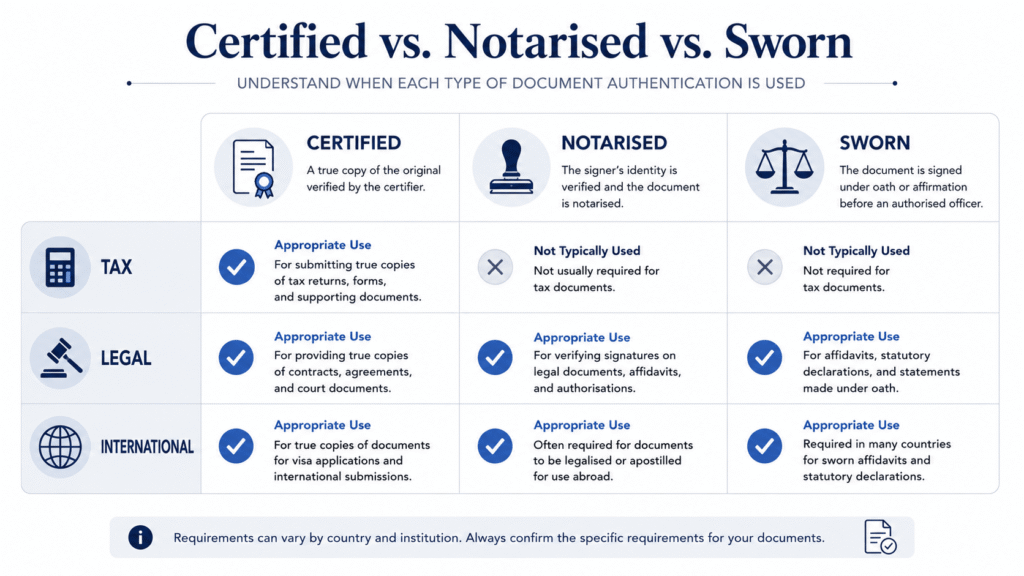
This is one of the biggest points of confusion.
Certified translation
For most UK-facing tax and compliance use, this is the logical starting point. A certified translation is usually the right choice when you need a professionally prepared translation with a certificate of accuracy and verifiable translator details.
See certified translation services if the document is being prepared for an HMRC-related process, a bank, an accountant, a solicitor, or another UK institution.
Notarised translation
Choose this only when the receiving body specifically asks for notarisation, legalisation, or formal authentication of the translator’s signature. This comes up more often in cross-border legal, property, or embassy use than in routine tax correspondence.
If that level is required, use notarised translation.
Sworn translation
This usually matters where a foreign court or foreign legal system expects a sworn translator or equivalent court-recognised format.
If the destination authority is outside the UK and has explicitly asked for this format, review sworn translation.
The practical answer
For most people dealing with HMRC document translation, the safest route is:
- start with certified
- upgrade only if the receiving authority asks for notarised or sworn
- confirm the destination before ordering
If you are unsure, use the how to get a certified translation guide, then send the document and submission details through the contact page.
Common mistakes that cause delays
These issues come up again and again in tax letter translation and self assessment evidence packs:
1. Only translating the obvious parts
The body text gets translated, but the stamp, reference code, handwritten note, or annex does not. In tax matters, those “small” details often carry the most weight.
2. Cropped scans
If the corner with the issue date, tax office stamp, or account number is missing, the translation cannot fix that later.
3. Inconsistent name spellings
A different spelling between passport, bank statement, foreign tax certificate, and translated letter creates unnecessary doubt.
4. Ignoring tables
Financial documents often live inside tables, not paragraphs. A good compliance document translation preserves the table structure so figures stay readable.
5. No explanation of the submission context
A translator should know whether the document is for HMRC, an accountant, an overseas authority, or a tax relief claim. The correct format depends on destination.
6. Ordering the wrong certification level
Paying for notarisation when certified was enough wastes time and money. Ordering plain translation when certified was needed creates rework.
Self assessment evidence: the part people underestimate
A lot of people assume self assessment evidence is just about “showing the document.” In reality, it is about showing that the figures in the return can be followed back to the underlying records.
That is why translated evidence should be organised as a bundle, not a pile of unrelated files.
A better way to structure a self assessment evidence pack
For each document, label:
- document name
- original language
- period covered
- taxpayer or entity name
- why it is included
- translated file reference
This makes it much easier for an accountant, adviser, or reviewer to cross-check the evidence against the return.
A useful bundle example
For a self-employed person declaring overseas income, a clean pack might include:
- foreign invoices
- matching bank statement extracts
- withholding tax certificates
- a short cover index
- certified English translations for each non-English item
That is far stronger than sending scattered screenshots without explanation.
Secure upload and fast turnaround: how to speed the job up
When the deadline is tight, most delays happen before the translator even starts.
Use this checklist before sending files:
- Scan every page clearly in colour if possible.
- Keep multi-page documents in the correct order.
- Include all attachments, not just the first page.
- State where the translation will be submitted.
- Confirm the deadline.
- Say whether you need digital PDF only or hard copy too.
- Mention whether the file contains sensitive financial material so handling can be prioritised correctly.
A secure upload workflow matters more for tax files than for many other document types because they often contain identifiers, financial figures, and address history. If the submission is urgent, say so up front and use the contact page to send the file and deadline in one go.
How long does HMRC document translation take?
Turnaround depends on:
- page count
- handwriting quality
- number of tables
- number of supporting attachments
- whether certification alone is enough
- whether notarisation is required
For a straightforward certified translation, many projects can move quickly when the scans are clean and the brief is complete. UK Certified Translation also advertises standard delivery and express options on its service pages, which is useful when a tax letter includes a response deadline.
The fastest jobs usually have three things in common:
- clean scans
- one clear instruction
- no missing pages
A practical case-style example
Example 1: Foreign income evidence for Self Assessment
A client has rental income from abroad and needs to support the figures with non-English bank records, tenancy paperwork, and tax statements.
A weak approach:
- translate only the tax statement
- leave the bank records untranslated
- submit mixed naming formats
- provide no index
A stronger approach:
- translate the full foreign tax statement
- translate the relevant bank statement pages
- translate the tenancy or payment summary
- align names and dates across the set
- add a short index showing which translated evidence supports which figure
The second approach is far easier to review.
Example 2: Certificate of residence support for relief abroad
A UK resident needs tax-residence paperwork for use with a foreign authority. The authority has a form, and the supporting documents include non-English tax material.
The translation needs to do more than sound accurate. It needs to preserve exact names, dates, and status wording so the pack works across both authorities.
This is where precise formatting, full document identification, and the right certification level matter most.
A quick acceptance checklist before submission
Before you send the final pack, check:
- Is every relevant page translated?
- Are stamps, seals, notes, and reference numbers included?
- Does the certificate state the translation is true and accurate?
- Are the translator’s details present and readable?
- Do names match your other supporting records?
- Are the tax periods and dates easy to identify?
- Are totals, currencies, and table headings preserved?
- Have you chosen certified, notarised, or sworn only as needed?
If the answer is yes to all eight, the translation is already doing more than most competitor pages explain.
Why clients choose UK Certified Translation for tax-related documents
UK Certified Translation positions itself around the things tax and compliance clients actually care about:
- a national network of accredited linguists
- dedicated project coordination
- secure document handling
- certified, notarised, and sworn options in one place
- fast turnaround for urgent official submissions
That matters because HMRC document translation is rarely just a language task. It is a deadline task, a risk task, and often a trust task.
“Uploaded my file in minutes and got the signed PDF back the next day. Solid service.”
“Their certified translation was accepted immediately. Clear, compliant, and fast.”
If you have a tax letter, foreign-language evidence pack, or compliance document translation to prepare, the simplest next step is to upload your file and request a quote.
FAQs
Do I need certified HMRC document translation for tax letters?
If the tax letter or supporting evidence is not in English, a certified translation is usually the safest option for official use. It gives the receiving body a complete translation plus a verifiable certification statement.
What should an HMRC document translation include?
A strong hmrc document translation should include the full translated content, a true-and-accurate certification statement, the date, translator details, and clear treatment of stamps, notes, tables, and attachments.
Can self assessment evidence be translated from scans?
Yes, clear scans are usually enough to start. The better the scan quality, the easier it is to preserve dates, amounts, names, and page structure accurately.
Do I need notarised translation for a compliance document translation?
Not always. Certified translation is often enough. Notarised translation is usually only needed when the receiving body specifically asks for formal authentication or overseas legal use.
Can foreign tax certificates and overseas income records be translated for HMRC?
Yes. Foreign tax certificates, withholding statements, bank records, invoices, and other non-English evidence can be translated into a submission-ready format when they are relevant to the tax issue.
How can I get fast turnaround for tax letter translation?
Send a complete, well-ordered file set, state the destination and deadline, and request the correct certification level at the start. That removes the delays caused by missing pages and unclear instructions.