


If you’re searching how to become a certified translator UK, the first thing to know is this: in the UK, there is no single government-issued “certified translator licence.” What matters is whether your translations are accepted by the organisation receiving them, and whether your work shows clear evidence of accuracy, professionalism, and proper certification wording.
That’s good news for new translators. It means there is a real path into the profession — and a clear way to build trust quickly — if you focus on the right things in the right order.
This guide walks you through the practical UK route: qualifications, portfolio building, certification standards, experience, professional memberships, and how to become the kind of translator clients and authorities trust.
What “Certified Translator” Means in the UK
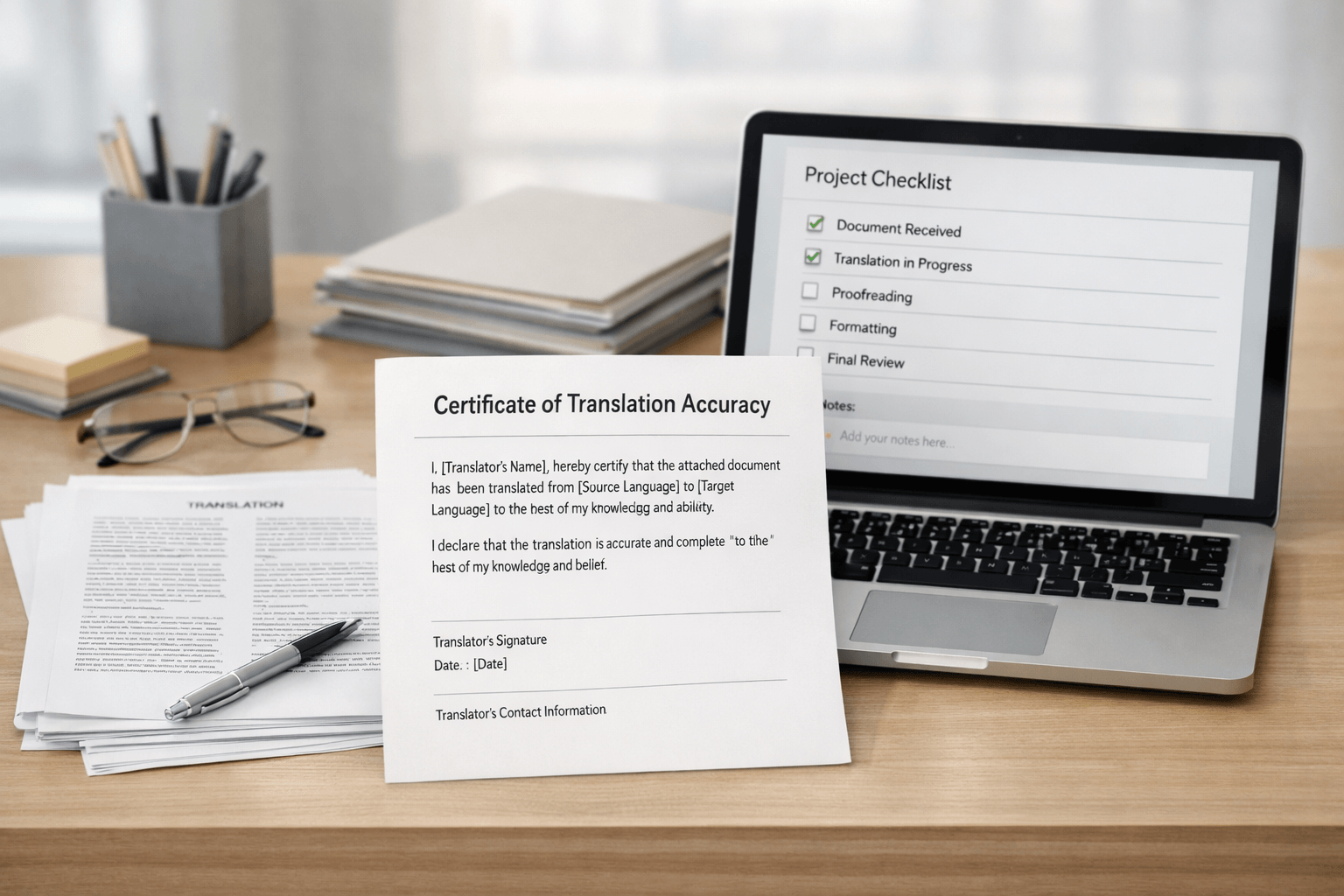
In the UK, “certified translation” usually refers to a translation accompanied by a signed statement confirming it is accurate, plus key translator or company details.
So becoming a “certified translator” in practice means becoming a translator who can produce:
- accurate human translations
- a compliant certification statement
- reliable formatting for official submissions
- a professional identity that clients and authorities can verify
The key distinction most beginners miss
You are not just learning to translate words.
You are building a professional, acceptance-ready service.
That means you need two skill sets:
- Language and translation skill (accuracy, terminology, style)
- Certification and delivery skill (statements, formatting, QA, deadlines, client communication)
If you build both from the start, you’ll progress faster than many linguists who only focus on the language side.
The Fastest Realistic Path to Becoming a Certified Translator in the UK

Here is the most practical route for most people.
1) Start with the right language direction
Most professional translators work:
- from a foreign language (source language)
- into their strongest language (usually their mother tongue)
This matters because official documents require high-precision writing. You are not only translating meaning — you are producing a document that may be reviewed by:
- immigration caseworkers
- universities
- solicitors
- registrars
- employers
- compliance teams
What to build first
Focus on:
- near-native comprehension in your source language
- excellent writing in your target language (usually English)
- document formatting discipline
- subject-specific vocabulary (legal, academic, civil documents, etc.)
2) Learn the UK-certified translation standard before you take paid work
This is where many new translators struggle.
Even a strong linguist can lose a client if the translation pack is missing the certification elements or is formatted poorly.
What a typical UK certified translation pack should include
At minimum, your certified output should usually include:
- the translated document
- a certification statement (accuracy declaration)
- translation date
- translator’s full name
- signature (or secure digital signature process)
- contact details
- company details (if working through an agency)
Why this matters
Clients often choose translators based on speed or price — but they return because the translation is accepted first time.
That is the mindset to develop early: acceptance-first translation work.
If you need a benchmark for certificate wording and layout, direct readers to your “Certified Translation Certificate” and “What Is a Certified Translation?” guides within the article body when publishing.
3) Choose your entry route: degree route or professional qualification route
You do not need one single path, but you do need proof of competence.
Route A: University route (common for new entrants)
A degree or postgraduate qualification can help, especially in:
- translation studies
- translation and interpreting
- modern languages
- combined language + specialist subject degrees
This route is useful if you’re early in your career and want structured training.
Route B: Professional qualification route (highly practical)
A strong UK route is through professional translation qualifications, especially CIOL qualifications such as:
- CertTrans (good for newer translators building a professional base)
- DipTrans (advanced level, widely respected)
This route is often faster for career changers or bilingual professionals who already have strong language skills.
Route C: Hybrid route (best for long-term growth)
This is the route many successful translators follow:
- language degree or strong bilingual background
- specialist knowledge (law, finance, medicine, engineering, immigration docs)
- CIOL qualification(s)
- portfolio + real client work
- professional membership and public directory presence
This hybrid path gives you both credibility and commercial readiness.
4) Build a specialism early (generalists struggle to stand out)
Beginners often say “I can translate anything.”
That usually slows growth.
Clients trust translators who can say:
- “I specialise in civil documents for UK submissions”
- “I handle legal and immigration documents”
- “I translate academic records and credential packs”
- “I focus on business and corporate compliance documents”
Good specialisms for certified translation in the UK
These are strong, repeatable categories:
- Civil status documents
(birth, marriage, divorce, death certificates) - Immigration and visa documents
(bank statements, employment letters, police certificates) - Academic documents
(degrees, transcripts, diplomas) - Legal documents
(court orders, affidavits, agreements) - Business documents
(incorporation docs, contracts, powers of attorney)
Original insight: choose one “volume niche” and one “value niche”
A smart growth strategy is to build two lanes:
- Volume niche: common documents that repeat (birth/marriage/passport docs)
- Value niche: more technical documents with better rates (legal/commercial/medical)
This gives you stable cash flow while your expertise grows.
5) Get qualified enough to be trusted — then keep upgrading

Clients and agencies look for signals that reduce risk.
The strongest signals in the UK are:
- recognised qualifications
- professional memberships
- consistent formatting and certification practice
- real portfolio samples
- references or agency work history
A practical progression ladder
Stage 1: Foundational readiness
- bilingual competence
- writing quality
- terminology research skill
- document formatting discipline
Stage 2: Professional proof
- CIOL qualification (such as CertTrans)
- starter portfolio
- CAT tool familiarity (translation memory, QA checks)
Stage 3: Market credibility
- agency work and/or direct clients
- professional membership
- directory listing
- repeatable QA process
Stage 4: Advanced positioning
- higher qualification (such as DipTrans)
- specialist reputation
- stronger rates
- chartered/professional recognition path
Don’t wait for “perfect” before starting
A common mistake is waiting until you have every credential.
Instead, do this:
- get your first solid qualification or proof point
- build a clean portfolio
- start with suitable document types
- improve your credentials while working
That is how most professionals build momentum.
6) Learn how to certify your translations properly
This is the part that directly affects acceptance.
You can be an excellent translator and still lose work if your certification format is inconsistent.
Your certification statement should be consistent every time
Create a standard template and use it for every certified job.
Your process should cover:
- document title/reference
- source and target language
- accuracy declaration
- date
- name and signature
- contact details
- company details (if applicable)
Build a “certification pack” template set
Create these before you market yourself:
- Template 1: certification statement page
- Template 2: translated civil certificate format
- Template 3: translated academic transcript format
- Template 4: delivery email template
- Template 5: invoice + reference numbering format
This saves time, improves consistency, and makes you look established from day one.
If the reader is a client rather than a translator, place a short callout here: “Need a certified translation now? Upload Your File and we’ll prepare an acceptance-ready translation pack.”
7) Get experience the smart way (without underpricing yourself)
Experience matters — but not all experience helps equally.
Best early experience sources
- junior agency assignments
- proofreading/revision work
- volunteer translation with strict QA (selective only)
- supervised portfolio projects
- specialist document practice sets (civil/legal/academic)
Avoid these early mistakes
- charging very low rates for complex legal work
- accepting every document type
- certifying work outside your competence
- skipping revision because the document “looks easy”
- using machine translation without full human control
A better beginner strategy
Use a three-tier service structure:
- Straightforward civil documents
(good for speed + process discipline) - Moderate complexity documents
(employment letters, academic docs) - Specialist documents
(take only when ready, or after peer review)
This keeps your quality high while you grow.
8) Join professional bodies and become visible
Professional memberships are not just badges — they help clients trust you faster.
They also help you:
- understand professional standards
- access training and CPD
- find networking opportunities
- improve referral potential
- signal seriousness to agencies and direct clients
The UK bodies that matter most
CIOL (Chartered Institute of Linguists)
Useful for:
- qualifications (CertTrans, DipTrans)
- professional progression
- long-term credibility
- chartered recognition pathway
ITI (Institute of Translation and Interpreting)
Useful for:
- practical career guidance
- professional standards
- assessments and membership pathways
- public directory visibility
ATC (Association of Translation Companies)
Useful if you work with or build an agency/company model, or want to align with UK translation company standards.
Visibility tip most new translators overlook
When you are ready, make sure your public profile is consistent everywhere:
- same professional name
- same language pairs
- same specialisms
- same certification wording style
- same contact details
Consistency builds trust.
9) Build the tools and workflow of a professional translator
You do not need an expensive setup on day one, but you do need a reliable one.
Your starter tool stack
- secure email + domain-based address
- CAT tool (or at least a planned workflow for translation memory/QA)
- terminology glossary
- version control/file naming system
- PDF handling tools
- secure cloud storage
- invoice and quote templates
Your non-negotiable workflow checklist
For every certified translation job:
- confirm destination authority (UKVI, university, court, employer, etc.)
- confirm language pair and deadline
- check scan quality and completeness
- translate
- revise
- format for official use
- add certification statement
- final QA check
- deliver PDF (and hard copy option if needed)
- store securely
This workflow alone will put you ahead of many inexperienced freelancers.
10) Understand the difference between translator and interpreter (important for qualifications)
Many people searching this topic mix up translation and interpreting.
- Translator = written documents
- Interpreter = spoken communication
If your goal is certified document work, focus on translation first.
If you want public service work (courts, police, healthcare), you may also need interpreting-specific qualifications and pathways later.
That is a different track, with different assessments and working conditions.
11) How long does it take to become a certified translator in the UK?
This depends on your starting point.
Typical timelines
If you are already bilingual and write excellent English
You may be able to become client-ready for basic certified documents in:
- 3–6 months (with focused study, templates, and supervised practice)
If you need formal training and portfolio building
A more realistic timeline is:
- 6–18 months for strong early-career readiness
If you want advanced positioning (higher rates / specialist work)
Plan for:
- 2–4 years to build deep specialism, stronger credentials, and a premium client base
The faster route is not “shortcutting”
It is simply doing the right things in the right order:
- niche first
- templates early
- quality control from day one
- professional proof as soon as possible
12) A realistic 90-day plan to get started
Here is a practical plan you can follow.
Days 1–30: Foundation
- choose your language pair(s)
- choose one niche (civil docs is a strong start)
- study UK certified translation formatting requirements
- create your certification statement template
- build 3 sample translations (clean formatting, no personal data)
- set up your email, file naming, and delivery workflow
Days 31–60: Proof
- enrol in a relevant course or qualification pathway
- start CAT tool practice
- build a glossary for your niche
- get feedback on 5–10 sample translations
- create quote, invoice, and delivery templates
Days 61–90: Market entry
- create a professional profile/CV
- prepare a short portfolio PDF
- apply to suitable agencies
- publish a simple service page or profile
- define your turnaround and revision process
- begin with low-risk, clear document types
This 90-day plan won’t make you an expert — but it will make you credible, organised, and ready for real work.
13) How to stand out in a crowded market
Most translators compete on price.
The professionals who grow fastest compete on clarity and confidence.
What clients actually want
They want to know:
- Will this be accepted?
- Will it be accurate?
- Will it arrive on time?
- Can I trust this person with sensitive documents?
If your website, emails, and translation pack answer those four questions clearly, you will convert more enquiries.
Your positioning statement (use this format)
Use a simple positioning line like:
“I provide certified translations for UK submissions, with acceptance-ready formatting, clear certification wording, and secure handling of official documents.”
This is clearer than just saying “professional translator.”
14) When you’re ready to move up: advanced credibility steps
Once your basics are strong, focus on the next layer.
Advanced moves that increase trust and rates
- upgrade qualifications
- deepen one specialism (legal/academic/business)
- improve QA and revision systems
- join/upgrade professional memberships
- build a referral network with solicitors, advisers, consultants, and agencies
- document your process (clients love predictable delivery)
A strong long-term goal
A great long-term target is to become known for one thing, for one audience, with one reliable process.
For example:
- UK immigration document certified translations
- university and ENIC-style academic document packs
- legal certified translations for solicitors
- business compliance document translation packs
Specialists get remembered. Generalists get compared.
Final takeaway
If you want to become a certified translator in the UK, do not wait for a single “official licence” that magically makes clients trust you.
Instead, build trust the way the UK market actually works:
- develop strong translation skills
- learn certified translation requirements
- choose a niche
- gain recognised qualifications
- build a clean certification workflow
- join professional bodies
- deliver acceptance-ready work consistently
That is the route that turns a bilingual person into a professional translator people rely on.
And if you’re reading this because you need a certified translation rather than a career path, the fastest next step is simple: Upload Your File and request an acceptance-ready translation pack prepared for your destination authority.
FAQs
Is there an official certified translator licence in the UK?
No single government-issued licence defines a “certified translator” in the UK. In practice, translators and agencies build credibility through qualifications, professional memberships, and properly certified translation packs that meet the receiving authority’s requirements.
How to become a certified translator in UK without a degree?
You can still build a strong path without a degree if your language skills and writing are strong. Focus on professional qualifications, certification-format training, portfolio building, and agency experience. Many translators enter through a professional route rather than a university route.
Do I need CertTrans or DipTrans to become a certified translator UK?
Not every client will demand a specific qualification, but recognised credentials help you stand out and build trust faster. A practical route is to start with an entry-level professional qualification path and progress to more advanced qualifications as you gain experience.
Can I certify my own translation in the UK?
For official submissions, authorities usually expect an independent professional translator or translation company, not the applicant or a family member. Even where self-certification is technically possible, it is often rejected in practice for formal use.
How long does it take to become a certified translator in the UK?
If you already have strong bilingual ability and excellent writing skills, you can become ready for straightforward certified document work in a few months. Building advanced expertise, stronger credentials, and premium rates usually takes a few years.
How do I get my first certified translation clients in the UK?
Start with a niche (such as civil or academic documents), create a professional certification pack template, build sample work, join relevant professional networks, and apply to agencies. Clear communication and consistent document formatting will help you win repeat work faster than low prices alone.