


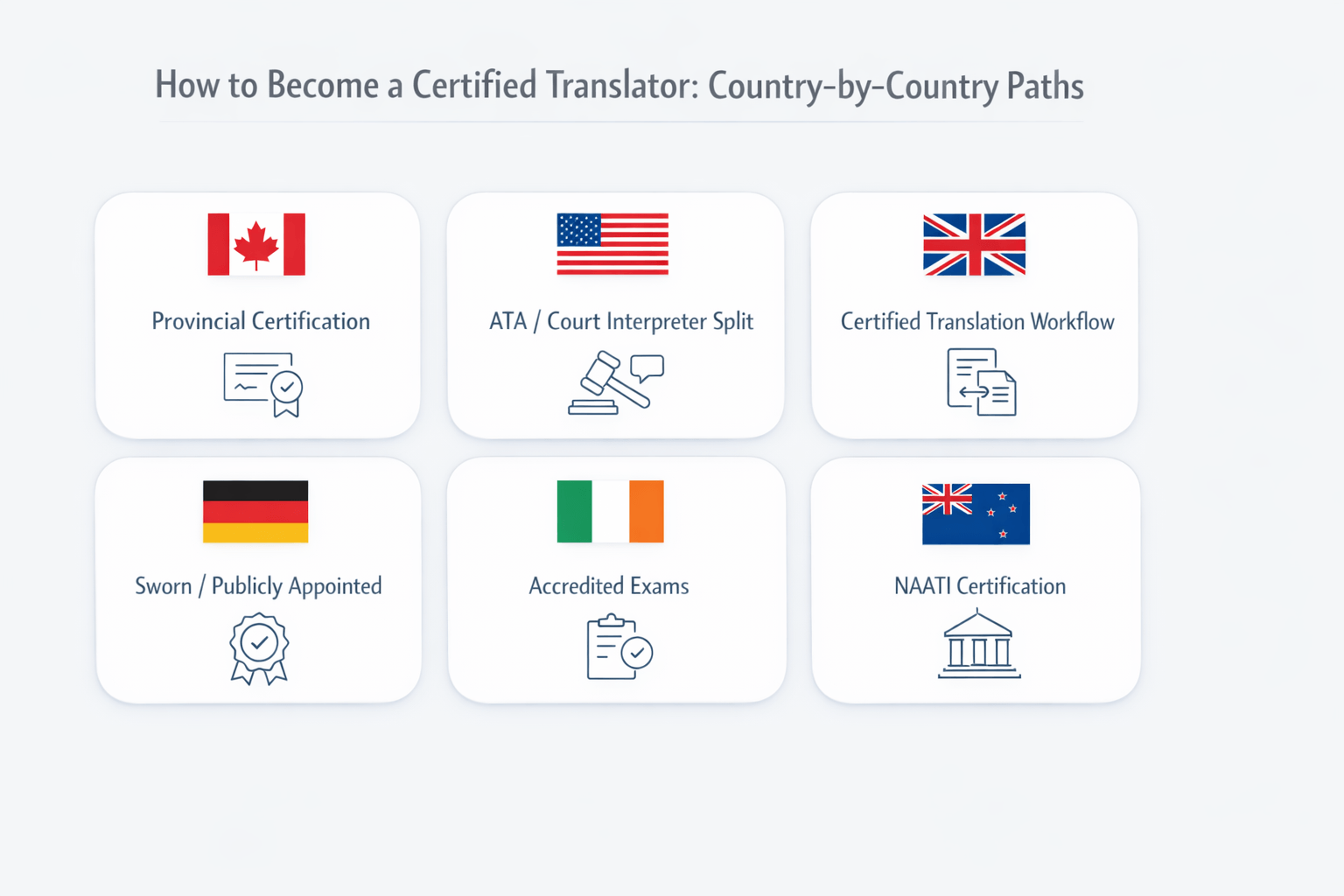
If you’re searching how to become a certified translator in Canada, you’ve probably noticed something confusing: the path changes depending on the country, and sometimes even the province or state. In some places, “certified translator” is a protected professional title. In others, the key credential is an exam (like ATA). And in the UK, the focus is often less about a state-issued title and more about producing a translation that meets official submission rules.
This guide gives you a clear, practical route—starting with Canada, then covering the US, UK, Germany, Ireland, New Zealand, and India—so you can build the right qualifications, avoid the common mistakes, and start getting trusted work.
If your immediate goal is to get documents accepted (rather than build a translation career), you can skip ahead and upload your file to UK Certified Translation for a compliant certified translation pack.
The One Thing Most New Translators Get Wrong
Many people confuse three different things:
- A certified translator (a person with a recognised credential or protected title)
- A certified translation (a document with a signed accuracy statement)
- A court/sworn translator or interpreter (a legal appointment or court credential, often country-specific)
That distinction matters because it changes what you should do next.
A simple way to think about it
- Canada (many provinces): often a professional title route (provincial association)
- US: usually a professional exam route (ATA) for translators, plus separate court interpreter tracks by state
- UK: no single national “sworn translator” status; clients mainly need a correctly certified translation format
- Germany and parts of Europe: often court-sworn / publicly appointed routes
- India and some other countries: authority-specific expectations, with no single nationwide path
That’s why the smartest approach is not “How do I get certified?” but:
“Which system applies in my country—and what kind of work do I want to do?”
How to Become a Certified Translator in Canada

If you want the clearest answer to how to become a certified translator in Canada, start here:
What “certified translator” usually means in Canada
In Canada, certification is often tied to provincial or territorial professional associations. In practice, you usually become certified through the association in the province where you live or work (for example, Ontario, Alberta, or Quebec), rather than through one single national government exam.
That means your path depends on your province.
The Canadian route in 6 practical steps
1) Pick your language pair and direction
Choose your working pair early and be specific, for example:
- French → English
- English → French
- Arabic → English
- English → Arabic
This matters because many bodies assess you by language direction, not just language pair.
2) Build formal translation competence
Before applying, strengthen your foundation in:
- Translation methods (not just bilingual fluency)
- Terminology research
- Legal/official document conventions
- Revision and QA workflows
- Ethics and confidentiality
A degree in translation helps, but it’s not the only path. What matters most is whether you can produce accurate, consistent, professional work under assessment.
3) Join or engage with your provincial association
Most candidates enter through a provincial body. Typical pathways may include:
- On dossier / experience-based routes (for experienced translators)
- Examination routes
- Mentorship or supervised pathways (depending on the province/body)
- Academic equivalency plus review
Each association sets its own process, so always check the current rules before applying.
4) Build a serious portfolio before you apply
Create 8–12 polished sample translations across real-world document types:
- Civil documents (birth/marriage certificates)
- Academic records
- Employment letters
- Legal declarations
- Business documents
- Medical summaries (if you plan to specialise)
For each sample, keep:
- Source document (redacted)
- Your translation
- Revision notes
- Final corrected version
That portfolio will help you pass assessments and win clients faster.
5) Learn “submission-ready” formatting
Being a strong translator is not enough if you want official-document work. You also need to know how to prepare:
- Complete translations (including stamps, notes, seals)
- Clear formatting and labels
- Accuracy statements/certification wording (where applicable)
- Signature/date details
- File naming and delivery standards
This is where many good linguists lose work—they translate well, but deliver in the wrong format.
6) Choose a specialisation early
Generalists struggle more in the beginning. Specialists win faster.
Good early specialisations include:
- Immigration and civil documents
- Legal and court-related documents
- Education and credential evaluation packs
- Medical records
- Financial/compliance documents
A focused niche makes your portfolio stronger and your pricing clearer.
How to Become a Certified Translator in Ontario
If you’re searching how to become a certified translator in Ontario, your first stop should be Ontario’s professional translation association pathway.
What to focus on in Ontario
- Confirm the current certification routes and eligibility
- Prepare for language-direction assessment requirements
- Build a portfolio that matches official-document and legal use cases
- Get comfortable with terminology in the sectors you want to serve
Ontario starter plan (90 days)
Days 1–30
- Pick one language direction
- Build your terminology bank
- Translate 3 sample official documents (redacted)
Days 31–60
- Add 3 more samples (academic + legal + business)
- Get feedback from an experienced translator
- Standardise your formatting and QA checklist
Days 61–90
- Review association requirements
- Prepare application materials
- Start a simple professional profile (CV, bio, service list)
How to Become a Certified Translator in Alberta
If you’re searching how to become a certified translator in Alberta, the process is typically tied to Alberta’s professional body and local requirements.
What to focus on in Alberta
- Check the Alberta association’s current certification options
- Understand document-handling standards for official use
- Build strong English + target-language legal terminology
- Prepare for exam or alternative assessment routes (if available)
Alberta tip that saves time
Don’t wait until after certification to learn official-document workflows.
Start practising with:
- Certificates
- Affidavits
- Academic transcripts
- Immigration support letters
- ID documents (redacted)
That experience helps you move from “qualified” to “hireable” much faster.
Quebec and Other Canadian Provinces
Quebec often uses a different framework and terminology than English-speaking provinces, and the requirements can be more formalised depending on the profession title you’re pursuing.
If you plan to work in Quebec:
- Check the province-specific professional order requirements
- Verify what title is protected
- Confirm language-direction and legal-document expectations
- Learn the exact certification/seal requirements used in that market
For other provinces, the same rule applies: use the local association first, not a generic internet checklist.
How to Become a Certified Translator in the US

Here’s the most important point:
In the US, “certified translator” usually does not mean a state-issued translator license
For most translators in the United States, the most recognised professional credential is ATA certification (American Translators Association). That is different from court interpreter certification, which is often managed by state courts.
So if you’re asking how to become a certified translator in the US, your path is usually:
- Build strong translation skills in a defined language pair
- Prepare for a professional translation exam
- Pass ATA certification (if available in your pair)
- Build a specialised portfolio
- Learn certified-translation document conventions for clients
What makes the US market tricky
Clients often use the wrong words. They may say:
- “I need a certified translator”
- “Are you court-certified?”
- “Do you do certified translations?”
These are not the same request.
A strong translator in the US learns to clarify fast:
- Do they need a certified translation for USCIS/university?
- Do they need a court interpreter?
- Do they need notarisation?
- Do they need a sworn translator for overseas use?
That clarity alone will win you more business.
State-by-State Search Terms: California, Florida, Georgia, Michigan, New York, Texas
These searches are very common:
- how to become a certified translator in california
- how to become a certified translator in florida
- how to become a certified translator in georgia
- how to become a certified translator in michigan
- how to become a certified translator in ny
- how to become a certified translator in texas
The reality
In these states, what people often mean is court interpreter certification, not translator certification.
If your goal is document translation, focus on:
- ATA certification (where available)
- A strong niche portfolio
- Certified-translation workflow and quality control
If your goal is court work, follow the state court interpreter route.
Quick state breakdown
California
California has a formal court interpreter pathway. If you want courtroom language work, follow the Judicial Branch / Language Access route.
Florida
Florida courts run a structured court interpreter certification/registration path with orientation, exams, and registration steps.
Georgia
Georgia court interpreting is handled through the state’s court professionals / interpreter licensing framework.
Michigan
Michigan has a state court interpreter certification program; this is separate from becoming a document translator for private/agency work.
New York (NY)
New York courts use written and oral interpreter exams (plus references for some languages). Again, this is for court interpreting, not general document translation.
Texas
Texas has a licensed court interpreter pathway under the judicial branch, with orientation, exams, application steps, and background checks.
How to Become a Certified Translator in the UK
Searches like these are also common:
- how to become certified translator uk
- how to become a sworn translator uk
- how to become sworn translator in uk
The key UK point: there is no single UK “sworn translator” status like in some civil-law countries
In the UK, official document submissions usually depend on the translation being correctly certified, not on a state-issued “sworn translator” title.
So the UK route is usually about building credibility through:
- Recognised translation qualifications
- Professional memberships
- Verifiable experience
- A compliant certified-translation process
- Specialisation (legal, immigration, academic, medical, etc.)
What UK clients and authorities care about most
They usually care that the translation is:
- Complete and accurate
- Signed and dated
- Traceable to the translator or agency
- Professionally presented
- Delivered in the format they requested (PDF / hard copy / notarised)
If a UK client asks for a “sworn translation”
This usually means one of two things:
- They are using the wrong term and actually need a standard certified translation, or
- They are submitting abroad and need a sworn translation in the destination country (or notarisation/apostille)
A professional translator should be able to spot that instantly and guide them properly.
How to Become a Certified Translator in Germany
If you’re searching how to become a certified translator in Germany, you’re entering a different system.
Germany typically uses publicly appointed / authorised / sworn translator pathways, and the rules can vary by federal state (Land).
What matters in Germany
- Requirements can be state-specific
- Legal/court translation routes are more formal
- Public appointment / swearing-in status matters for many official uses
- The national databases help users find officially sworn/authorised translators
A practical Germany pathway
- Pick your Land (state) and check its exact rules
- Build proof of language and legal translation competence
- Meet any local qualification/background requirements
- Apply through the relevant court/justice authority
- Learn the certification format expected for German official use
If Germany is your target market, don’t rely on generic “certified translator” advice from English-language blogs. Always follow the specific Land requirements.
Europe Beyond Germany: Why “Sworn Translator” Means Different Things
Across Europe, systems vary a lot.
Some countries use:
- Sworn translators
- Court translators/interpreters
- Publicly appointed translators
- Ministry or court registers
That means “certified translator” is not a single European standard.
The best way to work across Europe
If you want cross-border document work:
- Learn the difference between UK-certified, notarised, and sworn formats
- Build a partner network in countries with sworn translator systems
- Use official registries where available
- Confirm the destination authority’s exact wording before you quote
This is one of the fastest ways to reduce rework and avoid rejected submissions.
How to Become a Certified Translator in Ireland
If you’re searching how to become a certified translator in Ireland, the right path depends on whether you’re targeting:
- General commercial translation
- Legal/court-related work
- Official document submissions
A smart route in Ireland is to:
- Build formal translation competence
- Join the relevant professional ecosystem
- Develop a legal/official-document portfolio
- Learn what Irish authorities and overseas authorities accept
- Build a strong revision and certification workflow
Ireland-specific career tip
Because many translators work on international submissions (UK/EU/immigration/education), your value increases a lot if you can confidently handle:
- Certification statements
- Document traceability
- Formatting for official submissions
- Country-specific escalation (certified vs notarised vs sworn)
How to Become a Certified Translator in New Zealand
If you’re searching how to become a certified translator in New Zealand, focus on two things:
- Professional recognition (such as NZSTI membership pathways)
- Acceptance rules for the authority receiving the translation (for example, immigration)
A strong New Zealand route
- Build translation training and practical experience
- Review NZSTI membership eligibility and levels
- Understand language-direction rules
- Build document-specialist samples (immigration, civil, education)
- Learn when NAATI credentials may also help (especially for AU/NZ crossover work)
Why this matters
Many new translators assume “bilingual + stamp = accepted.”
In reality, authorities care about:
- Who translated it
- Whether the translator is acceptable to them
- Whether the translation is complete and properly certified
- Whether the language direction matches the task
How to Become a Certified Translator in India
If you’re searching how to become a certified translator in India, the process is often less centralised than in countries with one national certification exam.
In practice, success in India usually comes from combining:
- Strong language and translation training
- A professional portfolio
- Domain specialisation (legal, immigration, academic, corporate)
- Professional association involvement
- Clear knowledge of notarisation/legalisation and embassy requirements when relevant
A practical India pathway
1) Build translation competence first
Focus on formal training, structured practice, and terminology management.
2) Pick high-demand document niches
Good starting niches:
- Civil and immigration documents
- Academic transcripts and diplomas
- Corporate and compliance documents
- Legal declarations and contracts
3) Learn certification and attestation workflows
In many jobs, clients don’t just need “translation.” They need:
- Translation + certification statement
- Translation + notary
- Translation + apostille/legalisation
- Translation accepted by an embassy, court, university, or immigration body
4) Build trust signals early
- Professional CV
- Clear language pairs
- Sample work (redacted)
- NDA/confidentiality process
- Revision/QA process
- Delivery standards
5) Work with reputable agencies while building your client base
This is the fastest way to gain volume and learn acceptance standards across jurisdictions.
The 12-Month Career Plan That Works in Any Country
This is the part most blogs skip.
Here’s a realistic plan you can actually follow.
Months 1–3: Foundation
- Choose your language pair and direction
- Study translation techniques (not just language)
- Build a terminology system
- Translate 6 redacted sample documents
- Learn professional formatting
Months 4–6: Credential Preparation
- Identify your local pathway (Canada province, ATA, UK professional route, Germany Land route, etc.)
- Gather documents and evidence
- Get mentor feedback
- Practise timed translation if an exam is involved
Months 7–9: Market Readiness
- Build your specialist portfolio
- Create service pages / profiles
- Prepare a certification statement template
- Set up QA and file-delivery workflows
- Start applying to agencies
Months 10–12: Authority and Growth
- Finalise or sit your certification/assessment
- Publish niche content (e.g., “birth certificate translation checklist”)
- Build referral relationships with solicitors, consultants, and agencies
- Standardise pricing and turnaround rules
Skills That Matter More Than “Being Bilingual”
If you want to become the kind of translator clients trust for official work, focus on these:
1) Terminology research
The ability to verify terms quickly and defensibly.
2) Legal/document literacy
Knowing how certificates, stamps, signatures, and notes should be handled.
3) Revision discipline
Professional translators revise. Great translators revise twice.
4) Process clarity
Clients trust translators who explain exactly what they will receive.
5) Country-specific compliance awareness
This is what separates a freelancer from a specialist.
Common Mistakes That Slow New Translators Down
Mistake 1: Chasing every market at once
Start with one niche, one language direction, one geography.
Mistake 2: Confusing court interpreting with document translation
They are related, but the pathways are often different.
Mistake 3: Waiting for certification before building samples
Build your portfolio now.
Mistake 4: Ignoring formatting and certification statements
Great translation can still be rejected if the format is wrong.
Mistake 5: Using the same process for every country
UK, Germany, Canada, and US workflows are not interchangeable.
A Better Way to Build Your Career: Learn the Workflow Clients Actually Need
The fastest way to stand out is to become excellent at two things:
- Translation quality
- Submission-ready delivery
That means you can tell a client:
- what level they need (certified / notarised / sworn)
- what documents to send
- what format they’ll receive
- what happens next if their authority asks for more
That’s what turns a translator into a trusted professional.
If You Need a Certified Translation Now (While You Build Your Career)
If your immediate goal is document acceptance rather than career development, UK Certified Translation can help you get the right format first time—whether you need a standard certified translation, a sworn route for overseas use, or notarisation and legalisation support.
You can upload your file, tell us where it’s being submitted, and we’ll guide you to the correct route before work starts.
And if you’re a practising translator building your own credentials, studying how professional certified translation packs are structured is one of the best ways to accelerate your learning.
FAQ Section
How do I become a certified translator in Canada?
In Canada, the route is usually provincial. Start by checking the professional translation association in your province (such as Ontario or Alberta), confirm the current certification pathway, build a strong language-direction portfolio, and prepare for the required assessment or experience route.
How do I become a certified translator in Ontario?
To become a certified translator in Ontario, focus on the provincial association pathway, confirm eligibility requirements, choose your language direction, and prepare strong official-document samples. Practical experience and a clean QA process help a lot.
How do I become a certified translator in Alberta?
To become a certified translator in Alberta, follow Alberta’s professional association route, review current certification options, and prepare for assessment with a portfolio of polished translations in your chosen language direction.
How do I become a certified translator in California, Florida, Georgia, Michigan, New York, or Texas?
In these states, people often mean court interpreter certification, not translator certification. If you want to translate documents, build a translation portfolio and pursue a recognised professional credential (such as ATA). If you want court work, follow the state court interpreter pathway.
How do I become a certified translator in Germany?
Germany usually follows a sworn/publicly appointed system with state-specific (Land-specific) rules. Choose your state, check the local justice/court requirements, and apply through the relevant authority for appointment/authorisation.
How do I become a certified translator in the UK or a sworn translator in the UK?
In the UK, there is no single national “sworn translator” status like in some civil-law countries. Most official UK submissions require a correctly certified translation. Build recognised qualifications, professional credibility, and a compliant certified-translation workflow.