


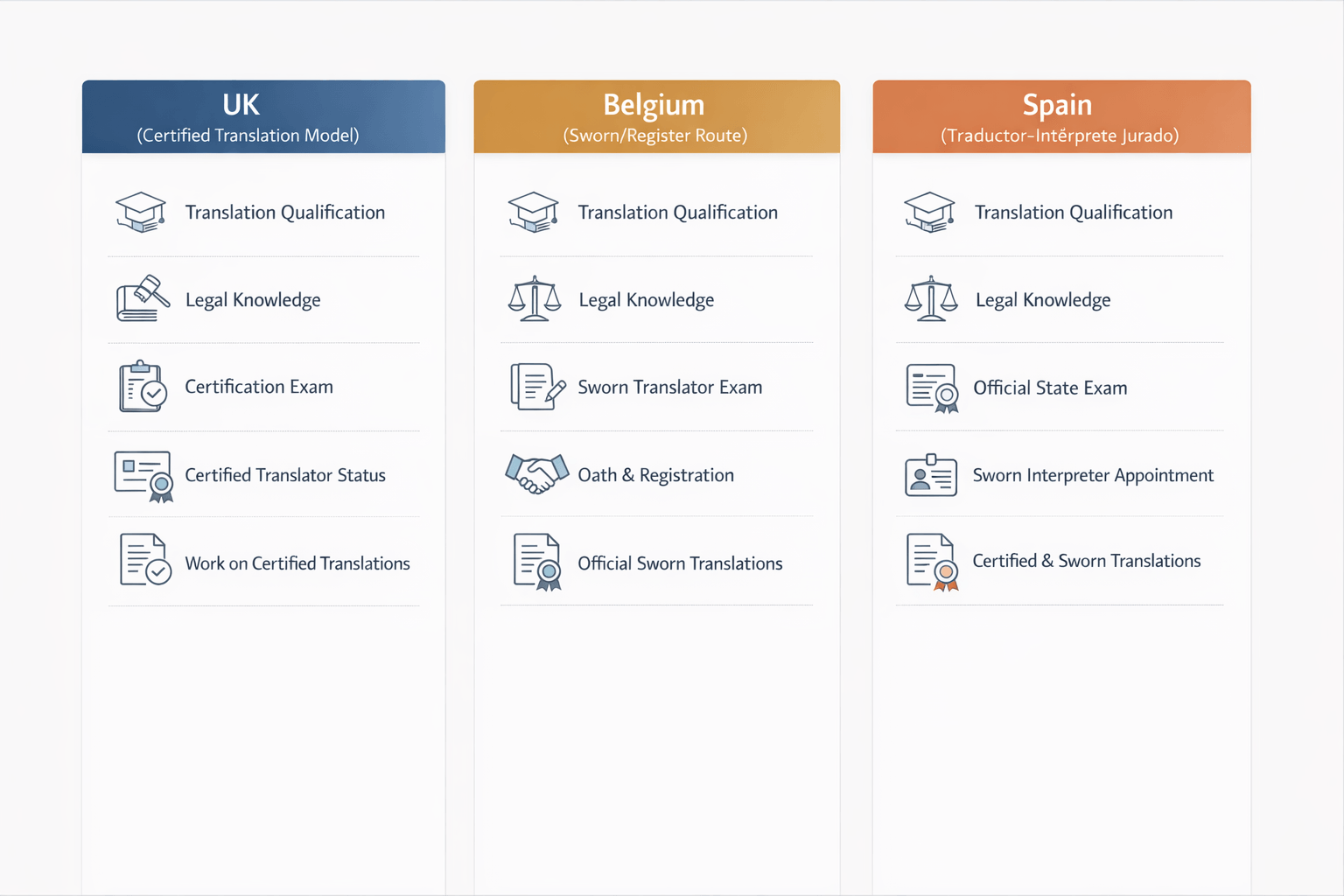
If you’re searching how to become a sworn translator, the first thing to know is this: the route depends entirely on the country where you want legal recognition. In some countries, “sworn translator” is a protected legal title (such as Spain and Belgium). In the UK, the system works differently, and most authorities ask for a certified translation rather than a sworn title.
That difference is where most people get stuck.
This guide gives you a practical, country-by-country path so you can stop guessing and start building the right qualification route for your destination market.
The fast answer most people need
To become a sworn translator, you usually need to:
- Reach professional-level ability in your language pair
- Train in legal/document translation
- Meet the legal eligibility rules in your country
- Pass the required exam or recognition process
- Register with the relevant court, ministry, or national register
- Use the correct certification wording, seal/stamp, and workflow
But the exact authority changes by country:
- UK: usually a certified translation model (not a single national sworn title)
- Belgium: court-linked/national register route
- Spain: Ministry route (Traductor-Intérprete Jurado)
If your goal is to work internationally, the smartest strategy is destination-first: choose the country where your translations must be accepted, then follow that country’s legal route.
What “sworn translator” means (and why the UK is different)
People often use “sworn translator” to mean three different things:
- a translator with a legal title granted by a public authority
- a translator who provides official/certified translations
- a translator whose work is accepted by a specific embassy, court, or ministry
Those are not always the same thing.
The key distinction
- In Spain and Belgium, the title is tied to official recognition and registration.
- In the UK, clients often say “sworn translation” when they actually need a certified translation for a Home Office, HMPO, university, or legal process.
This is why many translators (and many clients) waste time pursuing the wrong path.
The 5-part career path that works in most countries
1) Build language mastery beyond “fluent”
Sworn/legal work is not general translation work. You need accuracy under pressure.
Focus on:
- legal vocabulary
- civil status documents (birth, marriage, divorce, police records)
- formatting conventions
- names, dates, stamps, seals, handwritten notes
- risk control (omissions, false friends, inconsistent transliteration)
A good benchmark is: you can translate official documents with zero improvisation.
2) Choose your legal market before your qualification route
This is the biggest career decision.
Ask:
- Where will your translations be submitted?
- Which authorities need to accept your work?
- Do they require a sworn translator, certified translator, notary, or apostille?
- Do they require registration in a national database?
Example
- If your work is mostly for UK immigration, passports, universities, and employers, build a UK certified translation workflow.
- If your work is for Spanish courts or public administration, you need the Spanish sworn title route.
- If your work is for Belgian legal proceedings, you need the Belgian sworn/register route.
3) Get a recognised translation qualification
Even where a country has its own legal title, professional qualifications still matter for credibility and client trust.
A strong progression path looks like this:
- translation degree or equivalent language/law background
- professional translation qualification
- specialist legal translation practice
- supervised quality review (mentor/agency/editor)
- documented portfolio of official-style translations
In the UK market, qualifications and professional standards are especially important because acceptance often depends on whether your translation looks credible, complete, and verifiable.
4) Build a compliant “official translation” workflow
This is where many excellent linguists fail.
Being a good translator is not enough. You also need a repeatable document workflow:
- source file handling and naming
- translation layout rules
- certification statement wording
- signature/date/contact details
- version control
- PDF delivery and hard-copy options (if needed)
- verification readiness (so an authority can confirm who produced it)
Think of this as your acceptance system, not just your translation process.
5) Learn the certification ladder (certified vs sworn vs notarised)
Many translators lose projects by offering the wrong level of certification.
A practical rule:
- Certified translation: common for UK authorities and institutions
- Sworn translation: required in some jurisdictions where the title is legally recognised
- Notarised translation: adds a notary step
- Apostille/legalisation: international authentication step (usually tied to the original/signature chain)
If you become known for correctly guiding clients through this ladder, you will earn trust faster than translators who only talk about language skills.
How to become a sworn translator in the UK
If you’re searching how to become a sworn translator UK or how to become sworn translator in UK, the short answer is: the UK usually works on a certified translation model, not a single national sworn-translator licensing system.
That means your path is mainly about becoming a qualified professional translator whose certified work is accepted by UK authorities and institutions.
Step 1: Train as a professional translator
Build a formal base in translation, not just bilingual ability.
Prioritise:
- translation qualifications (not only language certificates)
- legal and official-document practice
- English drafting quality (clear, consistent, professional)
- terminology management
Recommended focus areas for UK official work
- immigration and visa documents
- civil status documents
- academic records
- police and court records
- corporate/legal documents
Step 2: Add recognised UK-facing credentials and memberships
For UK-facing credibility, it helps to combine:
- a recognised translation qualification
- professional body membership/profile
- a visible, verifiable workflow (certificate wording, contact details, signature practices)
This is often what clients and agencies mean when they ask, “Are you an official translator?”
They are usually asking whether your work will be accepted first time.
Step 3: Learn UK acceptance rules for certified translations
To work in this market, you need to know what UK bodies typically expect in a certified translation:
- confirmation it is an accurate translation
- date of translation
- translator’s full name and signature
- translator/company contact details
- credentials (where requested)
This is the practical difference between a translator who gets repeat business and one who creates rejections.
Step 4: Offer the right route when clients say “sworn” in the UK
A lot of UK enquiries are phrased incorrectly.
When a client asks for a “sworn translation” in the UK, you should immediately clarify:
- Is this for a UK authority? (often certified is enough)
- Is this for an overseas authority/embassy? (sworn/notarised/apostille may be needed)
This single question will save your clients money and save you hours of revision.

Client-ready wording you can use
“For UK submissions, a certified translation is usually the correct route. If your destination authority is abroad, send us the requirement wording and we’ll confirm whether you need sworn or notarised translation instead.”
That positioning builds trust and reduces back-and-forth.
Step 5: Build your UK portfolio around acceptance, not just translation samples
The best portfolio for this niche includes:
- sample certification statement formats (with placeholders)
- document types you handle (birth, marriage, police, academic, legal)
- turnaround options
- digital vs hard-copy delivery options
- clear escalation route for notarisation/apostille
If you want to attract better clients, present yourself as an acceptance-focused specialist, not a generic translator.
How to become a sworn translator in Belgium

If your target search is how to become a sworn translator in Belgium, treat this as a legal-registration pathway, not just a freelance career step.
Belgium uses a formal framework linked to sworn experts/translators/interpreters and a national register.
The Belgium route in practice
1) Check legal eligibility first
Before training decisions, check whether you meet the base legal conditions for admission in Belgium.
This avoids wasted time on courses before you know whether you qualify.
2) Build legal knowledge (not just language skills)
Belgian sworn work expects legal-process awareness, not only translation accuracy.
You should be ready for:
- court-facing documents
- procedural language
- legal terminology consistency
- evidentiary precision (names, dates, numbers, seals)
3) Prove professional competence
Belgium’s route is competency-based and tied to official recognition. Depending on your profile, that can involve evidence of qualifications, exams/training, or other accepted proof under the applicable framework.
4) Take the oath and complete registration steps
A key milestone is not just passing a test — it is formal recognition, including the oath/registration process linked to the court and national register system.
5) Make sure clients can verify you
For sworn work, discoverability matters. Your clients (law firms, courts, individuals) should be able to verify your status through the official/public mechanisms available in Belgium.
Practical Belgium advice for new translators
If you want to enter the Belgian market faster:
- start with one strong language pair
- specialise in court and civil-status document sets
- study legal document conventions in both languages
- practise “zero ambiguity” drafting
- prepare a document checklist for every job (names, dates, stamps, annexes)
Belgian sworn work rewards precision and consistency far more than marketing language.
How to become a sworn translator in Spain
If you’re searching how to become a sworn translator in Spain, the route is much more formal and clearly defined than in the UK.
Spain uses the Traductor-Intérprete Jurado framework under the Ministry route, with an official title and register/list system.
Step 1: Understand the Spanish title pathway
In Spain, sworn translators/interpreters are officially recognised through the Ministry framework. This is a legal/professional title route, not just a private certification model.
That means your goal is not simply “start translating documents,” but to obtain the recognised title and complete the related formalities.
Step 2: Meet the eligibility conditions
Spain’s framework sets eligibility rules for access to the title route (including age, qualification, and nationality criteria in the standard examination route, with a separate path for recognition of EU/EEA/Swiss qualifications).
If you trained outside Spain, do not assume your degree is automatically accepted — check equivalence/homologation requirements early.
Step 3: Sit the exam (or use the EU qualifications recognition path)
There are two broad routes:
- Examination route (when the Ministry opens the relevant exam for your language)
- Recognition of professional qualifications route (for eligible EU/EEA/Swiss professionals, sometimes with compensatory measures/exams)
Important: the language combinations offered can vary by call, so plan your career timing around real announcements rather than assumptions.
Step 4: Complete verification of signature and seal
After obtaining the title, Spain’s process is not finished until the signature/seal verification formalities are completed.
This is essential for actual practice.
Many candidates miss this operational step and then wonder why they are not fully ready to work.
Step 5: Set up your sworn translation format correctly
Spain is strict about official appearance and wording.
Your translations need to follow the expected structure, including:
- title/status identification
- registration number
- certification wording
- signature (and approved seal format)
- proper handling of the source-document copy
This is not a stylistic detail — it is part of legal validity and acceptance.
Step 6: Make your contact details findable for clients
Spain maintains a public list framework for sworn translators/interpreters. If you want client enquiries, make sure your active practice details are up to date where applicable.
This is one of the most overlooked growth steps for newly qualified sworn translators.
How to be a sworn translator in other countries
If you’re asking how to be a sworn translator outside the UK, Belgium, or Spain, use this 10-minute checklist before you commit to any course:
The “destination-first” checklist
- Who grants the title?
- Court
- Ministry
- National register
- Professional body (or no legal title)
- What is the legal term locally?
- Sworn translator
- Authorised translator
- Court-appointed translator
- Certified translator
- What is required to practise?
- exam
- degree
- oath
- registration
- seal/signature verification
- How is the public supposed to verify you?
- official online directory
- court list
- ministry list
- What makes a translation “official” there?
- exact certification wording
- seal format
- attached source copy
- notarisation/legalisation rules
If you can answer those five points, you can build the right route in almost any jurisdiction.
Common mistakes people make when trying to become a sworn translator
1) Mixing up “certified” and “sworn”
This is the most common mistake, especially in the UK market.
Clients often use the wrong word. Translators should not.
2) Choosing a qualification before choosing a target country
A qualification can help your career, but it won’t replace the legal route in a country that requires formal title recognition.
3) Ignoring the document workflow side
Even strong translators get rejected when they miss:
- signature
- date
- contact details
- proper certification wording
- source copy attachment requirements
- formatting clarity
4) Offering notarisation or apostille too early
Not every job needs it.
The better approach is:
- confirm the destination authority
- match the required certification level
- upgrade only if requested
This protects your client’s budget and improves trust.
5) Building a generalist brand instead of a legal-document brand
If you want sworn/certified work, position yourself around:
- official acceptance
- legal/document precision
- compliance-ready delivery
- clear country guidance
That messaging attracts better enquiries than “I translate everything.”
A realistic roadmap for your first 12 months
Months 1–3: Foundation
- choose your target country/countries
- select 1–2 language pairs
- start legal-document practice
- create terminology glossaries
- study official document formats
Months 4–6: Qualification and systems
- begin/complete your key translation qualification
- build your certification templates and workflow
- create your QC checklist
- practise formatting official documents
Months 7–9: Verification and positioning
- set up your professional profiles
- prepare acceptance-focused service pages
- build document-type pages (birth, marriage, police, academic)
- define when to refer jobs for notarisation/apostille
Months 10–12: Scale carefully
- specialise in the document sets you handle best
- collect verified reviews
- document acceptance outcomes
- refine your onboarding process
This is the point where many translators go from occasional jobs to a stable official-document niche.
Need sworn or certified translation support while you build your career?
If you’re becoming a translator and also handling real client submissions, it helps to work with a team that already manages certified, sworn, and notarised routes.
UK Certified Translation can support the delivery side while you focus on your qualification path:
- UK-ready certified translations
- sworn translation for country-specific requirements
- notarised translation and legalisation support
- document review if the destination requirement is unclear
If a client sends you a screenshot or letter saying “official translation required,” the fastest move is to match the requirement before the job starts.
FAQs
How to become sworn translator in UK if there is no single sworn title?
In the UK, most official document work is handled through certified translations rather than a single national sworn-translator licence. The practical route is to become a qualified professional translator, learn UK acceptance requirements, and deliver certified translations with complete certification details.
How to become a sworn translator in Belgium step by step?
The Belgium route is a formal recognition pathway linked to legal eligibility, competence/legal knowledge, oath/registration steps, and inclusion in the official system used for verification. Start by checking eligibility and the current register/admission process before enrolling in training.
How to become a sworn translator in Spain for official documents?
Spain uses the Traductor-Intérprete Jurado framework. You typically need to meet the eligibility rules, follow the exam route or the EU qualifications recognition route (if applicable), complete signature/seal verification, and then work using the required sworn format and certification wording.
How to become a sworn translator if I want to work in multiple countries?
Pick your main destination country first and qualify there properly. Then build a referral/partner network for countries with different legal systems. Trying to treat all countries as one “sworn translation” market usually creates rejections.
Can I be a sworn translator and still offer certified translations?
Yes. In fact, many professionals do both. The key is to match the output to the destination authority: certified for many UK uses, sworn for jurisdictions that legally require it, and notarised/apostilled only when specifically requested.
Do I need a law degree to become a sworn translator?
Not always. Some systems focus on translation qualifications plus legal knowledge and official recognition steps, while others set specific degree or eligibility rules. Check the exact requirements for your target country before choosing a training route.