


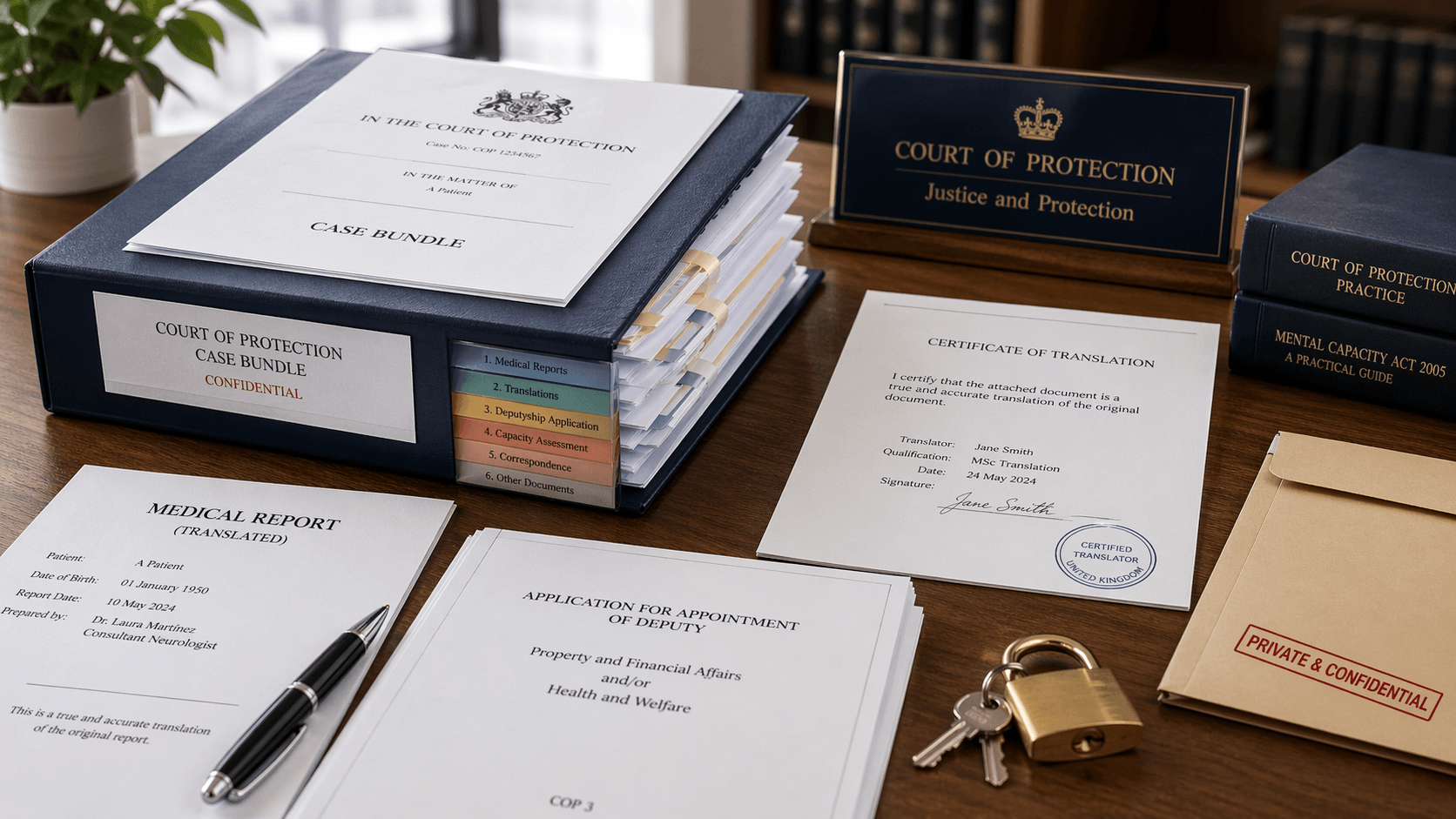
Court of protection translation is not just about converting words from one language into English. It is about making sure sensitive medical and legal documents can be understood, checked, filed, and relied on in a process that already carries enough pressure for families, deputies, solicitors, and healthcare professionals. In England and Wales, the Court of Protection makes decisions for people who lack mental capacity, and the paperwork often combines clinical evidence, legal forms, supporting statements, and time-sensitive communication. (GOV.UK)
When the documents are in another language, the risks multiply. A weak translation can blur the meaning of a diagnosis, soften the force of a safeguarding concern, misstate a financial arrangement, or create avoidable delays in deputyship applications. A strong translation does the opposite: it preserves meaning, keeps terminology consistent, and gives the court a clear record it can work with.
That is why the best court of protection translation work sits at the point where deputyship documents translation, capacity assessment translation, and legal medical translation meet. It is not enough to be “good at languages.” The translator also has to understand how medical evidence and legal procedure interact.
Get a quote from UK Certified Translation when you need a court-ready document pack handled securely and without unnecessary back-and-forth. UK Certified Translation describes itself as a UK-wide network of accredited linguists handling court filings and medical records through GDPR-compliant workflows, with a dedicated project coordinator for each job. (UK Certified Translations)
What Court of Protection translation usually includes
A Court of Protection matter can involve a surprisingly broad evidence bundle. Depending on the application, you may need translation of:
- deputyship applications and supporting forms
- capacity reports and clinical letters
- hospital discharge papers
- psychiatric or psychological reports
- safeguarding records
- witness statements
- property and financial records
- foreign powers of attorney, judgments, or identity documents
- correspondence between family members, carers, professionals, and authorities
On GOV.UK, Court of Protection forms and guidance include the main application form, property and finance and personal welfare annexes, the COP3 capacity report, deputy declarations, witness statements, and notification forms. That is one reason a court of protection translation project often becomes a document-pack exercise rather than a single-document job. (GOV.UK)
The real challenge is not language alone
The court is not reading these documents in isolation. It is reading them to answer practical questions such as:
- Does the person have capacity for this decision?
- Is deputyship necessary?
- What evidence supports the application?
- Are there urgent welfare or financial risks?
- Have the right people been notified?
- Can the evidence be trusted as complete and accurate?
If even one translated document uses inconsistent terminology, leaves out handwritten notes, mistranslates medication names, or strips out stamps and annotations, confidence in the whole bundle can drop.
Why medical and legal documents need to be translated together
Many pages ranking for legal translation talk only about certification. Many medical translation pages talk only about terminology. Court of Protection cases need both.
A clinical phrase can carry legal consequences. A legal form can depend on a clinical opinion. For example:
- a consultant’s note may support or weaken a capacity argument
- a diagnosis may affect the court’s view of fluctuating capacity
- a discharge plan may matter in a welfare application
- a financial risk note may support a property and affairs deputyship request
- a safeguarding concern may need to be read in the same light as family evidence
This is where legal medical translation becomes critical. The translation must preserve:
- diagnostic accuracy
- time references and chronology
- decision-specific language
- names of professionals and institutions
- drug names, dosages, and treatment history
- formatting, stamps, signatures, and handwritten comments
A good rule is simple: if the original could influence a judicial decision, the translation must preserve the exact evidential value of the original.
Deputyship documents translation: what the court needs to understand quickly

In many cases, the practical starting point is deputyship. Property and financial affairs applications often turn on whether the court can clearly see the person’s circumstances, the evidence of incapacity, and why authority is needed now.
Documents commonly translated for deputyship matters
A deputyship file may include:
- ID and civil status documents
- overseas bank statements or pension evidence
- medical evidence supporting lack of capacity
- care home or hospital correspondence
- foreign property documents
- inheritance paperwork
- existing power of attorney documents from another jurisdiction
- family statements explaining why the application is needed
For professional users, HMCTS guidance covers applying for a property and financial affairs deputyship order. The Court of Protection also publishes form sets and guidance for both property/finance and personal welfare cases. (GOV.UK)
Where deputyship translations most often go wrong
The most common failure points are not dramatic. They are small details that create procedural friction:
- Partial translation
Only the main text is translated, while stamps, handwritten notes, marginal notes, or back-page endorsements are ignored. - Inconsistent names and dates
Different spellings across medical letters, IDs, and financial records make the bundle harder to trust. - Weak certification
The receiving body cannot easily see who translated the document, when, and on what basis. - No bundle logic
Documents are translated one by one without consistent terminology across the whole file.
If you are preparing a deputyship application, it is usually smarter to submit the whole pack together for review rather than drip-feeding pages over several days. That reduces contradictions and speeds up checking.
Need urgent help with a deputyship matter? Upload the full bundle, not just the headline documents. A complete pack is usually faster to assess and less likely to trigger follow-up requests.
Capacity assessment translation: why COP3 and medical evidence require extra care

A capacity assessment translation is one of the highest-risk parts of a Court of Protection file because capacity is decision-specific. The point is not whether a person can make decisions “in general,” but whether they can make the relevant decision at the relevant time.
That is reflected directly in the COP3 form. GOV.UK states that the assessment must be based on the person’s ability to make a decision in relation to the relevant matter, not their ability to make decisions in general. (GOV.UK)
Why this matters in translation
A translator working on a COP3 or supporting medical report has to preserve distinctions such as:
- impairment vs diagnosis
- temporary vs long-term inability
- inability to understand vs inability to communicate
- inability to retain information vs inability to weigh it
- present capacity vs likely future recovery
- observed behaviour vs professional opinion
These are not stylistic differences. They go to the heart of the legal test.
Documents often included alongside a capacity report
A capacity assessment translation may involve:
- COP3 forms
- consultant psychiatrist letters
- neuropsychology reports
- GP summaries
- discharge notes
- social work assessments
- occupational therapy records
- mental health tribunal or safeguarding records
- correspondence with family or care teams
When these documents are translated separately by different people, terminology can drift. One report may say “cognitive impairment,” another “confusion,” another “executive dysfunction,” and another “memory loss.” Those may overlap, but they are not identical. In a court context, that difference matters.
A practical standard for capacity assessment translation
For Court of Protection work, the safest approach is to treat the capacity evidence as one terminology set. That means:
- one translator or one coordinated specialist team
- a consistent glossary for diagnoses and recurring clinical terms
- full translation of attachments, appendices, and handwritten clinical notes where legible
- preservation of dates, page numbering, and professional titles
- a final review against the original pack, not just the translated pages
Certified translation services are often the right starting point for this kind of document set, with additional legal review where the receiving body or solicitor needs a particular format. UK guidance on certifying a translation says the translation should confirm that it is a true and accurate translation, and include the date, the translator’s full name, and contact details. (GOV.UK)
Confidentiality is not a side issue
Court of Protection files often contain some of the most sensitive information a person can hold: psychiatric history, cognitive assessments, medication records, family conflict, safeguarding concerns, financial vulnerability, and social care evidence.
Under ICO guidance, health information is special category personal data and needs extra protection. Lawful processing requires both a lawful basis under Article 6 and a separate condition under Article 9 of the UK GDPR. (ICO)
That is why confidentiality should be treated as an operational requirement, not a marketing phrase.
What secure handling should look like
A provider handling Court of Protection material should be able to explain:
- how files are transferred securely
- who can access the documents
- whether the translators are subject to confidentiality obligations
- how long files are retained
- whether client data is used for machine training or not
- how urgent matters are escalated without widening access unnecessarily
UK Certified Translation states that its workflows are GDPR-compliant and designed for secure handling. (UK Certified Translations)
A simple rule for families and professionals
Never assume a general translator is suitable just because they speak the language. In Court of Protection matters, privacy risk and meaning risk sit together. If the provider cannot explain its security and review process clearly, that is a warning sign.
Urgent help: what to do when a deadline is close
Sometimes the translation is needed because the court deadline is fixed. Sometimes the urgency comes from life outside the court file: hospital discharge, safeguarding concerns, blocked access to funds, overseas records needed for a deputyship application, or an upcoming hearing.
In those cases, urgent help is not just “fast turnaround.” It is a triage process.
The fastest way to keep an urgent case moving
Send:
- every page in one upload
- clear scans or photos with all edges visible
- the target language and country of origin
- the filing or hearing deadline
- the document priority order
- the receiving body’s format requirements, if known
- one contact person for approvals
This is especially important when the file contains both medical and legal documents. Fragmented intake wastes time.
What can be prioritised first
In a tight case, the first-pass priority is usually:
- COP3 or other core capacity evidence
- deputyship application support documents
- witness statements or key correspondence
- urgent clinical records
- financial records proving immediate risk or need
Then the rest of the bundle can follow in a controlled order.
If your deadline is close, start your project with the pages the judge, solicitor, or caseworker will need first. Then let the remainder of the file be completed as a managed second stage.
Do you need certified, sworn, or notarised translation?
This is one of the most common points of confusion.
In many UK matters, what matters is a properly prepared certified translation with a clear certification statement. GOV.UK’s guidance on certifying a translation is straightforward about the basic details required. But some overseas authorities or specific legal processes may ask for notarisation or a sworn format instead. (GOV.UK)
A practical way to think about it:
- Certified translation: usually the starting point for official UK submissions
- Sworn translation: may be needed for certain foreign court or cross-border legal uses
- Notarised translation: may be required where a notary layer is specifically requested
If you are unsure, do not guess. Sworn translation services and the broader services page can help you identify the right route before you file anything.
What a court-ready translation should include
A strong court of protection translation should do more than sound fluent. It should be submission-ready.
That usually means:
- complete translation of all relevant text
- translated stamps, seals, and handwritten notes where possible
- consistent names, dates, and terminology across the bundle
- preserved formatting where structure affects meaning
- certification details that can be checked
- one accountable provider or project coordinator
- secure handling from intake to delivery
This is the difference between a translation that merely exists and one that can actually be used.
Interpreting may also be needed for hearings and meetings
Written translation solves one problem. It does not solve spoken communication at hearings, solicitor meetings, assessments, or family discussions.
GOV.UK provides a route to ask for an interpreter at a court or tribunal hearing, which is a separate issue from written translation of documents. (GOV.UK)
That distinction matters because many Court of Protection cases require both:
- document translation for evidence and forms
- interpreting for hearings, case conferences, or assessments
If the case involves both written and spoken language support, it is worth coordinating them together. Interpreting support and document translation work best when the terminology is aligned across both.
Common mistakes that create avoidable delays
1. Sending only selected pages
The court or solicitor may need the full context, including annexes, stamp pages, or covering letters.
2. Using generic terminology in medical evidence
In capacity cases, vague wording can distort the clinical meaning.
3. Forgetting handwritten annotations
A short note in the margin can change the significance of a report.
4. Mixing several translators without one review layer
This creates inconsistent names, diagnoses, and formatting.
5. Waiting to ask what format is required
If a body wants certification, sworn status, hard copy, or a sealed pack, it is better to know before the work starts.
6. Treating confidentiality as optional
Medical evidence and welfare records should never be handled casually.
A better way to think about court of protection translation
The strongest translation providers do not treat a Court of Protection matter as “just documents.” They treat it as a decision-making file.
That changes the whole workflow:
- the medical evidence is translated for legal use
- the legal paperwork is translated with clinical context in mind
- the project is managed as one pack
- urgency is assessed by filing risk, not by word count alone
- confidentiality is built into the process from the first upload
That is also why this work is particularly valuable to:
- solicitors handling deputyship and welfare matters
- professional deputies
- hospitals and case managers
- local authority teams
- family members supporting an application
- overseas relatives asked to provide evidence or records
When accuracy matters, start before the deadline becomes the problem
If you are dealing with a deputyship application, a COP3 report, foreign medical records, or a mixed bundle of legal and clinical evidence, the safest move is to organise the translation before the filing pressure peaks.
Start your project with UK Certified Translation if you need a secure, court-ready translation pack for medical and legal documents. For many clients, the biggest relief is not just speed. It is knowing the pack has been handled in one place, with one review process, and with the level of confidentiality Court of Protection matters demand.
A good provider should make the next step simple: upload the files, explain the destination and deadline, and receive clear guidance on the right certification path. That is how Court of Protection translation should work.
“Their sworn translations were accepted without challenge.”
“Absolute confidentiality.”
These are the kinds of outcomes legal clients actually remember when the stakes are high. (UK Certified Translations)
FAQs
What is court of protection translation?
Court of protection translation is the professional translation of documents used in Court of Protection matters, including deputyship paperwork, capacity evidence, medical reports, witness statements, and supporting legal documents. The goal is to preserve evidential meaning, protect confidentiality, and make the documents ready for official use.
Do deputyship documents need certified translation?
If deputyship documents or supporting evidence are not in English or Welsh, a certified translation is usually the safest route for UK use. The translation should clearly confirm accuracy and include the translator’s name, date, and contact details. (GOV.UK)
What is a capacity assessment translation?
A capacity assessment translation is the translation of decision-specific mental capacity evidence, often including COP3 forms, consultant letters, and supporting clinical records. It requires extra care because the legal test depends on precise medical wording and clear chronology. (GOV.UK)
Is legal medical translation really necessary for Court of Protection cases?
Yes. Many Court of Protection matters rely on both legal procedure and medical evidence. If the translation provider understands only one side, important meaning can be lost.
How quickly can I get urgent help with Court of Protection documents?
Urgent matters can often be prioritised when the provider receives a complete, legible bundle, the target language, and the exact deadline at the start. The fastest jobs are usually the ones prepared clearly, not the ones sent in fragments.
Are medical records and capacity reports confidential?
Yes, and they should be handled as highly sensitive material. Health information is special category personal data and requires stronger protection under UK data protection rules. (ICO)