


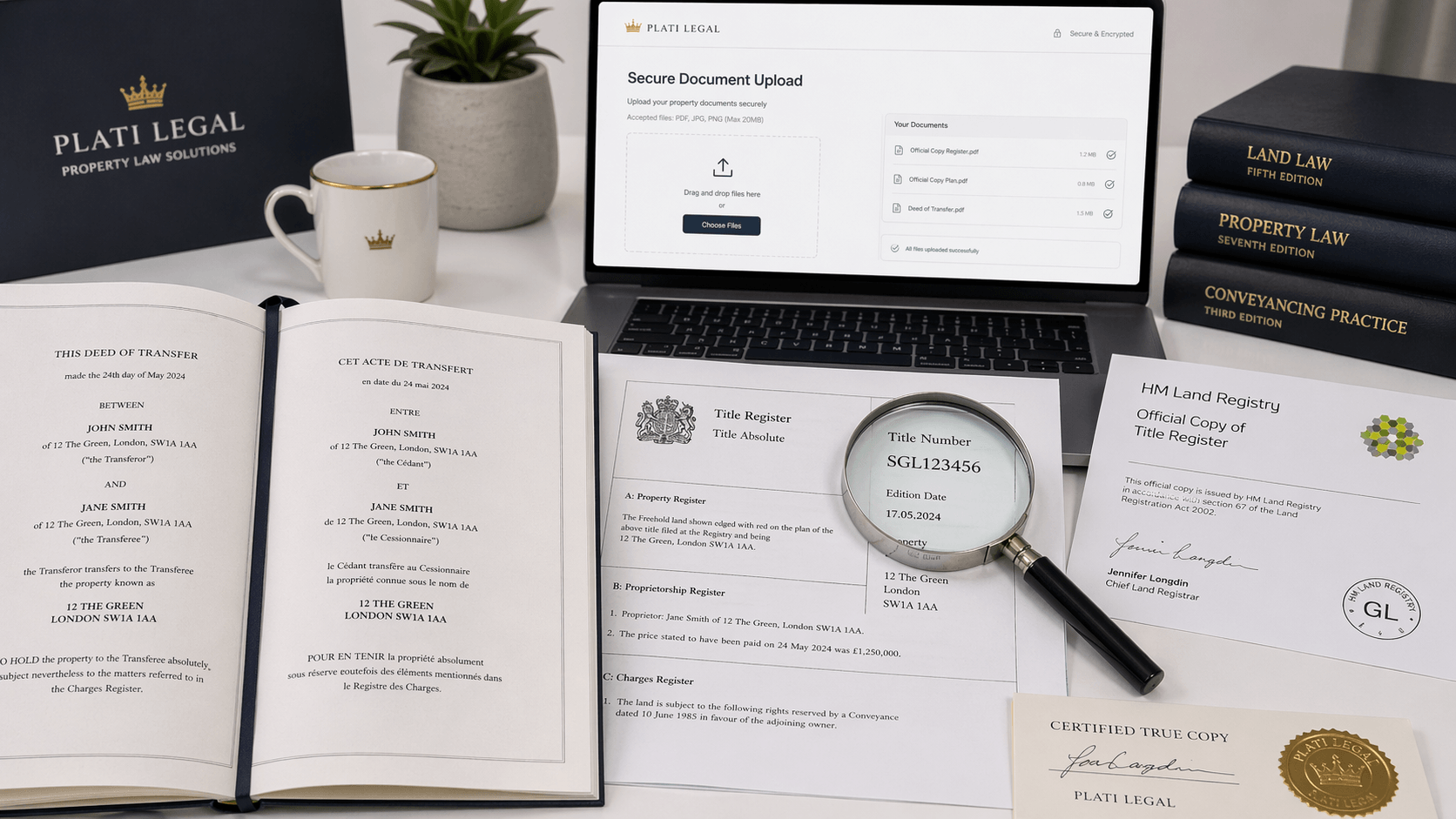
If you need hm land registry document translation for a property transaction, title review, lender check, overseas entity filing, or supporting evidence pack, the safest approach is to treat the translation as part of the legal file, not as an afterthought. A title register translation, deed translation, or property evidence translation must be complete, consistent, and easy for a solicitor, case handler, or reviewer to verify against the original.
That is where many submissions go wrong. The problem is rarely the headline wording alone. It is usually the missing annex, the untranslated stamp, the handwritten margin note, the title number that appears differently across documents, or the certificate wording that leaves the reviewer unsure whether the translation can be relied on.
A strong translation pack does three things at once:
- it preserves the legal meaning of the original document
- it lets the reviewer match key details line by line
- it arrives in a format that is ready for legal or administrative use
If your file includes a foreign-language deed, title register, property evidence, company record, or supporting identity document, send it for review before submission. A clear scan and the destination requirement are often enough to confirm the right level of certification and avoid delays.
How can I get an HM Land Registry document translated professionally?
If you are asking, “How can I get an HM Land Registry document translated professionally?”, the safest route is to send the complete property document bundle to a legal-document translation provider and ask for the certification level to be matched to the destination. In practice, that usually means a full certified translation of the title register, deed, filed copy, title plan wording, and any supporting evidence the solicitor, lender, or reviewing authority may need to follow.
The safest ordering process is simple:
Send every page, including schedules, annexes, reverse pages, and visible stamps or handwritten notes.
State where the translation will be used, such as a UK solicitor, lender, conveyancing file, overseas entity filing, foreign authority, court, or notary.
Confirm the language pair and your deadline.
Ask whether certified translation is enough or whether notarisation, sworn translation, or legalisation is required for the destination.
Request delivery in the exact format needed, such as certified PDF, hard copy, wet-ink signed copy, notarised pack, or legalised set.
This reduces the two problems that cause most delays: incomplete source bundles and the wrong certification level being ordered at the start.
The short answer
For most UK-facing property matters, the safest route is a full certified translation of every relevant page, including visible stamps, annotations, seals, schedules, and annexes. If the receiving body specifically asks for notarisation, overseas legalisation, or a court-appointed format, upgrade only then. The goal is not to buy the highest level by default. The goal is to submit the right translation pack the first time.
Which papers usually need translating?
Property files are rarely just one document. In practice, requests often involve a bundle of records that work together.
Title register translation
A title register translation is usually needed when the reviewer must understand who owns the property, what rights affect it, whether restrictions appear on the title, and which supporting documents are referred to elsewhere in the file. When the translated register is being compared with lender forms, ID documents, company records, or overseas purchase records, name consistency becomes critical.
Deed translation
A deed translation may be required for sale deeds, transfer deeds, gift deeds, mortgage deeds, settlement deeds, inheritance records, partition agreements, or older title documents that explain how ownership was acquired. In many cases, the deed matters more than the short extract because it contains the operative wording, execution details, witness wording, schedules, and annexes.
Property evidence translation
Property evidence translation often includes the supporting documents around the main deed or register entry, such as:
- certificates of registration
- company constitutions or corporate authority documents
- powers of attorney
- marriage, birth, death, or probate records linked to ownership history
- planning or cadastral extracts
- tax or valuation papers where they are part of the wider evidence trail
Referenced documents and filed copies
A title register may point to another document that contains the detail the reviewer actually needs. If rights, covenants, easements, restrictions, or historic transfers are referred to in a separate filed deed, that deed often needs translating too. This is one of the most common reasons a file that looked complete at first turns into a follow-up request later.
Title plans, official copies, and historic filed deeds
Many people assume that only the title register needs translating. In practice, the answer depends on what the file is being used to prove. A title register may show the current legal position, but the detail the reviewer needs can sit in the title plan, official copy wording, filed transfer, historic conveyance, easement deed, mortgage deed, or restrictive covenant document referred to in the register.
Where a title plan contains labels, notes, parcel references, or handwriting that affects interpretation, those elements should be translated or clearly accounted for in the pack. Where the register refers to copy filed documents, it is often safer to review and translate those at the same time instead of waiting for a follow-up request later.
Searches, official copies, and proof documents are not the same thing
Some clients order a property search and assume it replaces the underlying title evidence. It does not. If the destination needs proof of ownership history, restrictions, covenants, execution wording, or linked rights, the reviewer may still need the relevant official copies or filed deeds translated as part of the supporting evidence trail.
What makes a solicitor-ready translation pack?

A solicitor-ready translation is not just accurate in general terms. It is built so that a legal reviewer can move through the pack quickly and trust what they are seeing.
The seven-point standard
- Full coverage
Every relevant page is translated, including reverse pages, schedules, annexes, signatures, seals, and handwritten notes where visible. - Stable names and numbers
Names, dates, addresses, parcel identifiers, company names, title numbers, reference numbers, and registration dates are reproduced consistently across the whole pack. - Visible non-body text is captured
Stamps, marginal notes, embossed seals, registry marks, filing references, and certification notes are not silently ignored. - Mirror-friendly layout
The translated version is organised so the reviewer can compare it easily with the source. Headings, sections, numbering, tables, and signature blocks should follow the same logic. - Clear treatment of unclear text
Illegible handwriting, partial seals, cropped scans, and damaged areas are marked honestly rather than guessed. - Strong certification wording
The pack includes a proper certificate of accuracy with the translator or provider details needed for verification. - Delivery that matches the destination
If a PDF is enough, a certified PDF should be supplied. If a hard copy, wet-ink signature, notarisation, or legalisation is required, the output should be prepared accordingly.
That is the difference between a translation that merely exists and one that can move a property matter forward.
What should the certificate of accuracy cover?
For land and property files, the certificate should make it easy for the receiving party to understand what has been translated and who is taking responsibility for accuracy. At minimum, it should identify the source document, confirm that the translation is complete and accurate to the best of the translator’s knowledge and ability, state the language pair, and include the date, name, signature, and contact details of the translator or translation provider.
If the pack contains multiple documents, the certificate should also make clear whether it covers the whole bundle or each document individually. That small detail can prevent unnecessary follow-up questions later.
Certified, notarised, or sworn?
These are not interchangeable labels. They solve different problems.
| What you need | Usually the right fit | Typical use case |
| A translation for a UK solicitor, lender, conveyancing matter, or administrative review | Certified translation | Most deed translation, title register translation, and supporting property evidence translation for UK use |
| A translation that must be authenticated for use abroad | Notarised translation | Foreign property transactions, embassy use, overseas legal filings, or legalisation routes |
| A translation required in a jurisdiction that recognises officially appointed translators | Sworn translation | Country-specific court or authority requirements outside the standard UK certified model |
The practical rule is simple: do not over-order by default, but do not under-order blindly either. If the receiving body only needs a certified translation, adding notarisation may increase cost and time without adding value. If the receiving body specifically asks for notarisation, apostille, or a sworn format, meet that requirement exactly.
If you are unsure which route applies to your file, send the document and the destination details together so the certification level can be matched before work starts.
Why HM Land Registry-related files get delayed
Most delays come from presentation failures rather than language difficulty. The document may be translated, but not translated in a way that supports the legal purpose of the file.
Common issues include:
- only the first page being translated when schedules or annexes carry legal effect
- missing references to filed deeds or linked evidence
- inconsistent transliteration of names across ownership and ID records
- omitted seals, stamps, and handwritten endorsements
- unclear scans that hide dates, signature blocks, or registration references
- certificate wording that does not make the translation easy to verify
- ordering notarisation too early, or not ordering it when it is actually required
A useful rule for property files is this: if a reviewer could reasonably ask, “Where did this detail come from?” the translation should make the answer obvious on the page.
How to prepare your documents before sending them

A clean source file makes a measurable difference to acceptance speed.
What to send
Before requesting a quote, gather:
- every page of the deed, extract, or register
- any annexes, schedules, referenced attachments, or back pages
- supporting evidence that must match the property record
- the country pair and target language
- the submission destination
- your deadline
- any instruction that mentions certified, notarised, sworn, apostilled, sealed, hard copy, or wet-ink requirements
What helps most
- flat scans rather than angled phone photos
- complete edges with nothing cropped out
- high enough resolution to read stamps and handwriting
- one clearly named file per document where possible
- a note telling us which document is the priority if the bundle is large
Use a secure upload route or direct project contact rather than sending fragmented screenshots over multiple channels. That reduces version confusion and protects sensitive property information.
How long does HM Land Registry document translation take?
Turnaround depends on the number of pages, image quality, language pair, and whether the file includes deeds, annexes, or supporting civil-status and company documents that must be cross-checked for name consistency. A short title register may move faster than a multi-document evidence bundle, but acceptance-focused preparation matters more than raw speed. A rushed pack that misses seals, schedules, or filed-deed references can create more delay than it saves.
What affects the cost of a translation pack?
Cost is usually driven by document volume, complexity, certification level, formatting needs, and whether the file must be aligned across several related documents. Title registers, deeds with schedules, handwritten notes, historic records, and company evidence packs often require more checking than a single clean extract. Ordering the correct certification at the start also helps avoid paying twice for re-issue or re-formatting later.
A practical example
A buyer’s solicitor receives a foreign-language sale deed, registry extract, power of attorney, and marriage certificate to explain a name change. On paper, that looks straightforward. In reality, the review can stall if the deed uses one spelling, the registry extract shortens the middle name, and the marriage certificate uses a different order of surnames.
A better submission pack does not just translate each document separately. It treats the whole bundle as one evidence chain:
- the deed translation preserves the operative transfer wording
- the title register translation keeps the title references aligned
- the property evidence translation explains the supporting name trail
- the certificate page makes the translation verifiable
- the final pack is delivered in the format the reviewer actually needs
That is how you reduce email back-and-forth and give the legal team a file they can work with immediately.
What clients actually value in this kind of work
In property matters, speed matters, but confidence matters more. The most useful service signals are the ones that reduce risk:
- experienced legal-document handling
- secure workflow and careful file handling
- clear communication on whether certified, notarised, or sworn service is needed
- transparent pricing before work begins
- formatting that helps solicitors and case teams review the pack quickly
If your deadline is tight or your file includes multiple documents that must match each other, it is worth getting the bundle checked together. That is usually faster than fixing acceptance problems one document at a time.
When to request notarisation as well
Some land or property matters sit inside a wider international process. You may need more than a standard certified translation when the file is going to:
- an embassy or consulate
- an overseas notary or public authority
- a foreign court or inheritance proceeding
- an international lender or cross-border compliance team
- a legalisation or apostille workflow
Where that applies, it is usually better to plan the sequence at the start rather than translating first and then discovering that the authentication path changes the required format.
What to check before you submit
Use this final review list before filing or sending the pack onward:
- Are all referenced pages included?
- Are names, dates, numbers, and property identifiers consistent across documents?
- Are stamps, seals, notes, and endorsements accounted for?
- Does the certificate wording make the translation easy to verify?
- Is the format correct for the destination: PDF, hard copy, wet ink, notarised, sworn, or legalised?
- Have you translated the evidence around the deed, not just the headline document?
If the answer is yes to all six, your file is far more likely to move smoothly.
Need a deed translation or title register translation?
If you are dealing with a foreign-language title register, filed deed, transfer deed, corporate ownership document, or supporting evidence bundle, the safest next step is to send the full file for review and ask for the right certification level up front.
A properly prepared hm land registry document translation should help your solicitor, lender, or reviewing authority understand the record without chasing missing pages, unexplained name differences, or incomplete evidence. That is what turns translation from a formality into a useful part of the transaction.
Send your documents for a fixed quote, mention the destination, and request the output format you need. Where speed matters, say so at the start so the project can be prioritised correctly.
FAQs
Do I need a certified translation for HM Land Registry papers?
If the supporting document is in a foreign language and is being relied on in a UK property-related process, a certified translation is the safest default unless the receiving body has asked for a different form. The key is that the translation must be complete, accurate, and easy to verify.
Is a title register translation different from a deed translation?
Yes. A title register translation usually summarises the registered position of the property, while a deed translation often carries the operative legal wording, execution details, schedules, and annexes behind that position. In many files, both matter.
Can I translate only the relevant pages of a property deed?
That is risky unless the receiving authority has explicitly confirmed that partial translation is acceptable. In property matters, legal effect often appears in annexes, schedules, or referenced sections that look secondary but are not.
What should a solicitor-ready translation include?
A solicitor-ready translation should include the full translated text, accurate treatment of stamps and handwritten notes, stable names and reference numbers across the file, and a certificate of accuracy that allows the translation to be verified.
When do I need notarised translation for property evidence?
You typically need notarised translation when the receiving body specifically asks for notarial authentication, when the document is moving through an overseas legalisation route, or when a foreign authority requires the translation to carry a notarial seal.
How should I send sensitive property documents?
Use a secure upload or direct project route, send complete scans rather than screenshots, and keep the bundle together so the translator can check consistency across the deed, title register, and supporting evidence.
Do I need to translate the title plan as well as the title register?
Translate any text, labels, notes, or endorsements on the title plan that affect interpretation or are referred to elsewhere in the property file. If the plan is being used only as a visual boundary reference with no foreign-language wording, the register and related deeds may matter more. When in doubt, send the plan with the rest of the bundle so the need can be assessed together.
Can I use AI or machine translation for HM Land Registry papers?
For a rough internal understanding, machine translation may help you identify the document type. For a submission pack, it is risky. Property files often contain operative legal wording, marginal notes, stamps, schedules, and inconsistencies across related documents that need professional review and certification. If the translation will be relied on by a solicitor, lender, court, or authority, a professionally prepared translation is the safer route.
Does the translation need to include stamps, seals, and handwritten notes?
Yes. Visible non-body text can carry evidential or procedural significance. Ignoring stamps, seals, filing notes, annotations, or handwritten wording is one of the quickest ways to create doubt about whether the translation is complete.
How do I get a quote quickly for HM Land Registry document translation?
Send a clear scan of every page, confirm the language pair, say where the translation will be used, and mention any deadline or certification requirement. The more complete the bundle, the more accurate the quote and the lower the risk of later delays.
Will a certified PDF be enough for a property matter?
In many UK-facing matters, a certified PDF is often enough unless the destination has specifically requested a hard copy, wet-ink signature, notarisation, or legalisation. The safest approach is to match the output format to the receiving body’s stated requirement.
Can older deeds and handwritten property records be translated?
Yes, but older and handwritten records should be assessed before quoting because legibility, damage, and historic terminology can affect scope and timing. Where wording is unclear, the translation should mark that honestly rather than guess.
Ready to send your HM Land Registry documents?
If you need a title register translation, deed translation, filed-copy translation, or full property evidence bundle reviewed for certification, send the complete pack together with the destination and deadline. That makes it easier to confirm the right certification level, issue a fixed quote, and prepare a pack that is ready for legal or administrative use the first time.