


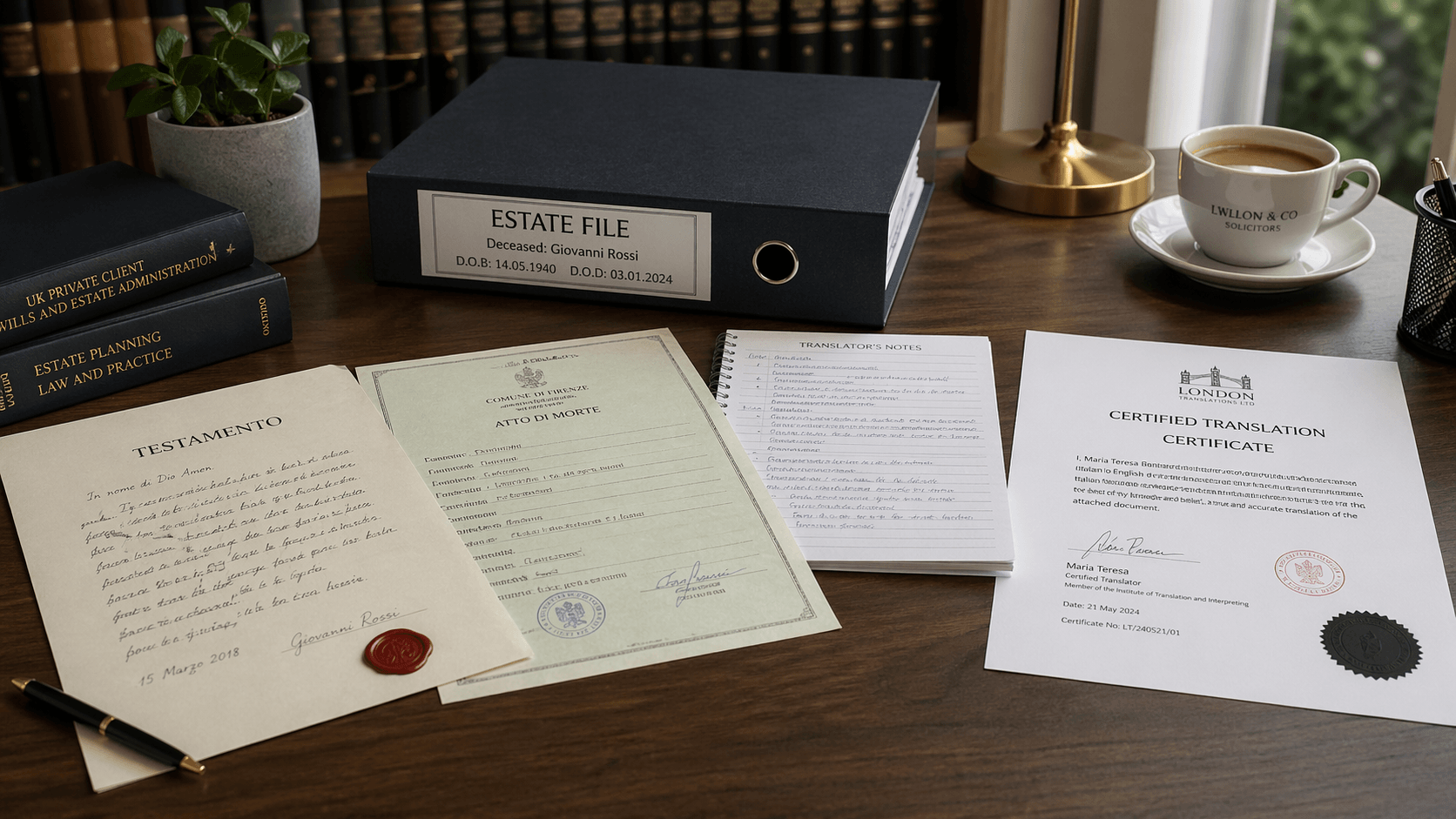
When families, executors, probate practitioners, and overseas beneficiaries need probate document translation UK support, the biggest problem is rarely the translation alone. It is getting every foreign-language document into the right format, with the right certification, at the right stage of the estate process, so nothing stalls when the papers reach the Probate Registry, a solicitor, a bank, or an overseas authority. For probate in England and Wales, HMCTS paperwork explicitly calls for an English translation of foreign wills where required, and a foreign death certificate must be translated if it is not already in English or bilingual. (GOV.UK)
Probate translation is also more sensitive than general legal translation. A single estate file can contain a foreign death certificate, multiple wills or codicils, inheritance tax papers, bank correspondence, asset evidence, marriage records, affidavits, and cross-border inheritance documents. Each one carries names, dates, asset references, signatures, stamps, and handwritten notes that may matter later. That is why the safest approach is not “translate the main text quickly,” but “prepare a complete, traceable, submission-ready bundle.” Competitor pages touch pieces of this problem, but they often stop at wills and death certificates; the real need is a coordinated estate-document workflow.
If you are handling an estate now, the simplest next step is to upload your file for a fast quote and say where the documents will be submitted. That one detail usually decides whether you need a standard certified translation, a sworn translation, or a notarised translation.
Where can I get professional probate document translation services in the UK?
If you are asking, “Where can I get professional probate document translation services in the UK?”, the safest route is a specialist legal translation provider that already handles wills, foreign death certificates, inheritance certificates, grants, and supporting estate papers for UK probate use. The provider should be able to tell you, before work starts, whether your documents need certified translation only, or whether sworn translation, notarisation, or apostille may also be required.
UK Certified Translation provides probate document translation UK support for foreign wills, foreign death certificates, codicils, succession papers, inheritance documents, bank letters, property documents, and other estate records. This is especially useful when the documents need to be prepared for submission to a solicitor, Probate Registry, bank, HMRC, or an overseas authority.
If you want an independent way to compare providers, you can also check public professional directories such as CIOL’s Find a Linguist and the ITI professional directory. For most families and executors, the fastest safe route is to send the full estate pack in one upload and state where each document will be used.
What probate document translation means in practice
Probate document translation is the translation of foreign-language estate papers so they can be relied on in a UK probate application, estate administration, inheritance claim, court matter, or related overseas filing.
In practical terms, that usually means one or more of the following:
- wills and codicils
- foreign death certificates
- succession certificates and inheritance certificates
- grants of representation from another jurisdiction
- grant of probate support docs
- marriage and birth certificates needed to prove family links
- powers of attorney
- bank and investment letters
- property deeds and asset schedules
- tax papers and declarations
- affidavits, witness statements, and other legal evidence translation materials
This matters because HMCTS probate application guidance for a will-based application requires a copy of any foreign wills, or any wills dealing with assets outside England and Wales, and says they need an English translation if not already in English. HMCTS also provides PA19 for personal applicants using a foreign death certificate that has been translated into English without a certificate from a licensed company. (GOV.UK)
The documents most likely to delay a probate case

1. Foreign wills and codicils
A foreign will often looks straightforward until the details are examined closely. Executors commonly run into trouble with:
- handwritten amendments
- annexes or schedules
- multiple versions of the will
- stamps or registry markings
- local legal terms with no exact English equivalent
- references to property or accounts held outside the UK
If the foreign will relates to assets outside England and Wales, it still needs to be disclosed in the probate pack, and if it is not in English, it needs an English translation. That is not a cosmetic extra. It is core evidence in the application. (GOV.UK)
2. Foreign death certificates
This is one of the most urgent estate documents because it is often needed early by probate registries, solicitors, banks, insurers, and pension providers. The official PA19 form states that if the foreign death certificate is not already in English, or does not include an English translation as part of the original, it must be translated. It also states that if a licensed translator’s company provides a certificate of translation, PA19 is not required. (GOV.UK)
That single point saves people time. If you choose a provider that issues a proper company certificate from the start, you may avoid an extra support form.
3. Overseas inheritance and succession papers
Many estates involve documents that do not look like “probate” papers to a UK family member, but are crucial in cross-border administration:
- certificates of succession
- declarations of heirs
- notarial inheritance deeds
- foreign court grants
- tax clearances
- registry extracts
- property transfer authorisations
HMCTS probate guidance also notes that if an inheritance certificate, succession certificate, or equivalent is issued by a court or notary in the country of domicile, and it is not in English, an official translation should also be provided with the application. (GOV.UK)
Certified, sworn, or notarised: what do you actually need?

This is where many estate files go wrong. People either order too little and face questions later, or overpay for legalisation they did not need.
Certified translation
For many probate-related uses in the UK, a certified translation is the right starting point. UK Certified Translation describes this as an exact translation with a signed statement confirming accuracy and completeness, and its own guidance explains that UK authorities typically expect a full translation, a signed certification statement, the date, and translator or company contact details. (UK Certified Translations)
Use this route when you need the translation for:
- probate applications in the UK
- solicitors’ estate files
- banks and financial institutions
- HMRC support papers
- general inheritance documents translation into English
Sworn translation
Use sworn translation when the receiving authority specifically requires a sworn format, or when the document is going into court-led or foreign legal proceedings that demand that extra formal step. UK Certified Translation presents sworn translation as a route for documents submitted to UK or international courts, tribunals, immigration appeals, and legal proceedings. (UK Certified Translations)
Notarised translation
Use notarised translation when an overseas authority, embassy, land registry, notary, or foreign court asks for notarisation or later apostille/legalisation. The site states that its notarised service is authenticated by a UK Notary Public and can be apostilled for global use. GOV.UK explains that apostille legalisation is used when another country asks for a UK document to be legalised. (UK Certified Translations)
The practical rule
Start with the destination, not the document.
- UK probate only: usually certified
- UK probate plus foreign court or specific legal instruction: possibly sworn
- Overseas filing requiring a notary or apostille: notarised, often followed by legalisation
That is the easiest way to avoid unnecessary cost and prevent late-stage document rejection.
The three risks that make probate translation different from ordinary document translation
Most pages ranking in this space talk about accuracy. Accuracy matters, but probate work has three separate risks:
Evidential risk
If the translation misses a stamp, handwritten note, seal, marginal remark, or reference number, the document may still be readable but no longer reliable as evidence.
Identity risk
Cross-border estates often contain multiple spellings of the same person’s name across passports, wills, property records, and civil certificates. A good probate translation workflow flags transliteration issues early instead of quietly reproducing contradictions.
Process risk
The translation may be linguistically excellent and still fail if the wrong route was ordered. A bank, registry, or overseas authority may ask for certification, notarisation, apostille, or a specific document bundle order.
That is why probate translation should be handled as legal evidence translation, not just language conversion. The safest providers work like document-risk managers: they identify what is being translated, where it is going, and what certification trail it needs before work starts.
A better way to organise probate translation: translate the bundle, not just the headline document
One of the most useful ways to reduce delays is to treat the estate papers as a bundle.
A typical cross-border probate pack might include:
- the foreign death certificate
- the will and codicils
- proof of identity or relationship
- foreign bank or asset letters
- overseas inheritance documents
- tax or valuation support papers
- affidavits, declarations, or explanatory letters
When these arrive in fragments over several days, problems multiply:
- inconsistent name spellings
- different formatting between documents
- duplicate charges for urgent partial jobs
- missing back pages or seals
- confusion over which certification applies to which file
A bundle-based approach is stronger. It lets the translator align names, dates, terminology, and document labels across the whole estate. It also makes it much easier for a solicitor, executor, or caseworker to follow the evidence trail.
If you already have the full pack, do not drip-feed pages one by one. Send everything together and ask for a document-by-document review first. Request a free consultation if you are unsure what belongs in the bundle.
Inheritance documents translation: where terminology becomes critical
Inheritance documents translation is often where generic legal translators struggle. Many civil-law jurisdictions use estate concepts that do not map neatly onto English probate language. A literal translation may sound official but still mislead the receiving reader.
Examples include:
- heirship documents that combine status and entitlement
- notarial inheritance acts that function differently from a UK grant
- succession certificates that confirm rights without mirroring English probate terminology
- marital property terms that affect what even counts as part of the estate
The right approach is clarity without distortion. That means:
- translating the document fully
- preserving original legal meaning
- using clean English that a probate practitioner can follow
- avoiding overconfident substitutions when the legal systems do not align perfectly
- adding clear document labels so each translation can be matched to the source
This is also why the provider matters. The Institute of Translation and Interpreting notes that the UK market is unregulated enough that, in theory, anyone can call themselves a translator. Its public directory exists precisely to help users find qualified professionals whose skills and experience have been checked. FCDO Services likewise directs people looking for certified civil-status-document translation to CIOL or ITI resources. (ITI)
How to choose a professional probate translation service in the UK
When comparing probate translation services, ask five practical questions:
Can you translate wills, foreign death certificates, inheritance certificates, and cross-border estate papers?
Will you issue a proper company certification statement accepted for UK use?
Can you review the full estate bundle and flag missing seals, notes, reverse sides, or name mismatches before certification?
Do you offer sworn or notarised routes if an overseas authority asks for them later?
Can you provide both urgent digital delivery and hard copies if needed?
A strong answer to those questions is often more useful than a generic claim that the company does “legal translations.” Probate files are process-sensitive, and the best provider is the one that can match the translation route to the authority receiving the documents.
How to check a probate translation provider before you send sensitive estate papers
Probate files contain some of the most personal paperwork a family will ever share. A strong provider should be able to explain:
- who handles the file
- how files are transferred
- whether the workflow is secure
- what certification statement will be included
- whether hard copies are available
- how urgent work is prioritised
- whether notarisation or apostille can be added if needed
This matters because confidentiality is not a decorative promise in estate work. It is part of the service itself.
Before sending sensitive estate papers, ask how files will be transferred, who will handle them, what certification statement will be issued, and whether any later notarisation or legalisation step changes the required format. If the destination has supplied instructions, send those with the documents before work begins.
For extra due diligence, you can also point families and legal teams to independent directories such as CIOL’s Find a Linguist and the ITI professional directory, both of which provide public routes to verify professionals or membership details. (CIOL)
When apostille and legalisation enter the probate picture
Sometimes the translation is not for the UK probate application itself. It is for the next step after that.
Common examples include:
- sending UK probate papers overseas
- proving authority to deal with foreign property
- dealing with overseas land registries
- closing foreign bank accounts
- using UK-issued estate documents abroad
In those situations, the translation may need notarisation and then apostille/legalisation. GOV.UK states that the Legalisation Office can legalise certain official UK documents by attaching an apostille, but documents issued outside the UK must be legalised in the country where they were issued, not through the UK service. (GOV.UK)
That distinction matters. A family may need:
- a foreign death certificate translated into English for UK probate, and
- a UK grant or related document notarised and apostilled for use abroad
Those are two different tracks. Keeping them separate avoids confusion and rework.
How fast can probate translation be done?
Speed matters in estates because delays affect property sales, bank releases, tax timelines, and distributions to beneficiaries.
Turnaround depends on the language pair, page count, scan quality, legal complexity and any certification or hard-copy requirements. Send the complete estate pack and deadline together so the scope and timing can be confirmed before work begins.
The smarter question, though, is not “How fast can you translate this?” It is:
“How fast can you translate it correctly for the authority receiving it?”
A true urgent workflow should include:
- same-day or priority review of the file pack
- confirmation of the correct service level
- a check for missing pages, seals, and reverse sides
- clarification of names and spellings before certification
- a clear delivery plan for PDF and hard copy if needed
That is why a fast quote is useful only when it is paired with a quick requirement check. If you want the fastest safe route, start your project here with all pages in one upload and include the destination authority in your message.
A probate translation checklist that prevents avoidable delays
Before ordering, make sure you have done these seven things:
- Confirm where each document will be submitted
- Gather all pages, including seals, notes, and reverse sides
- Flag every variation of the deceased’s name and every beneficiary name
- Separate UK-use documents from overseas-use documents
- Check whether any item needs certification, notarisation, or apostille
- Send the whole estate pack together where possible
- Ask for the translation certificate format before work begins
For general submission standards, the site’s own guides on how to get a certified translation, certificate wording and examples, government-facing requirements, and how to find a certified translator are useful companion reads. (UK Certified Translations)
Why families and probate professionals choose UK Certified Translation
For probate work, what people usually want is not marketing language. They want clarity, speed, and acceptance.
When comparing a provider for probate work, check whether the available route matches the destination and the estate documents involved:
- whether certified translation is sufficient for the UK-facing probate use
- whether the receiving authority specifically requires a sworn or notarised route
- how names, dates, seals, annotations and document references will be checked across the bundle
- how urgent files and staged estate documents will be prioritised
- whether overseas-use documents need a separate notarisation or legalisation step
- how sensitive personal and estate paperwork will be transferred and handled
For probate and estates, the useful checks are practical rather than promotional: can the provider explain the certification route, identify gaps in the document bundle, keep names and references consistent, and confirm the required delivery format before work starts?
If you are searching specifically for professional probate document translation services in the UK, the practical advantage is having one provider that can handle the main probate document categories in one workflow: foreign wills, codicils, foreign death certificates, inheritance and succession papers, bank letters, property records, and overseas-use documents that may later need notarisation or apostille. That makes the service relevant not only for translation, but for deciding the correct certification route before submission.
If your estate file includes a foreign will, foreign death certificate, or cross-border inheritance papers, contact UK Certified Translation today and send the full document pack for review. The right translation route is usually obvious once the destination and the complete set of papers are in front of the team.
FAQs
Do I need probate document translation UK services for a foreign death certificate?
Yes, if the death certificate is not already in English, or does not contain an English translation as part of the original document, it must be translated for the relevant probate use. HMCTS PA19 also explains that personal applicants use the form when the certificate was translated into English without a certificate from a licensed company. (GOV.UK)
Which grant of probate support docs usually need translation?
Common grant of probate support docs include foreign wills, codicils, death certificates, succession certificates, inheritance documents, marriage certificates used to prove relationships, and overseas asset papers such as bank or property evidence. HMCTS probate guidance specifically mentions foreign wills and certain overseas succession-related documents where English translations may be needed. (GOV.UK)
Is certified translation enough for inheritance documents translation?
Often, yes, for UK-facing probate work. But if the receiving court, embassy, registry, or overseas authority specifically asks for sworn, notarised, or apostilled paperwork, you should order that level instead. UK Certified Translation offers all three routes, and GOV.UK explains when apostille legalisation becomes relevant for UK-issued documents being used abroad. (UK Certified Translations)
How is confidentiality handled in probate and legal evidence translation?
A professional provider should be able to explain how sensitive files are transferred and handled, who has access to the project, what certification process applies, and what happens to the documents after delivery. Ask for those details before sending a large or particularly sensitive estate bundle.
How fast can I get a fast quote for probate document translation UK work?
The fastest route to an accurate quote is to send all pages in one batch, include the destination authority and state the deadline. Timing can then be confirmed against the language pair, document volume, scan quality and any certification or delivery requirements. Send the full pack for review.
How do I know the translator is qualified?
In the UK, a better test than a vague “certified translator” label is whether the provider is traceable, can issue a proper certification statement, and can be independently checked. Public checks are available through CIOL and ITI, and ITI explains that its qualified members have proven skills and experience. (CIOL)
Where can I get professional probate document translation services in the UK?
You can get probate document translation services in the UK from a specialist legal translation provider that handles wills, foreign death certificates, inheritance certificates, and supporting estate papers, and that can issue the correct certification for the authority receiving the documents. UK Certified Translation provides certified, sworn, and notarised routes for probate-related documents in one place, and independent comparisons can also be made through CIOL and ITI directories.
Can I send my full estate file for one probate translation quote?
Yes. In fact, sending the full estate pack together is often the safest approach because it allows the provider to check for missing pages, reverse sides, seals, name variations, and conflicting dates across the whole file before certification. It also reduces the risk of inconsistent terminology between the will, death certificate, succession documents, bank letters, and property papers.
How do I compare probate translation providers in the UK?
Compare providers by asking whether they handle probate-specific documents, what certification statement they provide, whether they can support sworn or notarised routes if required, how they protect confidential estate papers, and whether they can review the whole probate bundle rather than just individual pages. Public professional directories such as CIOL and ITI can also help with independent checks.