


If you’re wondering how to find a certified translator, the safest approach is not to start with price or speed — it’s to start with acceptance. A translation is only useful if the organisation receiving it accepts it. In the UK, that usually means a complete translation with a certification statement and clear translator or company details that can be checked if needed. This guide shows you exactly how to choose a provider, how to know if a translator is certified, and how to avoid common mistakes that lead to delays.
Where can I find certified translator services in the UK?
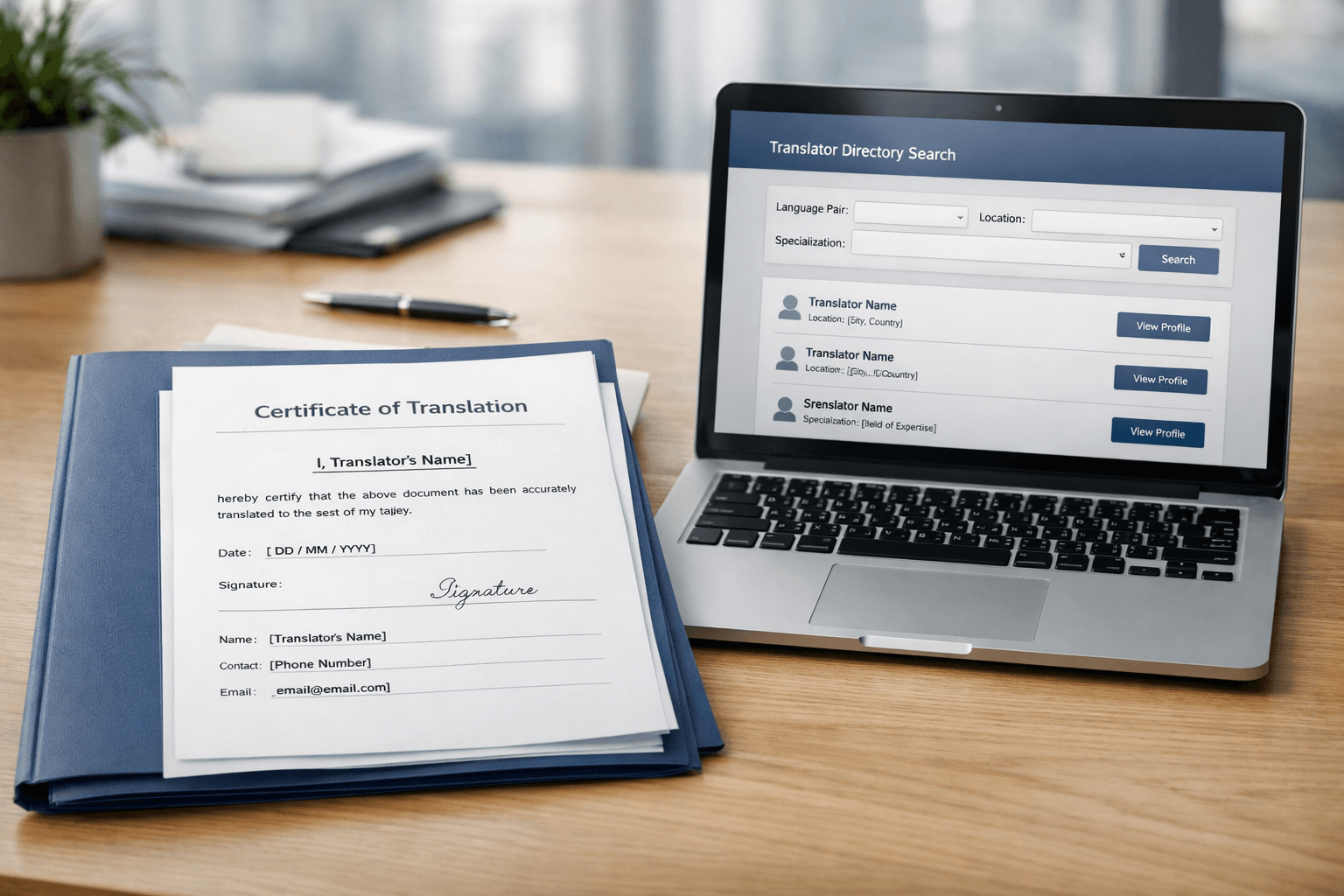
If you are asking where to find certified translator services in the UK, the safest places to start are recognised professional directories, established UK translation companies, and specialist providers that regularly handle official documents. Good starting points include the ITI directory, CIOL’s Find a Translator service, the ATC directory, and specialist providers of certified translation services that explain exactly what is included on the certificate of accuracy.
In many UK cases, you do not need a translator in your exact town or city. A professional UK provider can often work from a clear scan, deliver a signed PDF, and post a hard copy if required. What matters most is that the translation is complete, traceable, and prepared in the format the receiving authority expects.
Useful next steps:
- Check recognised directories such as ITI, CIOL, and ATC
- Compare the route you need: certified translation services in the UK, sworn translation service, and notarised translation service
- If you want a fast decision, contact us with the document type and destination so the correct route can be confirmed before you pay.
Start with the most important question: where are you submitting the translation?
Before you compare translators, identify the destination:
- UK Home Office / visa application
- HM Passport Office
- University or ENIC/ECCTIS-related process
- Employer or regulator
- Solicitor / court
- Overseas embassy or authority
Why this matters: different destinations may ask for different levels of formality.
The practical rule
Use this simple rule before ordering:
- Ask what they require in writing (certified, notarised, sworn, apostilled)
- Match the translator/service to that requirement
- Check credentials and traceability
- Order the correct format (PDF only vs hard copy)
If you already have the destination requirement text, send it with your document when requesting a quote. It prevents overpaying and reduces the risk of rejection.
What “certified translator” usually means in the UK
In the UK, people often search for a “certified translator” when they really need one of these:
- A professional translator or translation company that provides a certified translation
- A translator with recognised credentials or membership
- A provider whose work can be independently verified if an authority asks questions
That’s why the better question is not only “Is the translator certified?” but also:
- Can they provide a proper certification statement?
- Can their identity and contact details be verified?
- Do they have relevant credentials for this type of document?
- Have they handled this submission type before?
The main places people look in the UK
Most people find certified translator services through one of these routes:
- professional directories for translators and interpreters
- specialist translation companies that issue certified translations every day
- document-type specialists for passport, visa, legal, academic, or overseas-use documents
- local searches, followed by a strict check of business identity, certification process, and traceability
If you are comparing providers, do not rely on “best translation agency” wording alone. Check whether the service explains certificate contents, business identity, delivery format, and the exact route for certified, notarised, sworn, or apostilled documents.
How to know if a translator is certified
Use this checklist:
- They can show a sample certificate of translation accuracy
- The certificate includes:
- confirmation of accuracy
- date
- name/signature
- contact details
- They can explain their qualification or professional affiliation
- They can explain who signs the certificate (translator or authorised company representative)
- They can explain how the translation can be verified if the authority asks
If a provider avoids these questions or gives vague answers, move on.
Useful UK checks before you order
When people ask how to verify a certified translator in the UK, the most useful public checks are:
- the provider’s own sample certificate and contact page
- Companies House to confirm the legal business identity
- the ICO register if the company handles personal data in the UK
- relevant professional directories such as ITI, CIOL, or ATC where applicable
These checks do not replace destination acceptance, but they make it much easier to filter out vague, untraceable, or misleading providers.
The 5-part credential check that actually works

Most guides stop at “check reviews.” That’s not enough for official documents. Use this stronger framework:
1) Acceptance check
Ask this first:
“Will this translation be accepted for my destination, and what exactly will be included on the certificate?”
A reliable provider will ask where the documents are going before confirming the service type.
Good signs
- They ask the destination authority or country
- They explain the difference between certified, notarised, sworn, and apostille
- They confirm whether a signed PDF is enough or if a posted hard copy is needed
Red flags
- They promise “accepted everywhere”
- They push notarisation without asking the destination
- They cannot explain the certificate contents
2) Identity check
This is the fastest way to avoid scams or lookalike businesses.
What to verify before you upload documents
- Registered business name
- Registered address
- Website domain
- Email domain (should match the website)
- Contact phone number
- Invoice details (if you’ve already been quoted)
Quick verification steps (60 seconds)
- Search the company on the UK company register
- Confirm the legal name and address match the website/invoice
- Check the email domain matches the business website
- Check the provider publishes a contact page and privacy information
- If they handle personal documents, ask how they manage data securely
This simple check is especially useful when you search generic terms and see many similar-sounding companies.
3) Credential check
This is where many people get stuck. There isn’t one universal badge that applies to every country and every document type.
What to ask for instead of a vague “Are you certified?”
Ask for:
- Professional memberships or affiliations (if applicable)
- Relevant qualification route (translator credentials, assessments, or recognised professional status)
- Experience with your document type (birth certificate, marriage certificate, legal order, academic transcript, etc.)
- A sample certificate page (with personal data removed)
Strong credibility signals
- Clear affiliation to recognised professional bodies or directories
- Document-type experience (immigration, legal, academic, medical)
- Transparent process (translation → review → certification)
- A provider who explains limitations honestly (for example, when notarisation is needed)
Useful question to send by email
“Please confirm what credentials or professional affiliations apply to the translator or translation company, and whether you can provide a certified translation with verifiable contact details for UK submission.”
That wording gets a much clearer answer than “Are you certified?”
4) Process check
A credible translator or agency should be able to explain what happens after you send the file.
Ask these 8 questions before paying
- What exactly is included in the price?
- Will the certification statement be included?
- Who signs the certificate?
- Do you translate all visible text (stamps, notes, seals, reverse sides)?
- What format will I receive (PDF, hard copy, both)?
- What is the turnaround time?
- What is your correction policy if a spelling needs fixing?
- How do you handle sensitive files and retention?
If the answers are clear, you’re probably dealing with a professional provider.
5) Traceability check
Official translations are often accepted quickly when the certificate is easy to verify.
What “traceable” looks like
A good translation pack usually includes:
- Full translation of the document
- Certification statement confirming accuracy
- Date of translation
- Translator or authorised representative name
- Signature
- Contact details
- Optional reference number (helpful for matching invoice/order)
This is where many cheap providers fail: they translate the page, but the certificate is incomplete or generic.
Certified vs notarised vs sworn vs apostille

These terms get mixed up constantly. Ordering the wrong type is one of the most expensive mistakes.
Certified translation
Usually the right starting point for many UK submissions.
Best for:
- Home Office-related submissions
- HM Passport Office supporting documents
- Universities and employers
- Most standard official document uses in the UK
Notarised translation
Adds a notary step (identity/authentication layer).
Best for:
- Some embassies
- Certain overseas legal uses
- Cases where a notary seal is specifically requested
Sworn translation
Used in countries with a sworn/court-authorised translator system.
Best for:
- Specific foreign jurisdictions that explicitly require a sworn translator
Apostille / legalisation
This is not a translation type. It is a legalisation step for international document use.
Best for:
- Countries or authorities that specifically ask for an apostille/legalisation
Simple rule: If the authority did not ask for notarisation or apostille, do not assume you need it.
Can I use an online certified translation service in the UK?
Yes, in many UK cases you can use an online certified translation service, provided the receiving authority accepts the format supplied. Many providers work remotely from clear scans and issue certified PDFs, then arrange hard copies when needed. For most people, the real decision is not “local or online?” but “Will this provider produce a complete, verifiable translation pack for my destination?”
A strong online service should still provide:
- a full translation of all visible text
- a certificate of accuracy
- a name/signature and date
- clear contact details
- a clear explanation of whether PDF only, hard copy, notarisation, or apostille is needed
Real-world examples: how to choose the right provider
Example 1: UK visa or Home Office submission
You need:
- A complete translation
- A proper certification statement
- Clear translator/company contact details
- A provider that can be verified if asked
What to check:
- They understand UK submission wording
- They provide signed certification
- They can deliver a clean PDF quickly
Best next step: Send the document and the destination route (for example, Skilled Worker, spouse visa, sponsor licence file) and ask for a same-day acceptance check before you pay.
Example 2: First passport application (documents not in English or Welsh)
You need:
- Original documents for the application
- Certified translation for non-English/Welsh documents
What to check:
- The provider is experienced with civil documents (birth/marriage certificates)
- They translate all visible content, including stamps and marginal notes
- The certificate page is clear and professional
Best next step: Upload a full scan (all edges visible) and request a certified translation with a certificate page suitable for UK submission.
Example 3: Overseas authority asks for notarised or apostilled documents
You need:
- The exact requirement confirmed first
- The correct sequence (translation, notarisation, apostille if required)
What to check:
- The provider does not guess
- They ask for the country and authority
- They can explain the route in plain English
Best next step: Contact the provider with the destination country and the authority’s wording. That one message can save days of delay.
How to avoid the 7 most common mistakes
1) Choosing on price alone
Cheap translations become expensive when you have to reorder them.
2) Not checking the certificate contents
If the certificate is incomplete, the translation may be questioned.
3) Sending low-quality scans
Blur, glare, cropped edges, or missing reverse sides cause delays and corrections.
4) Ordering notarisation “just in case”
You may pay for a service you do not need.
5) Assuming every “certified” service is the same
Acceptance depends on the destination and how the certificate is prepared.
6) Ignoring company identity details
Always verify the business before sharing passports, IDs, or bank statements.
7) Not asking about data handling
Official documents contain sensitive personal information. Ask how files are handled and stored.
A simple message you can send to any translator today
Use this template when requesting a quote:
Hello, I need a certified translation for [document type] from [language] into English.
It will be submitted to [authority/country].
Please confirm:
- what type of translation I need (certified/notarised/sworn),
- what will be included on the certificate,
- turnaround time,
- delivery format (PDF/hard copy), and
- your credentials or professional affiliations.
Thank you.
This one message helps you compare providers properly.
What a strong provider response should look like
A professional response usually includes:
- Confirmation of the correct service type
- Clear turnaround time
- Price and what it includes
- Delivery format
- Certification statement details
- Contact details and business identity
- Optional note on credentials/affiliations
- A quick question if anything is unclear in the scan
That’s the standard you should expect for official documents.
Why clients choose UK Certified Translation for this
When documents are for official use, people usually want three things: acceptance, speed, and clarity.
UK Certified Translation is built around that workflow:
- Clear guidance on the correct route (certified, notarised, or sworn)
- Certified translation packs prepared for official submission
- Fast digital delivery, with hard-copy support when needed
- Responsive support if an authority requests clarification
Clients often mention the same strengths in feedback: clear communication, fast turnaround, and translations accepted without problems.
If you already have your document ready, the fastest way forward is to upload your file and tell us where it’s being submitted. You’ll get a clear quote and the right route from the start.
Final checklist before you place your order
- I know where I’m submitting the translation
- I’ve confirmed the required type (certified/notarised/sworn/apostille)
- I’ve checked the provider’s business identity
- I’ve asked what will be included on the certificate
- I’ve sent clear scans (all pages, all edges, no glare)
- I’ve confirmed delivery format and turnaround
- I’ve asked how sensitive files are handled
If all seven are ticked, you’re in a strong position to order with confidence.
Related guidance before you order
If you are still comparing providers or requirements, these related guides may help:
- certificate of translation accuracy examples
- how much a certified translation costs
- passport certified translation guidance
- NAATI certified translation UK alternatives
- how to verify a translation company in the UK
- about UK Certified Translation
These pages help answer the follow-up questions people often ask after searching for a certified translator in the UK.
FAQ Section
Where can I find certified translator services in the UK?
You can find them through recognised professional directories such as ITI, CIOL, and ATC, or by using established UK translation companies that provide certified translations for official documents. The safest option is a provider that can show a clear certificate of accuracy, explain whether you need certified, notarised, or sworn translation, and provide traceable company or translator details.
Can I use an online certified translation service instead of finding a local translator?
Yes, in many UK cases an online UK provider is enough, as long as the receiving authority accepts the format supplied. What matters most is the quality and traceability of the translation, the completeness of the certificate, and whether the provider can deliver the correct format for your submission.
Which directories or registers should I check before ordering a certified translation?
Useful places to check include the ITI directory, CIOL’s Find a Translator, the ATC directory, Companies House, and the ICO register. These checks help confirm that the provider is real, traceable, and suitable for handling official documents.
How to find a certified translator in the UK?
Start by checking where the translation will be submitted, then choose a provider that can produce a certified translation with a clear certificate of accuracy, signature, date, and contact details. Verify the provider’s identity, ask about credentials or professional affiliations, and confirm the exact delivery format required.
How to know if a translator is certified?
The most practical way is to ask what credentials or affiliations apply, request a sample certificate page, and confirm the certificate includes the required details (accuracy statement, date, signature, contact details). A trustworthy provider will explain this clearly.
Do I need a certified translator or a certified translation?
In most UK cases, what matters is the certified translation itself and whether it meets the receiving authority’s requirements. The provider should be professional, traceable, and able to provide a properly signed certification statement.
Can I use any translator for official UK documents?
Not safely. Even if the translation is linguistically good, it may be rejected if the certificate is incomplete or the provider cannot be verified. For official documents, choose a provider with a clear certification process and verifiable contact details.
When do I need notarised or sworn translation instead of certified translation?
Only when the receiving authority specifically asks for it. Many UK submissions only require a certified translation, but some overseas authorities or legal processes may require notarisation, sworn translation, or apostille/legalisation.
What should I check before sending passport or birth certificate scans?
Check the provider’s business identity, privacy handling, and certificate process first. Then send full-page scans with all edges visible, no glare, and all pages included (including reverse sides if they contain stamps or notes).