


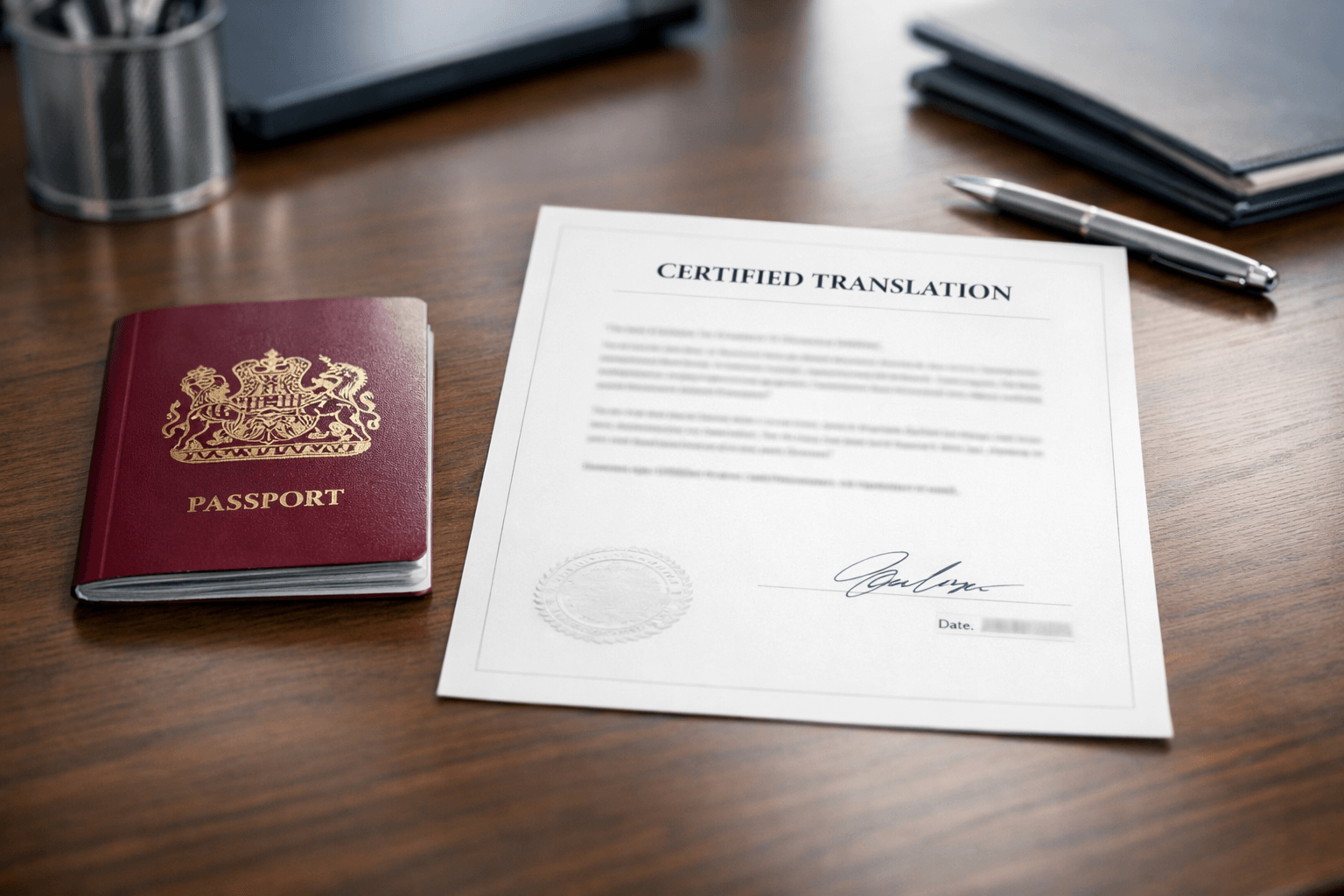
If you’ve been told you need a passport certified translation, you’re usually trying to avoid one thing: delays. Whether you’re applying for a British passport with documents in another language, submitting a translated passport for a visa or residency application, or dealing with a bank, employer, or authority abroad, the rules are simple in principle—yet easy to get wrong in practice.
This guide explains when you actually need a passport certified translation, what an authority typically expects to see on the translation, and how to make sure yours is accepted first time.
If you want it handled end-to-end, you can start with our certified translation service or send your file for a quote.
What “passport certified translation” actually means
People use the phrase passport certified translation in two different ways. Knowing which one applies to you saves time.
1) Certified translation for a passport application
This is the most common UK scenario. You’re applying for a British passport (often a first adult passport), and some of your supporting documents—like a birth certificate, marriage certificate, or naturalisation evidence—are not in English or Welsh. Those documents must be translated and the translation must be “certified” (i.e., accompanied by a signed translator confirmation).
2) Certified translation of a passport
This is common for international use. Some countries and institutions ask for a translated passport (or translated identity details) for:
- visas and residency permits
- work permits, study admissions, professional registration
- banking and compliance checks
- marriage registration abroad
- driving licence conversion
- property transactions, notarisation, or legal filings
In this case, you’re translating the passport itself (usually the identity page, sometimes additional pages depending on the request).
When you need a passport certified translation

You need it when the receiving organisation can’t process your document in its current language
That’s the core rule. The “receiving organisation” could be HM Passport Office, a visa office, a university, an overseas authority, or a bank.
Below are the most common real-world triggers.
1) Applying for a British passport with documents not in English or Welsh
If any supporting document you submit is not in English or Welsh, you should expect to provide a certified translation.
This typically applies to:
- foreign birth certificates and registration extracts
- marriage or civil partnership certificates (especially for name change evidence)
- divorce or annulment documents
- adoption papers
- naturalisation / registration evidence, where additional supporting documents are in another language
- name change documents issued outside the UK
If you’re applying from overseas, requirements can be stricter—some routes expect an “official translation” that is signed and stamped, sometimes linked to recognised professional membership. If you’re unsure, we’ll sanity-check your exact requirement before we translate—start here: contact UK Certified Translation.
2) Visa, residency, and immigration applications that include passport evidence
Many immigration and visa systems rely on passport details to confirm identity, nationality, and travel history. Even if the passport itself is in a common language, some applicants are asked to provide a translated version of:
- identity details (name, date/place of birth)
- parental details where shown
- endorsements, amendments, observations
- old passports showing travel stamps (sometimes selective pages)
If you’re compiling a bundle, it’s often more efficient to translate the passport identity page alongside any supporting documents in one project.
3) Banking, employment screening, and compliance checks
Banks and regulated organisations may request a certified translation because they need:
- a translation that can be verified (translator name, signature, contact details)
- a clear statement taking responsibility for accuracy
- consistent formatting and unambiguous identity fields
These checks are often time-sensitive. If you’re facing a deadline, ask for an accelerated turnaround when you upload your file.
4) Marriage, civil registration, and legal processes abroad
Some jurisdictions require a certified (and sometimes notarised/apostilled) translation of passports for:
- marriage registration
- civil status updates
- court submissions
- notarial acts
- property purchase or inheritance matters
If the requirement mentions notarisation or apostille/legalisation, you likely need a different format than a standard certified translation. See the section “Certified vs notarised vs sworn” below—or go straight to notarised translation.
The 30-second decision rule
Use this quick test:
You probably need a passport certified translation if:
- the organisation is keeping the document on file, and
- the passport (or supporting document) is not in the language they process, or
- they specifically say “certified translation,” “official translation,” “signed translation,” or “translator declaration.”
You probably don’t need it if:
- the passport is already in the language they accept, and they only need to see it (not file it), or
- they want a certified copy (a certified photocopy) rather than a translation.
If the instruction says “certified copy,” that’s a different service (copy certification), not translation.
What a certified passport translation must include
A passport translation fails when it’s missing the “certification” elements, not because the language is wrong.
A robust passport certified translation should include:
The non-negotiables (what authorities usually look for)
- A statement confirming it is a true and accurate translation of the original document
- The date of the translation
- The translator’s full name (and typically a signature)
- The translator’s contact details (so it can be verified)
What improves acceptance (highly recommended)
- Source and target languages clearly stated (e.g., Arabic → English)
- Document description (e.g., “Passport identity page,” “Birth certificate,” “Marriage certificate”)
- Consistent formatting that mirrors the original layout
- Translation of stamps/notes where present (or a clear note when a field is not applicable)
- A reference number (useful for audits and re-issue requests)
- Professional stamp/seal (where the receiving body expects it)
For passports specifically: what should be translated?
Usually:
- identity page fields (name, nationality, date of birth, place of birth, passport number, issue/expiry, authority)
- any observations/amendments on the same page
- additional relevant pages if requested (e.g., endorsements)
Machine-readable zones (MRZ) are typically reproduced as shown, and the key identity fields are translated in a clear table format.
A quick “acceptance checklist” before you submit

Before you send your translation, tick these off:
- Every required page/side has been included (no missing back pages if relevant)
- Names match your application spelling (especially transliteration from non-Latin scripts)
- Dates are unambiguous (day/month format made clear)
- All stamps, notes, and marginal text are accounted for
- The translator’s certification statement is present
- The translation is signed (and stamped if required)
- Translator contact details are included
If one item is missing, it’s the kind of thing that triggers a request for resubmission.
Certified vs notarised vs sworn: which one do you need?

This is where many applicants lose time—because the words sound similar.
Certified translation
Best for most administrative and official submissions where the institution needs a reliable translation with a translator declaration.
Start here: certified translation
Notarised translation
Used when a notary must verify the identity of the translator and/or the attached declaration—often for embassies, overseas government bodies, and formal legal processes abroad. Notarisation is also commonly paired with legalisation steps (apostille/embassy legalisation).
Sworn translation
Typically required in legal contexts where a sworn/court-authorised translator is specified, often for court proceedings or jurisdictions that mandate sworn translators.
See: sworn translation
If your instruction email includes phrases like “notary,” “apostille,” “legalisation,” “sworn translator,” or “court-certified,” don’t guess—send it to us and we’ll match the right format before you pay: contact us.
How to get a passport certified translation that’s accepted first time
Here’s the process that prevents back-and-forth.
Step 1: Send a clean scan (or photo) of the exact pages needed
- Capture the whole page edge-to-edge
- Avoid glare, shadows, and blur
- Include any page that contains stamps, notes, or amendments
If the receiving body is picky about scan quality, submitting a clean image can matter as much as the translation itself.
Step 2: Confirm the destination requirement (UK or abroad)
Different institutions care about different details:
- some accept digitally signed PDFs
- some want a wet signature on paper
- some insist on stamp + signature
- some require notarisation or legalisation for overseas use
We’ll confirm this up-front when you upload your file for a quote.
Step 3: Translation + structured layout
For passports, clarity wins:
- a neat table layout for identity fields
- faithful reproduction of spellings, numbers, and dates
- clear notes where a field is not present in the original
Step 4: Certification statement + delivery format
You receive:
- a certified translation with the required declaration elements
- delivery as a signed PDF (and hard copy if required)
Typical turnaround for certified translations is 2–4 business days, with express options available if you’re working to a deadline.
Common reasons passport translations get rejected
Most rejections happen for preventable reasons:
- Missing certification statement (no explicit accuracy confirmation)
- No translator identity (missing full name / signature / contact details)
- Partial translation (only translating the main text while ignoring stamps, notes, endorsements)
- Name inconsistencies (passport spelling differs from translated supporting documents)
- Unclear dates (day/month ambiguity or inconsistent formatting)
- Bad scan quality (blurry fields or cropped document edges)
- Wrong service type (certified provided when notarised/sworn was required)
A simple way to avoid this: send the receiving body’s instruction email or checklist when you request a quote. We’ll format your translation to match what they’re expecting.
Practical tips that save days on passport-related submissions
Keep spellings consistent across the whole bundle
If your passport spells your name one way, your translated birth certificate and marriage certificate should mirror that spelling unless the authority explicitly requires a different format.
Don’t “tidy up” data
Translators should not alter content to make it look nicer. Even small edits (like changing a place name style or reformatting a passport number) can cause a mismatch.
Translate what’s actually on the page
If there’s an observation line, amendment, or stamp—even if it seems irrelevant—include it or note it.
Match the delivery method to the submission method
- online portal: signed PDF is usually ideal
- postal submission: ask if a wet-ink signature is required
- embassy/legal use: check if notarisation/legalisation is needed
Example certification statement (typical wording)

Below is an example of what a certification page can look like for a passport certified translation. The exact wording can vary, but the required elements should be present.
Certificate of Translation Accuracy
I, Alex Morgan, certify that I am competent to translate from Spanish into English and that the attached translation is a true and accurate translation of the original document presented to me, described as:
Document: Passport (Identity Page)
Language: Spanish → English
Date of translation: 19 February 2026
Translator name: Alex Morgan
Signature: ____________________
Contact details: UK Certified Translation, 124 City Road, London EC1V 2NX, United Kingdom
Email: hello@ukcertifiedtranslation.co.uk
If your receiving body has its own preferred wording, send it—we can align the certificate to their format while keeping all required elements intact.
Ready to get your passport certified translation?
If you want a translation that’s formatted for official acceptance (and delivered with the correct declaration, signature, and verification details), start here:
- Get a quote / upload your file
- Or view our certified translation service for turnaround and delivery options.
FAQs
Do I need a passport certified translation for a British passport application?
If any supporting document you submit is not in English or Welsh, you’ll typically need a certified translation for that document. In some cases (especially overseas applications), the translation may need to be signed and stamped as an official translation.
What must be included in a passport certified translation?
It should include a true-and-accurate translation statement, the translation date, the translator’s full name (and usually signature), and the translator’s contact details. Many institutions also expect a stamp and clear language pair (e.g., Arabic → English).
Can I translate my own passport and certify it?
Generally, no. Most authorities want an independent professional translator who can be verified and who takes responsibility for accuracy.
Is a certified passport translation the same as a notarised passport translation?
No. A certified translation includes a translator declaration. A notarised translation adds notary authentication, often required for embassies or overseas legal use. If your instruction mentions notary, apostille, or legalisation, you likely need notarisation.
How long does a passport certified translation take?
It depends on the language and urgency. Standard certified translations are often delivered within a few business days, with express options available for urgent submissions.
Will a digitally signed PDF be accepted?
Many organisations accept signed PDFs for online submissions, but some still require a wet-ink signature or hard copy—especially for certain legal or overseas processes. Always match delivery to the submission method.