


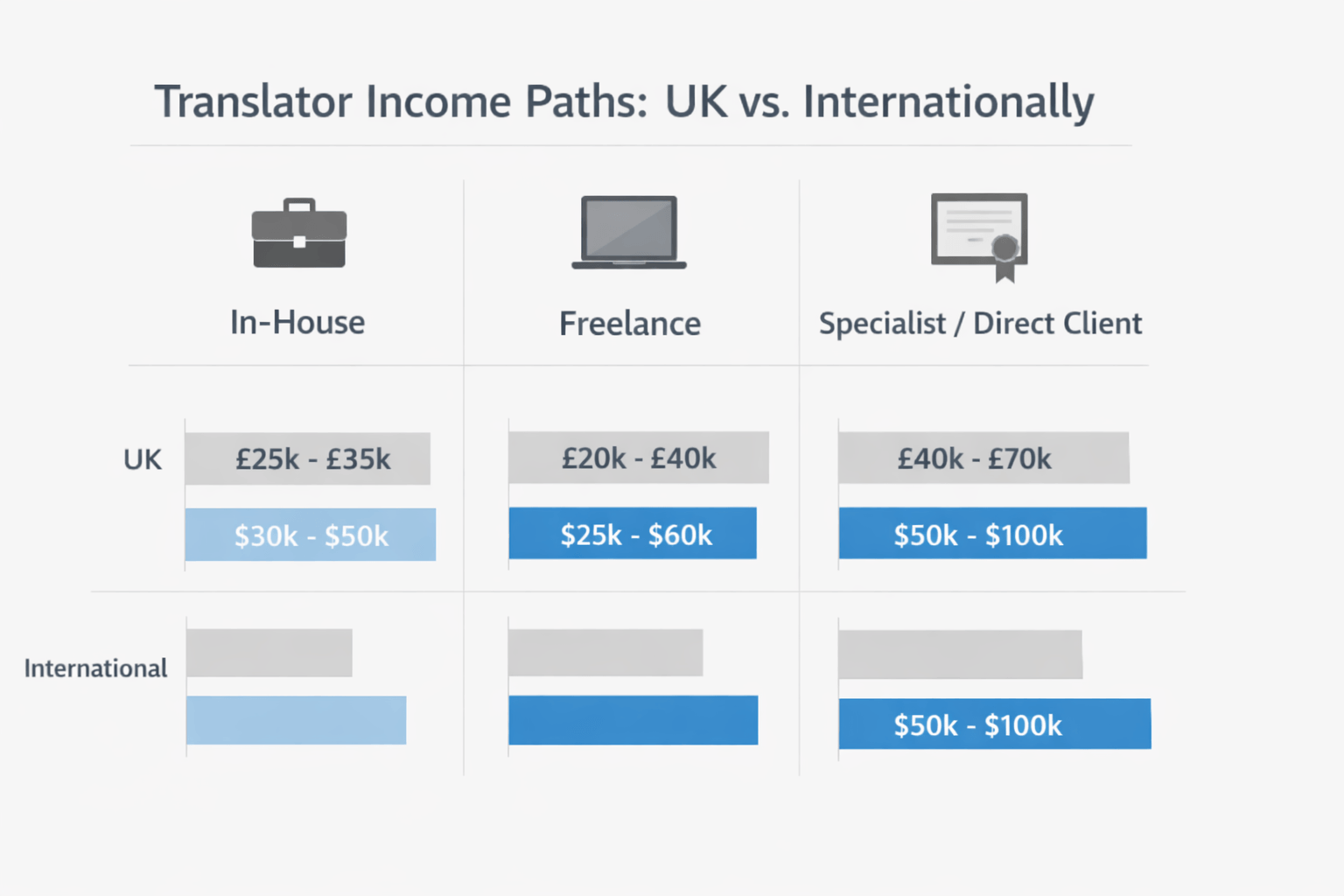
If you’re asking how much do certified translators make, the short answer is: it depends on whether you work in-house, freelance, or specialise in high-value fields like legal, medical, or technical translation.
In the UK, a recent benchmark from Indeed shows an average translator salary of £31,545 per year (based on reported salaries), while U.S. government data (BLS) shows a $59,440 median annual wage for interpreters and translators in 2024. The big difference is that many translators work freelance, and freelance income can swing much higher (or lower) depending on language pair, specialism, client mix, and consistency of work. (Indeed)
If you need certified translations for UK authorities rather than becoming a translator yourself, the faster route is to use a professional provider and submit documents correctly the first time. Upload your file and get a quote from a UK-certified team instead of risking delays with DIY translation.
What most people really mean by “certified translator salary”
People usually search this phrase for one of three reasons:
- They want to know what a career in certified translation pays
- They want to compare freelance vs employed translator earnings
- They want to know how much it costs to become a certified translator
This guide covers all three, with UK-focused advice and international benchmarks so you can make a realistic decision.
Quick salary snapshot
UK benchmark (employed translator roles)
A current UK benchmark lists the average translator salary at £31,545/year. That figure is helpful for orientation, but it is not specific to “certified translators” only, and it doesn’t fully capture freelance income. (Indeed)
U.S. benchmark (interpreters and translators combined)
The U.S. Bureau of Labor Statistics reports a 2024 median pay of $59,440/year for interpreters and translators, with pay varying by language, specialism, experience, and certification. BLS also notes these wage figures exclude self-employed workers, which matters because many translators are freelance. (Bureau of Labor Statistics)
Freelance reality
Freelance translators often earn:
- less than salaried benchmarks while building a client base
- similar to salaried roles once established
- significantly more when they move into specialist, direct-client work
Prospects also notes that most translators work freelance and that rates vary by qualifications, experience, subject matter, and language demand. (Prospects)
What affects how much a certified translator makes?
Income is driven less by the word “certified” and more by your commercial setup.
1) Language pair demand
Common language pairs can be competitive. Rarer or high-demand pairs often command higher rates, especially for urgent or official work.
2) Specialism
Translators in these areas often earn more:
- legal
- medical/pharma
- financial
- technical/engineering
- immigration and compliance documents
Specialist texts generally attract higher rates, which aligns with UK career guidance on translator pay variation. (Prospects)
3) Client type
Your earning ceiling changes depending on who pays you:
- Agency work: easier to start, lower rates, more volume
- Direct clients: higher margins, more business development required
- Corporate/government contracts: steadier but competitive
- Law firms / immigration advisers: repeat certified-document work, often deadline-sensitive
4) Experience and proof of competence
In practice, credentials can help you win better-paid work faster:
- CIOL qualifications (CertTrans / DipTrans)
- ITI membership and assessment routes
- ATA certification (for U.S.-focused markets)
- Portfolio quality and subject-matter expertise
5) Turnaround speed and workflow
Fast translators with strong QA processes earn more because they can:
- handle urgent jobs
- deliver consistent quality
- avoid rework
- retain repeat clients
Salary vs freelance income

This is where many articles fall short: they quote one average salary and stop there.
A better question is:
What can a certified translator actually take home based on business model?
Employed translator (in-house or agency)
Typical outcomes:
- predictable monthly pay
- lower sales/admin burden
- lower upside than top freelancers
- better for early-career stability
A UK salary benchmark around £31.5k is a useful reference point for employed roles. (Indeed)
Freelance translator
Typical outcomes:
- variable monthly income
- higher earning ceiling
- time spent on quoting, invoicing, marketing, admin
- income depends on billable workload, not just skill
Illustrative freelance earnings (gross revenue examples)
These examples are simple planning models (before tax, software, insurance, and downtime):
- Starter freelance setup:
1,500 words/day × £0.10 × 18 billable days/month
= £2,700/month
= £32,400/year - Established specialist freelance setup:
2,200 words/day × £0.14 × 18 billable days/month
= £5,544/month
= £66,528/year - High-value legal/compliance work (direct clients):
1,800 words/day × £0.18 × 18 billable days/month
= £5,832/month
= £69,984/year
The point is not the exact rate. The point is that certification helps credibility, but specialism + direct clients + repeat work is what usually moves earnings into the higher brackets.
How much does a certified translator make in the UK?
In the UK, the phrase “certified translator” is used loosely. For many official submissions, authorities are looking for a properly certified translation (with translator details and declaration), not a government-issued translator licence.
That’s why UK translator earnings are usually influenced by:
- document type (birth/marriage certificates vs legal bundles vs technical files)
- urgency
- language pair
- whether you work via agencies or directly
- your professional credentials and track record
UK official processes often require translations to meet specific formatting/certification expectations for document submissions (for example, visa and passport applications), so translators who consistently produce compliant packs tend to win more repeat work. (GOV.UK)
A practical UK earnings ladder
A common progression looks like this:
- Entry level / junior / agency-heavy: lower and more inconsistent income
- Qualified + experienced (generalist): stable mid-range earnings
- Specialist + direct-client mix: stronger margins and recurring work
- Trusted provider of official/certified documents: high repeat value, especially with immigration, legal, and academic clients
If you’re building a business in this space, consistency and acceptance rates matter as much as raw speed.
How much do certified translators make in the U.S. and internationally?
For international comparison, U.S. BLS data is the strongest public benchmark:
- Median annual pay (2024): $59,440
- Job outlook (2024–2034): 2%
- About 6,900 openings per year on average (mostly replacement demand) (Bureau of Labor Statistics)
BLS also shows pay varies by employer type, with some sectors paying higher median wages than others. It specifically notes pay depends on language, specialty, experience, education, and certification. (Bureau of Labor Statistics)
For UK readers, this is useful as a market signal:
- English + high-demand second language pairs remain commercially viable
- specialist translation is usually better paid than general document work
- certification alone is not the whole income story, but it can improve trust and pricing power
How much does it cost to become a certified translator?

This is the other big question people search for, and it’s where many articles are vague.
The real answer: there isn’t one universal cost, because different countries and markets use different qualification routes.
UK route examples (professional qualification + membership pathway)
CIOL CertTrans (Certificate in Translation)
CIOL describes CertTrans as a Level 6 (working level / degree-equivalent) qualification designed for working translators, and the current full exam fee is listed at £545. (CIOL)
CIOL DipTrans (Diploma in Translation)
CIOL describes DipTrans as a Level 7 (Master’s level) qualification and “the gold standard” for many professional translators. A full exam entry is listed at £895. (CIOL)
ITI membership and assessment costs (UK)
ITI publishes transparent fees, including:
- £60 one-off application fee (for Associate or Qualified/MITI)
- Associate (AITI): £180 annual fee
- Qualified (MITI): £268 annual fee
- MITI Translation Portfolio Assessment: £165 + VAT (ITI)
ITI also notes annual membership subscriptions may be tax-deductible in the UK because ITI is on HMRC’s list of approved bodies. (ITI)
So, what’s a realistic UK starting cost?
A realistic entry budget to become more competitive can range from a few hundred pounds to well over £1,000, depending on your route and whether you add:
- exam fees
- membership fees
- training/prep courses
- CAT tools/software
- CPD
- insurance
- website/portfolio setup
If you’re starting from scratch, the “hidden cost” is often not certification—it’s the time needed to build a client base.
U.S. route example (ATA)
For translators targeting U.S.-based clients or international credibility:
- ATA exam registration is $525
- ATA membership is required to sit the exam
- ATA also offers an optional practice test ($105 members / $155 non-members) (American Translators Association (ATA))
ATA also recommends joining at least four weeks before the exam date to allow time for processing. (American Translators Association (ATA))
The fastest way to increase your translator earnings
If your goal is income growth, focus on these in order:
1) Pick one profitable niche
Do not market yourself as “I translate anything.”
Choose one:
- legal/court
- immigration
- medical
- finance
- technical
2) Build a compliance-ready portfolio
Show examples of:
- certification statement formatting
- document QA process
- terminology consistency
- acceptance-focused delivery
This is especially important in official document work.
3) Move from agency-only to mixed client acquisition
A healthy model is:
- agency work for baseline volume
- direct clients for margin
- repeat institutional clients for stability
4) Package your service, not just your language pair
Higher earners sell:
- fast turnaround
- certified delivery
- revision support
- formatting
- submission-readiness
5) Improve trust signals on every quote page
Add:
- professional memberships/credentials
- turnaround promise
- acceptance-focused wording
- client feedback
- clear pricing logic
That combination usually improves both conversion rate and price tolerance.
If you need certified translations (instead of becoming a translator)
If your real goal is to get documents accepted by a UK authority, employer, university, or legal body, the better move is to use a specialist service.
UK Certified Translation already offers:
- certified, sworn, and notarised translation routes
- UK-focused document compliance support
- a quote-first workflow and fast turnaround messaging
- document-specific service positioning (legal, academic, personal, corporate) (UK Certified Translations)
Ready to get your documents translated and certified?
Upload your file today and get a quote.
If you’re unsure whether you need certified, sworn, or notarised translation, contact the team and they’ll point you to the right route before you pay.
Credibility cues to place near your quote form
Use short proof points beside the CTA:
- “Accepted for official UK submissions”
- “Translator declaration included”
- “Fast turnaround options available”
- “Clear pricing before work starts”
A short client quote also helps. For example, your site already features acceptance-focused feedback for Home Office use, which is exactly the kind of reassurance this audience wants. (UK Certified Translations)
Frequently Asked Questions
How much do certified translators make in the UK?
There is no single fixed salary because many translators work freelance. A recent UK benchmark shows an average translator salary of £31,545/year, but certified-document specialists and freelancers can earn more depending on niche, language pair, and client type. (Indeed)
How much does a certified translator make as a freelancer?
Freelance income varies widely. New freelancers may earn around entry-level salary equivalents, while specialists with direct clients can exceed them. Your rates, billable workload, and repeat business matter more than the title alone.
How much does it cost to become a certified translator?
It depends on the route. UK examples include CIOL CertTrans (£545) and DipTrans (£895), plus optional/ongoing professional costs such as ITI membership and assessments. U.S. ATA certification involves membership plus a $525 exam fee. (CIOL)
Is a certified translator the same as a sworn translator?
Not always. In UK usage, “certified translation” usually means a translation with a signed declaration. “Sworn” or “notarised” is typically a different route and may be required by some overseas authorities or legal processes. (GOV.UK)
Do I need a degree to become a certified translator?
A degree is common and often helpful. BLS lists a bachelor’s degree as typical entry-level education for interpreters/translators, while UK career guidance also points to degrees and other routes such as apprenticeships and work-based progression. (Bureau of Labor Statistics)
Can certification help me earn more?
Certification can improve trust and help you win better clients, but income growth usually comes from combining credentials with specialist expertise, repeat clients, and strong service packaging.