


If you’re searching for how to become a certified legal translator, the first thing to know is this: there is no single worldwide license that makes you “certified” everywhere. The route depends on what you do (translation vs interpreting) and where you want your work accepted (UK, US, UAE, court, hospital, immigration, etc.).
That matters even more if you’re also searching how to become a certified medical translator or how to get certified as a medical translator, because in many countries the formal certifications are for medical interpreters (spoken language), while written medical translators build credibility through qualifications, specialist experience, and quality-assured workflows.
This guide gives you the practical route for both legal and medical specialisation, including the UK path, the US path, and how to build a portfolio clients actually trust.
Start Here: Translator vs Interpreter (This Changes Your Path)
A lot of people use these terms interchangeably, but the qualification routes are often different.
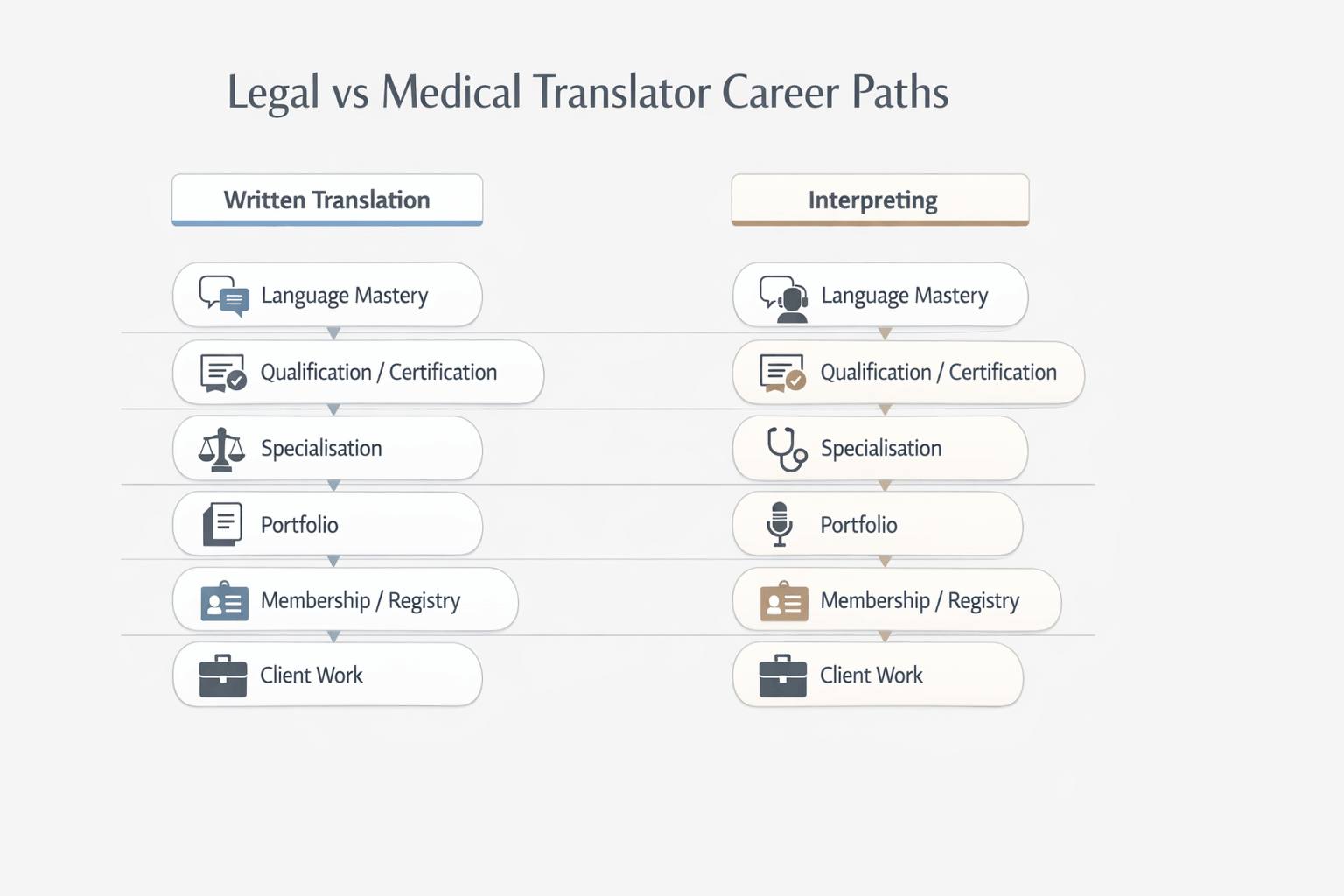
Translator (written work):
- Translates documents (contracts, witness statements, medical reports, discharge summaries, consent forms)
- Usually builds credibility through language qualifications, professional memberships, subject expertise, and a compliant certification statement (for certified translations)
Interpreter (spoken work):
- Interprets live conversations (court hearings, police interviews, GP appointments, hospital consultations)
- Often follows more formal qualification/registry routes (especially public service and healthcare)
If you want to work in courts or hospitals, you may need an interpreting qualification pathway.
If you want to translate legal/medical documents, you need a strong translation qualification + subject-matter specialisation + quality process.
The 3-Layer Credential Stack That Actually Wins Work

Most aspiring linguists focus only on “a certificate.” Clients and agencies usually care about a stack of proof:
1) Language credibility
Show that you genuinely work at a professional level in both languages.
Examples:
- Degree(s) in languages/translation
- Recognised language exams
- Proven professional experience
- National/professional certification exams (where available)
2) Translation credibility
Show that you can produce publishable, accurate written translations.
Examples:
- Translation qualification (e.g., DipTrans, CertTrans)
- ATA certification (where applicable)
- Assessed membership (e.g., ITI qualified routes)
- Portfolio of reviewed work samples
3) Domain credibility (legal or medical)
Show you understand the subject matter, terminology, format, and risk.
Examples:
- Legal translation CPD (contracts, court documents, immigration packs)
- Medical translation CPD (clinical terminology, patient-facing docs, research)
- Subject-specific glossary development
- QA checklists and revision workflows
- Experience in a narrow niche (e.g., family law, oncology, radiology, UKVI documentation)
This is the difference between “bilingual” and “trusted professional.”
The UK Route for Legal Translators
If your goal is to become a legal translator serving UK clients, the strongest path is to combine a recognised translation qualification with professional membership and a legal-specialist portfolio.
Step 1: Build advanced language and writing ability
Legal translation is not just language conversion. It requires:
- Precision
- Register control
- Terminology discipline
- Awareness of legal systems and document conventions
Your output must read like a legal document, not a classroom exercise.
Step 2: Get a recognised translation qualification
For the UK market, strong options include:
- Diploma in Translation (DipTrans) (advanced translation qualification)
- Certificate in Translation (CertTrans) (solid foundation and progression route)
If you want to work with high-risk legal documents, aim for the strongest qualification you can realistically pass and maintain.
Step 3: Join a professional body and become visible
Professional membership helps with:
- Credibility
- Directory visibility
- CPD access
- Peer review and professional standards
A practical progression is:
- Qualification
- Portfolio
- Membership
- Specialist positioning
Step 4: Specialise in legal document types
Don’t market yourself as “legal translator” too early. Start with a narrower niche.
Good starting niches:
- Immigration and visa documents
- Civil status documents (birth, marriage, divorce)
- Police or court correspondence
- Contracts and powers of attorney
- Academic/legal evidence packs
Each niche has its own terminology patterns and formatting expectations.
Step 5: Master certified translation formatting
In the UK, many legal/official submissions require a certified translation with a proper certification statement and translator details.
You should be able to produce a clean translation pack with:
- Accurate translation
- Certification statement
- Translator name/signature/date
- Contact details
- Reference number (optional but useful)
- Clear file naming and version control
This alone can set you apart from newer freelancers.
The UK Route for Legal or Medical Public Service Work (Interpreting)
If your goal is court, police, NHS, or public service work, you’re often looking at an interpreting pathway, not only translation.
Legal/public service interpreting path
A recognised route is public service interpreting qualifications, especially:
- DPSI (Law) for legal settings
- Registration pathways such as professional registers used by public-service buyers
Health/public service interpreting path
For healthcare and public service settings, the relevant route is usually:
- DPSI (Health) or other accepted interpreting qualifications/degree routes
- Registry/membership requirements depending on employer and contract
Why this matters for “medical translator” searches
Many people search for how to become a certified medical translator when they actually want to work in clinics or hospitals.
In practice, that is usually medical interpreting, which follows different qualification and registry expectations.
If your work is spoken, follow interpreting pathways.
If your work is written (reports, discharge instructions, research docs), build a translation-specialist path.
The US Route: Certified Legal Translator and Medical Language Work
The US market has a clearer national path for some certification routes, but it still depends on translation vs interpreting.
If you want to become a certified legal translator (written translation)
A strong US-facing route is:
- Develop professional bilingual ability
- Train in translation technique
- Take a recognised certification exam (where available for your language pair)
- Build legal specialisation through CPD and portfolio work
- Join directories and professional networks
- Use a secure, documented QA workflow
A key point: certification exams may test general translation competence, not just legal content. Your legal specialisation still comes from focused practice and subject knowledge.
If you want to work in legal interpreting (spoken)
That is a separate track and may involve:
- Court interpreter exams
- State/federal court pathways
- Public-sector requirements
How to Become a Certified Medical Translator (What the Term Usually Means)
Here’s the straight answer:
For written medical translation
In many markets, there is no single universal “medical translator certification” for written translators.
Clients usually assess you by:
- Translation qualification/certification
- Medical subject expertise
- Terminology competence
- Revision and QA process
- Experience in specific document types
- Confidentiality and compliance practices
For spoken medical work (medical interpreting)
This is where formal certification is more common.
If you mean hospital/clinic interpreting, you may be looking at:
- National healthcare interpreter certifications (e.g., US pathways)
- Documented training hours
- Language proficiency proof
- Written + oral exams (depending on body/language)
So if you’re searching how to get certified as a medical translator, first decide:
- Written translation career (documents) → translation qualification + medical specialisation
- Interpreting career (appointments/consultations) → healthcare interpreter certification route
That one decision saves months of confusion.
A Practical 12-Month Plan to Become a Legal or Medical Specialist
This is the roadmap I recommend for most new professionals.
Months 1–2: Choose your lane and market
Pick one primary path:
- Legal translation (documents)
- Medical translation (documents)
- Public service interpreting (law/health)
Then choose:
- Your language pair(s)
- Your country focus (UK, US, UAE, EU)
- Your starting niche
Do not start with “I translate everything.”
Months 2–4: Get core training and qualification momentum
Build the foundation:
- Translation techniques
- Terminology research
- Style guides
- Revision methods
- Ethics/confidentiality
- File handling and formatting
If you’re aiming for a formal exam, start exam-focused prep early.
Months 3–6: Build a portfolio that looks professional

Create a portfolio with anonymised sample packs.
Include 4–6 samples:
- 2 legal samples (e.g., contract extract, witness statement, court order style)
- 2 medical samples (e.g., discharge summary, consent form, lab report style)
- 1 certified translation sample pack
- 1 terminology sheet/glossary sample
For each sample, include:
- Document type
- Audience
- Risks handled (terminology, formatting, tone)
- QA steps used
This is far stronger than saying “I’m detail-oriented.”
Months 4–8: Build domain expertise deliberately
Legal focus areas to learn
- Contract clauses
- Identity/civil documents
- Court terminology
- Procedural terms
- Legal abbreviations
- Jurisdiction differences (common law vs civil law concepts)
Medical focus areas to learn
- Anatomy and physiology basics
- Common specialties (cardiology, oncology, obstetrics, orthopaedics)
- Patient-facing vs clinician-facing language
- Medication and dosage conventions
- Lab and diagnostic terminology
Build your own bilingual glossary from real sources and revise it continuously.
Months 6–10: Get assessed, certified, or professionally listed
This is where you formalise your credibility:
- Sit your translation certification/qualification exams
- Apply for professional membership
- Complete assessments required by membership bodies
- Apply to relevant directories/registers
You don’t need every credential at once. You need the right sequence.
Months 9–12: Start winning paid work
Focus on client-ready positioning:
- Clear service pages
- Strong document samples
- Secure intake process
- Fast quote turnaround
- Transparent revision policy
- Professional certification statement format
At this stage, your job is not “be the most qualified.”
Your job is to be the easiest qualified person to trust.
The Skills That Matter Most in Legal and Medical Translation
Many new translators over-focus on grammar and under-focus on risk. In legal and medical work, risk management is the skill.
Legal translation skills that get you repeat work
- Terminology precision (same term, same meaning, every time)
- Formatting fidelity (numbering, clauses, references, seals/annotations)
- Neutral tone (no “improving” the source)
- Jurisdiction awareness (don’t force false equivalence)
- Traceability (version control, naming, revision logs)
Medical translation skills that protect quality
- Terminology accuracy under pressure
- Abbreviation handling (and ambiguity checks)
- Readability for the target audience
- Safety mindset (especially patient-facing text)
- Consistency across repeated forms and reports
Business skills that separate professionals from hobbyists
- Scope confirmation before quoting
- Turnaround planning
- Data security
- Invoice and reference discipline
- Clear communication with clients and agencies
Common Mistakes That Stop People From Getting Certified or Getting Hired
1) Chasing the wrong credential
A common error is preparing for a spoken interpreting route when you want written translation work (or vice versa).
2) Marketing too broadly
“Legal + medical + marketing + websites + subtitles” looks unfocused.
Pick one main niche first.
3) Skipping portfolio quality
A weak sample hurts more than no sample.
Your portfolio should look like client-ready work.
4) Ignoring formatting and certification statements
For official submissions, presentation quality matters. The translation may be accurate, but the pack can still look unprofessional.
5) Treating terminology as a one-time task
Legal and medical translators live in glossaries. Build and maintain yours.
6) Waiting to feel “ready”
You become ready by shipping good work under a strong process.
What Clients and Agencies Look For Before They Trust You
When a client hires a legal or medical translator, they are buying risk reduction.
They want to see:
- Recognised qualifications
- Clear domain focus
- Professional membership or certification
- Consistent formatting
- Confidentiality and secure handling
- Fast, clear communication
- A credible sample of previous work
A better positioning line than “I’m a certified translator”
Use something like this in your profile:
Legal and medical translator for [language pair], specialising in certified document packs, immigration/legal submissions, and patient-facing medical documents. Qualified, quality-checked, and confidentiality-focused.
That’s specific, professional, and client-friendly.
Career Visibility: Where New Specialists Get Found
Once you’re qualified (or qualification-ready), your next goal is discoverability.
High-value visibility channels
- Professional association directories
- Specialist agencies (legal/medical)
- Your own site/landing page
- LinkedIn with niche-specific samples
- Referral relationships with solicitors, clinics, and caseworkers
- Translation agencies that handle certified submissions
What to publish to get inbound leads
- “What a certified translation includes” guide
- “Legal document translation checklist” PDF
- “Medical report translation quality checklist”
- Example certified translation statement (sample)
- Turnaround and confidentiality policy
Educational content builds trust faster than generic advertising.
A Simple Service Stack You Can Offer as a New Specialist
You don’t need 20 services. You need a clean, credible stack.
Core offer
- Certified translation of legal/official documents
- Certified translation of medical documents
- PDF delivery with certification statement
- Optional hard copy and courier (if relevant to your market)
Add-ons that increase conversion
- Urgent turnaround
- Formatting recreation
- Multi-document bundle pricing
- Terminology consistency across cases
- Notarisation / sworn translation guidance (where required)
This is exactly where your website and process can outperform less organised competitors.
Final Word: The Fastest Path to Becoming “Certified” Is Clarity
If you remember one thing, make it this:
There is no one-size-fits-all “certified legal translator” path.
The best route is the one that matches:
- Your work type (translation vs interpreting)
- Your target market (UK, US, UAE, etc.)
- Your specialty (legal or medical)
- The documents and clients you want to serve
Once you choose the right lane, the path becomes much simpler:
- Train
- Qualify
- Specialise
- Build samples
- Join the right bodies
- Deliver work in a professional, verifiable format
If you’re building your career while also handling real client documents, keep your process clean and your standards high. That’s what turns qualifications into long-term work.
Frequently Asked Questions
How to become a certified legal translator in the UK?
Start by building professional-level bilingual and writing skills, then pursue a recognised translation qualification (such as a high-level translation diploma/certificate), build a legal-focused portfolio, and join a respected professional body. If you want court or public-service spoken work, follow an interpreting route instead.
How to become a certified medical translator?
For written medical translation, focus on a strong translation qualification plus medical subject specialisation, terminology mastery, and quality-assured workflows. In many countries, formal national certification is more common for medical interpreters than for written medical translators.
How to get certified as a medical translator if I want hospital work?
If your goal is live hospital communication, you likely need a medical interpreter certification route, not a written translator route. That usually involves training hours, language proficiency proof, and passing certification exams.
Can I be a legal and medical translator at the same time?
Yes, but it is better to build one specialty first, then add the second. Legal and medical work both carry high accuracy risk, so clients trust specialists more than generalists.
Do I need a degree to become a certified legal or medical translator?
Not always. What matters most is proof of language competence, translation competence, and subject expertise. Depending on your market, you may qualify through a mix of exams, professional qualifications, assessed membership, and verified experience.
What is the difference between certified, notarised, and sworn translation?
They are not the same. “Certified” usually refers to a translator’s signed accuracy statement; “notarised” adds a notary step; “sworn” is used in jurisdictions where translators are officially appointed/authorised. The requirement depends on the receiving authority and country.