


If you’re searching how to become a court translator, you’re usually trying to answer one practical question: what’s the fastest credible route into legal and court language work — and does that mean translation, interpreting, or both?
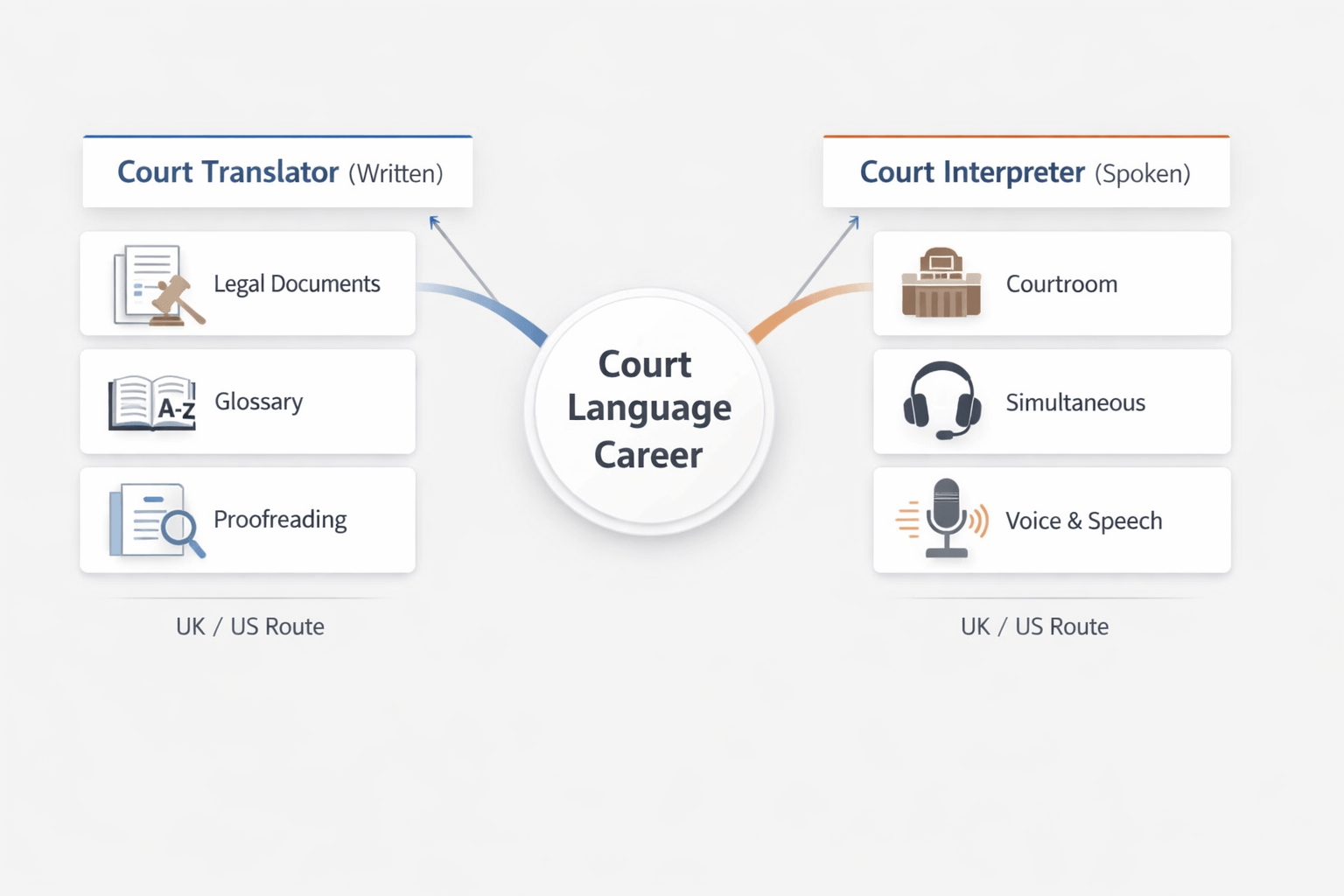
The short answer: court work is usually an interpreting path (spoken language), while document work is a translation path (written language). Many people want to do both, but the training, exams, and day-to-day skills are different. In the UK, public service/court interpreting commonly follows a route built around DPSI Law and NRPSI registration; in the US, the route depends on whether you’re targeting state courts or the federal courts. (American Translators Association (ATA))
If your immediate need is not a career move but a court-ready certified document translation, UK Certified Translation can handle the document side while you focus on hearings, clients, and case preparation.
Court Translator vs Court Interpreter
This is the biggest source of confusion — and the reason many people end up on the wrong qualification path.
What a court translator does
A court translator works with written legal documents, such as:
- witness statements
- contracts
- judgments
- court orders
- police documents
- immigration records
- evidence bundles
This is precision-heavy writing work. You’ll need strong legal terminology, document formatting discipline, and excellent revision habits.
What a court interpreter does
A court interpreter works with spoken language in real time, such as:
- hearings
- interviews
- solicitor-client meetings
- police interviews
- tribunal proceedings
This is performance-heavy language work. You must process meaning fast, stay neutral, and handle pressure.
A simple rule: translators write, interpreters speak. (American Translators Association (ATA))
The Best Route Depends on the Work You Want
Before you start exams or courses, choose your lane.
Route A: UK court/public service interpreter (spoken legal work)
Choose this if you want to interpret in:
- courts and tribunals
- police or criminal justice settings
- legal interviews
- public service appointments
In the UK, this usually means building toward DPSI Law and then working toward NRPSI registration. The UK National Careers Service also lists professional-body routes (including CIOL qualifications) as a standard entry pathway for interpreters. (National Careers Service)
Route B: Legal translator (written court/legal documents)
Choose this if you want to translate:
- court paperwork
- legal correspondence
- evidence and supporting documents
- certified translation packs for official submissions
In the UK, a translation-focused route often includes a degree/postgraduate path or professional-body qualifications such as CertTrans or DipTrans, plus a legal specialism and a strong QA workflow. (National Careers Service)
Route C: Hybrid legal linguist (translation + interpreting)
This is a strong long-term path if you want:
- interpreting assignments
- legal document translation
- certified translations for court-related submissions
- agency and direct-client work
It takes longer to build, but it can stabilize income and make you more useful to solicitors and law firms.
How to Become a Translator in Court Work: The Core Skills You Need
Whether you’re asking how to become a translator in court or how to be a translator for the court, the same fundamentals apply.
1) Professional-level bilingual ability (not just fluency)
Court work requires:
- exact meaning transfer
- register control (formal/informal/legal tone)
- terminology consistency
- strong memory and listening (for interpreters)
- exceptional writing and revision (for translators)
The UK National Careers Service also highlights detail, listening, communication, and accuracy as core interpreter skills. (National Careers Service)
2) Legal language competence
You need to be comfortable with:
- procedural language
- legal roles and titles
- evidence terminology
- dates, names, and document conventions
- regional/legal system differences
3) Neutrality and professional discipline
Court language work is not casual bilingual support. You need to be:
- accurate
- impartial
- consistent
- reliable under pressure
- careful with confidentiality
4) A repeatable workflow
Professionals get trusted because they’re predictable. Build a workflow for:
- terminology prep
- note-taking method (interpreting)
- revision/QA checklist (translation)
- file naming and version control
- delivery standards
UK Path: How to Be a Court Translator or Court Interpreter

For UK readers, this is the clearest starting point.
Start with the right qualification path
The National Careers Service lists several entry routes into interpreting, including university study, college courses, volunteering, and specialist qualifications through professional bodies. It specifically names DPSI and DPSI Law for interpreters working in the justice system. (National Careers Service)
For translation (written work), the National Careers Service points to degree/postgraduate routes and professional-body qualifications such as CertTrans and DipTrans. (National Careers Service)
Why DPSI Law matters for court-focused interpreting
CIOL describes the DPSI as a long-standing benchmark qualification for public service interpreting, and notes it is an Ofqual-regulated Level 6 professional qualification. CIOL also states that DPSI holders may apply for CIOL membership and can apply for NRPSI registration. (CIOL)
If your goal is court and justice-system work, DPSI Law is one of the most practical signals of competence you can build early.
Get onto the NRPSI pathway
NRPSI describes itself as the UK’s independent voluntary regulator for public service interpreters and maintains a public searchable register of qualified, accountable interpreters. (NRPSI)
That matters because clients, agencies, and public bodies often need interpreters who are:
- verifiable
- qualified
- accountable
NRPSI also provides the application/joining pathway, so once you meet the requirements for your language, you should treat registration as a career milestone, not an optional extra. (NRPSI)
Important UK court point
For criminal justice work, UK government guidance for criminal investigations states that interpreters used for evidential interviews and procedures must be on NRPSI. That makes the register especially important if you want serious legal/court-related assignments. (GOV.UK)
Build a legal portfolio even before you get court bookings
If you’re asking how to be a court translator, don’t wait for your first paid court job to look credible.
Create a starter portfolio with:
- a translated witness statement sample
- a court order sample
- a solicitor letter sample
- a glossary (EN ↔ target language)
- a short style guide for names, dates, and legal references
For interpreters, build a practice portfolio:
- consecutive practice recordings
- sight translation drills
- legal terminology sheets
- mock hearing roleplays
US Path: How to Become a Court Certified Translator or Court Interpreter
A lot of searchers use the phrase how to become a court certified translator when they actually mean court-certified interpreter. In the US, certification is usually tied to interpreting exams and court systems.
State court route (most common entry point)
The National Center for State Courts makes this clear: state court interpreter credentialing is handled by each individual state, not by one national credential. It also notes candidates are tested on multiple skills before becoming court interpreters. (National Center for State Courts)
That means your exact route depends on the state where you want to work.
Example: California (clear published pathway)
California’s court language access site is a good example of how structured state pathways work.
For certified spoken languages, candidates must pass:
- the Written Exam
- the Bilingual Interpreting Exam (BIE)
For registered spoken languages, candidates must pass:
- the Written Exam
- English Oral Proficiency Exam
- target-language Oral Proficiency Exam (where available)
California also publishes examples of which languages are in each category. (Language Access Services)
This is a useful model even if you’re not in California, because it shows the pattern: written test + oral performance testing + state-specific rules.
Federal court route (US federal judiciary)
If you want federal court work, the U.S. Courts pages are essential reading.
The Administrative Office of the U.S. Courts classifies interpreters into categories (including certified, professionally qualified, and language skilled/ad hoc), and notes that certified/professionally qualified interpreters are paid at a higher rate than language-skilled/ad hoc interpreters. (United States Courts)
Federal certification exam (FCICE)
The Federal Court Interpreter Certification Examination (FCICE):
- is administered in two phases (written, then oral)
- tests the three core modes of court interpreting:
- sight translation
- simultaneous interpretation
- consecutive interpretation
- is currently offered for Spanish/English in the federal judiciary
The U.S. Courts page explicitly states the oral exam tests these modes and that FCICE is offered only for Spanish/English. (United States Courts)
If your language is not Spanish
The U.S. Courts also explain that other languages may be classified under professionally qualified or language skilled/ad hoc, depending on the court and your credentials. They list routes such as qualifying through certain recognized exams or credentials (including full NCSC oral certification exams in some cases). (United States Courts)
The 5 Skills That Separate Newcomers from Court-Ready Professionals

1) Consecutive interpreting control
You need to:
- listen in full chunks
- retain meaning accurately
- reproduce cleanly without summarising
2) Sight translation speed
This is where many new interpreters struggle. Legal text is dense, and hesitation breaks confidence.
Practice with:
- charge sheets
- warnings/notices
- procedural forms
- witness statements
3) Legal terminology management
Create a living glossary by domain:
- criminal law
- family law
- civil litigation
- immigration
- employment tribunals
4) Accuracy under pressure
Courtrooms are high-stakes. Train for realism:
- timed practice
- background noise
- unfamiliar accents
- interrupted speech
- fast read-alouds
5) Professional presence
Courts and solicitors rebook people who are:
- punctual
- prepared
- calm
- neutral
- easy to work with
How Much Do Court Translators Make?
This is one of the most searched questions — and the answer depends heavily on country, language pair, and whether you’re employed or freelance.
How much does a court translator make in the US?
A useful benchmark is the U.S. Bureau of Labor Statistics category for interpreters and translators (not court-only roles). BLS lists a 2024 median pay of $59,440/year ($28.58/hour). It also notes BLS wage data does not include self-employed workers, which is important because many legal linguists work freelance. (Bureau of Labor Statistics)
So, for court work specifically:
- entry-level/ad hoc work may be lower and inconsistent
- certified/professionally qualified work can pay more
- specialist languages can command higher rates
- freelance earnings vary widely by booking volume and court region
The U.S. Courts also note higher pay tiers for certified/professionally qualified interpreters vs language-skilled/ad hoc interpreters. (United States Courts)
How much do court translators make in the UK?
The UK National Careers Service lists interpreter pay as variable, and also highlights that many interpreters work freelance/self-employed. (National Careers Service)
Prospects also describes interpreter salaries as very varied, with examples such as NHS roles around £34,000 and some BSL roles ranging roughly £26,000 to £60,000, depending on experience and expertise. (These are broader interpreting benchmarks, not court-only fixed rates.) (Prospects)
What actually changes your income most
Whether you’re asking how much do court translators make or how much does a court translator make, your income is usually driven by:
- credential level (e.g., DPSI/NRPSI, state certification, federal status)
- language demand and scarcity
- court vs agency vs direct-solicitor work
- location
- reliability and repeat bookings
- whether you also offer legal document translation
Practical takeaway: the fastest way to improve earnings is usually not “raise rates first.” It’s:
- improve credentials,
- improve availability/reliability,
- specialise in legal work,
- build repeat referrers.
The Most Common Mistakes New Court Linguists Make
1) Choosing the wrong path
They search “court translator,” then spend months on written translation training when they actually want courtroom interpreting.
2) Delaying legal specialisation
General language ability is not enough. Court work needs legal terminology and procedural confidence.
3) Avoiding performance practice
Interpreters improve by doing timed oral practice — not just reading terminology lists.
4) Ignoring verification signals
Court-facing clients want to see proof:
- qualifications
- registration
- exam passes
- references
- professionalism
5) Treating document formatting as an afterthought
Even if your main goal is interpreting, you’ll often be asked about documents. Knowing how certified, notarised, and sworn translations differ makes you more useful to legal clients.
If you need a reliable document partner for court bundles, witness documents, or supporting paperwork, UK Certified Translation can handle the certified translation side and advise when notarisation or sworn formats are needed.
A 90-Day Plan You Can Actually Follow
Days 1–14: Pick your lane and your jurisdiction
- Decide: court interpreter, legal translator, or hybrid
- Decide: UK, US state, US federal (or another jurisdiction)
- Read the official credential pages for your route
- Pick one legal niche to focus on first (criminal, family, immigration, civil)
Days 15–30: Build your foundations
- Start a legal glossary
- Do daily terminology drills
- Practice sight translation (if interpreting)
- Build two portfolio samples (if translating)
Days 31–60: Start formal preparation
- Enrol in a course or exam-prep pathway aligned with your target route
- Start weekly mock practice (record yourself)
- Create a simple professional CV/profile for legal language work
Days 61–90: Build credibility and book first work
- Apply for beginner-friendly legal or public-service assignments
- Track mistakes and terminology gaps after every assignment
- Improve your portfolio and references
- Prepare your registration/credential application path
A smart move while you train
If your clients, law firms, or private customers need certified legal document translations now, send them to a provider that already handles official-ready formatting and certification correctly. That helps you protect your reputation while you focus on interpreting skills and exams.
For fast document support, clients can upload files and request a quote directly with UK Certified Translation.
FAQs
How to become a court translator in the UK?
If you mean written legal document translation, start with a translation pathway (degree/postgraduate study or professional-body translation qualifications), then specialise in legal texts and build a strong QA workflow. If you mean courtroom spoken work, the UK route is usually public service interpreting, often through DPSI Law and then NRPSI registration. (National Careers Service)
How to become a translator in court if I only speak two languages fluently?
Fluency alone is not enough. Court work requires legal terminology, accuracy under pressure, and professional standards. You need formal training, deliberate practice, and a credential path that matches your jurisdiction (UK, state court, or federal court).
How to become a court certified translator in the US?
In the US, most “court-certified” pathways apply to interpreters, not written translators. State court requirements vary by state, and the federal route uses the FCICE for Spanish/English. Start by checking your target state court interpreter program or the U.S. Courts federal interpreter pages. (National Center for State Courts)
How much do court translators make?
There is no single fixed number. In the US, the BLS median for interpreters and translators was $59,440 (2024), but court work varies by credential level, language, and whether you are freelance. In the UK, official career guidance lists pay as variable, and many interpreters work freelance. (Bureau of Labor Statistics)
How much does a court translator make when starting out?
Beginners usually earn less because they have fewer credentials and fewer repeat bookings. Income rises faster when you:
- gain recognized credentials
- specialise in legal work
- improve availability and reliability
- build direct relationships with law firms and agencies
How to be a translator for the court without making mistakes on documents?
Use a strict legal translation workflow:
- glossary + terminology checks
- name/date consistency review
- final QA pass
- correct formatting for stamps/seals/notes
- certified translation packaging when required