


If you’re searching for certified translation services gov uk, you’re usually trying to answer one practical question: what exactly must my translation include to be accepted by the Home Office or another UK authority? The good news is the requirements are clear once you know what “certified” means in the UK—and what it doesn’t.
This guide breaks down what UK authorities typically expect, how to avoid the most common rejection triggers, and how to get a submission-ready certified translation without paying for extras you don’t need.
What “gov uk certified translation” really means
In the UK, “certified translation” usually refers to:
- A complete translation of the document (including stamps, seals, handwritten notes, marginal text, reference numbers)
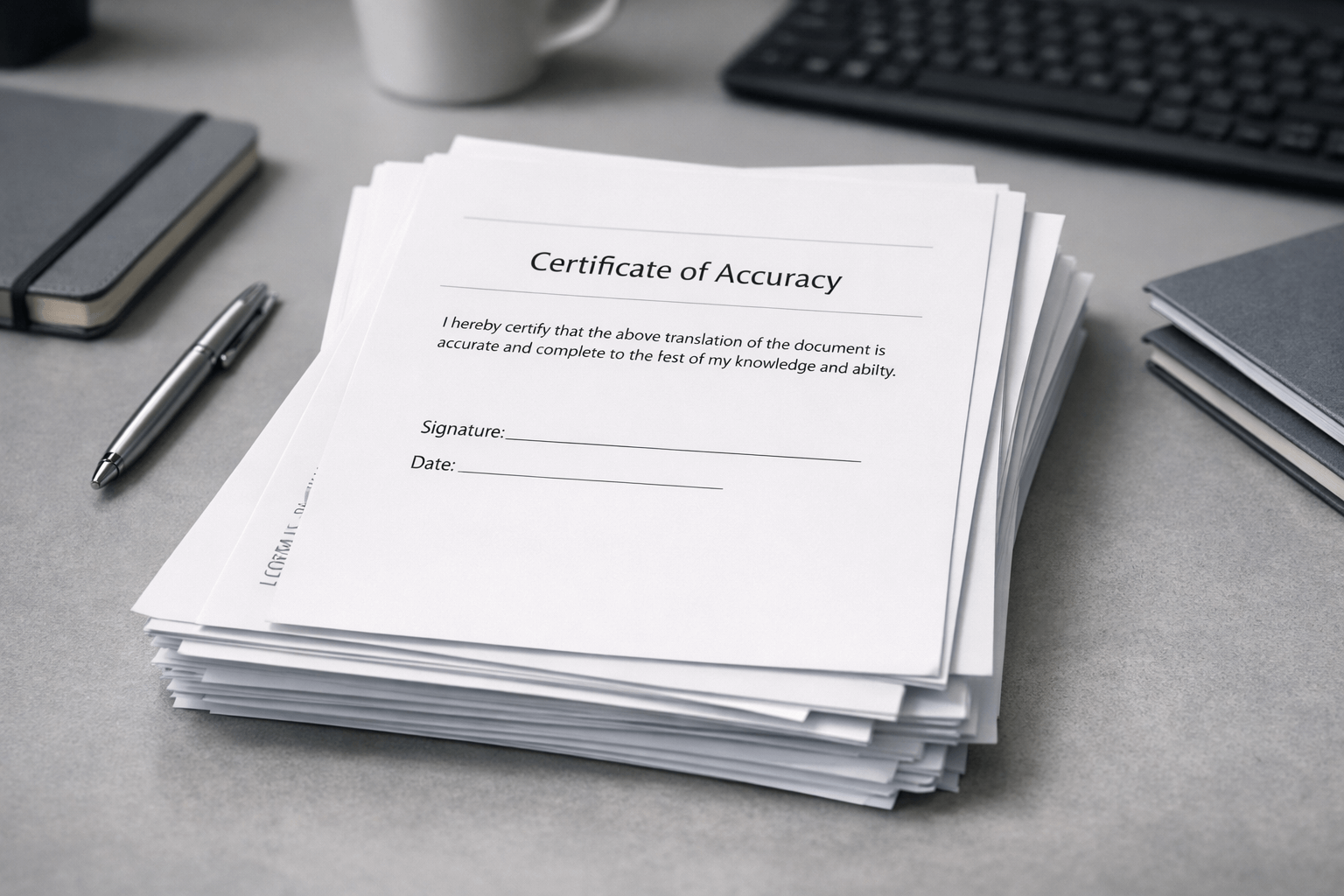
- Accompanied by a signed certification statement (often called a Certificate of Accuracy)
- With enough translator/company details for the translation to be independently checked if needed
It does not usually mean:
- The government has “approved” a specific translation company
- You must notarise every translation
- You need an apostille for UK-only submissions
Most UK authorities care less about branding and more about verifiability, completeness, and a proper certification statement.
The non-negotiables UK authorities look for

For Home Office and many other UK bodies, a certified translation should be submitted with the original document (or a clear scan) and must include:
- Confirmation of accuracy
A clear statement that the translation is a true and accurate translation of the original. - Date of translation
The date the translation (and certification) was completed. - Translator’s full name and signature
Signed by the translator or an authorised representative of the translation company. - Translator/company contact details
Enough details to verify who produced it (email/phone and typically an address or business details).
If any of the above are missing, you’re relying on luck.
A copy-and-paste Certificate of Accuracy (safe template)
Below is a practical certification statement that fits what UK authorities typically want. It’s written to be clear, verifiable, and easy for caseworkers to understand.
Certificate of Accuracy (Template)
I, [Full Name], certify that I am fluent in [Source Language] and English, and that the attached document is a true and accurate translation of the original document in [Source Language].
Translator / Authorised Representative: [Full Name]
Signature: __________________________
Date: [DD Month YYYY]
Contact details: [Email] | [Telephone]
Organisation (if applicable): [Company Name]
Address: [Company Address]
Reference / Order ID: [Optional but recommended]
Best practice add-ons (recommended):
- A short line stating your role (e.g., “Professional translator” / “Project Coordinator on behalf of the translation company”)
- A reference/order ID so your translation can be traced quickly
- A consistent layout (certificate page attached to the translation, not buried in an email thread)
Certified vs notarised vs sworn: which one do you actually need?

People often overpay because they’re told to “make it official” without being told which kind of official.
Certified translation (most UK submissions)
Choose this when you’re submitting to:
- Home Office / UKVI (most visa routes)
- DVLA (common cases)
- Many universities and employers
- Banks and regulated institutions (often)
If you’re not specifically instructed otherwise, certified is usually enough.
Notarised translation (identity/authentication step)
Choose this when the receiving body needs:
- A notary to confirm the identity of the signer / authenticity of the certification
- An extra layer of formal authentication (often for overseas use)
If you’ve been told “notarised” by an embassy, foreign court, or overseas regulator, then it’s relevant. Otherwise, it may be unnecessary.
You can read more about our notarised translation service when notarisation is specifically required.
Sworn translation (jurisdiction-specific)
“Sworn translation” depends on the country you’re submitting to. Some countries require court-appointed or sworn translators for legal filings.
If you’re submitting outside the UK (or to a foreign authority in the UK), sworn may be required. See sworn translation when a receiving authority explicitly requests it.
Apostille/legalisation (for international recognition)
An apostille/legalisation is for documents used abroad. It does not usually add value for UK-only submissions unless the receiving body demands it.
If you’re unsure, it’s better to ask the receiving authority what they require in writing before paying for extra steps.
Common “UK authority” scenarios (what people submit and what usually works)
| Where you’re submitting | What usually works | Watch-outs |
| Home Office / UKVI | Certified translation + certificate | Missing contact details or signature; partial translations |
| HM Passport Office (supporting docs) | Certified translation + certificate | Name spellings must match passport; include stamps/notes |
| DVLA | Certified translation + certificate | Clear scan quality matters; include all pages |
| Universities | Certified translation (sometimes certified copies too) | Some ask for sealed hard copies or official letterhead |
| Professional regulators (e.g., medical/engineering) | Certified translation; sometimes notarised | They may specify format or require stamped/signed pages |
| Overseas embassies / foreign courts | Often notarised / sworn / apostilled | Requirements vary by country—confirm first |
The 60-second acceptance check (use this before you submit)
Before you upload or post your translation, confirm:
- ✅ Every page is translated (front/back if relevant)
- ✅ Stamps, seals, handwritten notes, and reference numbers are included
- ✅ The Certificate of Accuracy is attached
- ✅ The certificate includes: accuracy statement, date, full name, signature, contact details
- ✅ Names, dates, and document numbers match the original exactly (formatting can differ, content cannot)
If you want the safest route, treat the translation like evidence: it should stand up to a quick verification call or email.
Scan quality matters more than people think
Even a perfect translation can be delayed if the original scan is unreadable. Aim for:
- PDF where possible (or high-resolution photos)
- Full edges visible (no cropped stamps)
- No blur or glare
- Correct orientation (no sideways pages)
- All pages included (including blank backs if they contain stamps/marks)
If you’re sending a bundle, keep it organised: one PDF per document type (e.g., birth certificate, marriage certificate, bank statements).
What usually causes rejection or delay

Here are the patterns that repeatedly trigger questions:
- Missing certification details (signature, date, contact details)
- Partial translations (stamps, handwritten notes, or back pages skipped)
- Name mismatches across documents (especially transliterations)
- Unclear scans (stamps not readable, sections cropped)
- Unverifiable provider (no real contact details)
- Mixed bundles with confusing labelling (caseworkers can’t match translation to original)

Getting it done properly (without overcomplicating it)
At UK Certified Translation, we focus on making submissions straightforward: a clean translation, a clear certification statement, and delivery formats that work for official use.
If you already have your document scan, the fastest next step is to get a free quote and tell us:
- Where you’re submitting (Home Office, passport, DVLA, university, embassy)
- The deadline (standard vs urgent)
- Whether you need digital PDF only or hard copy as well
You can also review our certified translation services page for common document types and turnaround options.
“Uploaded my file in minutes and got the signed PDF back the next day. Solid service.” — Client feedback (Notarised translation)
“Their certified translation was accepted immediately. Clear, compliant, and fast.” — Client feedback (Immigration)
Frequently asked questions
Does Gov.uk provide an “approved” list of certified translation services?
Usually, no. Most UK processes focus on whether your translation includes the required certification details and can be independently verified, not whether you used a specific named provider.
What must a certified translation include for the Home Office?
A complete translation plus a certification statement confirming accuracy, the date, the translator’s full name and signature, and the translator/company contact details.
Do I need notarisation for a UK visa or UK authority submission?
Most of the time, no—unless the receiving authority specifically asks for notarisation. If you were instructed to provide a notarised translation, use a service designed for that requirement.
Can I translate my own documents?
Self-translations are risky for official submissions because they are often not considered independently verifiable. A professional certified translation is the safer route.
Do translations need to be in English?
For many UK submissions, English is standard. Some authorities also accept Welsh. Always check the receiving body’s instructions for your specific route.
Will a digital PDF certified translation be accepted?
In many cases, yes. Some organisations may request hard copies, wet-ink signatures, or sealed packs—especially universities or overseas submissions. If you’re unsure, ask what format they require before ordering.