


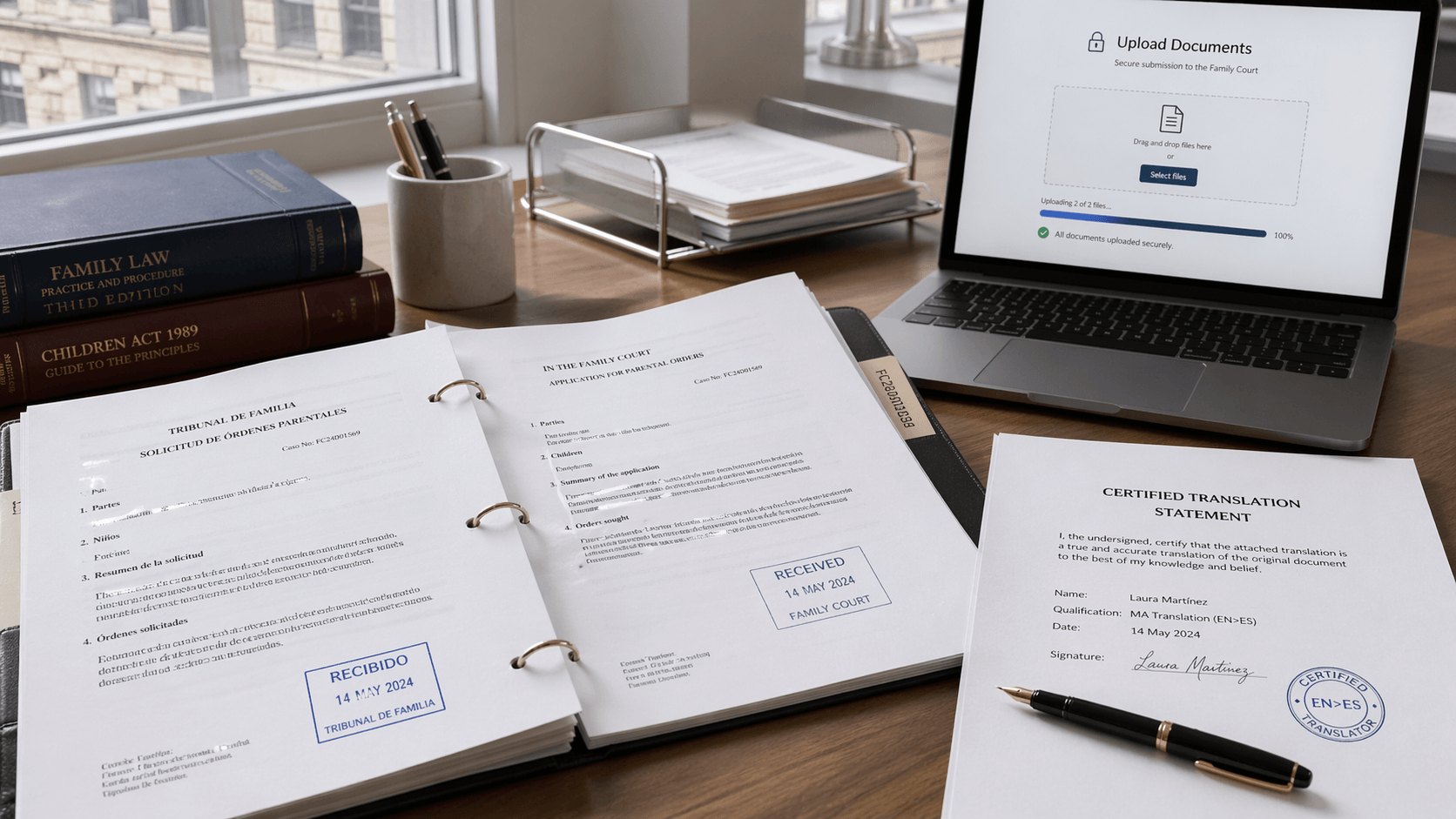
When family proceedings involve documents from another country, translation is not a box-ticking exercise. A missed date, mistranslated relationship term, or incomplete court order can create confusion at exactly the moment you need clarity. Whether you are preparing custody documents translation, court order translation, or supporting evidence for a solicitor or the court, the translation needs to be accurate, complete, and professionally presented.
Family court document translation is the translation of family law records for use in UK proceedings, prepared so names, dates, legal terms, orders, and evidence can be understood clearly and relied on with confidence.
If you are working to a filing deadline or hearing date, the safest approach is to get the right format from the start. For many cases, that means using certified translation services. Where an overseas authority, foreign order, or cross-border legal process requires a higher-formality route, sworn translation services or notarised translation services may be more appropriate.
This guide is for general information and document preparation purposes. It is not legal advice.
Direct answer: how to translate family court papers for UK legal use
If your family court papers are not in English or Welsh, the safest route is to send clear copies of the full documents to a professional legal translator or specialist translation provider and request a certified translation for UK use.
For many UK submissions, the certified translation should include a signed statement confirming that it is a true and accurate translation of the original document, together with the date of translation, the translator’s full name, and contact details.
If a solicitor, court, embassy, or overseas authority has asked for a higher level of formality, sworn translation or notarised translation may also be needed. The safest approach is to match the translation route to the requirement that has actually been given, rather than paying for a higher level of certification that may not be necessary.
In family cases, it is also important to translate the full visible document properly, including stamps, seals, handwritten notes, case numbers, and attachments where relevant, so the translated version can be understood clearly in the context of UK proceedings.
Why family cases need specialist legal translation in the UK
Family proceedings often involve highly sensitive records and legally significant wording. In this area, translation is not only about language. It is about preserving legal meaning.
That matters because family cases can involve:
- child arrangements and custody records
- foreign divorce decrees or dissolution papers
- court orders made overseas
- witness statements
- birth and marriage certificates
- school letters and welfare records
- police, medical, or social services documents
- financial disclosure and supporting correspondence
- text messages, emails, and screenshots used as evidence
A general translation may read fluently and still be unsuitable for proceedings. Family law documents require consistency, neutral wording, and careful handling of legal references, names, stamps, handwritten notes, and case numbers.
If your matter also involves a hearing, conference, or client meeting where spoken language support is needed, it often helps to arrange interpreting services alongside the written translation.
When family court documents usually need translation
Translation is commonly needed when key documents are not in English or Welsh and must be understood in the context of UK proceedings.
Common situations include:
- an overseas custody or guardianship order needs to be reviewed in a UK case
- one parent relies on foreign court papers to explain existing arrangements
- a non-English marriage or divorce document is needed to establish relationship history
- school, medical, or welfare records from abroad are used to support a child-focused application
- foreign-language messages or letters are being relied on as evidence
- a solicitor needs a translated bundle for review, advice, or filing
In practice, the right question is not simply, “Do I need a translation?” It is, “Which documents need translating first, and what level of certification will make them usable without delay?”
A practical way to prioritise a family court bundle
One of the most effective ways to manage cost, urgency, and risk is to split documents into three levels of priority.
1. Decision documents
These are the papers that define rights, obligations, and legal history.
Examples include:
- judgments
- custody orders
- child arrangement orders
- divorce decrees
- protection orders
- maintenance orders
- parental responsibility decisions
If there is a deadline, start here.
2. Core evidence documents
These explain why the court order matters or what the current circumstances are.
Examples include:
- witness statements
- school reports
- medical records
- social services documents
- police reports
- key email or message chains
3. Supporting records
These are often important for context, identity, chronology, or proof.
Examples include:
- birth certificates
- marriage certificates
- passports
- proof of address
- travel records
- supporting letters from institutions or professionals
This triage approach is especially useful when a private client or solicitor is facing a short timetable. It allows the most important documents to be translated first, while lower-priority items follow in a second stage if needed.
Need urgent help with a live matter? Get a Quote and request a priority review of the key documents first.
Certified, sworn, or notarised: which route is right?
This is where many family court submissions go wrong. Clients often order the wrong format because different authorities use different wording.
Certified translation
For many UK submissions, certified translation is the starting point. It is usually the right option when you need a professional translation with a formal certificate of accuracy and clear provider details.
A certified route is often appropriate for:
- family court supporting documents
- civil status records
- evidence in a solicitor’s bundle
- standard official submissions in the UK
If you want a plain-English explanation of what this means, see what certified translation means.
Sworn translation
Sworn translation is usually relevant where a foreign legal system or overseas court specifically requires a translation produced under a sworn or court-authorised framework.
This may apply when:
- the original order comes from a jurisdiction that uses sworn translators
- an overseas court or authority has specified a sworn format
- a foreign legal process will also rely on the translation
For those situations, sworn translation services are the safer route.
Notarised translation
Notarised translation is different again. It is normally used when a notary’s seal or an added level of formal authentication is required.
This may be relevant when:
- the receiving authority specifically asks for notarisation
- the document is being used internationally
- apostille or legalisation may also be needed
In those cases, notarised translation services can prevent avoidable rework.
The simplest rule is this: do not upgrade to sworn or notarised unless the receiving body, solicitor, or overseas authority actually requires it.
What a court-ready translation should include

A family court document translation should do more than convert words. It should make the document usable.
A strong, court-ready translation usually includes:
- a complete translation of all relevant visible text
- accurate treatment of names, dates, addresses, and case references
- clear rendering of stamps, seals, handwritten notes, and annotations
- consistent translation of repeated legal terms across the bundle
- formatting that remains easy to compare with the original
- a professional certification statement where required
- clear identification of the translator or translation provider
This is especially important for court order translation. Orders often contain precise restrictions, directions, and timelines. Even small inconsistencies can create real confusion.
Can you translate family court papers yourself?
In formal family law matters, self-translation is usually a poor-risk option. Even where a document could technically be understood, a translation produced by the person relying on it, a relative, or another interested party may raise questions about independence, completeness, or accuracy.
For documents that may be reviewed by a solicitor, relied on in evidence, or included in a court bundle, the safer route is to use an independent professional translator and make sure the translated version matches the original document closely.
This is particularly important for court orders, witness statements, messages, and records that may be scrutinised line by line.
Document translation and hearing interpreters are not the same thing
A written translation and a court interpreter solve two different problems.
A document translation is used so foreign-language papers can be read, reviewed, and relied on properly in the context of UK proceedings.
An interpreter helps spoken communication during a hearing, appointment, conference, or meeting.
In family court cases involving children, domestic violence, or forced marriage, an interpreter may be provided for the hearing. In other family cases, availability can depend on the circumstances. But even where an interpreter is available for the hearing itself, that does not remove the need for properly translated written documents where the papers must be reviewed or filed in English or Welsh.
Custody documents translation and the records most often needed
In family matters, “custody documents translation” can cover a much wider set of records than clients first expect.
Children and care arrangements
This category may include:
- child arrangement orders
- custody or guardianship decisions
- contact schedules
- parental consent documents
- travel authorisations
- school attendance letters
- welfare assessments
Relationship and status documents
These often establish the legal background to the case:
- birth certificates
- marriage certificates
- civil partnership documents
- divorce decrees
- dissolution orders
- name change records
Evidence and supporting documents
These may be central to the case narrative:
- witness statements
- emails and text messages
- WhatsApp chats and screenshots
- medical letters
- police reports
- social services records
- tenancy or housing documents
Financial and practical records
These can matter in child and family cases too:
- payslips
- bank statements
- maintenance records
- proof of residence
- travel bookings
- childcare invoices
When these records come from different countries, consistency matters. The names, dates, transliterations, and legal references should align across the whole bundle, not page by page in isolation.
Common mistakes that delay family court translation
The fastest way to lose time is to order translation before checking what the receiving party actually needs.
The most common problems are:
- Sending incomplete scans
Missing corners, reverse pages, stamps, or handwritten notes can make a translation unusable. - Translating only part of the document
A summary may be helpful for internal review, but formal submissions often need a full translation. - Using inconsistent spellings of names
This becomes a problem when names appear differently across passports, certificates, and court orders. - Ordering the wrong certification level
Certified, sworn, and notarised are not interchangeable. - Waiting until the deadline week
Urgent work is possible, but avoidable pressure increases risk. - Relying on machine translation for legal evidence
Family law documents often depend on nuance, chronology, and legal context. - Forgetting the end use
A translation for solicitor review, for filing, and for overseas use may not all require the same format.
If you are unsure what is required, a quick route check before work starts can save days of back-and-forth. Contact Us Today for a document review before translation begins.
How to choose a family court translator in the UK
When choosing a provider for family court document translation, it helps to check more than price and turnaround.
A strong provider should be able to explain:
how certification will be handled
whether the translation will be prepared for UK use, overseas use, or both
how names, dates, and legal references will be kept consistent across the bundle
how confidential family documents will be stored and shared
what happens if part of the scan is unclear or incomplete
whether urgent documents can be prioritised first
If you want an extra credential check, you can also review public professional directories such as the Institute of Translation and Interpreting directory or the Chartered Institute of Linguists’ Find a Translator service when assessing language professionals.
Confidentiality matters in family law
Family cases are among the most sensitive documents a translation provider can handle. They often contain children’s details, addresses, medical information, allegations, financial records, and personal communications.
That is why confidentiality should never be treated as a marketing add-on. It should be built into the process.
A professional family court translation workflow should include:
- controlled document access
- secure file handling
- limited circulation
- careful storage practices
- clear project ownership
- privacy-conscious communication
For clients and law firms alike, this matters as much as linguistic accuracy. A provider handling family law material should understand that trust is part of the service.
Fast turnaround without sacrificing accuracy

Fast turnaround is important in family cases, but speed only helps if the translation is still usable.
A better approach is not “rush everything.” It is smart prioritisation.
For urgent matters, ask for:
- an immediate triage of the bundle
- priority translation of orders and key evidence first
- rolling delivery for larger files
- early flagging of unreadable scans or missing pages
- confirmation of the right certification route before work starts
This is often the most efficient way to meet a hearing or filing date without paying for unnecessary extras.
Working to a deadline? Start Your Project now and ask for the key court papers to be translated first.
What to send when requesting a quote
To get an accurate quote and avoid delay, send:
- clear scans or photos of every page
- the language pair required
- the deadline
- where the translation will be used
- whether you need PDF only or hard copy as well
- whether any authority has asked for certified, sworn, or notarised translation
If you want a step-by-step walkthrough, see how to get a certified translation.
A checklist that helps prevent delay
It also helps to say:
whether the translation needs to cover every page or only specific documents first
whether the original includes stamps, handwritten notes, annotations, or reverse-side text
whether screenshots, chat exports, or message threads need to be translated exactly as evidence
whether the court, solicitor, or overseas authority has provided any wording about certification or formatting
The clearer the brief at the start, the less likely it is that the translation will need to be redone or reformatted later.
Why clients choose UK Certified Translation for family law material
Family proceedings need more than literal translation. They need a provider that understands official use, sensitive handling, and the importance of getting the format right the first time.
UK Certified Translation is a practical fit for this work because clients can access:
- certified, sworn, and notarised routes from one provider
- legal-document experience across personal and court-related records
- support for both private clients and legal professionals
- a clear path for urgent and staged delivery
- additional spoken-language support through interpreting when needed
“Sent over a batch of legal documents for sworn translation. The team kept me updated at every step and delivered exactly what I needed. Pricing was given upfront. Excellent service.”
“Uploaded my file in minutes and got the signed PDF back the next day. Solid service.”
If your case involves family proceedings, child-related documents, or a foreign court order, the safest next step is a document review before work begins. Upload Your File or Request a Free Consultation and confirm the right route from the start.
Final word
Family court document translation should reduce risk, not add to it. The right translation helps the court, your solicitor, and the other professionals involved understand the documents clearly and in the right context. The wrong one can create delay, confusion, and unnecessary cost.
If you need custody documents translation, court order translation, or broader legal translation in the UK for family proceedings, start with the documents that matter most, choose the right certification route, and work with a provider that treats accuracy, confidentiality, and timing as equally important.
Ready to move forward? Get a Quote and send your family court documents for review today.
FAQs
Do I need family court document translation for UK proceedings?
If key documents in your case are not in English or Welsh, a professional translation is often needed so the documents can be reviewed properly in the context of UK proceedings. The right format depends on how the documents will be used and whether any specific certification has been requested.
Can you handle custody documents translation and child arrangement orders?
Yes. Custody documents translation can include child arrangement orders, guardianship papers, contact schedules, parental consent documents, school records, and related supporting evidence. The most important point is preserving dates, legal terms, and the relationship between the parties consistently across the file.
Is court order translation different from general legal translation UK work?
Yes. Court order translation requires particular care because orders contain precise directions, restrictions, and timelines. A translation that sounds natural but shifts legal meaning can create serious problems, so court orders should be handled as specialist legal translation UK work.
Are family court translations confidential?
They should be. Family law files often contain highly sensitive personal information, including child-related details, addresses, health information, and private communications. Confidential handling should be part of the workflow from first upload to final delivery.
How quickly can family court document translation be completed?
That depends on the size of the bundle, language pair, scan quality, and whether certified, sworn, or notarised handling is required. For urgent cases, the best approach is usually to translate the decision documents and key evidence first, then complete the rest in priority order.
Do I need certified, sworn, or notarised translation for family documents?
Certified translation is often the starting point for UK use. Sworn or notarised translation is usually only needed when a court, solicitor, embassy, or overseas authority specifically asks for it. If the requirement is unclear, confirm the destination before ordering.
Can I translate family court papers myself for UK use?
For formal family court use, self-translation is usually not the safest option. Where documents may be reviewed by a solicitor, relied on in evidence, or included in a bundle, an independent professional translation is the more reliable route because it reduces arguments about accuracy, completeness, and independence.
What should a certified family court translation include?
A certified family court translation should clearly identify the translator or provider and confirm that the translation is a true and accurate translation of the original document. In practice, it should also include the date of translation, the translator’s full name, contact details, and any provider information needed for formal use.
Will the court provide an interpreter and translate my documents too?
Not necessarily. A court interpreter and a written document translation are different services. In some family court cases, an interpreter may be provided for the hearing, but that does not automatically mean your foreign-language documents will be translated for filing or review. Written documents should still be translated properly where they need to be read and relied on in the proceedings.
How do I know whether I need certified, sworn, or notarised translation?
The safest answer comes from the receiving body. For many UK uses, certified translation is the normal starting point. Sworn or notarised translation is usually only needed when a court, solicitor, embassy, or overseas authority specifically asks for that higher-formality route.
Can WhatsApp messages, screenshots, and handwritten notes be translated for family court?
Yes, where they are relevant to the case. The important point is that the translation should reflect the original material carefully, including dates, names, visible annotations, and the sequence of messages, so the context is not distorted.
How can I check whether a translator is properly qualified?
Ask how the provider handles certification, confidentiality, and legal-document consistency, and whether they have experience with family law material. You can also cross-check public professional listings such as the ITI Directory and CIOL’s Find a Translator service.