


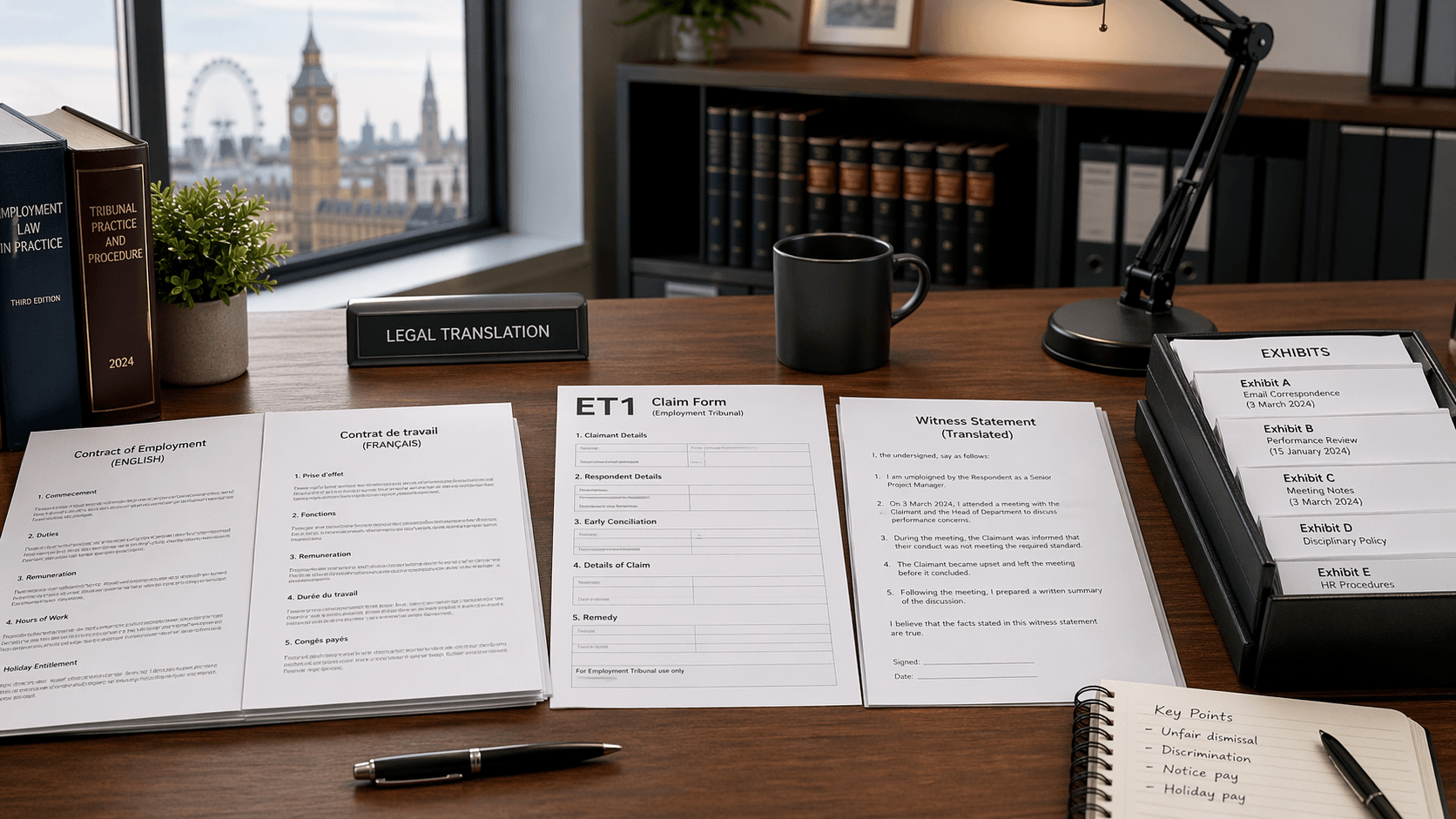
Employment tribunal translation matters when a workplace dispute includes contracts, grievance files, disciplinary records, witness statements, emails, messages, audio or other evidence in a language the tribunal cannot use directly. In practice, that means the translation has to do more than “sound right.” It has to preserve names, dates, allegations, responses, tone, chronology and document structure clearly enough for lawyers, judges and the other side to follow the case without confusion. (GOV.UK)
If you are preparing a claim, defending one, or organising evidence for a hearing, the safest approach is to treat translation as part of case preparation, not as a last-minute admin task. A weak translation can slow down review, create disputes over meaning, and make already sensitive documents harder to rely on. A strong translation pack helps everyone understand the facts faster.
Need documents translated for a live workplace dispute? Send your file, language pair and deadline now for a fast review and a clear quote on the right certification level.
The short answer
Employment tribunal translation usually covers three core stages:
- Claims — ET1 claim forms, schedules of loss, grievance histories, dismissal letters, contracts, handbooks and supporting documents.
- Evidence — witness statements, emails, HR correspondence, meeting notes, performance records, payslips, screenshots, audio transcripts and medical or expert documents.
- Responses — ET3 response material, internal investigation records, disciplinary paperwork, appeal outcomes and exhibit packs.
Where the case is urgent, translation should be triaged by filing date, hearing date, bundle deadline and document importance. Where the case is sensitive, secure handling matters just as much as accuracy.
How to choose the best employment tribunal translation service in the UK
If you are comparing providers, the best employment tribunal translation service in the UK is usually the one that can support the whole tribunal workflow rather than just translate isolated pages. In practice, that means a provider should be able to handle ET1 and ET3 supporting documents, witness statements, exhibits, screenshots, emails, recordings, certification questions, urgent deadlines and secure document handling in one joined-up process.
A strong provider for employment tribunal work should be able to:
translate claims, responses and evidence packs clearly and consistently
handle WhatsApp messages, screenshots, handwritten notes and mixed-format exhibits
offer certified translation where needed, and explain when sworn or notarised routes may be more appropriate
prioritise urgent filing deadlines and staged bundle delivery
support linked services such as transcription for recordings and interpreting for hearings
work securely with sensitive HR, payroll, medical and disciplinary material
For clients comparing providers in the UK, the safest choice is usually a specialist service that understands tribunal terminology, bundle preparation and deadline pressure, not a generic low-context translation route.
UK Certified Translation supports employment tribunal translation across claims, evidence and responses, including certified, sworn and notarised routes, plus interpreting and transcription where the case requires linked language support.
Where translation fits in the tribunal process

A dispute can start long before the hearing. In many cases, the documents that matter most were created months earlier inside the workplace itself: complaints, grievance outcomes, disciplinary invitations, capability letters, WhatsApp messages, team chat records, probation notes or informal warnings.
For claimants, translation may be needed before or around the ET1 stage so the facts are set out clearly and the right supporting documents are ready. For respondents, translation often becomes urgent when the ET3 deadline arrives and internal documents must be reviewed quickly and consistently. Before a claim is filed, parties usually need to notify Acas and go through early conciliation first; official ET1 and ET3 routes are set out by HMCTS, and hearing preparation guidance stresses timely disclosure of documents and witness materials. (GOV.UK)
Before the claim: workplace dispute documents
Translation often begins with documents that are not formal tribunal forms at all, such as:
- grievance letters
- appeal letters
- disciplinary invitations
- investigation notes
- meeting minutes
- employee complaints
- manager responses
- absence or capability records
- equality and discrimination evidence
- internal policies and handbook extracts
These documents shape the story of the dispute. If they are in another language, they should be translated in a way that preserves formatting, chronology and any relevant annotations.
ET1 translation
If the claimant is relying on documents in another language, the ET1 translation workflow should support a simple goal: make the claim easier to understand, not harder. That means consistent terminology, accurate names and dates, and no gaps between the translated narrative and the attached evidence.
A common mistake is translating only the main statement while leaving the supporting records untranslated. That forces advisers and decision-makers to work from fragments. A better approach is to build a translation pack that matches the structure of the claim from the start.
ET3 translation
For employers and respondents, ET3 translation is often time-sensitive. The response has to answer the allegations clearly, and the supporting documents need to align with the defence. That may include translated contracts, policy wording, investigation documents, meeting records, performance notes, grievance responses or internal emails.
Where multiple managers or departments were involved, terminology consistency becomes critical. If the same event is described three different ways across three translated documents, it can create unnecessary argument about what happened.
What documents usually need employment tribunal translation

Not every case needs the same pack, but the most common document types include:
Claim and response documents
- ET1 or ET3 supporting papers
- schedules of loss
- chronology documents
- pleadings and amendments
- case management correspondence
Employment records
- contracts of employment
- offer letters
- job descriptions
- staff handbooks
- policies and procedures
- probation documents
- warning letters
- dismissal letters
- appeal outcomes
Evidence documents
- witness statements
- emails
- text messages
- WhatsApp chats
- screenshots
- handwritten notes
- attendance logs
- payslips
- rotas
- performance reviews
- grievance submissions
- disciplinary bundles
Audio and video evidence
- recorded meetings
- voicemail evidence
- interview recordings
- hearing recordings where permitted
- translated transcripts of relevant clips
Specialist documents
- medical reports
- counselling or occupational health material
- police or regulatory records where relevant
- overseas employment documents
- foreign court or authority papers connected to the dispute
If the evidence exists in audio form, the right order is usually transcription first, translation second. That creates a cleaner audit trail and makes it easier to reference specific passages later. This is especially useful when recordings become part of a bundle.
What makes legal evidence translation reliable
In tribunal work, the translation has to survive scrutiny. That means it should be:
- complete — not just selected extracts unless extracts are specifically requested and clearly labelled
- accurate — especially with names, dates, roles, allegations and outcomes
- consistent — the same term should not change meaning across the pack
- traceable — exhibits, annexes and page references should match the source
- readable — legal teams need to review it quickly under pressure
- secure — the workflow should protect sensitive employment and personal data
A tribunal-ready translation pack should usually preserve:
- stamps and seals
- signatures
- handwritten notes
- tracked dates
- references and exhibit labels
- page order
- attachments
- redactions already present in the source
A practical rule for evidence packs
If a document helps prove what happened, when it happened, who knew, what was said, or how the employer responded, it should be reviewed for translation.
That includes documents parties often overlook, such as:
- Slack or chat exports
- calendar invites
- meeting agendas
- translated screenshots with visible timestamps
- side-by-side exhibits for short messages
- annexed policy pages rather than whole manuals where appropriate
Certified, sworn or notarised: what is usually needed?
This is where many people lose time.
For many UK submissions, a certified translation is the starting point. For some foreign or court-related uses, a sworn translation or notarised translation may be needed instead. UK Certified Translation offers certified, sworn and notarised translation services, as well as interpreting and transcription, which is useful when a case includes both written evidence and spoken language support. Its site also highlights GDPR-compliant handling, legal standards, and support for court-related work. (UK Certified Translations)
A practical way to think about it:
- Certified translation is often the right starting point for official written documents that need a signed statement of accuracy.
- Sworn translation may be needed where a jurisdiction or receiving body expects a court-authorised or formally sworn route.
- Notarised translation may be needed where the signature or certification itself must be authenticated for overseas or formal legal use.
The safest method is destination-first: ask where the document will be used, who must accept it, and whether a simple certified format is enough.
Not sure which level you need? Upload the document and the receiving authority’s wording. You can confirm the right route before paying for extras you may not need.
Do employment tribunals accept translated documents?
Employment tribunals deal with the material parties rely on, so where an important document is in another language, the practical question is whether the tribunal, representatives and the other side can read and test it properly. That is why key foreign-language evidence should usually be translated clearly, completely and in a format that can be matched back to the source. Certified translation is often the sensible starting point for official documents or formal evidence packs, while the exact level of certification should be checked against the receiving body’s requirements.
Machine translation can help with first-pass triage, but it is not a safe substitute for tribunal-ready evidence where wording, tone, chronology or handwritten context may matter. If the document is likely to be quoted, disclosed, challenged or placed in a hearing bundle, human translation is the safer route.
Filing routes and why translated documents should be prepared early
Current Employment Tribunal practice directions in England and Wales set out the permitted methods for presenting claims and responses, with online filing generally being the quickest route and email filing being exceptional where the online service has malfunctioned. That matters for translation because late preparation can create avoidable risk: if the form is ready but the supporting documents are still being translated, the party may end up filing incomplete material or rushing the evidence pack later. (Judiciary)
A practical approach is to separate the filing-critical documents from the wider bundle at the start. That lets the most important translated documents be prepared first while the rest of the evidence is completed in a second phase.
Urgent service for ET1, ET3 and hearing bundles
Urgent employment tribunal translation is not just about speed. It is about deciding what has to be translated first.
A smart urgent workflow usually starts with four questions:
- What is the next hard deadline?
- Which documents are essential for filing or review?
- Does the whole bundle need translation, or only the key evidence now?
- Do you also need transcription, certification, interpreting or hard copies?
What can be prioritised first
For a live filing or imminent hearing, the first-pass priority list is often:
- ET1 or ET3 supporting documents
- witness statements
- core chronology documents
- key emails and messages
- dismissal, grievance or disciplinary outcomes
- the most relied-on exhibits
- any audio transcript excerpts that go to the heart of the case
Once the immediate filing risk is controlled, the rest of the bundle can be completed in a structured second phase.
How to avoid rush mistakes
When time is short, problems usually come from:
- incomplete scans
- mixed-up page order
- missing attachments
- untranslated handwritten notes
- inconsistent name spellings
- unclear exhibit numbers
- sending screenshots without context
A better brief includes:
- case reference
- party names as filed
- source language and target language
- hearing or filing date
- list of urgent documents first
- required format
- whether certification is needed
- whether an interpreter or transcript is also needed
Can only part of the bundle be translated first?
Yes. In urgent tribunal work, it is often sensible to translate the filing-critical or hearing-critical documents first, then complete the rest of the bundle in stages. That is often the safest route where there are large chat exports, long email chains or background records that are useful but not immediately decisive.
A first phase often covers:
the documents needed for ET1 or ET3 review
the core witness statements
the most important exhibits
the documents most likely to be quoted in correspondence or at hearing
A second phase can then cover supporting materials, background attachments and lower-priority documents once the immediate deadline has been protected.
Secure handling of workplace dispute documents
Employment cases can include payroll data, sickness records, disciplinary allegations, protected disclosures, discrimination complaints, settlement discussions and personal messages. That is why secure handling should never be treated as a nice extra.
A strong translation workflow for workplace dispute documents should cover:
- restricted file access
- secure transfer methods
- careful version control
- clear redaction handling
- confidentiality across translators and reviewers
- clean naming of files and exhibits
- deletion or retention policies that suit legal work
For clients, this means fewer loose ends. For advisers, it means a cleaner record of what was translated, when and why.
Interpreting at hearings and evidence from abroad
Some cases involve both written translation and spoken language support. A witness may understand the translated bundle but still need an interpreter at the hearing. GOV.UK states that you might be able to get an interpreter for free in a court or tribunal setting, and tribunal users may need to ask for one when completing their form or by contacting the tribunal before the hearing. GOV.UK and Judiciary guidance also cover evidence by video link from abroad, and whether that is possible depends on the country and the rules that apply. (GOV.UK)
That creates three separate language tasks which should not be confused:
- Document translation for written evidence
- Interpreting for the hearing itself
- Transcription plus translation for recordings
If an overseas witness may give evidence remotely, raise that issue early. It should never be left until the final days before a hearing.
Translation, interpreting and transcription: what is the difference?
These services solve different problems.
Translation deals with written documents such as contracts, grievance files, ET1 support papers, emails and screenshots.
Interpreting deals with spoken communication at a hearing, conference, meeting or remote evidence session.
Transcription turns audio or video into written text before that text is translated.
In employment tribunal cases, confusion between these services causes delay. A party may ask for an interpreter when they actually need translated witness exhibits, or ask for document translation when the real issue is a recorded meeting that needs transcription first. Identifying the right service early saves time and cost.
Three case-style examples
1. Claimant with mixed-language evidence
An employee brings a discrimination claim and has grievance emails, manager messages and screenshots in Spanish. The tribunal team can understand the ET1 but not the supporting evidence. The fix is not just to translate random screenshots. It is to build a coherent pack: translated chronology, key messages, grievance documents, outcome letters and witness statement, all using consistent terminology.
2. Employer defending an ET3 under pressure
A respondent receives a claim and has internal documents in Polish and English across HR, operations and line management. The urgent need is an ET3 translation workflow that standardises policy terms, dates, meeting records and disciplinary language. This helps the response stay internally consistent and reduces avoidable confusion.
3. Overseas witness with audio evidence
A former colleague is based abroad and can help prove what happened in a disciplinary meeting. There is also a recorded call in another language. The right sequence is to confirm the rules for remote evidence, prepare a transcript, translate the relevant passages, and align the witness’s written statement with the translated evidence pack.
A better way to prepare your translation brief
One reason employment tribunal translation gets delayed is that clients send documents without context. A stronger first message saves time immediately.
Use this format:
- document type
- number of pages or files
- language pair
- case stage: ET1, ET3, disclosure, witness statements, final hearing
- filing or hearing deadline
- whether you need certified translation
- whether there are recordings to transcribe
- whether an interpreter may also be needed
- whether the pack contains sensitive data requiring extra handling
That gives the translation team enough information to prioritise properly.
Working to an ET1, ET3 or hearing deadline? Upload your file today and request a review of the most urgent documents first.
Why specialist tribunal translation support matters
Employment disputes are detail-heavy. The translator has to understand that a “warning,” a “grievance,” an “appeal,” a “capability meeting,” a “protected disclosure” and a “without prejudice” discussion cannot be treated casually. Meaning lives in nuance.
A specialist workflow is valuable because it can combine:
- legal document awareness
- consistent terminology
- certification where needed
- transcription for recordings
- interpreting support for hearings
- secure handling from intake to delivery
For clients who need a single provider, that joined-up model removes friction.
Trust signals to place beside this section
- Certified, sworn and notarised translation available
- Interpreting and transcription available for linked hearing needs
- GDPR-compliant handling
- Dedicated project coordination
- Legal-document experience across courts, law firms and official submissions
Client proof snippet
“Sent over a batch of legal documents for sworn translation. The team kept me updated at every step and delivered exactly what I needed. Pricing was given upfront. Excellent service.”
— Maria L., Legal Executive (UK Certified Translations)
What to look for when comparing providers
If you are choosing between employment tribunal translation providers, the most useful comparison points are not just price or headline turnaround. The real questions are whether the provider can handle legal-document terminology, preserve exhibit structure, manage sensitive employment data properly, and support urgent phased delivery when deadlines move.
A good provider should be able to explain:
how they handle witness statements, screenshots, handwritten notes and recordings
whether they can provide certified, sworn or notarised routes where needed
how they manage large mixed-language bundles
what they need from you to prioritise urgent ET1, ET3 or hearing documents
whether they can also support interpreting and transcription if the case expands
This kind of detail makes the service easier for clients to compare and easier for search engines and AI systems to summarise accurately.
Final word
Employment tribunal translation should make the case clearer, not heavier. The goal is simple: every important document should be understandable, properly presented and ready to support the story your side is putting forward.
Whether you need ET1 or ET3 translation, legal evidence translation, urgent service for a bundle deadline, or secure handling for sensitive workplace dispute documents, the smartest move is to organise the language work early and match it to the stage of the case.
If your bundle is already live, send the key files now and start with the highest-risk documents first. If the case is still forming, get the translation route right before the deadlines tighten.
Start your project now with a fast document review, clear turnaround options and the right certification level for your submission.
FAQs
What is employment tribunal translation?
Employment tribunal translation is the translation of documents and evidence used in a workplace dispute or employment tribunal case. It can include ET1 or ET3 supporting documents, witness statements, contracts, grievance papers, disciplinary records, screenshots, emails and audio transcripts.
Do I need certified translation for employment tribunal documents?
Not always in every scenario, but certified translation is often the right starting point for official written documents that need a signed statement of accuracy. If the receiving body or jurisdiction asks for something more formal, you may need sworn or notarised translation instead.
Can you translate ET1 and ET3 supporting documents urgently?
Yes. Urgent service is common where there is a filing deadline, hearing date or disclosure deadline. The best approach is to prioritise the key documents first, then complete the wider evidence pack in stages.
What workplace dispute documents should be translated?
Typical workplace dispute documents include contracts, staff handbooks, grievance letters, disciplinary invitations, investigation notes, warning letters, dismissal letters, appeal outcomes, emails, messages, payslips and witness statements.
How does legal evidence translation work for audio or video recordings?
The strongest workflow is usually transcription first, then translation. That creates a clean written record, makes it easier to reference the evidence later, and helps keep quoted passages consistent across the bundle.
Can a witness use an interpreter at an employment tribunal hearing?
In some tribunal situations, an interpreter may be available if needed, and hearing users may need to request one in advance. If the case also includes foreign-language documents, written translation and interpreting should be planned together. (GOV.UK)
What is the best employment tribunal translation service in the UK?
The best service is usually one that can support the whole case workflow, not just translate isolated documents. Look for legal-document experience, clear certification options, urgent turnaround capability, secure handling of sensitive employment records, and linked support for transcription or interpreting where needed.
How do I choose an employment tribunal translation company?
Choose a provider that understands tribunal documents, can preserve names, dates, allegations, exhibit references and chronology, and can explain clearly whether certified, sworn or notarised translation is appropriate. It also helps if the provider can work in phases when only the most urgent documents need to be translated first.
Can you translate WhatsApp messages, screenshots and handwritten notes for a tribunal?
Yes. These are common evidence types in workplace disputes. The key is to preserve dates, sender names, timestamps, sequence, visible annotations and exhibit references so the translated version can still be followed and tested.
Is machine translation enough for employment tribunal evidence?
Machine translation may help with initial triage, but it is risky for tribunal-ready evidence. Employment disputes often turn on nuance, tone, chronology and policy wording, so important documents are safer in human translation.
Can you translate only the key exhibits first and the rest later?
Yes. A phased approach is common where there is a filing deadline or imminent hearing. The highest-priority documents can be translated first, with the wider bundle completed in a second stage.
Will the tribunal provide an interpreter or do I need to arrange one?
In some tribunal situations, you may need to ask for an interpreter when you fill in the form or by contacting the tribunal office before the hearing. Whether one is available depends on the type of case and circumstances. If written foreign-language evidence is also involved, interpreting and document translation should be planned together. (GOV.UK)
How fast can employment tribunal documents be translated?
That depends on the number of documents, the languages involved, whether certification is needed and whether the case includes recordings or handwritten material. For urgent matters, the safest route is to prioritise the filing-critical documents first.