


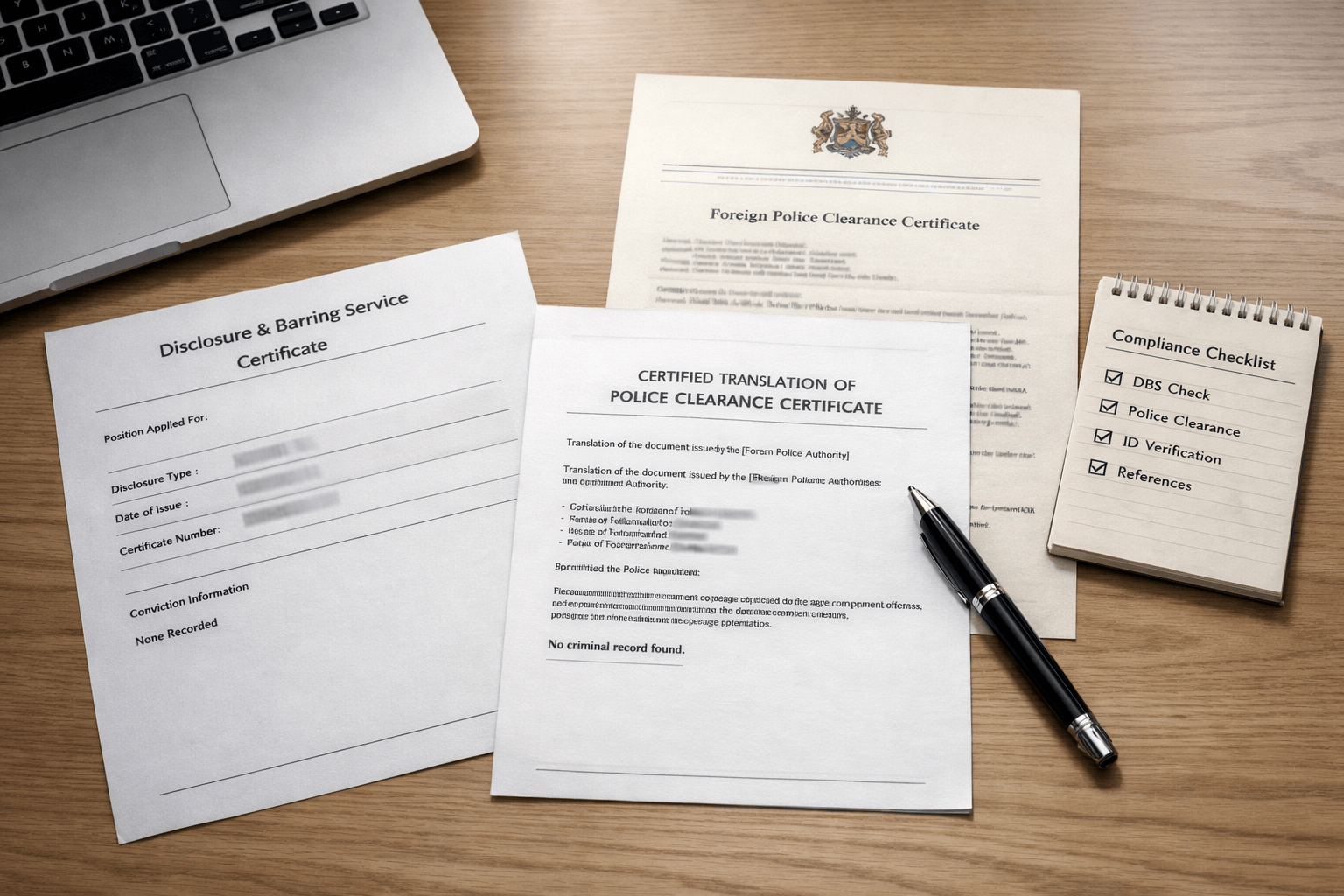
If you are searching for dbs check translation uk, the first thing to know is that employers are often not asking for a translated UK DBS certificate alone. In many cases, they actually need a certified English translation of an overseas criminal record document, police clearance certificate, or background check so they can assess a candidate properly during recruitment. That distinction matters, because it affects which document you should submit, what the translation must include, and whether you need certified, notarised, or sworn format.
For applicants, getting this right can prevent onboarding delays. For employers, it supports cleaner hiring decisions, smoother document checks, and stronger HR compliance. And for both sides, speed matters — but accuracy, confidentiality, and a clear certificate of translation matter more.
If you already have the document and deadline, the quickest route is to use certified translation services and upload a clear scan for review before ordering.
Do I need a certified translation for an overseas police check for UK employment?
In most cases, yes — if the overseas police check, police clearance certificate, certificate of good conduct, or criminal record certificate is not in English or Welsh and it is being submitted for UK employment, a certified English translation is usually the safest and most appropriate format.
The reason is practical. When an applicant has lived abroad, UK employers may need overseas criminality information in addition to any UK-based checks. If that overseas document is not in English, HR, safeguarding, compliance, or screening teams usually need a certified translation so they can review the document clearly and keep a reliable hiring record.
For standard UK employment and onboarding, certified translation is usually enough unless the employer, regulator, or screening provider specifically asks for notarised, sworn, or apostilled translation.
If the original overseas police certificate is already in English or Welsh, translation is usually not needed.
The most important distinction is this: for a UK job, the request is often not for a translation of a UK DBS certificate. It is usually for a certified English translation of an overseas police certificate or equivalent criminal record document from a country where the applicant previously lived.
Why this request comes up during hiring
A translated criminal record document usually enters the process when an applicant has lived, worked, or studied outside the UK, or when the employer is reviewing official documents issued in another language.
Typical examples include:
- a teacher who previously lived in Spain and submits a police certificate in Spanish
- a care worker returning from Italy with a criminal record document from local authorities
- a finance or compliance applicant whose screening pack includes non-English legal or police records
- an international candidate whose recruitment file contains a foreign-language certificate of good conduct
- a UK candidate applying abroad and being asked to translate a UK-issued DBS or police certificate for a foreign employer
In practice, employers want one thing: a document they can review clearly and confidently. That is why background check translation and criminal record translation UK services are often requested during recruitment and onboarding.
What employers usually mean by “DBS check translation”
This phrase is used loosely. Sometimes it means a translation of an actual DBS certificate for use outside the UK. Just as often, it refers to one of the following:
- a translated overseas police certificate
- a translated certificate of good conduct
- a translated criminal record extract
- a translated background screening report
- a translated ACRO police certificate
- a translated court or police document used as part of employment screening
That is why the safest approach is not to guess based on the phrase alone. Check what the employer, regulator, recruiter, or screening provider has actually asked for.
A simple rule helps:
- If the document is going into the UK and it is not in English, you usually need a certified English translation
- If the document is going out of the UK to another country, you may need certified, notarised, sworn, or apostilled translation depending on the receiving authority
If you are unsure which level applies, start with how to get a certified translation and confirm the destination requirements before paying for extras you may not need.
DBS, overseas police certificates, and ACRO: the difference

A lot of confusion comes from mixing these documents together.
| Document | Who issues it | Usually used for | When translation is needed |
| DBS certificate | Disclosure and Barring Service | UK employment checks | When a foreign employer or authority asks for it in another language |
| Overseas police certificate / certificate of good conduct | Local police or relevant authority in another country | UK recruitment, visa, licensing, safeguarding, or compliance checks | When the certificate is not in English |
| ACRO police certificate | ACRO Criminal Records Office | Overseas visa, emigration, and some international requests | When the receiving country does not accept English-only documents |
For UK employers, the key point is practical: if a candidate lived abroad, the UK DBS record may not be enough on its own, so additional overseas criminality information may be required. When that information arrives in another language, translation becomes part of the hiring workflow.
Important ACRO note for UK employment
An ACRO Police Certificate is not the same thing as a DBS check. If someone is applying for a job in the UK, employers normally focus on the correct UK disclosure route and any overseas criminal record documents required from countries where the applicant has lived. ACRO Police Certificates are more commonly used for overseas visa, emigration, and international requests, not as a substitute for a UK employment check.
When employers request a translated criminal record document
1. The applicant has lived outside the UK
This is the most common trigger. If a candidate spent meaningful time abroad, employers may need evidence from the relevant country or countries in addition to any UK DBS check.
That is especially common in:
- healthcare
- education
- childcare
- social care
- regulated financial roles
- charity and volunteer roles involving safeguarding
- recruitment for international schools or cross-border employers
2. The role involves safeguarding or regulated work
Where the stakes are higher, employers tend to document screening more carefully. If an applicant provides a foreign-language criminal record certificate, HR teams often ask for a certified translation so the content can be reviewed, stored correctly, and assessed consistently.
3. The employer is using a screening provider
Some employers outsource parts of pre-employment vetting. Screening companies often require a clear English translation of non-English documents so they can check names, dates, issuing authorities, offences, or “no trace” statements without ambiguity.
4. The candidate is applying from overseas
When an applicant has not yet arrived in the UK, they may submit foreign-language police paperwork, identity documents, and supporting records as part of the recruitment pack. A reliable translation helps prevent repeated requests for clarification.
5. The translated document will also be reused elsewhere
Sometimes the same criminal record translation is needed for:
- employer onboarding
- professional registration
- visa support
- university or placement checks
- internal audit or compliance files
That is why it makes sense to order a version that is complete, certified, and presentation-ready from the start.
Which documents may need translation
A dbs check translation uk request may involve more than one page or one certificate. Common documents include:
- DBS certificates
- police clearance certificates
- certificates of good conduct
- criminal record extracts
- court disposition records
- police registration letters
- background screening reports
- rehabilitation or discharge documents
- identity pages that support the criminal record document
- stamps, seals, handwritten notes, and issuing authority remarks
A good criminal record translation UK service should translate all relevant visible content, including official stamps and annotations where required.
What a compliant certified translation should include
For official UK use, the safest format is a certified translation with a clear certificate of accuracy. A strong translation pack should include:
- a full and accurate translation of the document
- the date of translation
- the translator’s or translation company’s full name
- signature where required
- contact details
- a statement confirming that the translation is a true and accurate translation of the original
- consistent presentation that mirrors the original document logically
- translation of stamps, seals, notes, and headings where relevant
This is where many low-cost providers fall short. They translate the text but miss the formal certification details that employers or official bodies expect.
If you want to see what that certification looks like in practice, review certified translation certificate examples.
What UK guidance says a certified translation should contain
For documents that are not written in English or Welsh, the safest benchmark is a translation that clearly states it is a true and accurate translation of the original document, shows the date of translation, and includes the translator’s or translation company’s full name and contact details.
A simple acceptance test for employers
Before accepting the translation into the hiring file, check that:
the overseas police certificate is complete and legible
the translation covers every page, stamp, seal, handwritten note, and reference number
the translation states that it is a true and accurate translation of the original document
the translation shows the date of translation
the translator or translation company name and contact details are included
the translated names, dates of birth, and document numbers match the original
This small check helps employers avoid unnecessary follow-up, repeat requests, and onboarding delays.
Certified, notarised, or sworn: which one do you need?
For most UK employment and onboarding uses, certified translation is the right starting point.
You may need more only if the receiving body says so.
Certified translation
Best for most UK submissions involving recruitment, HR checks, universities, and standard official use.
Notarised translation
Usually needed when a foreign authority, embassy, court, or overseas institution specifically asks for notarisation. If the employer says the translation must be notarised, use notarised translation.
Sworn translation
Usually relevant when the destination country uses a sworn translator system. If the receiving body has asked for a court-authorised or sworn translator, use sworn translation.
The most expensive option is not automatically the right one. The right option is the one the receiving authority will accept.
A simple decision guide
Use this quick check before ordering:
You probably need certified translation if:
- the employer is in the UK
- the document is not in English
- the request is for recruitment, screening, HR, licensing, or compliance
- the employer wants a signed translation with company details
You may need notarised translation if:
- the employer or authority specifically says “notarised”
- the document will be used overseas
- a foreign regulator or embassy is involved
You may need sworn translation if:
- the receiving country uses sworn translators by law
- the instructions mention court-authorised or officially sworn translators
Common scenarios employers and applicants face
Scenario 1: Care-sector hiring from overseas
A care provider offers a role to an applicant who previously lived in Romania. The candidate supplies a Romanian criminal record certificate. HR cannot assess it properly in Romanian, so they request a certified English translation for the onboarding file.
Best outcome: a full certified translation with translated stamps, issue date, authority details, and a signed certificate of accuracy.
Scenario 2: Teacher returning after time abroad
A teacher applying for a UK role has spent several years in Spain. The school asks for overseas criminality information covering that period. The applicant submits the Spanish certificate, but it must be translated into English before the safeguarding team can review it.
Best outcome: a certified English translation prepared by a provider familiar with official education-sector checks.
Scenario 3: UK candidate applying to work abroad
A UK national is asked by a foreign employer to provide a criminal record document. They obtain the correct UK-issued record, then need it translated into the destination language. Depending on the country, the process may also require notarisation or apostille.
Best outcome: confirm the destination rules first, then order the correct translation format once.
The mistakes that cause the most delays
The fastest way to lose time is to translate the wrong document, or to translate the right document in the wrong format.
Here are the delays we see most often:
- ordering translation before confirming which certificate is actually required
- assuming a DBS and an overseas police certificate are interchangeable
- sending incomplete scans or cropped phone photos
- omitting back pages, stamps, or handwritten notes
- using a provider that does not include proper certification wording
- ordering notarisation when only certified translation was needed
- ordering certified translation when the receiving body specifically required sworn or notarised format
- missing deadlines because the original certificate itself has not yet been obtained
A good provider will check the document type and destination before starting, not after delivery.
How to get it right first time

Step 1: Confirm what the employer has asked for
Ask for the exact wording if possible. Even one line from HR or the screening provider can tell you whether they want:
- a UK DBS
- an overseas criminal record certificate
- an ACRO police certificate
- a certified translation
- notarisation or sworn translation
Step 2: Send a clear scan
A clean scan helps avoid rework. Make sure the file shows:
- the full page
- all stamps and seals
- all corners
- all pages
- any barcode, serial number, or issuing reference
Step 3: State the destination and deadline
Tell the translator:
- where the translation will be used
- whether it is for a UK employer or foreign authority
- whether digital PDF is enough
- whether you need hard copy
- your deadline
This is where fast service becomes useful. Short structured documents can often be turned around quickly, but only if the brief is clear from the start.
Step 4: Check names and identifiers carefully
Criminal record documents are sensitive. Names, dates of birth, document references, and issue dates must be consistent. Small identity mismatches can create unnecessary HR queries.
Step 5: Request the right delivery format
Employers often accept a signed PDF. Some ask for hard copy. Some overseas authorities require notarised or apostilled documents. Do not assume one format fits every case.
Step 6: Keep the file secure
Because these documents contain sensitive personal data, the process should involve secure upload, controlled handling, and clear confidentiality procedures.
Why security matters with background check translation
A criminal record certificate is not an ordinary document. It contains highly sensitive personal information, which is why confidentiality should be treated as part of the service, not an afterthought.
A secure workflow should include:
- secure document transfer
- restricted internal access
- professional handling by specialist linguists
- traceable project management
- safe digital delivery
- clear retention and deletion practices
For employers, this supports better governance. For applicants, it reduces the risk of unnecessary exposure of private information.
UK Certified Translation highlights GDPR-compliant handling, dedicated project coordination, and specialist document workflows across official submissions, which is exactly the kind of process you want when translating criminal record material.
What makes a translation more likely to be accepted first time
A translation is easier for an employer to accept when it is:
- complete
- clearly certified
- easy to verify
- professionally formatted
- delivered with the right level of authentication
- matched to the purpose of use
That may sound obvious, but it is why specialist providers outperform generic document translation services on official records.
If you are comparing providers, do not just ask, “How fast?” Ask:
- Have you translated criminal record and police certificate documents before?
- Will the translation include a full certificate of accuracy?
- Can you match the right format to the receiving authority?
- Do you offer digital and hard-copy delivery?
- How do you handle confidential files?
You can also compare what certified translation covers against notarised translation and sworn translation before you decide.
A practical HR compliance checklist for employers
If you are an employer, recruiter, or HR lead, use this checklist before accepting a translated document into the hiring file:
- Confirm whether the applicant lived outside the UK and for how long.
- Identify which country-issued criminal record documents are required.
- Check whether the document is in English.
- If not, request a certified English translation.
- Make sure the translation includes certification wording, date, name, signature or equivalent, and contact details.
- Review all pages, stamps, and issuing authority details.
- Store the translated document in line with your handling policies.
- Avoid asking for higher certification levels unless the receiving rule actually requires them.
This saves time for HR teams and avoids repeat back-and-forth with candidates.
Why applicants choose a specialist service
When the document affects a job offer, applicants usually care about three things:
- acceptance
- speed
- confidentiality
That is where specialist service matters. UK Certified Translation positions itself around accredited linguists, official-use document handling, dedicated project support, and a national network built by language professionals with over a decade of experience.
A practical way to move forward is simple: send the document and the employer’s wording together. That makes it much easier to confirm the right format before the project begins.
“Uploaded my file in minutes and got the signed PDF back the next day. Solid service.” — Emma B.
“The team kept me updated at every step and delivered exactly what I needed.” — Maria L.
If your onboarding deadline is close, contact the team with the file, language pair, and deadline so the correct route can be confirmed immediately.
Final word
A dbs check translation uk request is really about clarity and compliance. Employers need to understand the document they are reviewing. Applicants need a translation that is accepted without delay. The right answer is usually not “translate everything” or “upgrade everything.” It is to identify the exact document, match the right certification level, and prepare a clean, verifiable translation that fits the purpose.
If you have been asked for a translated criminal record, police certificate, or background check, do not guess. Send the document, the destination, and the exact wording of the request. That is the quickest way to avoid paying twice, missing a start date, or submitting a translation the employer cannot use.
For a fast, confidential review, upload your file through the contact page or start with certified translation services.
FAQs
Do I need a certified translation for an overseas police check for UK employment?
Usually, yes. If the overseas police check is being submitted for a UK job and it is not in English or Welsh, the safest route is usually a certified English translation so the employer, recruiter, or screening provider can review it properly.
Do I need a translation if my overseas police certificate is already in English or Welsh?
Usually not. If the original certificate is already in English or Welsh, translation is not normally needed unless the employer or receiving authority asks for an additional certified format for a specific reason.
Can a DBS check replace an overseas police certificate?
No. A DBS check and an overseas police certificate are not interchangeable. A DBS check relates to UK-based information, while an overseas police certificate is issued by the relevant authority in the country where the applicant lived.
Is an ACRO police certificate the same as a DBS check for UK hiring?
No. An ACRO Police Certificate is a different document used more commonly for overseas visa, emigration, and international requests. It should not be treated as the same thing as a DBS check for UK recruitment.
Do I need a dbs check translation uk for a UK job?
Only if the employer or screening provider needs to review a non-English criminal record document. In many cases, the request is actually for a certified English translation of an overseas police certificate or background check, not a translation of a UK DBS certificate itself.
Is background check translation the same as criminal record translation UK?
Often, yes. The wording varies by employer and country, but both usually refer to translating official screening records such as police certificates, certificates of good conduct, criminal record extracts, or related background check documents.
What should a certified criminal record translation UK include?
It should include the full translation, a statement confirming it is a true and accurate translation of the original, the date, the translator’s or company’s full name, signature where required, and contact details.
Can an employer ask for an overseas criminal record translation as part of HR compliance?
Yes. If the applicant has lived abroad and submits a foreign-language police certificate or criminal record document, the employer may reasonably request a certified English translation so the file can be assessed properly and kept in order.
Do I need notarised or sworn translation for a DBS or police certificate?
Not always. Most UK employment uses only require certified translation. Notarised or sworn translation is usually needed only when the receiving authority specifically requests it.
How quickly can I get a background check translation?
Turnaround depends on the language pair, document quality, number of pages, and whether you need digital delivery only or extra certification. Short official documents can often be handled quickly when the scan is clear and the requirements are confirmed upfront.