



If you need an a level certificate translation for university, work, visa paperwork, or overseas recognition, the most important thing to know is this: translation alone is not the whole job. The document must be readable, the result must be provable, and the final pack must match what the receiving institution actually asks for. That is where many applicants get delayed. They submit a translated certificate, but miss the proof of results, the certification wording, or the supporting pages that make the document usable in the real world.
This guide explains what an A-Level certificate translation is, when you need one, what makes it acceptable in the UK and abroad, and how to prepare a clean, official-ready submission the first time. If your deadline is close, the safest approach is to use a specialist certified translation services provider that handles academic documents every day and can give you an online quote based on your exact certificate, language pair, and deadline.
Where can I get a certified translation of my A-Level certificate in the UK?
If you need a certified translation of your A-Level certificate in the UK, the safest options are a specialist certified translation provider or a qualified translator or translation company that regularly handles official academic documents. For extra reassurance, you can also use professional UK directories such as CIOL’s Find a Linguist service or the ITI Directory to look for a suitable translator. GOV.UK says that for a translation to be certified, the translator should confirm in writing that it is a true and accurate translation of the original document, and include the date, full name, and contact details. FCDO Services also directs members of the public to CIOL and ITI when they need help finding a qualified translator.
If your certificate has been lost, damaged, or never received, do not order a translation from memory, screenshots, or an incomplete student portal view. Get official proof from the awarding body first, then translate that official proof document. That route is far more likely to be accepted by universities, employers, and authorities.
What an A-Level certificate translation actually does
An A-Level certificate translation turns your certificate into a complete, accurate version in the target language, while preserving the meaning of the original.
For academic documents, that usually means translating:
- candidate name
- subjects
- grades
- awarding body details
- dates
- seals, stamps, or visible annotations
- back-page notes or grading explanations where relevant
For official use, the translation should not be a loose summary. It should mirror the original clearly enough for an admissions officer, employer, or authority to compare both documents side by side.
A simple way to think about it is this:
Translation makes the document readable. Recognition makes it acceptable. Proof makes it verifiable.
That distinction matters. A translated certificate can help someone understand what the document says, but it does not automatically prove equivalence to another qualification system. It also does not replace missing source documents.
The recognition stack: the three things institutions usually care about
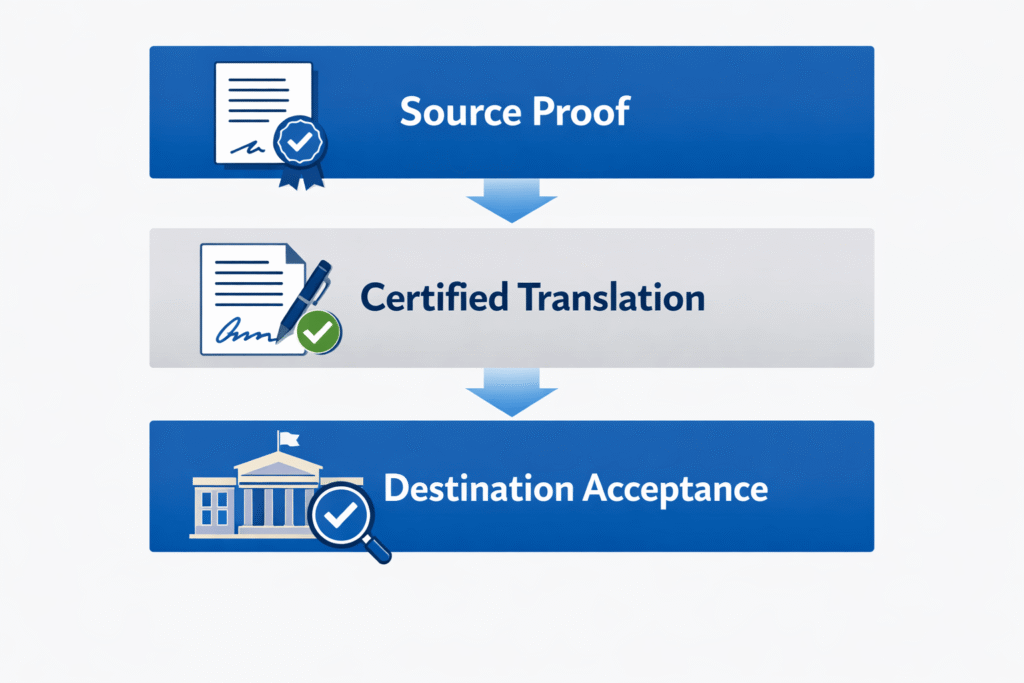
Most problems with academic certificate translation happen because people focus on only one layer.
1. Source proof
This is the document that proves the result exists.
Examples include:
- the original A-Level certificate
- a certifying statement of results
- an official transcript or results statement from the awarding body
- a replacement document issued through the correct channel
If the original has been lost, the first step is not translation. The first step is getting valid proof of results.
2. Translation proof
This is the part that shows the translated version can be trusted.
A proper academic certificate translation should include:
- a complete and accurate translation
- a certification statement
- the date
- the translator’s or provider’s name and contact details
- a signature or certification format suitable for official use
If you want a plain-English breakdown of the format, read what certified translation means and review these certified translation certificate examples.
3. Destination proof
This is whatever the receiving body needs to accept the document.
That might include:
- a PDF upload for UK university entry
- a hard copy for an overseas institution
- a notarised translation
- apostille or legalisation
- a grading scale
- ID or name-change evidence
- a direct verification route from the exam board
The translation is only successful when all three layers line up.
When you may need an A-Level certificate translation
An A-Level or equivalent academic certificate translation is commonly needed in five situations.
Applying to a university abroad
If your A-Level certificate is in English and the receiving institution works in another language, you may need a translation into that language. This is common for overseas admissions, exchange programmes, scholarship applications, and professional recognition.
UK university entry with non-English academic documents
If your school-leaving certificate is not in English, universities may need an English version so they can review your qualifications, subjects, and grades. In that context, what many people call “A-Level certificate translation” is really an academic certificate translation for comparison with UK entry standards.
For related academic documents, you can also review our guide to academic transcript translation.
Visa, immigration, or credential assessment
Where qualifications support a visa route, a professional registration, or a formal qualification comparison, the translation has to be clear, complete, and official-ready.
Employment and licensing
Employers, licensing bodies, and training providers may need translated academic proof before they can assess your level of study.
Replacement proof after a lost certificate
If the original certificate is missing, damaged, or never received, you may need to obtain official proof first and then translate that replacement proof for submission.
What makes an A-Level certificate translation acceptable in the UK
For UK use, the safest rule is simple: the translation should be complete, accurate, and accompanied by the right certification details.
A strong document translation UK package for academic use should include:
- every page that matters
- every visible mark that affects meaning
- a faithful layout where practical
- clear handling of stamps, seals, signatures, and handwritten notes
- certification wording confirming accuracy
- contact details for verification
It should also avoid the common shortcuts that lead to rejection:
- partial translation of only the “main” page
- omission of stamps or handwritten notes
- translating the certificate but not the transcript
- leaving names inconsistent across documents
- retyping grades without showing source structure
- using AI output with no certification trail
If your submission is for an overseas authority, do not assume “certified” is enough. Some authorities want notarisation or apostille as an extra step.
What UK guidance says a certified translation should include
For UK official use, the baseline certification wording is straightforward. GOV.UK says the translator should confirm in writing on the translation that it is a “true and accurate translation of the original document”, and include the date, their full name, and their contact details. That is the core checklist many applicants should verify before ordering. If a receiving body later asks for a notary or apostille, that is usually an added formality on top of the certified translation rather than a replacement for it.
Certified, notarised, or apostilled: which one do you need?
These are not interchangeable.
Certified translation
This is the right starting point for most academic submissions. It includes the translation plus a certification statement confirming it is true and accurate.
Best for:
- UK university entry
- general official use
- employers
- admissions teams
- credential checks
- routine academic submissions
Notarised translation
This adds a notary step to authenticate the signature or declaration attached to the translation package.
Best for:
- overseas legal use
- institutions that explicitly request notarisation
- jurisdictions with stricter documentary formalities
Apostilled translation or legalised document pack
This is usually needed when a foreign authority wants the signature or seal on a UK document recognised internationally.
Best for:
- certain embassies
- foreign civil registry use
- overseas legal or official filing
If the receiving organisation has not asked for notarisation or apostille, do not pay for extra steps too early. Start with the level actually requested, then upgrade only if required.
A-Level certificate translation for UK university entry
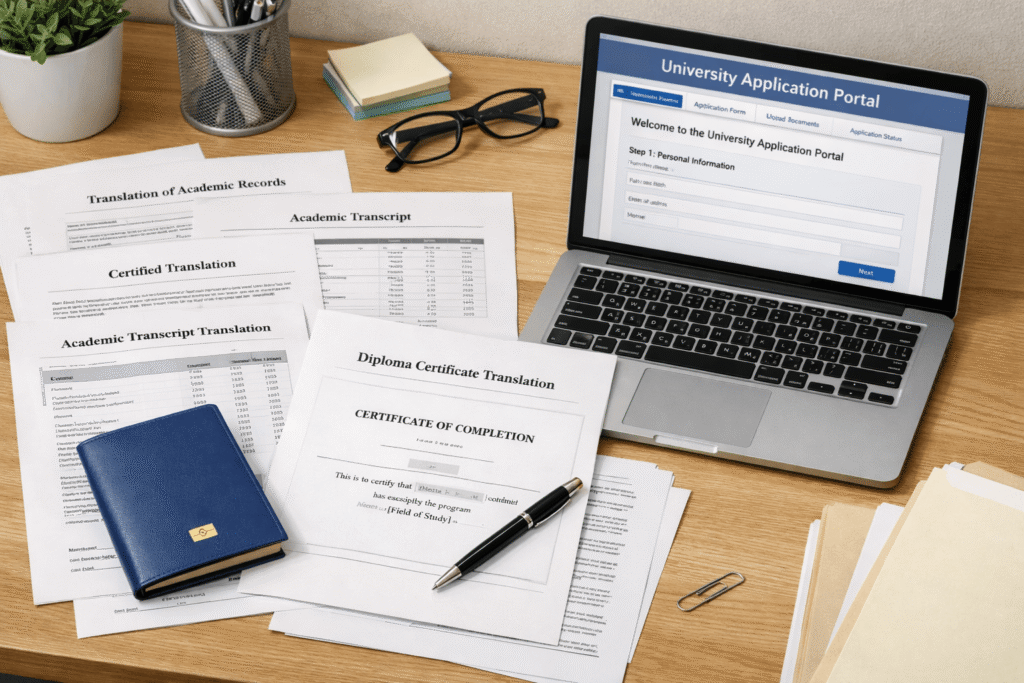
For UK university entry, the key issue is not just language. It is clarity.
Admissions teams need to understand:
- what qualification you hold
- when it was awarded
- which subjects were studied
- what grades were achieved
- whether the document is complete
- whether the document appears reliable and consistent
That is why academic translation work often includes more than one file. A strong submission pack may include:
- the certificate
- the transcript or subject breakdown
- any grading explanation or reverse-side notes
- certified translation of each relevant page
- supporting ID or name-change evidence where names differ
If you are applying with an overseas secondary-school credential rather than a UK-issued A-Level, translation helps the admissions team read your documents, but recognition of level is a separate step. The translation shows what the document says. It does not itself declare the qualification equivalent to UK A-Levels.
That distinction is where many applicants lose time.
What UK admissions and qualification-comparison routes may ask you to upload
For UK admissions, applicants should not assume the certificate alone will be enough. UCAS guidance says applicants may need to upload international qualifications, transcripts, translated qualifications, and evidence of a name change where the name on the qualification differs from the current name. For formal qualification-comparison routes, Ecctis says applicants for English Proficiency and Qualification Comparison must upload final certificates, official transcripts showing all subjects and grades, certified translations if the documents are not in English, photo ID, and name-change evidence where relevant. Ecctis also says that service should not be used for qualifications awarded by a UK institution.
In practice, this means a UK-issued A-Level certificate usually does not need a UK qualification-comparison service just because somebody needs a translation for overseas use. The translation helps another institution read the document. A comparison service is a separate process and depends on the destination requirement.
What to do if you have lost your A-Level certificate
This is one of the most useful places to get the process right.
If your certificate is missing, do not ask a translator to work from memory, screenshots, or an incomplete portal view. Get official proof first.
Step 1: Go to the awarding body, not Ofqual
Ofqual does not hold copies of certificates or provide replacements. You usually need to contact the exam board that issued the qualification.
Step 2: Request the right kind of proof
Depending on the board and the qualification type, you may be able to obtain:
- a certifying statement of results
- a replacement certificate
- an official confirmation letter
- direct third-party confirmation to a university or employer
Step 3: Translate the proof document, not guesswork
Once you have valid proof, translate that official document as the source.
This matters because a receiving institution is far more likely to accept:
- official results proof + certified translation
than:
- incomplete copy + explanation email + informal translation
Step 4: Keep names and dates aligned
If your current name differs from the name on the certificate, include your name-change evidence from the start. This prevents avoidable back-and-forth later.
If you need fast help, upload a clear scan of the certificate or certifying statement and request an online quote before your deadline gets close. A short review at quote stage often catches missing pages before they become a problem.
Where to get official proof before translation
If you no longer hold the original certificate, the most practical route is usually the awarding body that issued the qualification. Current public routes include AQA past results and lost certificates, OCR certifying statements or replacement routes, Cambridge certifying statements for lost certificates, and Pearson certificate services for replacement documents or official confirmation sent to a third party. Ofqual says it does not hold copies of certificates and cannot provide replacements, so applicants normally need to go directly to the exam board or, if they do not know the board, ask their school first.
What a translator needs from you for a clean academic certificate translation
A good translation starts with a good source file.
Send:
- a full-colour scan or clear phone photo
- all pages, including reverse pages if they contain notes
- any transcript, statement of results, or grading scale
- clear indication of where the document will be submitted
- the required language
- whether you need digital PDF, hard copy, notarisation, or apostille
- your deadline
Also mention:
- any urgent service needed
- whether the institution wants the translation posted
- whether the document has handwritten notes or seals
- whether names differ across documents
This helps the translator prepare the correct certification format from the start.
How long does A-Level certificate translation take?
Turnaround depends on:
- language pair
- number of pages
- image quality
- whether you need only a certified PDF or extra formalities
- whether the document includes multiple supporting pages
- whether the deadline requires an urgent service
For a straightforward one-page certificate with clear scans, the process is often fast. For a multi-document academic pack with transcript pages, grading notes, and legalisation requirements, it takes longer.
The safest way to speed things up is not to ask for “fastest possible” with no detail. It is to send everything at once and ask for an online quote based on the real submission requirements.
How to choose the right provider for academic certificate translation
Not every general translation provider handles academic proof documents well. Choose a service that understands academic structure, certification wording, and submission risk.
Look for:
- experience with academic credentials
- clear explanation of what certified translation includes
- ability to handle transcripts as well as certificates
- transparent turnaround options
- realistic advice on notarisation and apostille
- secure file handling
- a clear quote before you commit
Red flags include:
- promising acceptance everywhere with no conditions
- refusing to review the actual document before pricing
- no explanation of certification wording
- no distinction between certified, notarised, and apostilled documents
- vague answers about missing pages or result proof
If you want a step-by-step overview before ordering, see how to get a certified translation and our guide to certified translation cost.
Two real-world scenarios that show where people get stuck
Scenario 1: UK A-Levels being submitted to an overseas university
A student has an English A-Level certificate and needs it translated into Spanish for enrolment abroad.
What works best:
- translate the certificate
- include any relevant results statement or subject page
- confirm whether the university wants hard copy, PDF, or notarisation
- keep names exactly consistent with passport and application
Where delays happen:
- translating only the front page
- ignoring the university’s format instructions
- sending the translation without certification wording
Scenario 2: Non-English school-leaving certificate being used for UK university entry
A student holds a foreign secondary credential and assumes translation alone proves A-Level equivalence.
What works best:
- certified English translation of the certificate and transcript
- clear grading and subject visibility
- any additional recognition route required by the institution
- consistent name evidence across all files
Where delays happen:
- sending only the certificate without marks breakdown
- using machine translation
- assuming translation equals formal comparability
Why this matters for recognition and proof
For academic documents, acceptance decisions are often made quickly. A reviewer may have only a short window to determine whether the file is readable, trustworthy, and complete.
That means your translation should do three jobs at once:
- read clearly
- prove accuracy
- reduce questions
That is why academic certificate translation is not just a language task. It is a document-preparation task.
A clean submission gives the receiving institution less reason to pause, query, or defer the application.
Need your A-Level certificate translated quickly?
If your deadline is close, the most practical next step is to send the certificate, transcript, and any supporting pages for review in one go.
UK Certified Translation can help with:
- academic certificate translation
- supporting transcript translation
- document translation UK requirements for official use
- urgent service requests where timing matters
- a clear online quote before you proceed
For fast help, use the contact page or start with our certified translation services page.
Final checklist before you submit
Before you order, make sure you have:
- the best available source document
- every relevant page
- the correct target language
- the receiving institution’s format requirements
- matching personal details across documents
- any name-change evidence
- your true deadline
- the right certification level
Before you submit, make sure the final pack includes:
- the original or official proof document
- the full translation
- the certification statement
- contact details and date
- any extra formalities requested by the recipient
When those elements are in place, an A-Level certificate translation stops being just paperwork and becomes a reliable proof bundle the receiving body can actually use.
FAQs
What is an A-Level certificate translation?
An A-Level certificate translation is a complete translation of an A-Level certificate, or a similar academic results document, into another language or into English. For official use, it should be accompanied by certification wording that confirms the translation is true and accurate.
Can I translate my own A-Level certificate?
For official use, that is usually a bad idea. Even if your language skills are strong, self-translation often fails because the receiving institution wants a neutral, certifiable translation prepared for formal submission.
Do I need both the certificate and the transcript translated?
Often, yes. The certificate may show the qualification, while the transcript or statement of results shows the subjects and grades in detail. If the institution needs to assess your academic profile, sending both is the safer option.
What if I lost my original A-Level certificate?
Contact the awarding body first and request official proof such as a certifying statement of results or replacement document where available. Once you have valid source proof, that official document can be translated for submission.
Is notarisation required for an A-Level certificate translation?
Not always. Many academic submissions only need a certified translation. Notarisation is usually only necessary when the receiving authority specifically asks for it or when the document is being used in a stricter legal or overseas setting.
How fast can an urgent A-Level certificate translation be done?
That depends on the language pair, the number of pages, the image quality, and whether you need extra formalities. The fastest route is to send a complete file set and ask for an online quote with your exact deadline.
Where can I get a certified translation of my A-Level certificate in the UK?
You can usually get one from a specialist certified translation provider or from a qualified translator or translation company that handles official documents. If you want to find a professional directly, CIOL’s Find a Linguist and the ITI Directory are two established UK routes. GOV.UK says the translator should certify that the translation is true and accurate, and include the date, full name, and contact details.
What should a certified translation of an A-Level certificate include?
For UK official use, the translation should include the full translated content and certification wording stating that it is a true and accurate translation of the original document, together with the date, the translator’s full name, and contact details. For academic use, it is also sensible to include all pages, visible stamps, seals, notes, and any supporting transcript or results statement where relevant.
Do UK-issued A-Level certificates need translating for UK use?
Usually, no. A UK-issued A-Level certificate is already in English, so translation is more commonly needed when the document is being sent to an institution abroad or when supporting academic documents are in another language. For UK admissions, translated qualifications and transcripts are mainly relevant where the original academic documents are not already in English. Ecctis also says its English Proficiency and Qualification Comparison service should not be used for qualifications awarded by a UK institution.
What if the university or employer wants proof but I no longer have the certificate?
You should go first to the awarding body for official proof such as a certifying statement of results, replacement document, or direct third-party confirmation where available. Ofqual says it does not hold copies of certificates or provide replacements. AQA, OCR, Cambridge, and Pearson each publish routes for lost certificates or official result confirmation.