


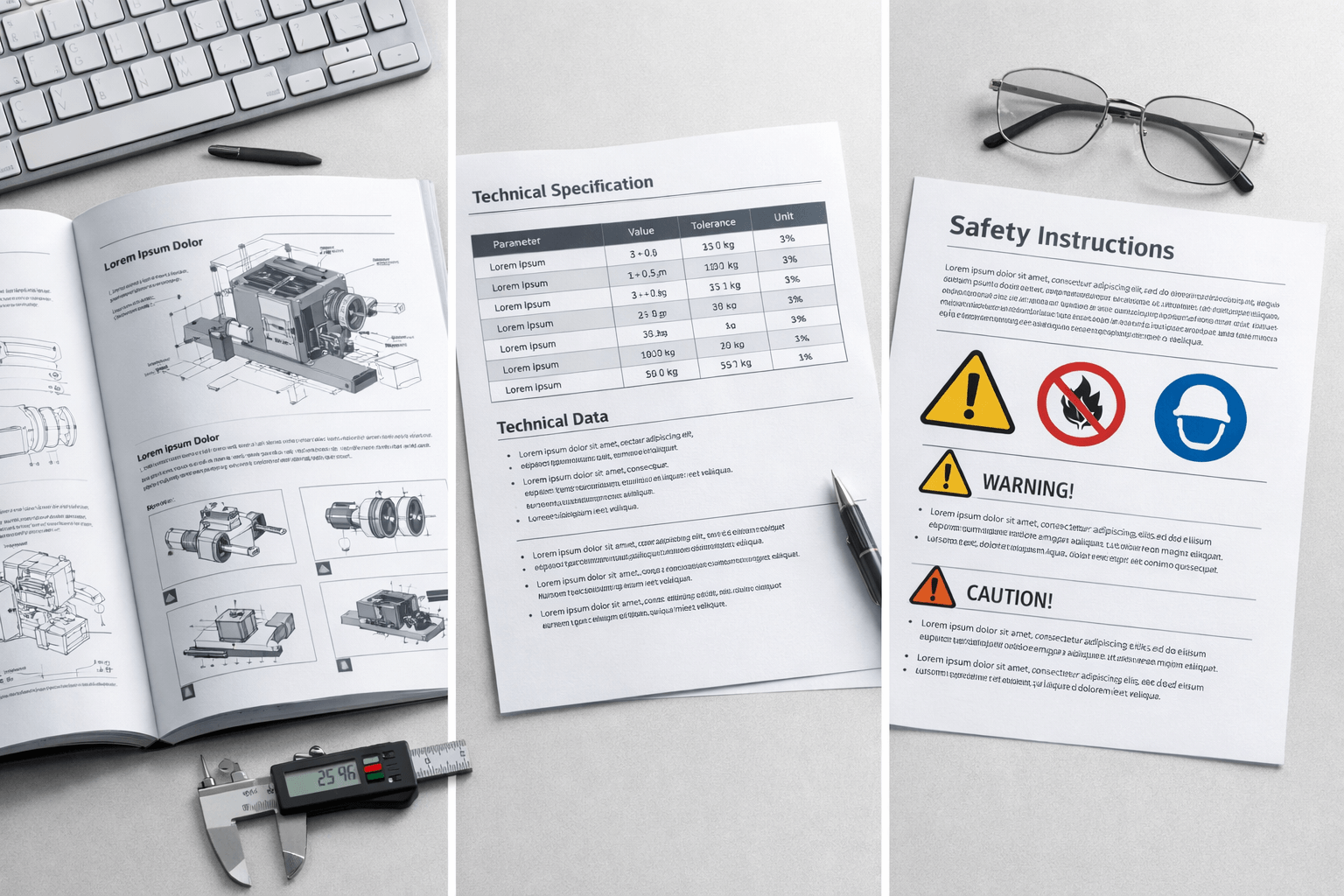
If you’re trying to decide which technical translation you need, the answer is rarely “just translate the file.” Manuals, specifications, and safety documents each have different risk levels, audiences, and formatting requirements. Choosing the wrong workflow can lead to delays, confusing instructions, failed approvals, or expensive rework.
This guide breaks it down by document type so you can choose the right technical translation services the first time—whether you’re a manufacturer, engineering team, importer, distributor, or compliance manager.
If you already have files ready, send them in as a bundle and ask for a document-by-document recommendation. That is the fastest way to avoid ordering the wrong level of service.
Start with the document’s job, not its file name
A common mistake is assuming the file name tells you everything:
- “Manual.pdf” could be a user guide (customer-facing), a service manual (technician-facing), or a compliance instruction set (regulatory-facing)
- “Specs.xlsx” could be a marketing datasheet, an engineering tolerance sheet, or a testing requirement
- “Safety.docx” could be internal training content, machine warnings, an SDS, or an incident-response procedure
The better question is:
What is this document used for, and what happens if a translation is misunderstood?
That one question usually tells you which technical translation workflow you need.
A practical decision matrix for technical translation

Use this simple rule before you request a quote:
1) If the document is used to operate or install something
You need manual translation with:
- terminology control
- layout preservation
- safety wording consistency
- screenshot/UI label matching (if included)
2) If the document defines dimensions, tolerances, or performance
You need specification translation with:
- engineering-aware linguists
- strict unit/symbol handling
- bilingual review against source values
- version control for revisions
3) If the document contains warnings, hazards, or compliance instructions
You need safety-document translation with:
- high-risk QA workflow
- approved warning terminology
- consistency across labels/manuals/SDS
- final review by a second qualified linguist
4) If the document will be submitted to an authority or regulator
You may need a technical + certified/notarised/sworn route depending on the destination country and authority requirements (not just a standard technical translation).
That last point matters more than most people realise. Many companies translate the technical file correctly, then get stuck because the receiving body also wants a formal certification layer.
Manuals: the most common technical translation request
Manuals are where most technical translation projects start—and where the most avoidable mistakes happen.
What counts as a manual?
A manual can include:
- user manuals
- installation guides
- commissioning instructions
- operator handbooks
- service manuals
- maintenance manuals
- troubleshooting guides
- quick-start guides
- assembly instructions
- HMI/UI instructions embedded in the document
Which technical translation do you need for manuals?
For most manual projects, choose a workflow designed for task completion, not just readable language.
That means the translator must preserve:
- sequence of actions
- warnings before steps
- part names and component labels
- units, symbols, and values
- cross-references (“See Section 4.2”)
- formatting logic (tables, callouts, icons, numbered steps)
A manual that “reads nicely” but changes the order of actions is a bad translation.
Manual translation risk levels
Low-risk manuals
Examples:
- internal process overviews
- non-safety product setup notes
- basic training handouts
These usually need:
- strong technical translator
- standard revision
- light formatting support
Medium-risk manuals
Examples:
- installation guides
- maintenance procedures
- troubleshooting documentation
These need:
- domain specialist translator
- terminology list approval
- bilingual QA pass
- formatted output that matches source layout
High-risk manuals
Examples:
- machinery operation manuals
- electrical installation instructions
- industrial maintenance procedures
- medical device IFUs
These should be treated as safety-critical:
- specialist technical translator
- second-linguist revision
- terminology lock
- label/manual consistency check
- final sign-off workflow
What to send with a manual (so the translation is actually usable)

When requesting technical translation services for manuals, send more than the PDF if possible:
- editable source files (InDesign, Word, XML, etc.)
- previous-language versions
- approved glossary/termbase
- product photos or diagrams
- UI screenshots (if buttons/messages are referenced)
- target-country list
- who the user is (operator, technician, end customer)
A technical translation company can work faster and more accurately when they know whether the audience is a trained engineer or a first-time user.
Need a fast recommendation? Upload the manual plus one sample page of specs or labels. A quick file review usually reveals whether you need a standard manual translation, a safety-critical workflow, or a combined package.
Specifications: where precision beats style
Specifications look simple because they are often short, dense, and repetitive. In reality, they are one of the easiest document types to mistranslate.
What counts as a specification document?
- product datasheets
- technical specifications
- tolerance tables
- material specifications
- test methods
- performance requirements
- bill of materials (BOM) notes
- drawing notes
- process specifications
- validation criteria
Which technical translation do you need for specs?
For specifications, you need a workflow built around exact meaning preservation.
The right approach is usually:
- technical translator with domain experience
- bilingual value checks (numbers, tolerances, units)
- terminology consistency against drawings/manuals
- formatting that preserves tables and headings
- change tracking for revised versions
The biggest spec translation mistakes (and how to avoid them)
1) Units and symbols are “localized” incorrectly
Examples of risky areas:
- decimal separators
- unit spacing
- pressure/temperature notation
- electrical symbols
- abbreviations that look universal but aren’t
Always confirm whether values should be:
- translated
- copied exactly
- converted
- or left unchanged by engineering instruction
2) A term is linguistically correct but technically wrong
In specs, synonym swaps are dangerous.
For example, two terms may sound similar in everyday language but refer to different:
- finishes
- tolerances
- materials
- test conditions
- component types
This is why spec translation should use an approved glossary early, not after the first delivery.
3) Tables break during formatting
Technical specs often fail in production because:
- columns shift
- units detach from values
- footnotes disappear
- superscripts/subscripts are lost
If your team will publish the specs, ask for output in the final layout format (or ask for DTP support).
A simple rule for spec-heavy projects
If the document contains more numbers than sentences, treat it as a verification project, not a writing project.
That mindset changes everything:
- the reviewer profile
- the QA checklist
- the quote assumptions
- the turnaround plan
Safety documents: the highest-risk technical translation category
Safety documents are where technical translation becomes a risk-management task.
If a mistranslation can cause injury, misuse, downtime, or a failed compliance review, the file belongs in a safety-document workflow.
What counts as a safety document?
- safety manuals
- warning and caution text
- risk assessments
- lockout/tagout procedures
- emergency instructions
- SDS (Safety Data Sheets)
- hazard communication documents
- PPE instructions
- incident response procedures
- compliance-related operating instructions
- medical device instructions for use (IFU)
Which technical translation do you need for safety docs?
For safety documents, choose a high-control workflow:
- specialist translator in the subject area
- locked terminology for warnings and hazard language
- second-linguist revision
- consistency check across all related files
- version traceability (what changed and when)
- final QA focused on warnings, values, and prohibited actions
This is where a strong technical translation company earns its fee. The goal is not only accurate language—it is controlled risk.
Safety-document translation should be consistent across the full document set
One of the most common failures is translating each file in isolation:
- manual uses one term
- label uses another
- SDS uses a third
- training deck uses a simplified variant
That creates confusion and, in some sectors, compliance problems.
Instead, request a document-set approach:
- manual
- labels
- specs
- warnings
- SDS
- training content
All translated from the same approved terminology base.
The “danger triangle” to watch for in safety translations
If your document contains all three of these, do not use a basic workflow:
- Hazard language (warning/caution/prohibited actions)
- Measurements or thresholds (limits, dosage, torque, temperature, pressure)
- Action steps (what the user must do, in sequence)
That combination creates the highest error cost.
If your files match this pattern, start your project with a bundled review. It is much safer (and usually cheaper) to set terminology and QA rules once than to fix inconsistencies after release.
Do you need a technical translation company or a freelance specialist?
Both can work. The right choice depends on project complexity.
A freelance technical translator is a good fit when:
- you have one document type
- one language pair
- stable terminology
- no layout-heavy files
- no urgent multi-market rollout
A technical translation company is a better fit when:
- you have manuals + specs + safety docs together
- multiple languages are needed
- you need formatting/DTP support
- updates will continue over time
- terminology must stay consistent across teams
- you need project coordination and QA tracking
How to choose a technical translation company
Ask these questions before you start:
Document and domain fit
- Have you handled this document type before (manual/spec/SDS/IFU)?
- Can you assign subject-matter translators for our industry?
- Can you work with our file formats (Word, InDesign, XML, CAD exports, spreadsheets)?
Quality control
- Do you use a second-linguist revision step for high-risk files?
- How do you manage approved terminology and client glossaries?
- How do you check consistency across manuals, labels, and specs?
Delivery and updates
- Can you preserve layout and tables?
- How do you handle revision cycles and version tracking?
- Can you support future updates without re-translating unchanged text?
Security and process
- Can you sign an NDA?
- How do you handle confidential technical documents?
- Who signs off the final delivery?
If the answers are vague, the project will be expensive later.
The 5-part workflow that prevents technical translation rework
Here is a practical workflow you can use internally or with your provider.
1) Classify every file by risk
Tag each file as:
- Operational (manuals, setup)
- Technical definition (specs, datasheets)
- Safety/compliance (warnings, SDS, IFU)
This helps you apply the right QA level to each file instead of overpaying for everything—or under-protecting critical documents.
2) Define the target market for each language
Do not just say “Spanish” or “Arabic.”
Specify:
- country/region
- end-user type
- submission authority (if any)
- print/digital use
- whether the text appears on labels, screens, or manuals
This avoids avoidable terminology disputes later.
3) Approve a mini glossary before full translation
Even a 30–50 term glossary can prevent major issues.
Start with:
- product names
- component names
- safety terms
- repeated actions (“tighten,” “vent,” “disconnect”)
- prohibited actions
- unit conventions
4) Translate in a controlled batch
For large projects, do not translate all files blindly at once.
Best practice:
- pilot batch first (manual section + one spec + one safety doc)
- review terminology
- lock style decisions
- then scale
5) Deliver a release-ready pack
Ask for a delivery pack that includes:
- translated files
- terminology list
- change log (if updates)
- formatting notes
- open questions (if any)
- final QA checklist for your team
That turns translation from a one-off purchase into a repeatable process.
Illustrative technical translation scenarios
Scenario 1: Machinery exporter entering two EU markets
Consider a machinery exporter that initially asks for “manual translation only.”
A sensible scope would split the project into:
- operator manual
- installation guide
- warning labels
- technical specifications
A single document-set workflow with shared terminology reduces the risk of review comments and label/manual terminology mismatches at launch.
Scenario 2: Chemical distributor updating product documentation
Imagine a chemical distributor translating an SDS first, then finding that its customer-facing safety sheet and handling guide use different hazard wording.
A safer approach is to establish the safety terminology base first and check all downstream files against it before release.
Scenario 3: Device manufacturer preparing a multilingual pack
Consider a device manufacturer with IFU text, packaging copy, and service instructions spread across multiple files.
Instead of treating each file as a separate translation, the project can be managed as one technical translation programme:
- terminology approval
- batch rollout
- update-ready structure for future revisions
This approach can make future changes faster because unchanged segments can be identified and reviewed consistently instead of rebuilding the workflow from scratch.
What to send when requesting a quote for technical translation services
To get an accurate quote (and a useful recommendation), send:
- files (editable + PDF where possible)
- language pairs
- target countries
- document purpose (manual/spec/safety/regulatory)
- required delivery date
- whether layout recreation is needed
- whether this is a one-time job or ongoing updates
- any existing glossary or approved terms
If you are unsure which category your files fall into, send the full bundle and ask for a split recommendation. A quick review can identify what needs standard technical translation, what needs safety-grade QA, and what may need certified or notarised handling for submission.
Final takeaway
The right answer to “which technical translation do you need?” is usually:
- manual translation for operation and use
- specification translation for technical definitions and values
- safety-document translation for warnings, hazards, and compliance content
- a combined workflow when those files must stay consistent across a product pack
If you want to avoid rework, start with a file review and a risk-based plan—not a generic word-count quote.
When you’re ready, send your manuals, specs, and safety files together and request a document-by-document recommendation. That gives the team enough context to define the scope, QA level and delivery format before translation begins.
FAQ Section
What is technical translation?
Technical translation is the translation of specialised documents such as manuals, specifications, safety documents, and engineering content. It requires subject knowledge, correct terminology, and a QA process that protects meaning, values, and instructions.
Which technical translation do I need for user manuals?
Most user manuals need a manual-translation workflow with terminology control, layout preservation, and consistency checks for warnings and step-by-step instructions. If the manual is safety-critical, use a higher-control QA process.
Do product specifications need a specialist technical translator?
Yes. Specifications often contain tolerances, units, test conditions, and part terminology that cannot be translated accurately by general translators. A specialist technical translator (or technical translation company) is the safer choice.
Are safety documents translated differently from manuals and specs?
Yes. Safety documents are usually treated as high-risk content. They need stricter terminology control, warning consistency, second-linguist revision, and cross-checks against related manuals, labels, and SDS files.
Can a technical translation company handle manuals, specs, and safety docs together?
Yes—and that is often the best option for multi-file projects. A technical translation company can manage one terminology base, one QA workflow, and one release pack across all document types.
How do technical translation services handle updates and new versions?
Good technical translation services use version control and translation-memory workflows so unchanged text can be reused, reviewed faster, and kept consistent across future updates.