


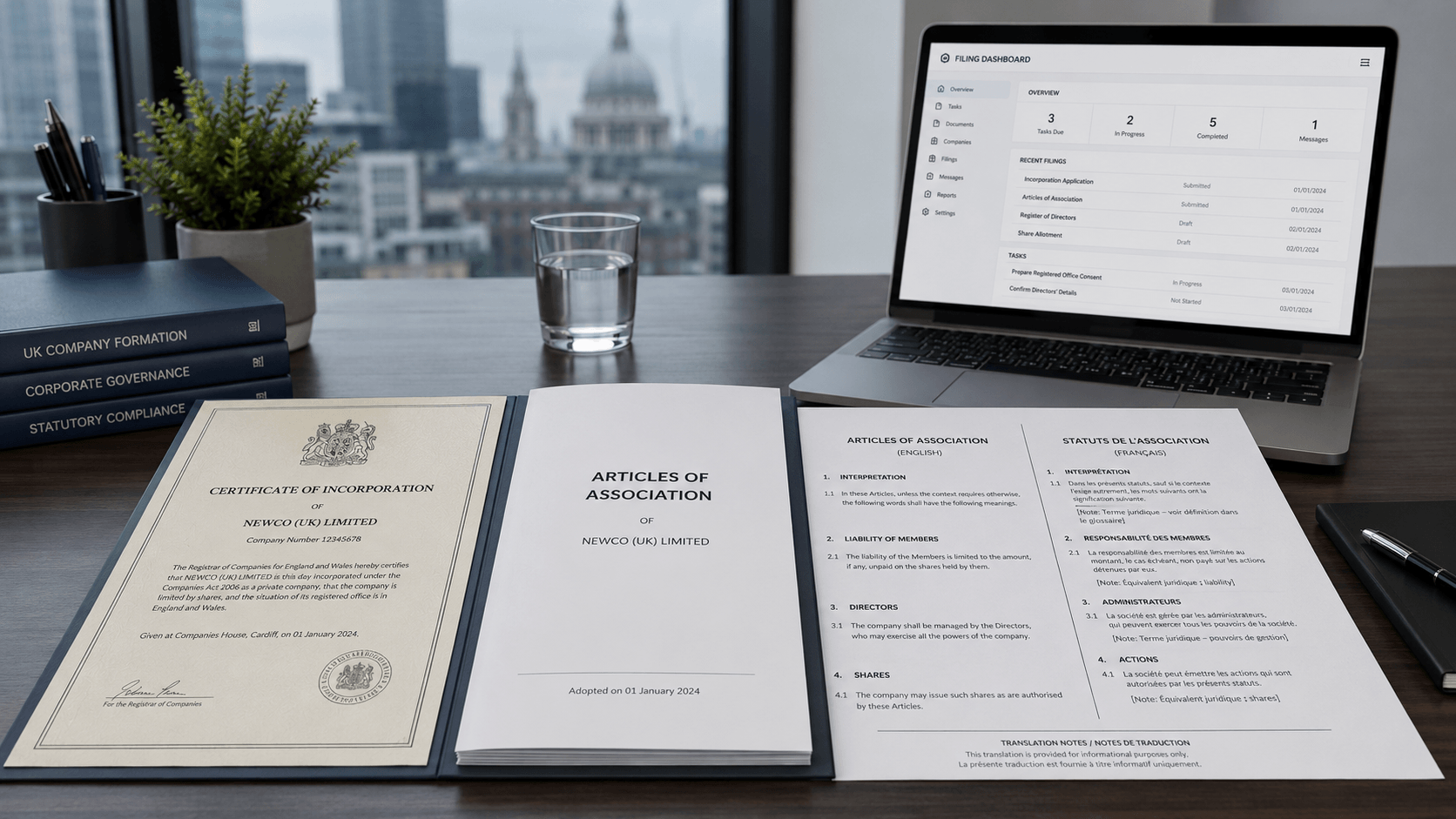
If you need companies house document translation, the real question is not simply “Who can translate this?” It is “What exactly will the receiving authority accept?” For corporate records, accuracy alone is not enough. The translation must be complete, consistent with the source, and prepared in the right format for filing, registration, legalisation, banking, or cross-border compliance. Whether you need incorporation documents translation, company filings translation, or help with a wider UK business setup, getting the format right at the start saves time, avoids rejection, and protects the legal value of the documents you submit.
For many businesses, the translation issue appears at one of three moments:
- An overseas company is entering the UK and needs English versions of core corporate records.
- A UK company is expanding abroad and must translate Companies House documents for a foreign registry, bank, or notary.
- A corporate transaction, compliance check, or ownership change requires translated supporting paperwork alongside official filings.
That distinction matters, because not every corporate document needs the same level of certification.
Need your corporate documents prepared without back-and-forth? Upload the full pack once and get a fixed quote based on the exact filing or destination requirement.
Best services for Companies House document translation in the UK
When people ask for the best services for Companies House document translation, the best choice is usually not the cheapest per-page provider. It is the provider that can match the translation to the filing route, destination authority, and certification level from the start.
For Companies House-related work, a strong provider should be able to:
- identify which documents in the corporate pack actually need translation
- explain whether certified translation is enough or whether notarisation, sworn translation, or apostille may also be needed
- preserve clauses, annexes, schedules, numbering, stamps, seals, and signatures
- keep company names, company numbers, officer titles, and dates consistent across the whole pack
- quote from the full filing bundle rather than isolated pages
- explain delivery format, turnaround, confidentiality, and certification before work begins
This is especially important if the project involves overseas-company registration, cross-border company expansion, banking, legalisation, investor due diligence, or bilingual Welsh filing issues.
If you want a filing-focused provider rather than a generic translation vendor, UK Certified Translation is built around certified corporate document handling, clear certification options, and practical support for filing, compliance, and official use.
For broader corporate, compliance and commercial document work, see our business translation services UK page. You can also review our translation services or contact UK Certified Translation for a filing-based review of the full pack.
When companies need Companies House document translation

The phrase “Companies House document translation” is often used for several different jobs at once. In practice, businesses usually need it in these situations:
- Registering a UK establishment for an overseas company
- Translating UK incorporation records for use abroad
- Preparing bilingual due diligence or KYC packs
- Submitting supporting records for legal, banking, tax, or notarial use
- Translating legacy constitutional documents, board resolutions, and accounts for cross-border transactions
A more useful way to think about it is this:
| Situation | Typical documents | Usual output needed |
| Overseas company entering the UK | Charter, statute, memorandum, articles, latest accounts | Certified English translation |
| UK company expanding abroad | Certificate of incorporation, articles of association, certificate of good standing, board resolutions | Certified translation, sometimes notarised or apostilled |
| Transaction or compliance pack | Shareholder resolutions, director paperwork, beneficial ownership records, powers of attorney, accounts | Certified translation matched to receiving body |
| Welsh filing context | Welsh-language company documents or bilingual filing needs | Filing-specific translation handling |
The strongest corporate translation projects start with the destination, not the document. A bank, registrar, solicitor, notary, or foreign authority may each ask for a slightly different output.
Which Companies House documents usually need certified translation?
For many users, this is the real question behind the search. In practice, the answer depends on whether the documents are being filed with Companies House, delivered to another UK authority, or taken abroad for use with a foreign registry, bank, notary, or court.
For overseas companies registering a UK establishment, the documents most commonly associated with certified English translation are:
- constitutional documents such as the charter, statute, memorandum, and articles of association
- the latest accounts, where the overseas company is required to prepare and deliver accounts under parent law
- the latest disclosed accounts, where the filing route requires them
- supporting records that must match the filing pack, such as resolutions, director authority documents, and related corporate evidence
For UK companies using Companies House records abroad, the pack often includes:
- certificate of incorporation
- articles of association
- memorandum of association
- certificate of good standing
- change of name documents
- board resolutions
- shareholder resolutions
- accounts or registry extracts
The key point is that the filing route decides the translation scope. A provider should review the full pack, not just one document title in isolation.
If you want a practical overview of how to get a certified translation for corporate records, start with the destination requirement and submit the full set of documents together.
What documents are commonly translated for UK corporate use
A good company filings translation service should be comfortable handling both core registry documents and the wider corporate paperwork that usually travels with them.
Core incorporation and constitutional records
These are the documents businesses most often need when opening branches, proving legal existence, or building a compliance pack:
- Certificate of incorporation
- Articles of association
- Memorandum of association
- Charter or statute
- Certificate of good standing
- Change of company name records
- Share certificates
- Registers and shareholder records
- Persons with significant control records
This is where incorporation documents translation is most commonly requested. These records define the company’s identity, legal structure, and powers, so terminology has to be consistent across the whole set.
Accounts and financial filings
Corporate translation work often extends beyond formation documents to include:
- Latest filed accounts
- Parent company accounts
- Annual reports
- Auditor statements
- Management accounts used in legal or banking packs
With financial documents, layout, tables, notes, and sign conventions matter just as much as the wording.
Director and governance paperwork
Businesses also search for director forms translation when they are preparing director appointment or change packs, especially for overseas registrations, bank onboarding, and legal review. That can include:
- Director appointment paperwork
- Change-of-details paperwork
- Board minutes
- Board resolutions
- Shareholder resolutions
- Powers of attorney
- Passport or ID support documents for corporate compliance files
In many cases, the official form itself is only one piece of the submission. The real risk sits in the supporting paperwork that explains authority, identity, and decision-making.
Supporting documents for cross-border business setup
During UK business setup or overseas expansion, a corporate pack may also include:
- Proof of registered office
- Tax registration records
- Commercial contracts
- Licensing paperwork
- Extracts from foreign company registers
- Legal opinions
- Notarial certificates
The safest approach is to translate the pack as a set, not as isolated files. That reduces inconsistencies in names, dates, capital structure, officer titles, and legal terminology.
Not every corporate translation job is the same

One of the biggest causes of delay is assuming every document needs the same treatment.
Certified translation
This is usually the right starting point for official corporate use. A certified translation is generally the translated document plus a signed certification statement confirming accuracy and identifying who produced it.
For many UK-facing submissions, this is the practical baseline.
For a detailed overview of certified translation services and what a certified translation certificate usually includes, see those guides before ordering.
Notarised translation
A notarised translation adds a notary layer. This is often requested when the translated corporate record will be used overseas, especially for embassies, foreign registries, overseas courts, or higher-risk legal formalities.
If the destination authority mentions a notary or formal witnessing, see our notarised translation page before sending the file.
Sworn translation
A sworn translation is not simply a “better” certified translation. It is a different legal format used in certain countries and jurisdictions where court-authorised or officially sworn translators are required.
If the destination country requires a court-authorised translator, see our sworn translation page so the format is matched correctly from the start.
Apostille or legalisation
This is yet another step. It does not replace translation and translation does not replace it. If a foreign authority asks for legalisation, you may need a translated document plus notarisation or apostille in the right order.
If you send the destination requirement with your files, the project can be matched to the right format before work begins, rather than upgraded later at extra cost.
What Companies House will usually accept for overseas-company filings
For overseas-company registration work, the practical filing question is usually whether the constitutional documents and accounts are in English already. If they are not, the filing route normally points to a certified English translation of those documents as part of the submission-ready pack.
That matters because businesses often ask for “Companies House translation” when the actual need is more specific:
- certified English translation of constitutional documents
- certified English translation of latest accounts
- a complete pack that matches the filing bundle
- clear authentication of the translation for official use
For this type of work, the safest approach is not to translate one page at a time. It is to review the filing set as a whole so that the names, dates, clauses, and corporate terminology stay consistent across the documents that sit together.
If you are dealing with a new UK establishment, it is also sensible to check the current official guidance for overseas companies registered in the UK before ordering translation, so the document set is assessed against the filing route rather than guessed from the document title alone.
What a submission-ready corporate translation pack should include
Businesses do not just need translated text. They need a pack that can survive review by someone who has never seen the original language.
A strong corporate translation pack typically includes:
- A full translation, not a summary
- Consistent company names, officer names, and dates across all documents
- Clear handling of stamps, seals, signatures, and handwritten notes
- Preserved numbering, clauses, schedules, and article references
- A certification statement
- Translator or provider details that can be checked if needed
- Delivery in the format the receiving body actually accepts
For corporate records, “nearly complete” is often where trouble begins. One omitted annex, untranslated handwritten note, or inconsistent director title can trigger questions that delay the whole filing.
If you are checking whether your pack includes the right wording and certification layer, our guide to the certified translation certificate explains what reviewers usually expect to see.
The details that matter more than most companies expect
For corporate filings and registry records, reviewers usually focus on:
- Exact legal entity name
- Registered number
- Jurisdiction of incorporation
- Share capital wording
- Director and shareholder names
- Date format consistency
- Clause numbering
- Whether the translation is clearly tied to the original document
These details affect legal interpretation, not just readability.
The three filing scenarios businesses misunderstand most
This is where most generic pages fall short. The translation requirement depends on the filing direction.
1. Overseas company registering in the UK
When a foreign company opens a UK establishment, the translation issue is usually inbound: foreign-language corporate records need to be rendered into English in a form suitable for submission.
Typical documents include constitutional documents and relevant accounts.
2. UK company using Companies House documents abroad
Here, the company takes UK-issued or UK-filed documents overseas. The destination may be a foreign trade register, bank, investor, or notary. In this case, the translation is outbound and the foreign authority decides what level of certification it wants.
Typical documents include:
- Certificate of incorporation
- Articles of association
- Certificate of good standing
- Board resolutions
- Shareholder resolutions
- Accounts
- Registry extracts
3. Corporate compliance, KYC, and transaction packs
This is the overlooked middle ground. A business may not be filing with a registry at all. Instead, it may be responding to a bank, investor, regulator, auditor, or law firm.
These packs often combine official filings with supporting records, which is why company filings translation and director forms translation often overlap in practice.
Welsh filings, bilingual forms, and when translation is not required
This is one of the most useful filing-specific questions to answer clearly because many pages either miss it entirely or oversimplify it.
For Welsh companies and LLPs, the filing position is not the same as for overseas-language documents in general. Certain documents can be sent to Companies House in Welsh without the company providing its own certified English translation. In those cases, Companies House arranges the certified English translation and both versions become available on the register.
That is especially relevant for documents such as:
- memorandum of association
- articles
- resolutions or agreements
- annual accounts and reports
- revised accounts and reports
- documents appended to group accounts
There is also a separate bilingual-forms route for companies whose jurisdiction is Wales rather than England and Wales.
This means the practical question is not simply “Do I need translation?” but “Is this a Welsh-company filing route, a bilingual form, or a document in another language that needs a certified English translation?”
If your filing has a Welsh-language angle, check the official Companies House Welsh services, the Companies House bilingual forms (English and Welsh), and the Companies Act 2006 language requirements before submitting the pack.
When VT01 is relevant
VT01 matters when a company wants to notify Companies House of a certified voluntary translation of a document in English that is being filed with the form or has already been delivered to the registrar.
This is not the same thing as a routine corporate translation request for use with a bank, foreign registry, or notary. It is a Companies House filing-specific route, which is why it deserves its own section rather than being mixed into a general explanation of certified translation.
If your matter involves a voluntary English translation of a document already delivered to the registrar, review the official VT01 certified voluntary translation route before ordering work.
For some filing routes, Companies House also provides a service to upload a document to Companies House, so it is worth checking the delivery method at the same time as the translation requirement.
A practical example: how translation scope changes by use case
Example 1: Overseas parent opening a UK establishment
A non-UK parent company needs to file English versions of its constitutional documents and accounts. The translation must be complete, internally consistent, and ready for review as part of the UK registration process.
Example 2: UK company registering a subsidiary overseas
The company takes its UK incorporation and governance documents abroad. The foreign registry may ask for local-language translations, and sometimes notarisation or apostille as well.
Example 3: Director change and bank compliance review
A company preparing a banking or investor pack may need translated board minutes, appointment paperwork, ID support documents, and ownership records. Here, director forms translation is often shorthand for a much wider governance bundle.
The lesson is simple: the safest quote is based on the whole document set and destination, not on one file sent in isolation.
Common mistakes that delay company filings translation
Ordering the wrong certification level
Many businesses pay for the wrong thing because they start with assumptions instead of requirements. Certified, notarised, sworn, and apostilled outputs solve different problems.
Translating only part of the pack
This creates inconsistencies. A translated certificate of incorporation will not help much if the receiving authority also needs untranslated articles, resolutions, or accounts.
Ignoring naming consistency
Corporate translations fail in small ways more often than big ones. Differences in director names, registered numbers, or legal entity type can create unnecessary questions.
Using a generalist instead of a corporate specialist
Company records carry legal and structural meaning. Articles, resolutions, and accounts are not ordinary business copy. They need a translator who understands filing language and corporate terminology.
Sending poor scans
If stamps, signatures, side notes, or annexes are unreadable, the translation will either be incomplete or delayed while replacement files are requested.
How to prepare your documents before requesting a quote
If speed matters, do these five things before sending the file:
- Include every page, annex, attachment, and reverse side that contains content.
- Say where the translation will be submitted.
- Confirm whether you need digital delivery only or hard copy as well.
- Group related corporate documents into one pack.
- Flag urgent deadlines at the start.
This is the fastest route to a fast quote that reflects the real scope of the job.
Send the complete corporate pack in one go and ask for the right certification level for the destination. That usually saves more time than trying to rush partial files one by one.
If you are comparing turnaround and budget, our guide on how much does a certified translation cost explains the factors that usually affect price, including certification level, document volume, language pair, and urgency.
What businesses should expect from a professional provider
A reliable corporate translation provider should be able to explain:
- Whether certified, notarised, or sworn output is appropriate
- How names, seals, signatures, and handwritten notes will be handled
- How long the work will take
- What format will be delivered
- What is included in the quoted price
- How confidentiality is handled for corporate records
That clarity is especially important for M&A, investor due diligence, banking, and regulated sectors.
Why bundled translation is usually safer than translating one document at a time
This is the part most businesses only discover after the first revision request.
When corporate documents are translated separately, inconsistencies creep in:
- Different versions of the company name
- Different translations of officer titles
- Inconsistent treatment of share classes
- Mismatched article numbering
- Variations in how stamps and notations are described
Bundled translation reduces those risks because terminology is controlled across the whole set. It also gives the reviewer a cleaner, more coherent pack.
For businesses with recurring filings, this can become a long-term advantage. Once the terminology is standardised, future updates are faster and more consistent.
Companies House document translation for growing businesses
As soon as a business crosses borders, translation stops being an admin task and becomes part of corporate risk management.
A strong translation process helps with:
- Faster onboarding with banks and counterparties
- Cleaner legal review
- Easier filing preparation
- Better consistency across corporate records
- Fewer questions from authorities and advisors
- Less internal back-and-forth between legal, finance, and operations teams
For international groups, translation quality also affects how the business is understood by people outside the original jurisdiction.
A simple way to decide what you need
If you are unsure what service to order, use this rule:
- If the document is for standard official or corporate use, start by checking whether a certified translation is enough.
- If the document will be used abroad and the receiving party mentions a notary, ask for notarised translation.
- If the destination country requires court-authorised translators, ask whether a sworn translation is needed.
- If the document will be used internationally as a formal legal instrument, check whether apostille or legalisation is required as well.
Do not guess. Match the translation type to the receiving authority.
Why businesses choose a specialist corporate translation partner
When the documents are high-stakes, companies want more than language support. They want a process that is predictable, accountable, and easy to approve internally.
That usually means:
- Clear document review before quoting
- Familiarity with legal and corporate formats
- Certification options explained in plain English
- Fast response times for urgent business setup projects
- Professional handling of sensitive files
- A submission-ready pack, not just translated text
If you are comparing providers, our guide on how to find a certified translator will help you assess experience, certification handling, and suitability for official corporate use.
If your filing deadline is close, the fastest next step is to upload the full pack and request a fixed review based on destination, language pair, and turnaround.
For a filing-focused review of your corporate documents, contact UK Certified Translation and send the full pack, destination country, language pair, and deadline in the first message.
Frequently asked questions
Do I need companies house document translation for every corporate filing?
No. The need for companies house document translation depends on the filing direction and the receiving authority. It commonly arises when overseas companies need English versions of foreign-language records for UK registration, or when UK companies must translate Companies House documents for use abroad.
What is included in incorporation documents translation?
Incorporation documents translation usually covers the certificate of incorporation, memorandum of association, articles of association, charter, statute, and related company formation records. In some cases, the pack also includes certificates of good standing, shareholder records, and resolutions.
Is director forms translation just for Companies House forms?
Not always. In practice, director forms translation often refers to a wider governance pack that may include appointment paperwork, board minutes, resolutions, identity support documents, and change-of-details records used for banks, registries, and legal submissions.
Can I translate company filings translation documents myself?
That is usually a bad idea for official use. For company filings translation, the issue is not just language accuracy. The translation often needs certification, full traceability, and formatting that supports acceptance by the receiving authority.
How quickly can I get a fast quote for corporate document translation?
A fast quote is usually possible when you send clear scans, the full document pack, the language pair, the destination, and the deadline in the first message. Quotes slow down when key pages, annexes, or submission requirements are missing.
Do I need certified, notarised, or sworn translation for UK business setup?
For UK business setup, many cases start with certified translation, but the exact requirement depends on where the documents will be submitted and whether the authority also asks for notarisation, sworn translation, or legalisation.
Will Companies House accept a certified translation?
Where the relevant filing route allows or requires a document in another language to be supported by English, the practical requirement is usually a complete certified English translation that matches the original clearly and can be authenticated properly. For overseas-company registration work, businesses should assess the constitutional documents, accounts, and any supporting records as one filing pack rather than assuming one translated page will be enough.
Who can certify a translation for Companies House?
For filing-sensitive corporate work, the important question is not just who translated the document, but whether the translation is certified and authenticated in the way the filing route expects. If the matter is specifically tied to Companies House overseas-company registration, the provider should check the filing route carefully and make sure the certification wording and sign-off are suitable for the submission.
Which documents normally need translation for an overseas company registering in the UK?
The most common documents are the constitutional documents and, where relevant, the latest accounts or latest disclosed accounts. In practice, related supporting records may also need translation if they form part of the wider filing or compliance pack.
Can Welsh companies file in Welsh without providing their own English translation?
In some cases, yes. Certain Welsh companies and LLPs can file specified documents in Welsh without supplying their own certified English translation, because Companies House arranges the certified English version for the public register. That is why Welsh filing should be treated as a separate route, not lumped together with ordinary foreign-language filing.
What is VT01?
VT01 is the Companies House route used to notify a certified voluntary translation of a document in English that is being filed with the form or has previously been delivered to the registrar. It is a filing-specific process, not just a general translation order.
Do I need notarisation for Companies House?
Usually, businesses start by checking whether certified translation is enough for the Companies House side of the matter. Notarisation is more commonly driven by overseas use, embassies, foreign registries, or legalisation requirements abroad rather than by routine Companies House filing alone.
How much does Companies House document translation cost?
Cost depends on the language pair, total page count, certification level, whether notarisation or legalisation is needed, the complexity of the corporate pack, and the turnaround time. The most accurate quote usually comes from sending the full pack at once rather than pricing one document in isolation.
What is the fastest way to get a quote?
The fastest route is to send the full corporate pack, language pair, destination authority, required deadline, and whether you need digital-only or hard-copy delivery. That gives the provider enough information to price the actual filing scope rather than a partial estimate.