


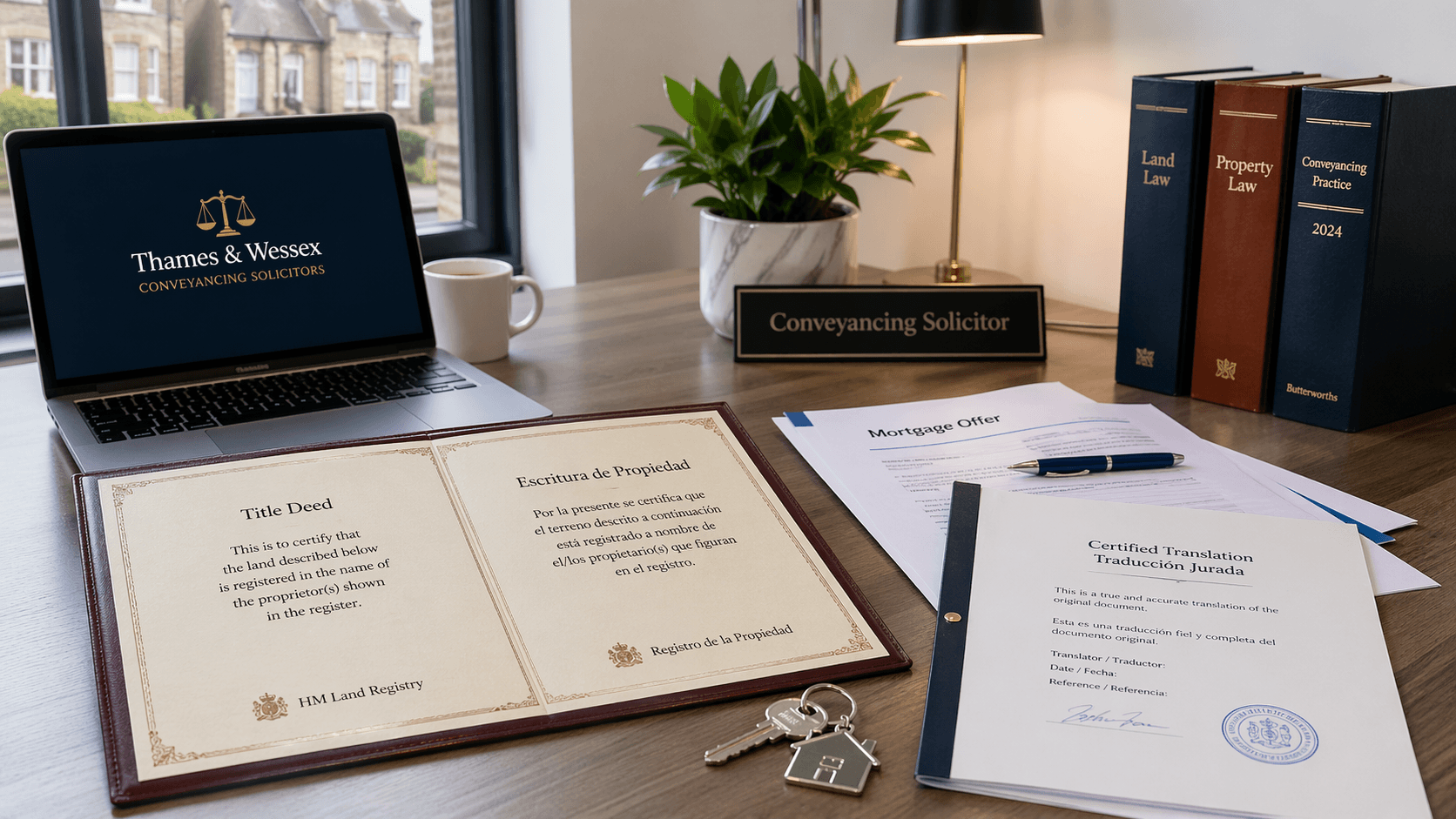
Property transactions move on deadlines, signatures, lender requirements, and evidence. When any part of the file is in another language, conveyancing document translation UK services become more than a convenience. They become part of the transaction pack itself.
Whether you are selling a flat with foreign-language title paperwork, buying with overseas proof of funds, or trying to satisfy a solicitor’s request for identity or name-change evidence, the translation has to do one thing above all: remove doubt. It must be complete, clearly certified, and usable by the people reviewing the matter.
If you need help quickly, send your file to UK Certified Translation and request a quote before your solicitor raises further requisitions or your lender asks for a tighter turnaround.
How to choose the best conveyancing document translation service in the UK
When people ask for the best conveyancing document translation service in the UK, they are usually not looking for a vague superlative. They are looking for the provider least likely to cause delay in a property matter.
In practice, the best service for conveyancing work is the one that can:
translate deeds, mortgage papers, proof-of-funds records, identity documents, company documents, and supporting legal evidence
provide a clear certified translation suitable for official submission
advise early on whether certified translation is enough or whether notarised or sworn translation is needed
handle personal, financial, and legal documents securely
quote on the full pack rather than one isolated page
work to a real deadline linked to exchange, completion, lender review, or registration
For property matters, the strongest provider is not the one making the biggest claim. It is the one reducing risk in the file.
What conveyancing document translation means in practice
Conveyancing document translation covers the documents that support a property sale, purchase, remortgage, transfer of equity, inheritance matter, or ownership query when some or all of the paperwork is not in English.
That can include the core property file itself, but it often includes the supporting proof around it too:
- property sale documents translation for deeds, powers of attorney, company papers, and supporting records
- solicitor paperwork translation for client due diligence, declarations, and supporting evidence
- mortgage documents translation for lender-facing paperwork, bank evidence, and related financial documents
- identity and civil-status records used to explain name differences or ownership history
- overseas corporate or registry documents linked to ownership or authority to sign
In other words, the translation is rarely “just a translated page.” In good conveyancing practice, it is part of the proof chain.
Why translation errors cause delays in property matters
Most delays do not happen because a document was translated at all. They happen because the wrong thing was translated, the pack was incomplete, or the proof around the translation was weak.
The most common problem points are:
- Partial translation
A key stamp, handwritten note, margin entry, or seal is left out. - Wrong level of certification
Certified was enough, but notarised was ordered unnecessarily — or notarisation was required and nobody confirmed it early. - Name inconsistency
Passport spelling, deed spelling, marriage records, and bank evidence do not line up clearly across the file. - Unreadable scans
The source document is blurred, cropped, or missing the reverse side. - Late submission
The translation is ordered only when exchange or completion pressure is already high.
A strong translation process solves these issues before they become solicitor queries.
Which documents usually need translation in a sale or purchase

Every matter is different, but the documents below come up repeatedly in property transactions and related legal checks.
Seller-side documents
A seller may need translated documents where ownership or authority has to be proved clearly. Common examples include:
- overseas title deeds or registry extracts
- foreign-language powers of attorney
- inheritance documents affecting title
- marriage certificates, divorce records, or deed poll evidence explaining a name change
- company documents if the seller is a corporate entity
- resolutions authorising a signatory
Buyer-side documents
A buyer’s file often includes supporting evidence that sits outside the transfer deed itself. Common examples include:
- overseas bank statements used as supporting financial evidence
- source-of-funds or source-of-wealth records
- foreign payslips, tax papers, or business accounts
- identity documents and civil-status records
- company incorporation documents for special purpose vehicles or overseas buyers
- proof of address or supporting declarations
Lender and mortgage-related documents
Mortgage documents translation is especially important when a lender, broker, solicitor, or compliance team needs to understand supporting evidence without ambiguity. This can include:
- mortgage offer support documents
- foreign-language bank letters
- loan confirmations
- property valuation support papers
- financial statements
- overseas employment or company records linked to affordability checks
Property sale documents translation: where sellers get caught out
Sellers often assume the buyer’s solicitor only needs the transfer paperwork. In reality, the issue is usually the evidence around ownership, authority, and identity.
A few high-risk scenarios:
Name changes across old and new documents
A title record may show one version of a name, while a passport, marriage certificate, or foreign civil record shows another. If the supporting proof is in another language, it must be translated in a way that makes the chain easy to follow.
Inherited property
Where a property has passed through probate, succession, or inheritance arrangements abroad, the supporting court or registry paperwork may need translation before the conveyancer can rely on it.
Attorney or representative signatories
If a person is signing under a foreign power of attorney, the conveyancer needs confidence not just in the wording, but in the authority behind it.
Corporate seller structures
If the seller is an overseas company, constitutional documents, board resolutions, and authority-to-sign evidence may all need translation as part of the registration or review process.
Purchases, mortgage documents, and buyer proof
Buyers are often the ones under the most time pressure because lender requirements, compliance checks, and completion dates can move faster than expected.
A buyer may need translation support for:
- proof of funds documents in another language
- overseas employment evidence
- corporate ownership documents
- identity documents used for verification
- mortgage-related support papers
- relationship or family documents where joint purchase details need to be evidenced
The key point is this: if a solicitor, lender, or reviewer cannot independently understand a document, they cannot comfortably rely on it.
That is why fast turnaround matters — but speed only helps when the translation is also complete, traceable, and delivered in the correct format.
What “proof” should come with the translation

In property matters, proof is not only the translated wording. It is the credibility of the translation pack.
A strong conveyancing translation pack should include:
- a full translation of all relevant visible text
- a certification statement confirming accuracy
- the date of translation
- the translator’s or authorised representative’s name
- signature where required for the destination
- contact details that allow the translation to be verified
- clear matching between the original document and the translated document
For stricter or international matters, the pack may also need:
- a hard-copy version
- notarisation
- apostille or legalisation
- a layout that mirrors the original closely enough for easy comparison
This is the difference between “we translated it” and “we produced evidence your solicitor can actually use.”
Are certified translations usually accepted in UK property matters?
In many UK property matters, a properly prepared certified translation is the practical starting point because the reviewer needs a translation that is complete, signed, dated, and easy to verify.
That said, acceptance always depends on the receiving party. A solicitor, lender, conveyancer, registry, overseas authority, or court may ask for a higher level of formality if the matter is cross-border or unusually high risk.
The safest approach is simple: treat certified translation as the normal starting point, but always follow the exact wording given by the person or authority asking for the document.
This is especially important for:
documents linked to overseas companies or overseas entities
foreign powers of attorney
inheritance or succession papers
identity records used to explain a name discrepancy
proof-of-funds or source-of-wealth documents being reviewed for compliance
Certified, notarised, or sworn: what should you order?
This is where many transactions lose time and money.
Certified translation
For many UK-facing submissions, certified translation is the starting point. It is usually the right option when the receiving party needs a professional, signed statement confirming that the translation is a true and accurate rendering of the original.
Notarised translation
Notarised translation is generally relevant when a foreign authority, overseas court, embassy, or formal legal process specifically asks for notarisation. It adds another layer of formal authentication, but it should not be ordered by default.
Sworn translation
Sworn translation is usually tied to the legal framework of the country where the document will be used. If the destination authority specifically asks for a sworn translator or court-authorised format, that requirement should be checked before work begins.
A practical rule
If your solicitor, lender, registry, or receiving authority says certified, order certified.
If they say notarised, order notarised.
If they say sworn, confirm the country requirement and follow that route precisely.
When in doubt, send the exact wording from the receiving authority with your file. That one step can prevent over-ordering, under-ordering, or a last-minute reissue.
The documents to send for a faster quote and smoother turnaround
If you want fast turnaround without unnecessary back-and-forth, send all of this at the start:
- A clear scan or photo of every page
- The destination of the translation
- Your deadline or exchange/completion date
- Whether you need PDF, hard copy, or both
- Any guidance from your solicitor or lender
- A note of any spelling sensitivities for names and addresses
That gives the translator enough context to quote accurately and prepare the correct service level from the beginning.
A simple conveyancing translation checklist
Before you approve the order, check these points:
- Have you sent every page, including stamps and reverse sides?
- Do names need to match a passport exactly?
- Does your solicitor want a PDF, a hard copy, or both?
- Has anyone specifically asked for notarisation or a sworn version?
- Are company records, powers of attorney, or supporting declarations included?
- Is the deadline linked to exchange, completion, registration, or lender review?
This short checklist is often the difference between one clean order and multiple urgent corrections.
Solicitor paperwork translation: how to make life easier for your conveyancer
Solicitors are not looking for literary translation. They are looking for documents they can trust, review, and place in the file with confidence.
That means your translation should be:
- complete rather than selective
- easy to match against the original
- professionally certified
- consistent in names, dates, and document references
- delivered in a format that fits the matter timeline
A useful rule is to think like the reviewer. If they had to justify relying on this document tomorrow, would the translation pack answer their questions without another email chain?
Fast turnaround: what it really depends on
Fast turnaround is not only about speed promises. It depends on five practical things:
- document volume
- language pair
- legibility of the source scan
- whether certification alone is enough
- whether hard copy, notarisation, or extra formatting is required
A short, clear document can often move quickly. A multi-document property file with company papers, financial evidence, handwritten notes, and tight completion timing needs a more managed approach.
The smartest move is to request the quote as soon as the first non-English documents appear in the matter, not when contracts are ready to exchange.
Typical scenarios where this service adds real value
Scenario 1: Sale with foreign-language ownership evidence
A seller needs to explain a surname difference between historic title records and current ID. The supporting marriage certificate and civil record are not in English. A certified translation pack helps the conveyancer link the identity trail clearly.
Scenario 2: Purchase backed by overseas funds
A buyer is asked to provide translated bank evidence and supporting financial paperwork. The value here is not just translating the pages, but making the pack complete and reviewable for the solicitor’s compliance checks.
Scenario 3: Overseas company buying or selling property
The matter involves constitutional documents, signatory authority, and supporting registration paperwork. Here, precision matters because the documents do legal work — they are not simply background reading.
Scenario 4: Last-minute mortgage support request
A lender or solicitor asks for urgent translation of supporting documents close to exchange. A responsive UK service with fast turnaround can protect momentum, provided the source file is complete and readable.
Why clients choose a specialist UK service
Conveyancing files are sensitive. They involve money, deadlines, legal responsibility, and identity evidence. A general translation workflow is not enough.
Clients typically want:
- a UK service that understands official submission standards
- straightforward communication with a real point of contact
- clear advice on certified versus notarised requirements
- secure handling of personal and financial documents
- fast turnaround when a property matter becomes time-critical
UK Certified Translation positions its service around certified, sworn, and notarised document workflows, with quote support, direct contact, and guidance on what level of proof is needed for the destination.
For property matters, the practical priority is a complete document pack, clear certification and a turnaround agreed against the solicitor, lender or registration deadline.
Why UK Certified Translation fits conveyancing matters
For property-related work, the real value is not simply language coverage. It is operational clarity.
UK Certified Translation offers:
- certified translation for official document use
- notarised translation where extra authentication is required
- sworn translation support for country-specific legal requirements
- contact-based quoting for unusual or high-stakes files
- a UK-facing service model suited to solicitors, individuals, and businesses
When users search for the best conveyancing document translation services in the UK, they are usually trying to find one provider that can deal with both the property documents and the supporting proof around them. That includes deeds, mortgage papers, source-of-funds evidence, identity records, company documents, and authority-to-sign paperwork. That is the practical problem this service is designed to solve.
If your file includes deeds, company records, mortgage paperwork, or foreign-language proof that a solicitor must rely on, the safest next step is to upload the documents early and ask for the correct route rather than the fastest generic option.
Ready to move the file forward?
If you already have the documents, the easiest next step is to send the full pack with your deadline and destination details.
Request your quote from UK Certified Translation, mention that the file relates to a property sale, purchase, remortgage, or registration matter, and ask whether certified translation is enough or whether notarisation is needed.
That single message can save time, reduce avoidable queries, and help your transaction move with fewer surprises.
Frequently asked questions
Do I need conveyancing document translation in the UK for every foreign-language property document?
Not every foreign-language document in a matter will always be requested immediately, but any document your solicitor, lender, registry, or reviewer needs to rely on should be translated properly. If it supports ownership, authority, identity, funds, or compliance, it is safer to assume it may need translation.
Is certified translation enough for property sale documents translation?
Often, yes. For many UK-facing purposes, certified translation is the practical starting point. But if the receiving authority, foreign court, or overseas property body specifically asks for notarised or sworn translation, you should follow that wording exactly.
Can solicitor paperwork translation be delivered quickly?
Yes, if the source file is clear and complete. Fast turnaround is most realistic for short or well-prepared document sets. Multi-document bundles, handwritten material, and notarised packs usually need more coordination.
What should be included in mortgage documents translation?
Mortgage documents translation should include all relevant visible text, dates, figures, stamps, and notes, plus the right certification details so the lender or solicitor can review the pack with confidence.
Can I send scans instead of original paper documents?
In many cases, yes. A clear full-page scan is usually enough to quote and begin the work. But some destinations still prefer or require a posted hard-copy pack, so it is best to confirm that at the start.
What is the fastest way to get a quote for conveyancing document translation UK work?
Send every page in one message, explain that the matter is property-related, state the deadline, and include any wording from the solicitor, lender, or authority about the type of translation required.
Are your conveyancing translations suitable for solicitors, conveyancers, and lenders?
They are prepared for official-use situations where the receiving party needs a complete, certified translation that can be reviewed and verified. If your solicitor, conveyancer, lender, or another authority asks for a specific format, send that wording with your file so the correct route can be arranged from the start.
Can you translate source-of-funds and source-of-wealth documents for a property purchase?
Yes. In conveyancing matters, that can include bank statements, savings records, tax papers, payslips, business accounts, company records, and supporting financial evidence where the reviewer needs the material in English.
Can you translate title deeds, powers of attorney, and overseas company documents?
Yes. These are all document types that can arise in a property sale, purchase, remortgage, transfer of equity, inheritance matter, or overseas company transaction. The key is to send the full pack so the translation can be prepared in context rather than page by page in isolation.
How do I choose the best conveyancing document translation service in the UK?
Choose the service that understands property-related documents, explains whether certified or notarised evidence is needed, checks the destination requirements early, and can prepare a complete translation pack that your reviewer can rely on. In conveyancing, the best service is the one that removes uncertainty from the file.