


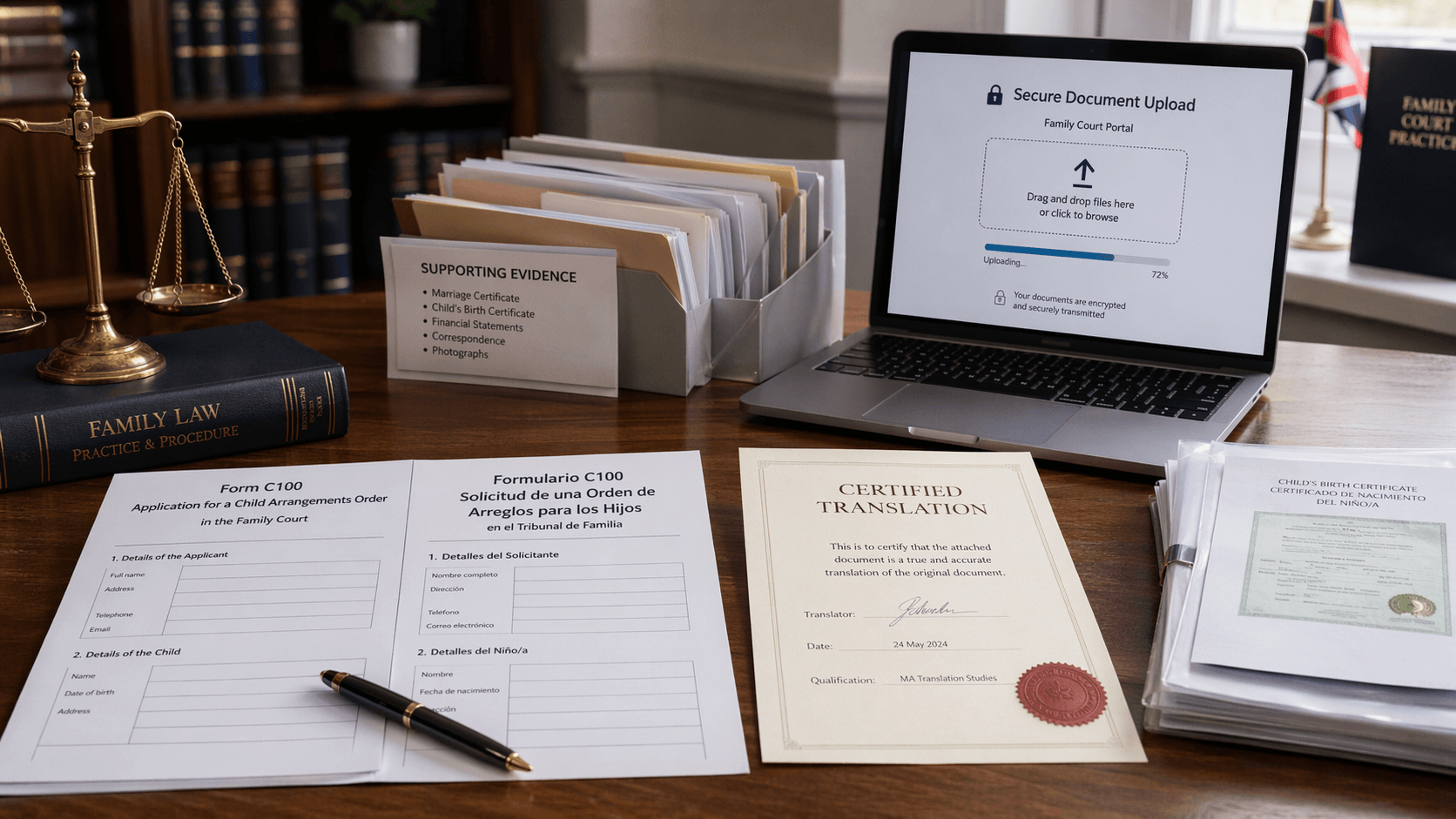
If you need hmcts form translation for a court or tribunal matter, accuracy is only part of the job. The real risk in UK filings is not just mistranslating a word. It is submitting a translated pack that does not match the original form, leaves out exhibits, breaks formatting, or arrives in the wrong filing format. That is where delays, challenges, and avoidable stress begin.
A strong HMCTS filing usually depends on three things working together:
- the right form
- the right translation standard
- the right submission format
This is why UK court forms translation should never be treated like a generic document job. Court bundles, witness evidence, affidavits, supporting records, and legal submissions all need careful handling so the translated version remains clear, traceable, and usable in proceedings.
When the filing is time-sensitive, the safest route is to upload your file, request a fast quote, and have the pack checked by a specialist before it goes anywhere near the court.
What HMCTS form translation actually covers
HMCTS forms sit across a wide range of proceedings, from family and civil matters to tribunals and specialist applications. In practice, “hmcts form translation” often includes more than the form itself.
A proper translation project may involve:
- the HMCTS form
- the supporting evidence attached to it
- stamps, seals, handwritten notes, and annotations
- witness statements or affidavits
- exhibits and appendices
- cover letters or solicitor correspondence included in the filing pack
That last point is where many mistakes happen. A party translates the headline form but leaves key attachments in the original language, or translates the text but strips out the labels, numbering, and exhibit references that make the filing intelligible.
For court use, a translated document should be treated as part of a working bundle, not as a standalone page.
The five mistakes that cause the most trouble in UK filings
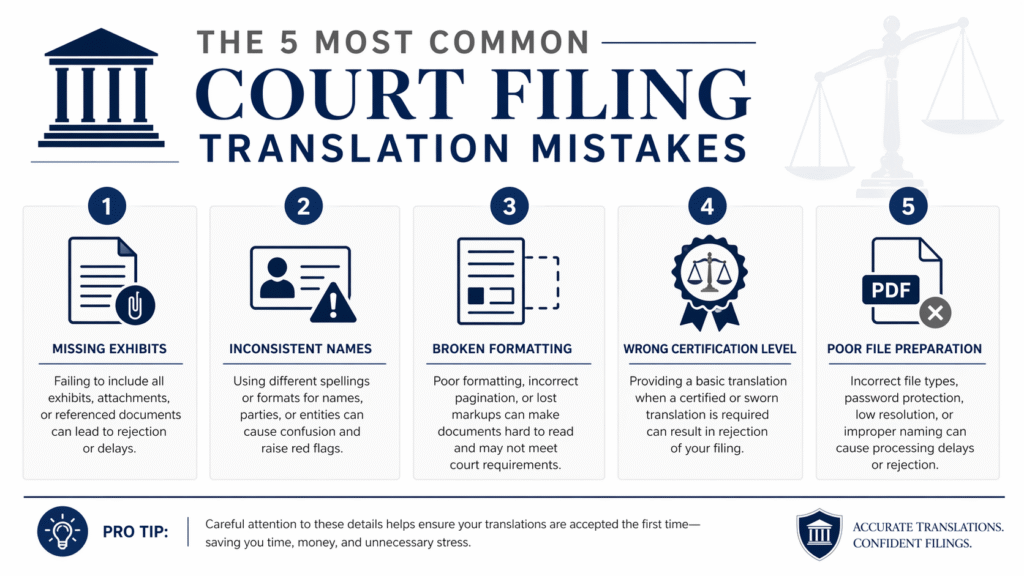
1. Translating only the form, not the filing pack
A court form rarely tells the whole story. If your filing includes foreign-language annexes, civil status documents, contracts, police records, medical evidence, or financial records, those items may also need translation.
A partial pack creates a simple but serious problem: the court can read the front end of the application, but not the material that supports it.
2. Losing the original structure
Legal submissions depend on traceability. Paragraph numbers, section titles, dates, case references, exhibit marks, and page order all matter.
If the translation is rewritten into a cleaner-looking format that no longer mirrors the source, reviewers can struggle to compare the two versions quickly. That slows down hearings, confuses bundle references, and increases the risk of procedural objections.
3. Using inconsistent names, dates, and reference numbers
This is one of the biggest avoidable errors in legal submissions.
Examples include:
- one spelling of a surname on the form and another in the translated exhibit
- date formats switched between day-month-year and month-day-year without clarification
- different transliterations of place names across the same bundle
- missing case numbers or exhibit labels in the translated version
The translation may be linguistically accurate and still create filing problems if these details drift.
4. Choosing the wrong level of certification
Not every legal document needs the same treatment.
Sometimes a standard certified translation is enough. In other cases, a court, tribunal, foreign authority, or solicitor may ask for sworn or notarised handling. Confusion here leads to wasted time, duplicated work, and unnecessary cost.
A smart first step is to send the form, the destination, and the deadline together so the provider can confirm exactly what level is needed before work begins.
5. Overlooking filing logistics
Even a well-translated document can run into problems if it is delivered badly.
Typical issues include:
- scanned pages cropped too tightly
- unreadable stamps or handwritten notes
- attachments with unclear file names
- merged PDFs that mix unrelated documents
- oversized email bundles
- translated forms supplied in a format that does not match how the court expects to receive them
This is why accurate formatting matters just as much as legal terminology.
What a court-ready translation pack should include
A reliable HMCTS translation pack should usually include the following:
A complete source record
Every page matters. That includes back pages, stamps, embossed sections, signatures, handwritten annotations, marginal notes, and any attached schedules.
A faithful translation
The content should be translated fully and clearly, while keeping the original structure usable for comparison. Good legal translation is not just about language. It is about preserving document logic.
A certification statement
For many UK official uses, the translated document should include a clear statement confirming that it is a true and accurate translation of the original, together with the translator or company details and the date.
Consistent formatting across the pack
The translation should preserve:
- headings
- paragraph numbering
- exhibit references
- dates
- names
- official reference numbers
Clean delivery for filing
Where a filing is going by email or portal, the translated pack should be delivered in a way that is easy for solicitors, litigants, and court staff to handle quickly.
If your deadline is close, the best move is to get a quote with the filing date included, rather than ordering a translation without explaining where it will be used.
Certified, sworn, or notarised: what is usually needed?
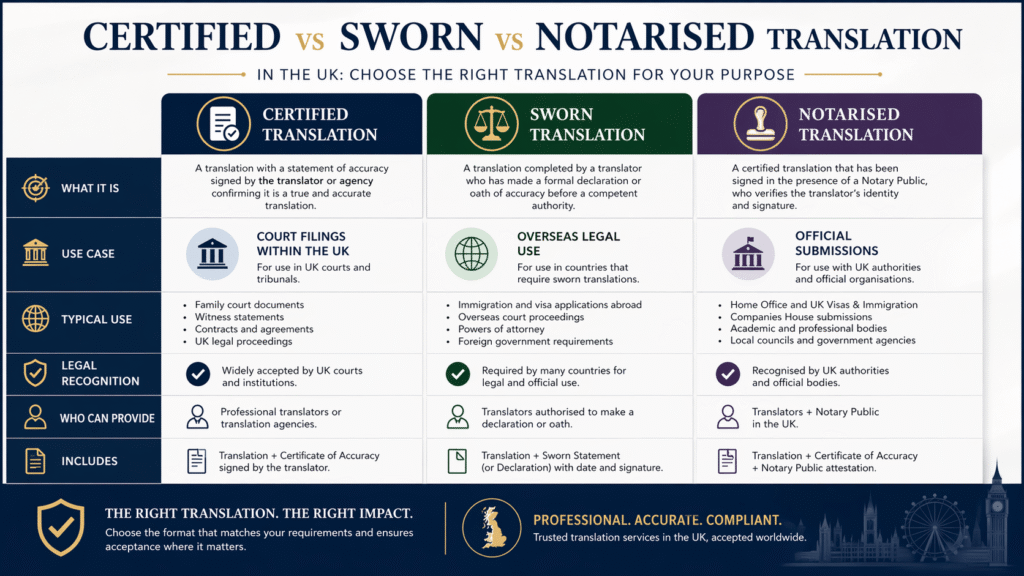
For many UK filings, a certified translation is the starting point. That is typically the right route when the court or authority wants a full translation with a formal statement of accuracy.
A sworn translation may be relevant where the document is tied to a jurisdiction that uses court-authorised sworn translators or where legal proceedings specifically require that status.
A notarised translation is usually needed when a notary must authenticate the signature or when the document is being used in a context that requires additional formalisation, especially across borders.
The practical rule is simple:
- if the instruction says certified, do certified
- if it says sworn, use sworn handling
- if it says notarised, upgrade accordingly
- if the instruction is unclear, confirm before filing
Do not assume that a more expensive option is automatically safer. The safest option is the one that matches the destination requirement exactly.
Special care for witness statements and affidavits
This is where court translation stops being routine and becomes procedural.
If a witness statement is in a foreign language, the translated version is not just a convenience for the court. It has to work within the evidence rules. The same goes for affidavits, which can involve stricter formalities.
That means the translation process should account for:
- the original foreign-language statement or affidavit
- the translated version
- certification wording
- the way the document is signed, dated, and filed
- any linked exhibits
This is one reason many legal teams prefer specialist handling rather than general document translation for witness evidence.
If your bundle includes witness material, say so at the start. It changes the job.
Accurate formatting is what keeps the filing usable
In court work, the translator is not only rendering text. They are helping preserve the internal map of the document set.
Keep the source layout recognisable
A judge, clerk, solicitor, or caseworker should be able to move between the original and the translation without guessing.
That usually means preserving:
- section order
- numbered paragraphs
- form labels
- tick-box meaning
- handwritten note placement
- stamp locations where relevant
- annex and exhibit labelling
Preserve form logic, not just sentences
Some forms are short but structurally dense. A one-line answer in the original may connect to a reference box, a continuation sheet, or an attached exhibit. If the translation smooths this out too much, the connection can disappear.
Make reviewer work easier
The strongest translation for UK filings is often the one that reduces friction for the person reviewing it.
That means:
- clean page order
- clear file names
- consistent naming conventions
- obvious matching between source and translation
- no missing pages
- no unexplained blanks or omissions
A useful working rule: if someone unfamiliar with the case can compare the source and translation in minutes, the formatting is probably doing its job.
A practical workflow for hmcts form translation
Here is the simplest way to reduce mistakes before filing.
Step 1: Gather the full pack
Include the form, every attachment, and any instruction you received from the court, tribunal, or solicitor.
Step 2: Identify where it will be filed
Say whether it is for family court, county court, tribunal proceedings, probate, or another route. Mention whether the filing is by portal, email, or hard copy.
Step 3: Flag deadlines early
If there is a hearing date, service deadline, or urgent filing window, say so immediately. This helps the translator plan QA and delivery properly.
Step 4: Confirm the certification level
If the receiving body has used words like certified, sworn, notarised, affidavit, statement of truth, or apostille, mention that in the brief.
Step 5: Request matching formatting
Ask for the translation to preserve the original layout, numbering, dates, and exhibit references.
Step 6: Review the final pack before submission
Before filing, check:
- names
- dates
- case number
- exhibit labels
- pagination
- whether every source page has a translated equivalent
- whether the final PDF or paper pack is ready in the right format
This is the stage where a secure upload and a quick pre-filing review can save a surprising amount of stress.
Real-world examples of where errors happen
Family court filing
A party submits a translated application form with an overseas marriage certificate, police report, and text-message screenshots. The form is translated, but the screenshots and one annex are not.
Result: the central claim is readable, but the supporting evidence is fragmented. The filing loses force.
County court claim
A claimant relies on a foreign-language contract and invoice trail. The translation is accurate, but the exhibit numbering does not match the original bundle.
Result: the other side struggles to verify which clause belongs to which exhibit. Time is wasted untangling the pack.
Tribunal submission
A witness statement is translated, but the translator does not preserve the date of translation, signature flow, or original wording structure.
Result: unnecessary questions arise about how the statement was prepared and whether the translated evidence can be relied on without clarification.
None of these problems start with “bad language skills.” They start with poor process.
The smartest way to order UK court forms translation
When people rush, they often ask only one question: “How fast can you do it?”
The better question is: “Can you make this filing-ready?”
A strong order brief should include:
- source language and target language
- the full form pack
- destination court or tribunal
- deadline
- whether you need digital delivery, paper delivery, or both
- whether any witness evidence or affidavits are involved
- whether you need certified, sworn, or notarised handling
That is how you get a fast quote that is actually useful, not just quick.
A simple pre-filing checklist
Before sending translated court documents, run through this list:
- Is every page translated, including stamps, annotations, and attachments?
- Do names, dates, and reference numbers match across the whole pack?
- Does the translated version preserve the original order and numbering?
- Is the certification wording included where required?
- Are witness statements, affidavits, or exhibits handled correctly?
- Are the files clearly named and easy to review?
- Are you sending the pack in the format the court or solicitor expects?
If any answer is uncertain, stop there and correct it before filing.
Why clients use a specialist provider instead of a general translator
Court filings are unforgiving. The issue is not only whether the language is right. It is whether the translated pack is usable in legal process.
That is why clients often look for:
- legal-document experience
- court-ready formatting
- secure handling
- clear certification
- urgent turnaround when deadlines are close
- direct communication when a requirement is unclear
UK Certified Translation positions its service around certified, sworn, and notarised work, with legal-document handling, specialist linguists, and quote-based support for official submissions. For court-sensitive work, that combination is far more useful than a generic translation marketplace. (UK Certified Translations)
“Uploaded my file in minutes and got the signed PDF back the next day. Solid service.”
“Their sworn translations were accepted without challenge.”
Those kinds of outcomes matter because a court filing is not judged by style. It is judged by whether it works.
Final word
HMCTS form translation is not just about converting one language into another. It is about reducing friction in UK filings.
When the translation is complete, properly certified, accurately formatted, and delivered in a filing-ready pack, you lower the risk of delay, confusion, and avoidable rework.
If your deadline is close, the safest next step is simple: upload your file, request a quote, and have the full pack reviewed before you file it.
FAQs
What is hmcts form translation?
HMCTS form translation is the translation of court or tribunal forms and related supporting documents for use in UK proceedings. In many cases, the work also includes exhibits, witness evidence, certificates, stamps, and other documents submitted as part of the filing.
Do I need a certified translation for UK court forms?
In many situations, yes. If the form or supporting evidence is not in English or Welsh, a certified translation is often the appropriate starting point. The safest approach is to check the receiving court’s direction or ask your solicitor what level of certification is required.
What is the difference between certified, sworn, and notarised translation for legal submissions?
Certified translation is generally used for official UK submissions that require a signed statement of accuracy. Sworn translation is linked to jurisdictions or proceedings that require a sworn or court-authorised translator. Notarised translation adds authentication by a notary and is often used when extra formalisation is required.
Can I submit a translated witness statement or affidavit in a UK filing?
Yes, but witness evidence and affidavits need more careful handling than ordinary supporting documents. The original foreign-language version, the translation, certification, and filing method all matter, so these should be prepared with legal-use formatting in mind.
How fast can hmcts form translation be completed?
Turnaround depends on the length of the pack, the languages involved, the certification level, and whether witness evidence or complex exhibits are included. The quickest route is to send the full pack upfront and ask for a fast quote with the filing deadline clearly stated.
What should I upload to get an accurate quote for UK court forms translation?
Upload the full form, every attachment, and any filing instruction you have received. Include the destination court or tribunal, the deadline, and whether you need certified, sworn, or notarised handling. That makes the quote more accurate and reduces the chance of later delays.