


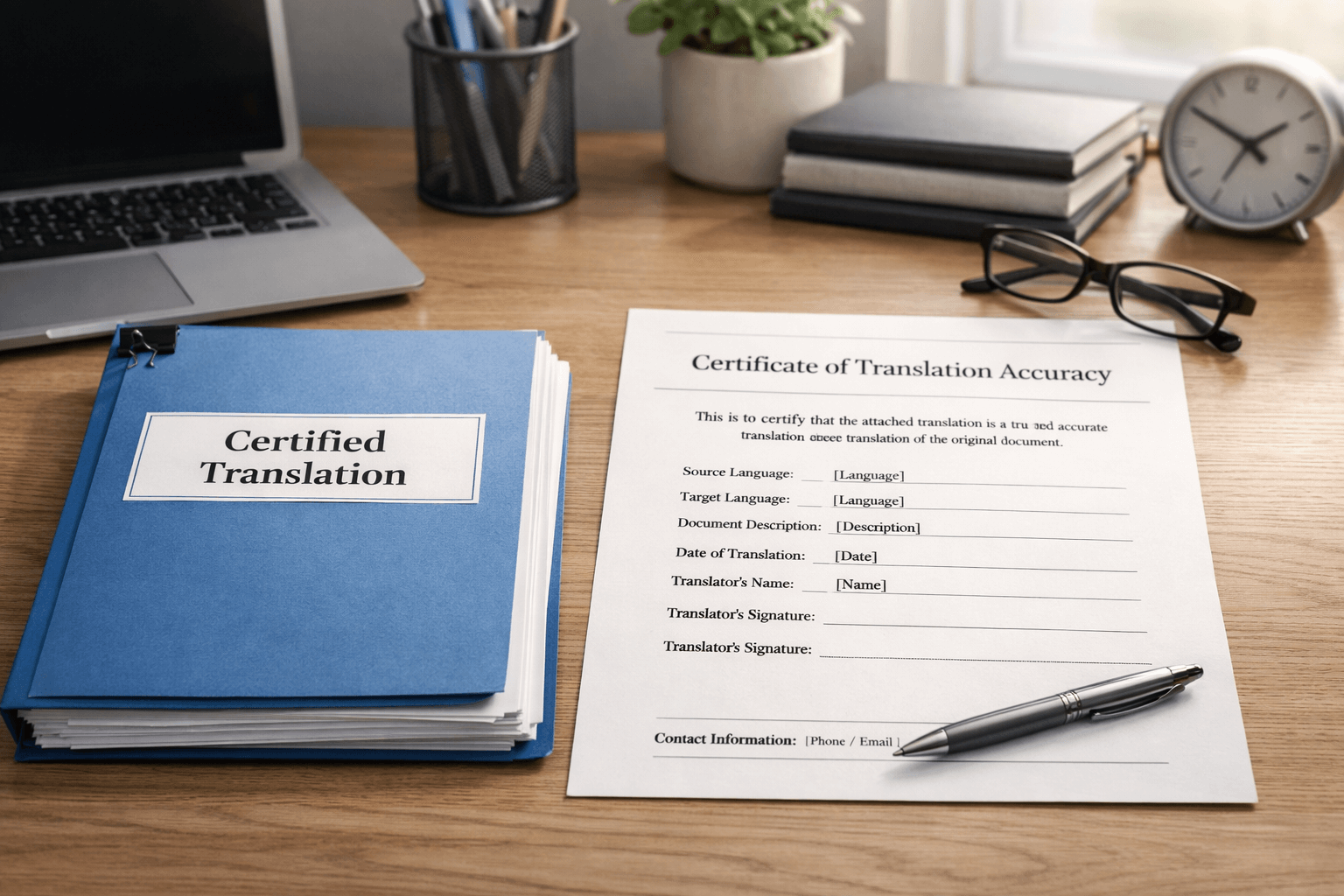
A certified translation certificate is the signed statement that turns a normal translation into an “official-ready” document. It confirms who translated it, what languages were used, and that the translation is a true and accurate translation of the original document—in the format many UK and international authorities expect.
If you’ve been asked for a certified translation stamp, a certified translation sample, or a certified translation template, this guide shows exactly what a compliant certificate looks like, what to include (and what to avoid), and several copy-and-paste examples you can use.
Need yours done quickly? You can upload your file and get a fast quote via our Contact page or view our Certified Translation service.
What “Certified Translation” Means in Practice
A certified translation is a professional translation that’s accompanied by a certificate (sometimes called a certificate of accuracy, translator’s declaration, or certification statement). The certificate confirms:
- the translation is complete and accurate
- the translator (or translation company representative) is competent to translate between the languages
- the translation is dated and signed
- the translator/company can be contacted if verification is needed
In the UK, “certified” usually refers to the translator’s written certification, not a government-issued licence. Different organisations may have slightly different preferences, but the certificate is the part that usually determines whether your translation is treated as “official”.
When You Usually Need a Certified Translation Certificate
You’ll commonly be asked for a certified translation certificate for:
- Home Office / UK immigration applications (visas, settlement, citizenship)
- HM Passport Office submissions (foreign-language birth/marriage documents)
- DVLA and driving-related paperwork
- Universities (admissions, enrolment, credential checks)
- Courts, solicitors, and legal filings
- Banks, lenders, and compliance checks
- Overseas embassies and foreign authorities (sometimes with notarisation or apostille)
If you’re unsure which level you need, start with a certified translation and upgrade only if requested:
- Certified: most common in the UK
- Notarised: often requested for overseas/legal use
- Apostille/legalisation: for international recognition of signatures/seals (where required)
You can see the options on our Services page, including Notarised Translation and Sworn Translation.
What a Certified Translation Certificate Must Include

Here’s the practical checklist many receiving bodies look for. If any of these are missing, you’re more likely to get a follow-up request (or a rejection).
Essentials (include every time)
- A clear statement that it is a true and accurate translation of the original
- Source language and target language
- Document identification (what was translated)
- Translator’s full name
- Signature
- Date
- Contact details (at minimum: email and/or phone; ideally a business address)
Strongly recommended (improves acceptance)
- Translator’s qualifications / membership (where applicable)
- Place of signing (city/country)
- Page count and/or reference to attachments (helps prevent tampering)
- A brief statement of competence/fluency in both languages
Quick rule: if someone reviewing your file can’t easily answer “who, what, when, and how to verify” from the certificate, it’s not strong enough.
Certified Translation Format: What the Finished Pack Should Look Like
A professional certified translation is usually delivered as a tidy “bundle”:
- Copy/scan of the source document (if needed for context)
- The translated text (typed, formatted, complete)
- The certified translation certificate (signed and dated)
Formatting details that help your translation look “official”
- Clear headings: document title, languages, reference numbers (if present)
- Page numbering: “Page 1 of 2”, “Page 2 of 2”
- Notations for stamps/seals/signatures using square brackets, for example:
- [Round stamp: Ministry of Justice – Registration Office – Date: 12/03/2024]
- [Signature]
- [Photo]
- Consistent spelling of names across the translation set (especially where passports are involved)
Certified Translation Stamp: Is It Required?

Many people search for a certified translation stamp because they assume a stamp is the only way a translation becomes “certified”. In reality:
- A stamp can help, especially for quick visual verification.
- But the certificate wording + signature + contact details are usually the deciding factors.
- Some organisations prefer a stamp; others don’t care as long as the certificate is complete.
What a stamp should (and shouldn’t) do
A stamp should support verification—think name/company, “Certified Translation”, date, optional reference number. It should not try to mimic government seals or reproduce protected logos.
If you need a translation with formal authentication for overseas use, you may be looking for notarisation instead. See Notarised Translation.
Certified Translation Sample: What It Looks Like (Plain-English Walkthrough)
A good certified translation sample usually has:
- The translated document laid out clearly (often mirroring the original structure)
- All visible text translated (including stamps, handwritten notes, marginal notes)
- A certification page at the end with:
- “true and accurate translation” statement
- languages
- translator name
- signature/date
- contact details
Tip: If your original has stamps or seals, don’t ignore them. Reviewers often check stamps first to confirm the translation is complete.

Certified Translation Template: Copy-and-Paste Certificate Wording
Below are several certified translation certificate templates you can adapt. Use one certificate per document (or use the multi-document version when submitting a bundle).
Template 1 — Standard Certificate of Accuracy (Most Common)
CERTIFICATE OF TRANSLATION ACCURACY
I, [Translator Full Name], certify that I am competent to translate from [Source Language] into [Target Language] and that the attached translation of [Document Name / Type] is a true, accurate, and complete translation of the original document presented to me.
Signed: _______________________
Name: [Translator Full Name]
Date: [DD Month YYYY]
Contact: [Email] | [Phone]
Address: [Business Address]
Place of signing: [City, Country]
Template 2 — Certificate on Behalf of a Translation Company
CERTIFICATE OF TRANSLATION
On behalf of [Company Name], I confirm that the attached translation of [Document Name / Type] from [Source Language] into [Target Language] has been completed by a qualified translator and has been checked for completeness and accuracy. To the best of my knowledge and professional belief, it is a true and accurate translation of the original document.
Authorised Signatory: _______________________
Name: [Full Name]
Role: [Role/Title]
Date: [DD Month YYYY]
Contact: [Email] | [Phone]
Address: [Business Address]
Template 3 — Multi-Document Certificate (Bundle-Friendly)
CERTIFICATE OF TRANSLATION ACCURACY (DOCUMENT BUNDLE)
I, [Translator Full Name], certify that I am competent to translate from [Source Language] into [Target Language]. I confirm that the attached translations listed below are true, accurate, and complete translations of the corresponding original documents provided.
| Item | Original document | Language | Translation language | Pages |
| 1 | [e.g., Birth Certificate] | [Source] | [Target] | [#] |
| 2 | [e.g., Marriage Certificate] | [Source] | [Target] | [#] |
Signed: _______________________
Name: [Translator Full Name]
Date: [DD Month YYYY]
Contact: [Email] | [Phone]
Address: [Business Address]
Place of signing: [City, Country]

Certified vs Notarised vs Sworn vs Apostille: What You Actually Need
| Type | What it is | Usually needed for |
| Certified translation | Translator’s certificate + signature/date/contact details | Most UK official use, universities, HMPO, DVLA, immigration submissions |
| Notarised translation | Notary verifies the signer’s identity/signature (adds seal) | Overseas authorities, embassies, formal legal use where notarisation is requested |
| Sworn translation | Translation tied to a sworn/court-authorised translator system (varies by country) | Civil-law jurisdictions that require sworn translators |
| Apostille/legalisation | Confirms authenticity of a signature/seal for international recognition (where required) | International submission where the receiving country requests legalisation |
If the receiving body’s wording says “certified translation”, start with certified, and if it says “notarised” or “apostille”, you’ll need the upgrade, and if it says “sworn”, it’s usually for a specific country’s legal framework—use Sworn Translation guidance and confirm the country requirement.
Digital vs Paper: Will a Signed PDF Be Accepted?
Many organisations accept a digitally delivered signed PDF, especially for online applications. But some situations still prefer (or require) a wet-ink signature and physically bound pack.
Use this rule of thumb:
- Online portals / email submissions: signed PDF is often fine
- Courts / strict legal filings / certain overseas authorities: paper pack may be required
If you’re uncertain, get it prepared for both: a signed PDF for immediate submission, and an optional printed pack if requested later.
The “60-Second Acceptance Test” Before You Submit

Before sending your translation, check these five items:
- Does the certificate clearly say true and accurate translation?
- Are languages stated?
- Is it signed and dated?
- Are translator/company contact details included?
- Does the translation include every stamp, note, and visible text?
If you can tick all five, you’re in the strongest position for acceptance.
Getting It Done Properly (Without Back-and-Forth)
If your deadline is tight or the document is high-stakes (visa, passport, court, university), the easiest route is to have the certificate and formatting handled for you end-to-end.
- View: Certified Translation Services
- If you suspect notarisation is required: Notarised Translation
- For multi-country legal use: Sworn Translation
- Ready now: Upload your file and request a quote
“Uploaded my file in minutes and got the signed PDF back the next day. Solid service.” — Emma B.
“The team kept me updated at every step and delivered exactly what I needed.” — Maria L.
FAQs
What is a certified translation certificate?
A certified translation certificate is the signed statement attached to a translation confirming it is a true and accurate translation of the original, including the date, the translator’s name, signature, and contact details.
Does a certified translation need a stamp?
A certified translation stamp is helpful but not always required. Many organisations focus on the certificate wording, signature, date, and contact details. If the receiving body specifically asks for a stamp, include one.
What should the certified translation certificate wording say?
At minimum, the wording should state the translation is a true and accurate translation of the original document, identify the languages, and include the translator’s name, signature, date, and contact details. A competence statement (“competent to translate between…”) strengthens it.
Can I use a certified translation template?
Yes—many people use a certified translation template for the certificate page. The key is making sure it includes the required elements and correctly identifies the document and languages. The templates above are designed to be adapted safely.
What is the correct certified translation format for official use?
A typical certified translation format includes the translated text plus a certificate page signed and dated by the translator (or translation company representative), with contact details, and clear notations for stamps/signatures/photos from the original.
Is a notarised translation the same as a certified translation?
No. A certified translation is certified by the translator via the certificate statement. A notarised translation adds a notary’s authentication of the signer’s identity/signature, which is sometimes required for overseas or legal use.