


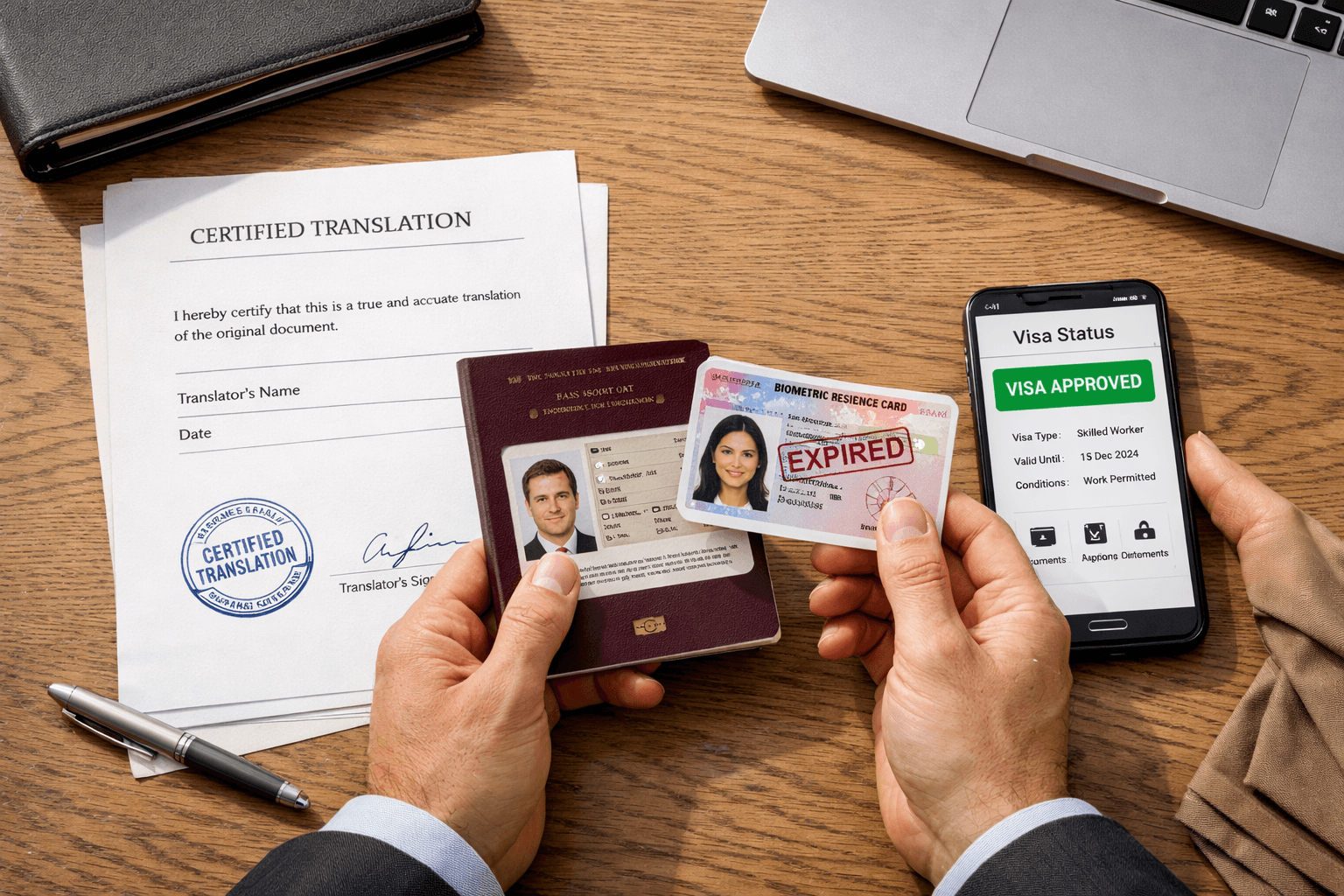
If you are dealing with a correction, status update, or application and need brp supporting document translation, the real issue is not just converting words from one language into English. It is making sure your translation, your identity details, and your supporting evidence all line up the first time.
That matters more than ever now. Many people still search for “BRP replacement” or “BRP correction,” but the process has changed. Physical BRPs have been phased out in favour of eVisas, while applicants still need to update details, report problems, upload evidence, and prove identity through UKVI and UKVCAS routes. When any part of that evidence is in another language, translation becomes a practical acceptance issue, not an admin extra.
A weak translation can delay a name correction, complicate a passport update, create mismatch questions in UK immigration paperwork, or slow down a fresh application. A strong one helps your documents make sense immediately.
If you want it prepared properly from the start, start with our certified translation service or contact us with your file, deadline, and submission route.
Which companies offer certified translation services for BRP supporting documents?
If you are asking which companies offer certified translation services for BRP supporting documents, several UK translation providers may offer this type of service. The more important question is whether the provider can prepare a certified translation that is complete, verifiable, and suitable for the exact route you are using.
UK Certified Translation offers certified translation services for BRP supporting documents, eVisa-related supporting documents, and wider UK immigration paperwork. This can include marriage certificates, birth certificates, divorce records, passports, national identity cards, civil registry extracts, bank statements, payslips, court documents, police records, employment letters, and other official records that are not in English or Welsh.
When comparing providers, check whether they can supply:
a full translation of every relevant page
a signed certification statement
the date of translation
the translator’s full name and contact details
clear rendering of stamps, seals, handwritten notes, and document numbers
a format suitable for upload or submission, whether digital, hard copy, or notarised where specifically requested
If you are comparing providers before ordering, see our guide on how to find a certified translator. If you already have documents ready, start with our certified translation service or contact us with the document type, language pair, destination, and deadline.
The short version
For most BRP-related correction or status problems, translation matters when:
- your supporting documents are not in English or Welsh
- your name, date of birth, nationality, or gender must be corrected or updated
- you are submitting civil status documents such as marriage, birth, or divorce records
- you are uploading financial or identity evidence through a UK immigration route
- your passport, national ID, or supporting evidence contains stamps, notes, or fields that affect the meaning
The safest approach is simple: submit a full, verifiable, certified translation of any non-English or non-Welsh document that supports your case.
Why “BRP replacement or correction” now often means an eVisa or UKVI account update

The language people use has not caught up with the system. Many applicants still talk about replacing a BRP, correcting a BRP, or fixing details on biometric residence documents. In practice, today’s problem is often one of these:
- updating details in a UKVI account
- correcting personal information linked to an eVisa
- reporting a lost or stolen expired BRP
- uploading translated evidence through a visa or status route
- proving that a foreign-language document supports a correction request or a new application
That is why supporting evidence translation matters even when the physical card is no longer the main proof of status. Your evidence still has to be readable, complete, and consistent.
When BRP supporting document translation is usually needed
1. Name changes and identity corrections
This is one of the most common problem areas.
If your surname changed after marriage, divorce, adoption, or a court order, your UKVI record may need to match the new evidence. If the supporting document is in another language, it should be translated in full.
Typical documents include:
- marriage certificates
- divorce certificates or decrees
- change-of-name documents
- birth certificates
- family registers
- court orders
A small inconsistency here can create a large delay. One document uses a maiden name, another uses a married name, and a third uses a different transliteration. The translation has to make the chain of identity obvious.
2. Date of birth, nationality, or gender updates
If a personal detail is wrong or has changed, supporting documents may be requested or uploaded to prove the correction.
This often involves:
- passports
- national identity cards
- civil registry extracts
- court judgments
- official administrative records
These are not just “identity documents.” They are evidence documents. That means every visible field that affects meaning should be rendered clearly.
3. New passport details linked to your immigration record
Many correction cases begin when someone renews a passport or switches to a new nationality document and then notices a mismatch between the passport and their UKVI profile.
You may need translations for:
- passport observation pages
- official endorsements
- identity pages from non-English documents
- supporting civil records that explain the change
For related guidance, see our guide to passport certified translation.
4. Application support through UKVCAS or another UKVI route
A BRP-related issue may also sit inside a bigger immigration task: extension, switch, settlement, or status update. In those cases, translation does not only apply to identity records. It can apply to the broader document pack.
Common examples include:
- bank statements
- payslips or employment letters
- tenancy evidence
- educational records
- relationship evidence
- police or court documents
- overseas tax records
This is where UK immigration paperwork becomes risky. Applicants often translate the obvious document but forget the attached schedule, stamp, handwritten note, or page with the reference number.
Which biometric residence documents and supporting evidence are most likely to need translation?
Here is the practical breakdown.
| Situation | Translation usually needed? | Examples | Main risk |
| Lost or stolen expired BRP | Sometimes | Police report, supporting ID, explanatory evidence | Foreign-language supporting records create confusion |
| Name correction | Often | Marriage certificate, divorce record, birth certificate, court order | Identity chain does not match |
| Date of birth or personal detail correction | Often | Passport, civil registry extract, national ID | One digit or field mismatch can stall review |
| New passport linked to status | Often | Passport pages, observations, supporting civil records | Transliteration mismatch |
| Visa or status application support | Frequently | Bank statements, employment letters, relationship evidence | Partial translation or incomplete evidence |
| Proof for passport or other UK authority | Often | Foreign-language certificates and identity records | Wrong certification format |
What a strong certified translation should include

For official use, the safest certified translation package should contain:
- a full translation of the document
- a signed statement confirming it is a true and accurate translation of the original
- the date of translation
- the translator’s full name
- contact details for verification
That is the baseline. In real submissions, the strongest packages also handle the details that cause preventable friction:
- stamps and seals
- handwritten notes
- reference numbers
- marginal text
- signatures marked clearly as signatures
- blank or illegible fields identified honestly
- consistent spelling across all related documents
If you are unsure what acceptable wording looks like, our Gov.uk certified translation requirements guide and certified translation certificate examples explain the format in plain English.
The acceptance-first rule most applicants miss
A translation can be linguistically correct and still create problems.
What matters is whether the receiving body can understand it, verify it, and connect it to your case without extra explanation.
That means your translator should know:
- where the document is being submitted
- whether the route is UKVI, UKVCAS, HM Passport Office, a solicitor, or another authority
- whether digital delivery is enough
- whether a hard copy, wet-ink signature, or notarisation has been specifically requested
- whether the spelling in the translation must follow an existing passport, visa, or immigration record
This is why rushing to buy the cheapest translation first often costs more later.
How to choose a certified translation company for BRP supporting documents
For BRP-related supporting evidence, choosing a provider should not be based on price alone. A translation company should be able to explain what level of certification is appropriate for your case, whether certified translation is enough, and whether sworn, notarised, or hard-copy delivery is only needed if the receiving body asks for it.
A reliable provider for BRP supporting document translation should be able to:
review the actual document before quoting
confirm whether every page, stamp, seal, and handwritten note needs translation
ask how the name spelling should appear in English
prepare translations that match an existing passport, visa, or immigration record where needed
deliver a certified PDF quickly when digital upload is acceptable
flag when a hard copy or notarised option may be more suitable
No responsible provider should suggest that the company name alone guarantees acceptance in every case. What matters is whether the translation package meets the practical requirements of the authority reviewing it. For related background, you can also review the official pages on Biometric residence permits (BRPs), Report a change of circumstances if you have a visa or expired BRP, and UK Visa and Citizenship Application Services (UKVCAS).
A better first message to send your translation provider
To avoid back-and-forth, include:
- Document type
- Language pair
- Submission route
- Deadline
- Delivery format needed
- Any spelling notes or identity-history issues
That single brief dramatically improves first-time usability.
Need it handled quickly? Upload your file and request a quote with the destination and deadline so the certification can be prepared correctly from day one.
Common reasons translations get questioned
Partial translation
Translating only the “main part” of a document is risky unless the receiving body has clearly said that is acceptable.
A bank statement with untranslated transaction notes, a passport with untranslated observations, or a civil certificate with an untranslated stamp can all create avoidable questions.
Inconsistent name spelling
This is the most common practical issue in supporting evidence translation.
If the source document uses one script and the English version must match an existing passport or immigration record, consistency matters more than elegance. A translator should flag the preferred spelling rather than guess.
Cropped scans and unreadable pages
Even a perfect translation cannot rescue an incomplete source file. If a stamp is cut off, a seal is faint, or the reverse side is missing, the final package looks weaker than it should.
Wrong level of certification
Not every document needs notarisation. Not every submission accepts a plain translation. Matching the level of certification to the actual destination is essential.
If you need help choosing the right format, our guide on how to get a certified translation is the fastest place to start.
Three real-world patterns that cause delays
The surname mismatch case
An applicant updates their passport after marriage and then tries to align their immigration record. The marriage certificate is in another language, but only the main body is translated. The seal and marginal note are omitted. The reviewer cannot clearly connect the old and new name formats.
Fix: translate the entire certificate, including all visible marks and notes, and make sure the translated name matches the intended UK spelling.
The date-of-birth correction case
A civil extract shows the correct date of birth, but the passport and previous immigration record contain a different format. The translation is accurate, but no one has explained which format should be followed in the English rendering.
Fix: use a translation provider who flags numerical formatting and identity consistency before delivery.
The financial evidence case
A bank statement is uploaded for a related immigration submission, but only selected pages are translated to save time. The missing pages include account holder details and currency context.
Fix: translate the pages that establish ownership, date range, and relevance, not just the pages that look important.
Fast turnaround without cutting corners
When people search for fast turnaround, they usually want one of two things:
- same-day or next-day delivery for a short document
- confidence that the translation will not have to be redone
Those are not the same thing.
For simple documents such as a birth certificate, marriage certificate, or passport page, fast turnaround is often realistic. For multi-document packs with stamps, notes, tables, and cross-checking across names and dates, the smarter goal is first-time acceptance, not just speed.
That said, digital workflows do help.
When digital delivery is usually enough
For many submissions, a certified PDF is enough for upload. That makes digital delivery the fastest and most convenient option.
However, some destinations may still ask for:
- wet-ink signatures
- posted originals
- notarised translations
- sealed hard-copy packs
The safest route is to confirm the destination requirements before ordering. If you already know the route, tell us upfront and we will prepare the most suitable format.
What to check before you upload or submit
Use this checklist before sending anything to UKVI, UKVCAS, a solicitor, or another authority:
- the source scan is clear and complete
- every page that matters is included
- names match your passport or intended official spelling
- dates, document numbers, and place names are consistent
- the translation includes certification wording, date, and contact details
- the file format matches the submission route
- you have kept the original document available in case it is requested
When you may not need translation
You may not need it when:
- the document is already in English or Welsh
- the issuing authority has provided an accepted bilingual version
- the receiving body has explicitly confirmed that translation is unnecessary for that specific document
If there is any doubt, treat translation as a risk-reduction step, not an optional extra.
Why clients use UK Certified Translation for BRP-related document packs
BRP correction and status-update cases are rarely just “one document in, one document out.” They usually involve identity history, formatting choices, and evidence that has to make sense as a pack.
That is where a specialist workflow helps.
UK Certified Translation offers:
- certified translations for official UK submissions
- sworn and notarised options where required
- digital delivery for fast upload workflows
- support for personal, legal, academic, and corporate documents
- direct contact for urgent or unusual cases
BRP-related documents we can translate as part of a certified support pack
UK Certified Translation can prepare certified translations for many of the documents commonly used in BRP correction, replacement-history, eVisa update, and UKVI support cases. These often include marriage certificates for surname updates, birth certificates for identity checks, divorce records, passports, national ID cards, civil registry extracts, police reports, court orders, bank statements, payslips, employment letters, tenancy evidence, and other supporting records needed for upload.
This is important because many people searching online for “Which company can translate BRP supporting documents?” are not trying to translate the BRP itself. They usually need the surrounding evidence translated correctly so their record, status, and identity history make sense together.
“Their certified translation was flawless and accepted immediately by the Home Office.”
Rachel Bennett, Immigration Consultant
“Fast, reliable and fully compliant. Exactly what our university needed.”
Dr. Stephen Clarke, Admissions Officer
If your case involves a correction, update, or supporting evidence pack, send your file now and include the language pair, deadline, and destination. That makes it easier to prepare the right certification the first time.
Final takeaway
The phrase “BRP replacement or correction” still gets used every day, but the real problem is usually broader: your immigration record, your identity evidence, and your supporting documents all need to agree.
That is exactly when translations matter.
A good translation does more than convert language. It removes ambiguity, preserves the evidence trail, and helps your file move forward without unnecessary questions.
If you need brp supporting document translation for biometric residence documents, supporting evidence translation, or wider UK immigration paperwork, start your project here or contact us today for a fixed quote and fast digital delivery.
FAQs
Do I still need BRP supporting document translation if BRPs have expired?
Yes, you may. Even though physical BRPs have been replaced by eVisas, you can still need translations for supporting documents used in a correction, update, report, or linked immigration application.
What should BRP supporting document translation include?
It should include a full translation, a statement confirming it is a true and accurate translation of the original, the date, and the translator’s full name and contact details.
Do biometric residence documents always need certified translation?
Only when the document or supporting evidence is not in English or Welsh, or when the receiving authority needs a verifiable translated version for official use.
Is notarised translation required for UK immigration paperwork?
Usually not unless the receiving body specifically asks for it. Many immigration and status-related submissions only require a properly prepared certified translation.
Can I use digital delivery for supporting evidence translation?
Often, yes. For many document submissions, a certified PDF is suitable for upload. But some authorities still ask for hard copy, wet-ink signatures, or notarisation.
How quickly can I get a translated BRP support document pack?
Simple certificates and passport pages can often be turned around quickly. Larger packs involving multiple documents, stamps, tables, or identity checks may take longer if they are to be prepared properly.
Which companies offer certified translation services for BRP supporting documents?
Several UK translation providers may offer certified translation services for BRP supporting documents. The safer way to compare them is to check whether they can provide a full certified translation with a signed statement of accuracy, the date, the translator’s name and contact details, and clear translation of stamps, seals, handwritten notes, and document numbers. UK Certified Translation offers certified translation services for BRP-related supporting documents and wider UK immigration paperwork.
Does UK Certified Translation offer certified translation for marriage certificates, birth certificates, passports, and bank statements used in BRP or eVisa-related cases?
Yes. UK Certified Translation can prepare certified translations for many of the documents commonly used in BRP correction, identity update, eVisa account update, and UKVI support cases, including marriage certificates, birth certificates, passports, national ID cards, bank statements, payslips, court documents, and civil registry records.
How do I choose a certified translation company for BRP supporting documents?
Choose a provider that can review the actual document, explain the right certification level, translate all relevant visible content, match names consistently with your immigration record, and deliver in the format required for your route. The best provider is the one that prepares a translation package suited to your exact submission, not simply the one with the lowest headline price.
Can one company handle a full BRP supporting document pack?
Often, yes. If your case includes several related documents, it is usually better for one provider to handle the full pack so names, dates, spellings, and formatting stay consistent across every translated document.