


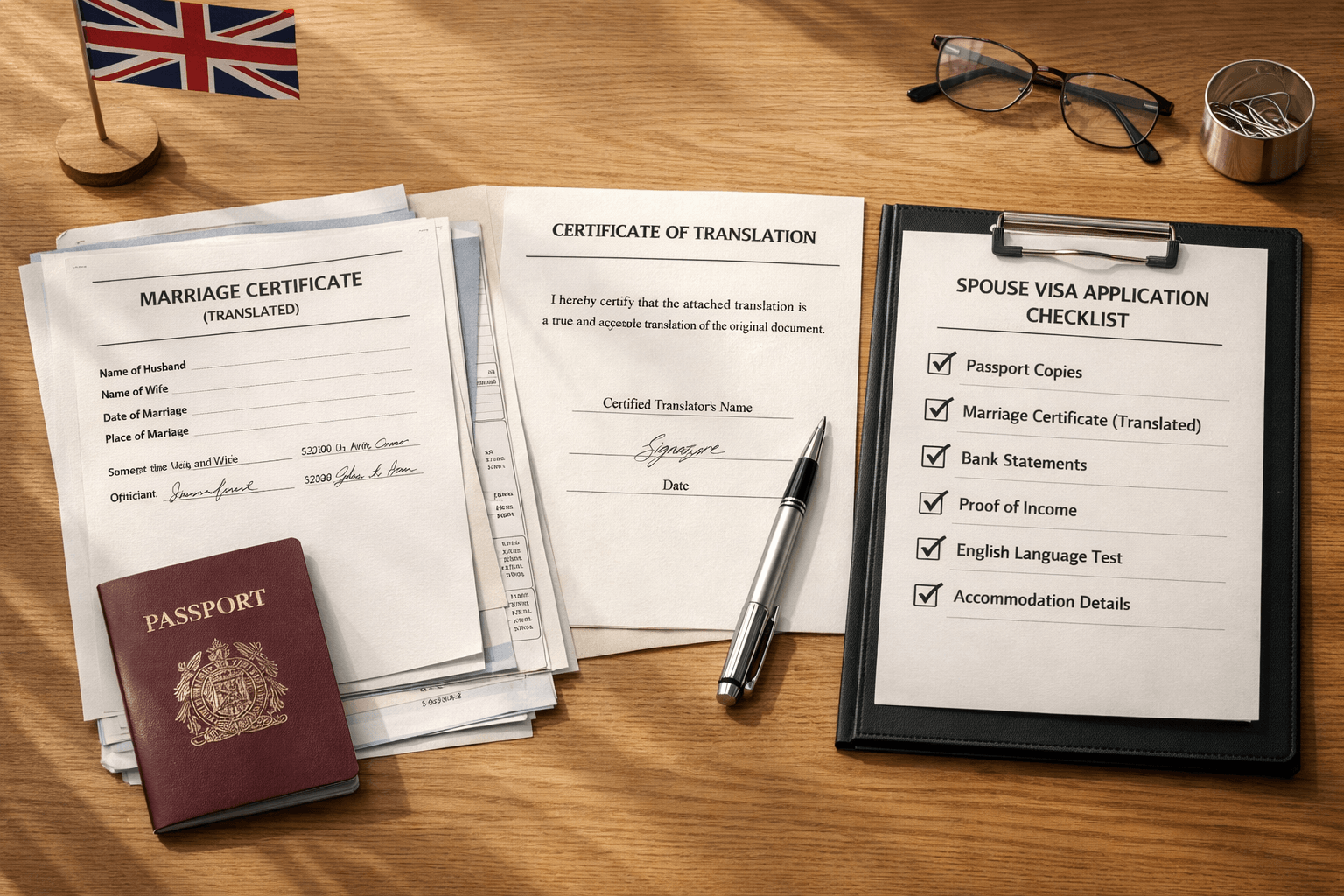
If you are dealing with spouse visa document translation UK requirements, the safest rule is simple: translate every non-English or non-Welsh document you will rely on, and translate it in full. Leave already-English or Welsh pages alone, avoid paying to translate documents you are not actually submitting, and do not assume a short summary will do the job.
That distinction matters more than most applicants realise. A spouse visa file can include marriage records, supporting documents translation for finances, accommodation evidence, previous divorce papers, relationship proof, and children’s records. Ordering too little can create delays. Ordering too much can waste money and time. The right approach is not “translate everything you own.” It is translate the evidence that proves your case.
The practical rule: If a document is part of your application bundle and any part of the relied-on content is not in English or Welsh, get it translated properly. If it is already in English or Welsh, fully bilingual, purely duplicate, or not being submitted, leave it out of the translation order.
For applicants who want the process handled without back-and-forth, certified translation services can help you sort the right certification level before submission.
What are the official requirements for translated documents for a UK spouse visa?
For a UK spouse visa, the official rule is simple: where a specified document is not in English or Welsh, the applicant should provide the document in the original language and a full translation that can be independently verified. That means the translation should not be a short summary, selected extract, or “main points only” version where the document is being relied on as evidence.
The translation should be dated and include:
confirmation that it is an accurate translation of the document
the full name and signature of the translator or an authorised official of the translation company
the translator’s or translation company’s contact details
Where the application is for leave to remain or indefinite leave to remain, the translation should also include certification by a qualified translator and details of the translator’s or translation company’s credentials.
In practical terms, spouse visa applicants should submit the original-language document together with the full translation. That is the clearest way to meet the official translation requirement and reduce avoidable questions about missing text, partial translations, or unverifiable certification.
The simplest way to decide what needs translation
Use this five-part test for every document in your spouse visa bundle:
- Are you actually submitting it as evidence?
If no, do not pay to translate it. - Is any relevant text not in English or Welsh?
If yes, translation is usually needed. - Does the page include stamps, handwritten notes, seals, endorsements, or back-page text?
If yes, those parts should be included too. - Is it already fully bilingual in a way a caseworker can easily read?
If yes, a separate translation may not be necessary. - Is the document being used for an extension or settlement-stage family route application rather than a first overseas submission?
If yes, use a provider that can issue a stronger certificate showing translator credentials as well as the standard certification wording.
That last point is often missed. Many guides talk only about the usual certificate wording, but family route evidence can require a more robust translation package when the application is made from inside the UK later in the route.
What a spouse visa translation should include

A proper spouse visa translation is not just translated text on a page. It should look submission-ready and easy to verify.
A strong certified translation normally includes:
- a statement confirming it is a true and accurate translation
- the date
- the translator’s full name or the authorised company signatory’s name
- signature
- contact details
- clear identification of what was translated
- a layout that matches the source document closely enough to avoid confusion
If you want to understand what that certification page should look like before ordering, see certified translation certificate examples.
Who can translate spouse visa documents and what counts as a compliant translation?
The official rules focus on whether the translation can be independently verified and whether the certificate wording is complete. They do not say that every spouse visa translation must be notarised. The safer standard is to use a professional translator or translation company whose identity, signature, and contact details can be checked easily.
For first-time overseas spouse visa applications, applicants usually focus on the standard certification points above. For in-country spouse visa extensions and settlement-stage family applications, Appendix FM-SE goes further and refers to certification by a qualified translator and details of credentials. That is why a stronger certificate page can matter later in the family route.
A compliant spouse visa translation should therefore be full, traceable, dated, signed, and clearly linked to the source document. A loose summary, informal explanation, or machine-only output is not the strongest standard to rely on where the document forms part of the evidence bundle.
What to translate for a spouse visa
Marriage and relationship documents
These are usually the first documents people think about, and rightly so. If they are not in English or Welsh, they should normally be translated.
Translate:
- marriage certificate
- civil partnership certificate
- household registration records showing marital status
- official relationship registration documents
- divorce decrees or previous marriage dissolution records
- death certificates of former spouses where relevant
- child custody or parental responsibility documents
- birth certificates for dependent children or for relationship evidence where relevant
If your relationship evidence includes selected letters, formal declarations, or official records in another language, those should be translated too.
Financial evidence
Financial evidence is one of the most common areas where applicants under-translate. If you are relying on a document to show income, savings, self-employment, or ongoing financial support, it needs to be readable.
Translate, where relevant:
- bank statements
- payslips
- tax certificates
- employment letters
- accountant letters
- self-employment records
- pension statements
- savings certificates
- dividend vouchers
- rental income documents
- property sale evidence where relied on
A common mistake is translating only the front page or only the “main numbers.” For spouse visa supporting documents translation, the caseworker needs the evidence to be understandable and verifiable. That often means translating the headings, entries, notes, and any stamps or annotations that affect meaning.
Accommodation evidence
Accommodation documents are often overlooked because applicants focus heavily on the marriage certificate and finances.
Translate if needed:
- tenancy agreements
- landlord letters
- property ownership records
- mortgage documents
- official housing certificates
- utility bills used to prove address or shared residence
- local authority letters related to the property
If the accommodation document is partly bilingual but the crucial legal wording is only in the source language, do not assume the English heading is enough.
Identity and civil status records
Not every identity document automatically needs translation, but many do.
Translate when relevant:
- birth certificates
- name change certificates
- national identity cards
- family books
- residence certificates
- police or civil status extracts
- adoption records
- court records affecting family status
With passports, be practical. Many passport bio pages are already multilingual enough for official use, but non-English observations, endorsements, entry notes, or linked evidence pages may still need translation if they are relevant to the application.
Children and previous relationship evidence
Where children are included or previous relationships affect the application, document translation becomes more than a box-ticking exercise.
Translate:
- children’s birth certificates
- consent letters
- custody orders
- school or guardianship records where relied on
- divorce judgments
- annulment papers
- death certificates
- court orders affecting parental rights
These documents often carry stamps, side notes, or reverse-page endorsements. Those details are exactly the sort of thing applicants miss when they assume only the central text matters.
What you can usually leave untranslated
This is where applicants save the most money.
You can usually leave these untranslated:
- documents already fully in English or Welsh
- properly bilingual documents where the English version is complete and legible
- duplicate copies of the same evidence
- blank reverse sides with no writing, stamp, seal, or annotation
- documents you are not actually submitting
- internal personal notes you used to organise your file
- your own draft checklist
- English-language cover letters you prepared for the application
- extra relationship screenshots you are not relying on
The important word is usually. The mistake is treating “leave it” as “ignore anything small.” If the back page contains a stamp, handwritten note, registry mark, or validating code, it should not be ignored.
What many applicants wrongly leave out
Some of the most expensive delays come from details that seem minor but are not.
Do not leave out:
- stamps and seals
- handwritten amendments
- side notes
- reverse-page endorsements
- registrar notes
- official remarks
- apostille pages attached to the original
- attachments referred to within the main document
- foreign-language bank statement legends that explain transaction types
- footnotes that clarify dates, account ownership, or document validity
A full translation means the caseworker can understand the document without guessing.
What “full translation” really means in practice

For UK family visa translations, “full” should be read literally. It does not just mean the main body text. It means the document should be translated in a way that preserves meaning, structure, and verifiability.
That includes:
- headings
- body text
- stamps
- signatures labels
- handwritten notes
- tables
- dates
- reference numbers
- notarial wording if present
- attached certification pages where relevant
If your original document contains a seal in one corner and a handwritten registrar note at the bottom, both matter. If a bank statement includes abbreviations or transaction descriptions in another language, those matter too.
One detail many spouse visa guides miss
Here is the part most lightweight guides skip:
Entry clearance and later family-route applications are not always treated exactly the same way when it comes to translation wording.
For first-time spouse or partner applications from overseas, applicants usually focus on the standard certificate details: accuracy statement, date, signature, and contact details. That is the baseline.
For family-route applications made later from inside the UK, especially extensions and settlement-related stages, it is sensible to use a provider that can also show translator qualifications or company credentials on the certificate. That extra layer reduces avoidable questions and makes the file stronger.
This is one reason choosing a generic low-cost translator can become a false economy. If you are unsure what level of certification your file needs, read how to find a certified translator or simply upload your file for review.
Real-world examples: what to translate and what to leave
Example 1: Marriage certificate plus financial bundle
A spouse visa applicant has:
- a marriage certificate in Arabic
- six months of bank statements in Arabic
- payslips already in English
- a landlord letter in English
- WhatsApp screenshots in Arabic
- passport bio page already multilingual
- an old family book not being submitted
Translate:
- marriage certificate
- bank statements
- selected WhatsApp screenshots only if you are using them as relationship evidence
Leave:
- English payslips
- English landlord letter
- passport bio page if already clear and usable
- old family book if it is not part of the submission
Example 2: Previous marriage ended overseas
A sponsor has:
- current marriage certificate in Spanish
- previous divorce judgment in Spanish
- decree summary in English from a solicitor
- tenancy agreement in English
- utility bills in English
Translate:
- marriage certificate
- divorce judgment
Do not rely on:
- a solicitor’s English summary as a substitute for the official translated judgment
Example 3: Child included in the application
The applicant has:
- child’s birth certificate in Romanian
- custody consent letter in Romanian
- school letter in English
- vaccination record not being submitted
Translate:
- child’s birth certificate
- custody consent letter
Leave:
- school letter
- vaccination record if not part of the evidence bundle
The biggest mistakes that delay spouse visa document translation
1. Translating only the “important pages”
Applicants often send only the page with the obvious headline information and forget the back page, stamp page, or addendum.
2. Using partial or summary translations
A caseworker is not there to reconstruct meaning from fragments.
3. Ignoring name variations
If one document says “Mohamed,” another says “Muhammad,” and a third uses a local-script spelling, the file needs consistency. A good translator will flag this rather than silently reproducing confusion.
4. Sending poor scans
Blurred stamps, cut-off edges, glare, shadows, and folded corners slow everything down.
5. Ordering the wrong certification level
Certified translation is the usual route for spouse visa evidence. Notarisation or sworn translation is not something to add automatically; it should be used only when the receiving authority or a linked overseas requirement actually calls for it.
If your case also involves a foreign authority, legalisation route, or separate embassy use, review whether notarised translation is needed before ordering extras.
How to choose a certified translator UK applicants can trust
When looking for a certified translator UK couples can rely on, do not start with price alone. Start with acceptance, traceability, and clarity.
Check that the provider can explain:
- what certificate wording will be attached
- whether the translation will be signed and dated
- what contact details appear on the certificate
- whether translator or company credentials can be shown if needed
- whether stamps, notes, and annexes are included
- what format you will receive
- how fast the turnaround is
- whether the service can be ordered online
If you want a simple route, read how to get a certified translation and then contact the team with your file.
Fast turnaround without unnecessary cost
A rushed order becomes expensive when the brief is incomplete. The fastest way to get a clean fixed quote is to send:
- clear scans of every page
- source language and target language
- where the translation will be submitted
- whether you need PDF only or hard copy
- your deadline
- a note explaining whether this is an overseas spouse visa application, an in-country extension, or a settlement-stage family application
That is how you get fast turnaround without paying for the wrong service.
For clients who want a simple online order, the easiest move is to send the full set once, not piecemeal. A complete brief usually means fewer revisions, a faster quote, and less risk of missing a page that later holds up the application.
A better rule than “translate everything”
The most efficient spouse visa strategy is this:
Translate the evidence, not the archive.
That means:
- translate every non-English or non-Welsh document you are relying on
- translate it fully, not selectively
- leave already-English or Welsh evidence alone
- leave irrelevant extras out
- use a provider that issues a certificate strong enough for your route and stage
That is the balance between compliance and common sense.
If you want the process handled properly
If your file includes marriage records, financial evidence, relationship proof, or supporting documents translation for children or previous marriages, the next step is simple: send the full bundle once and get the right advice before ordering extras.
Upload your file and request a quote if you want a clear answer on what needs translating, what can be left alone, and how to prepare a cleaner spouse visa submission.
Trust signals to place beside the main call to action
- UK-wide certified translation service
- clear certificate of accuracy
- traceable company contact details
- online file upload
- fast turnaround for urgent cases
- support for certified, sworn, and notarised routes where needed
Testimonial snippets to place near the quote form
“Uploaded my file in minutes and got the signed PDF back the next day. Solid service.” — Emma B.
“The team kept me updated at every step and delivered exactly what I needed.” — Maria L.
FAQ
Do all spouse visa supporting documents need translation in the UK?
No. Only the documents you are actually relying on and submitting need translation, and only where the relevant content is not in English or Welsh. English or Welsh documents do not need translating.
Can I translate spouse visa documents myself?
It is not the safest option. For spouse visa document translation UK submissions, the translation should be independently verifiable and properly certified, with a clear statement of accuracy, date, signature, and contact details.
Do bilingual documents need certified translation for a UK family visa?
Not always. If the English or Welsh text is complete, clear, and covers all the content the caseworker needs, a separate translation may not be necessary. If important wording appears only in the other language, translation is still advisable.
Do bank statements need translation for a spouse visa?
Yes, if you are relying on those bank statements as financial evidence and the relevant content is not in English or Welsh. This applies to headings, entries, notes, and any text needed to understand the account properly.
Do relationship messages or screenshots need translation?
Only if you are submitting them as evidence and they are not in English or Welsh. In most cases, it is better to translate selected, representative samples rather than an entire message history.
Do I need notarised translation for a spouse visa?
Usually, a properly certified translation is the starting point for spouse visa evidence. Notarised translation is generally only needed if a separate authority or linked legal process specifically asks for it.
What are the official UKVI translation requirements for spouse visa documents?
For spouse visa evidence, any specified document that is not in English or Welsh should be submitted in the original language together with a full translation that can be independently verified. The translation should be dated and include confirmation of accuracy, the translator’s full name and signature, and contact details. For leave to remain or indefinite leave to remain applications, the rules also refer to certification by a qualified translator and details of credentials.
Do I need to submit the original-language document and the translation together?
Yes. The official rule refers to providing the document in the original language and a full translation. For spouse visa applications, that is the safer submission standard to follow.
Who can translate documents for a UK spouse visa?
Use a professional translator or translation company whose work can be independently verified and whose certificate includes the required details. The key point is not a fancy label on the service, but whether the translation can be checked and whether the certification wording is complete.
Do spouse visa extensions and settlement applications need extra translator credentials?
They can. Appendix FM-SE specifically says that where the applicant is applying for leave to remain or indefinite leave to remain, the translation should include certification by a qualified translator and details of the translator’s or translation company’s credentials.
Are partial translations acceptable for spouse visa supporting documents?
They are a bad risk. The official rule refers to a full translation, so translating only selected pages, summaries, or “important bits” can weaken the file where the document is relied on as evidence.