


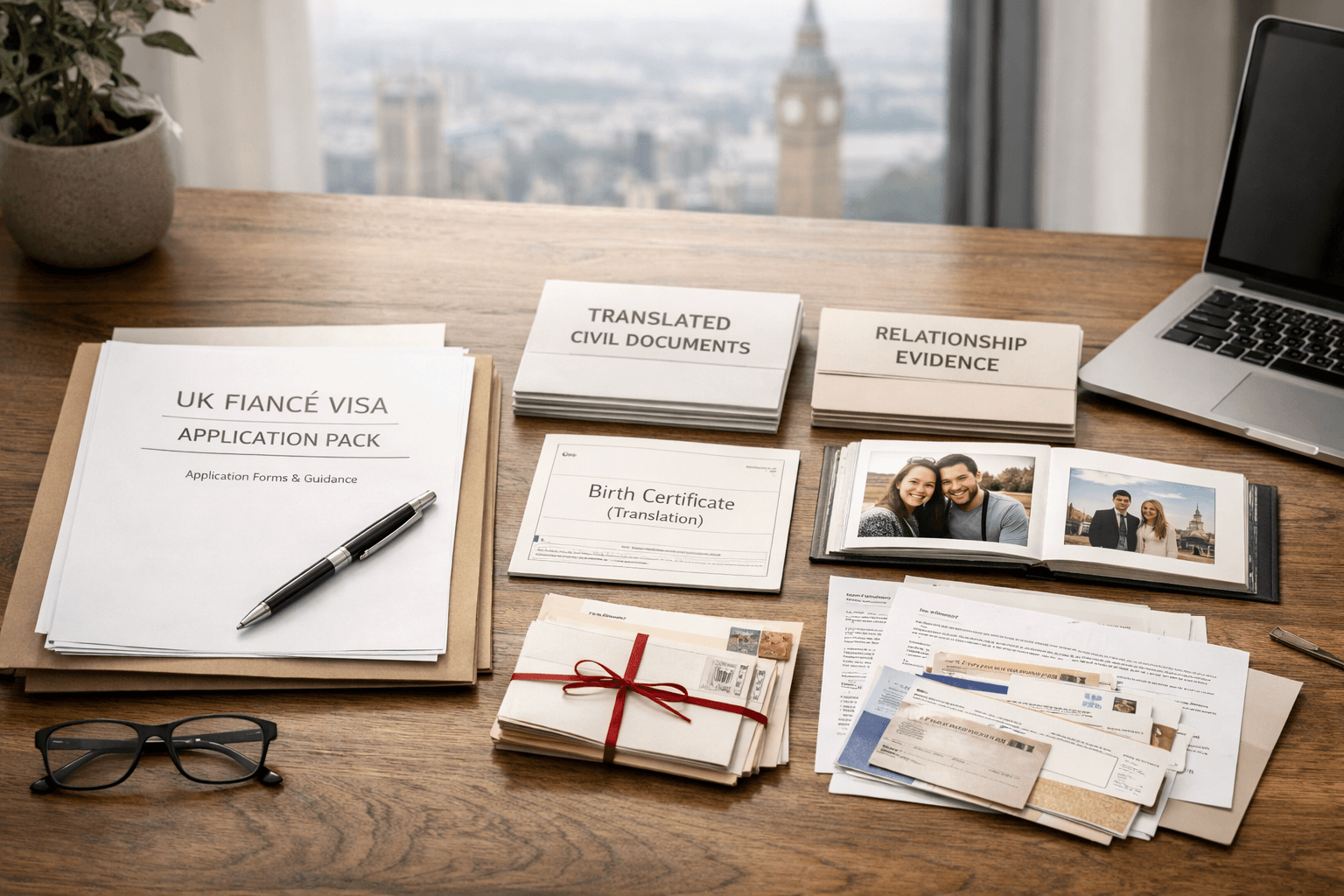
If you are preparing a partner application as a fiancé, fiancée or proposed civil partner, your translation work should be treated as part of the evidence strategy, not as an afterthought. For UK family visa cases, non-English or non-Welsh documents should be translated in a format the Home Office can independently verify, and fiancé applicants must show they plan to marry or enter a civil partnership within 6 months of arriving in the UK. The burden is on the applicant to prove the relationship requirements on the balance of probabilities. (GOV.UK)
The mistake many couples make is simple: they spend time translating the noisiest evidence instead of the strongest evidence. Hundreds of chat screenshots may feel persuasive, but current Home Office partner guidance places more weight on official, verified records than on informal material. That is why a smart fiancé visa document translation UK strategy starts with civil documents and high-value relationship evidence first, then adds supporting evidence translation selectively. (GOV.UK)
If you want to move quickly, start with a specialist certified translation service and get a quick quote before you build the final bundle.
Which documents require translation for a UK fiancé visa?
If you submit a document with a UK fiancé, fiancée or proposed civil partner application and it is not in English or Welsh, it should be accompanied by a certified translation the Home Office can independently verify. In practice, that means the translation rule is not limited to birth or marriage certificates. It usually applies to any non-English or non-Welsh document you rely on in the application bundle.
Documents that commonly need translation in a fiancé visa case
Common examples include:
birth certificates
divorce certificates, decree absolutes, final orders, dissolution papers, annulment records, or death certificates from previous relationships
household registers, family books, civil registry extracts, and official residence records
name-change certificates, deeds, or other civil status records
tenancy agreements, utility bills, council tax records, landlord letters, mortgage papers, and other address-linked relationship evidence
bank statements, joint account records, and money transfer receipts
travel bookings, boarding passes, hotel bookings, and other records showing time spent together
selected chat records, call logs, certified transcripts, or message excerpts where you rely on them as supporting evidence
tuberculosis test certificates or medical evidence, where required for the application
academic qualification documents used to prove English, where relevant
court orders, custody records, or child-related documents if they form part of the case
For fiancé visa applications in particular, applicants must prove they plan to marry or enter a civil partnership within 6 months of arriving in the UK, and that any previous marriages or civil partnerships have ended. That is why civil status records and any official documents supporting wedding plans are often among the first documents that should be translated.
What a compliant translation should include

For UK official submissions, the safest route is a full certified translation with a clear certificate of accuracy. At minimum, GOV.UK says the translation should confirm that it is a true and accurate translation of the original, and include the date, the translator’s full name, and contact details. In visa practice, applicants also commonly use a signed certificate page so the document is easier to verify and submit without back-and-forth. (GOV.UK)
A direct rule many applicants miss
For a UK family visa, the translation rule applies to any document submitted in support of the application that is not in English or Welsh, not only to certificates. That is why applicants often need certified translations for financial records, tenancy paperwork, travel evidence, court documents, or medical evidence as well as core civil records. As a practical matter, it is safer to translate the full document you rely on, including stamps, seals, side notes, and reverse-side entries, rather than only the section you think is important.
A dependable official document translation for a fiancé visa should therefore be:
- complete rather than partial
- matched to the full original document, including stamps, seals, notes, and marginal text
- clearly certified
- consistent with the spellings and dates used elsewhere in the application
- delivered in the format the receiving authority expects
For a practical explainer, link readers to what certified translation means and certificate wording examples.
Why relationship evidence and civil documents should be translated in a specific order

A stronger application is easier to assess. Current Home Office partner guidance separates evidence into broad categories such as strong, acceptable, and weak, and gives the most weight to official, verified records. That gives couples a much better roadmap for family route translations than the usual “translate everything” advice. (GOV.UK)
First priority: core civil documents
Translate these first if they are not already in English or Welsh:
- birth certificates
- divorce decrees, dissolution papers, annulment records, or death certificates from previous relationships
- marriage or civil status certificates relevant to the case history
- household registers or family books
- name-change certificates or deeds
- official residence or civil registry records
This matters because fiancé applicants must show that any previous marriages or civil partnerships have ended before the new application can succeed. (GOV.UK)
Second priority: high-value relationship evidence
If your relationship evidence depends on non-English documents, prioritise records that are official, dated, and independently checkable. Depending on your circumstances, that often includes:
- tenancy agreements, mortgage papers, landlord letters, or ownership documents
- utility bills, council tax records, or other official address-linked documents
- joint or linked bank statements
- money transfer records and bank transactions
- official letters showing the same address over time
- children’s birth certificates, where relevant
This is the kind of material that helps a caseworker follow the story of the relationship quickly. Official guidance also says relationship evidence should be recent, and examples on GOV.UK point applicants toward material that is less than 4 years old. (GOV.UK)
Third priority: supporting evidence translation
Supporting evidence still matters, but it should support the file rather than carry it. Useful examples include:
- flight, train, or bus tickets
- holiday bookings
- work or study documents explaining periods apart
- selected communication records
- photographs from time spent together
- short written statements where context is needed
Here is the key judgment call: communication records and photos can help, but Home Office guidance treats them as weaker evidence than official financial or address-linked records. For most couples, the best supporting evidence translation plan is to translate a representative sample, not an entire archive. (GOV.UK)
The overlooked point: chats and call logs should be curated, not dumped
Many applicants assume more pages equals a stronger relationship case. Usually, it just makes the file harder to read. If you rely on messages, choose a sample that shows continuity across time, major milestones, travel planning, family involvement, or practical commitment. Then translate only those excerpts cleanly and consistently.
If the evidence includes voice notes, recordings, or long non-English exchanges, a better route is often to create a certified transcript first and then translate the relevant parts. That is especially useful because Home Office partner guidance explicitly refers to communication records as evidence and even mentions certified transcripts in this context. For this type of supporting evidence translation, an internal link to transcription services adds real value. (GOV.UK)
A practical translation model for fiancé visa applications
1. Translate what proves legal eligibility
Before anything else, translate the documents that prove you are free to marry and that your civil status is clear.
2. Translate what proves the relationship most efficiently
Use official address-linked, financial, and travel records ahead of informal screenshots.
3. Translate what explains unusual facts
If you have lived apart because of work, study, culture, or caregiving, translate the records that explain that pattern rather than forcing the reader to guess. Current guidance specifically recognises that couples may live apart for legitimate reasons, but expects evidence of commitment alongside that explanation. (GOV.UK)
4. Translate samples, not clutter
A neat, chronological pack beats a huge file full of repetitive low-value material.
5. Check names, dates, and document history
Transliteration differences, old surnames, multiple spellings, and inconsistent dates are common causes of avoidable delay. A good provider will flag them before certification.
Common mistakes that weaken a fiancé visa translation pack
- Translating weak evidence first and leaving civil documents until the end
- Sending cropped scans that hide stamps, annotations, or reverse-side entries
- Mixing translated and untranslated pages from the same record
- Using inconsistent spellings for the same person across passports, certificates, and bank evidence
- Ordering a higher certification level without checking whether standard certified translation is the right fit for a UK visa submission
For most UK family-route submissions, a standard certified translation is the starting point. An upgraded notarised translation is more often relevant when another authority specifically asks for notarial authentication or overseas legalisation. (GOV.UK)
A simple example of strong vs weak translation choices
Imagine two couples preparing similar files.
Couple A translates 80 pages of chat screenshots, 25 photos, and long social media conversations, but leaves the applicant’s divorce record untranslated.
Couple B translates the divorce record, birth certificate, money transfer history, travel bookings, and a short certified transcript of selected messages that show continuity over time.
Couple B gives the decision-maker a much clearer file. The application is easier to understand because the strongest documents are readable first, and the supporting evidence translation actually supports the story instead of burying it.
Why a specialist UK service makes a difference
A generic freelancer marketplace can translate words. A specialist UK service is supposed to reduce document risk.
UK Certified Translation positions its service around official-use document work, states that its certified translations are accepted by UK institutions including UK Visas & Immigration, and says its team was founded by language professionals with over a decade of experience. The site also highlights end-to-end project coordination, a three-stage review process, and standard delivery in 2 to 4 business days with express options available. (UK Certified Translations)
That is exactly the kind of workflow couples want when they are ordering family route translations under deadline: one point of contact, a clear certification format, and a provider that understands why relationship evidence is not the same as a generic business document.
“Their certified translation was flawless and accepted immediately by the Home Office.”
— Rachel Bennett, Immigration Consultant (UK Certified Translations)
“Transparent pricing and clear communication from start to finish.”
— client testimonial on the certified translation service page (UK Certified Translations)
If the file includes civil certificates, relationship proof, and message evidence together, the cleanest next step is to upload your file and request a quick quote with the note: fiancé visa application, relationship evidence plus civil documents. That helps the team scope the right certification level from the start.
What to send when requesting a quote
To get a faster answer from a UK service, send:
- a clear scan or photo of every page
- the source language
- confirmation that the destination is a UK fiancé visa application
- your deadline
- whether you need digital PDF only or hard copies as well
- any issue with names, older surnames, or transliteration differences
Readers who want to understand pricing before ordering can be sent to how much certified translation costs and anyone dealing with a key civil record can be sent to how to get a certified translation of a marriage certificate.
FAQs
What documents require translation for a UK fiancé visa?
Any document you submit in support of a UK fiancé, fiancée or proposed civil partner application that is not in English or Welsh should be accompanied by a certified translation. Common examples include birth certificates, divorce or dissolution documents, civil registry records, name-change records, tenancy agreements, utility bills, bank statements, money transfer evidence, travel bookings, selected relationship evidence, tuberculosis certificates where required, and academic qualification documents used for English language evidence.
Do I need certified translation for a fiancé visa in the UK?
Yes. If a document you rely on is not in English or Welsh, it should be translated in a format that can be independently verified. GOV.UK says the translation should confirm it is a true and accurate translation of the original and include the date, translator name, and contact details. (GOV.UK)
Which supporting evidence translation matters most for a fiancé visa?
Start with official civil documents and high-value relationship evidence such as divorce papers, birth certificates, tenancy records, utility bills, bank statements, and money transfers. Messages, photos, and informal statements should usually support the case rather than lead it. (GOV.UK)
Can I translate my own fiancé visa documents?
A safer approach is to use a professional provider that can certify the translation properly and provide verifiable contact details. That is the standard expected in UK visa-focused translation guidance and common practice for official submissions. (Certified Visa Translation)
Do chat messages need to be translated for a fiancé visa document translation UK file?
Only if you are relying on them as evidence. In most cases, translate a representative sample rather than every conversation. If the material is audio-heavy or lengthy, a certified transcript plus translation is often cleaner and easier to assess. (GOV.UK)
Do I need notarised translation or just certified translation for family route translations?
For many UK family-route submissions, certified translation is the logical starting point. Notarised translation is more relevant where another authority specifically asks for notarial authentication or legalisation. (GOV.UK)
How quickly can I get official document translation from a UK service?
Turnaround depends on the document type, language pair, and urgency. UK Certified Translation states standard delivery in 2 to 4 business days, with express options available. (UK Certified Translations)