


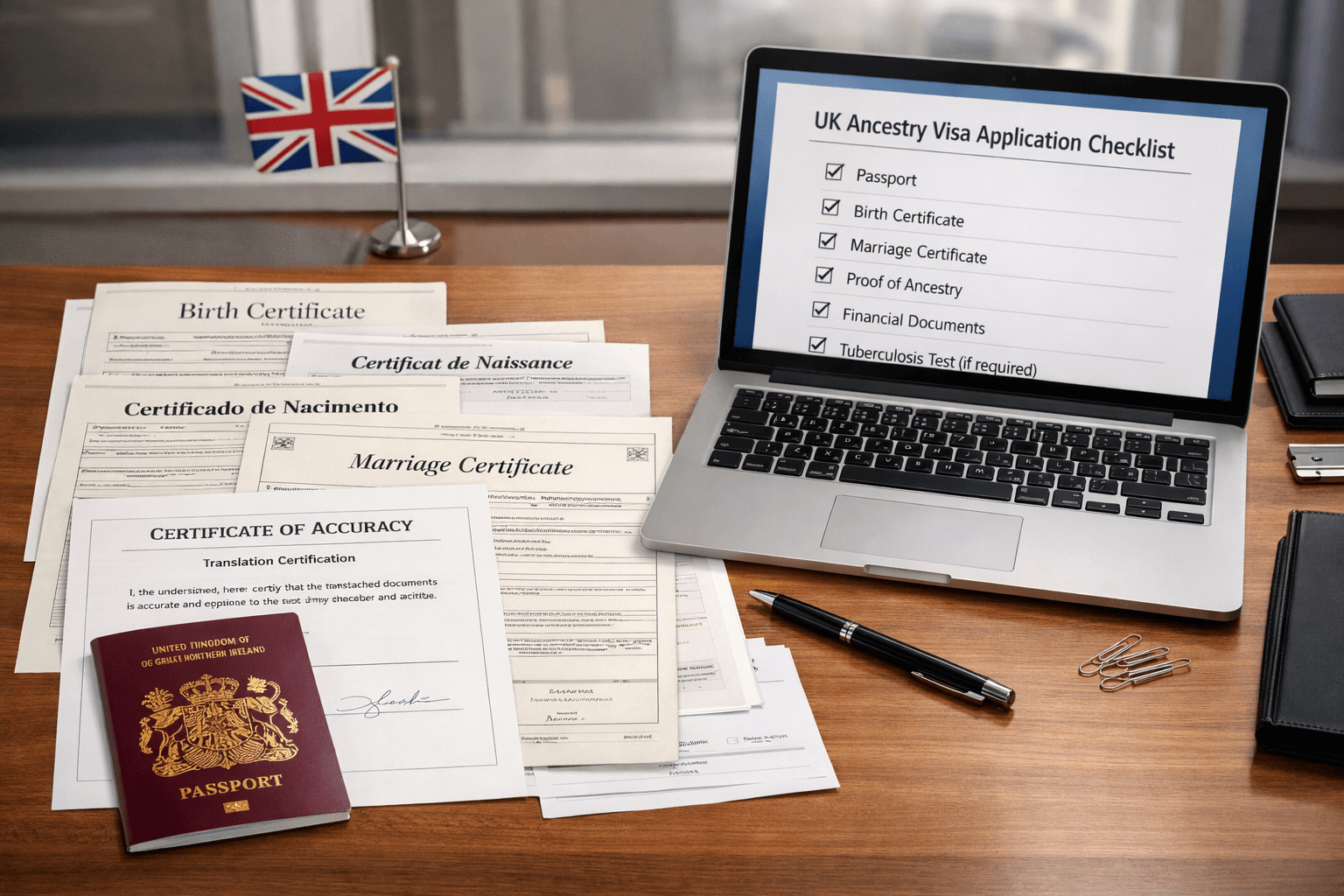
If your application depends on family records issued abroad, ancestry visa document translation uk is not just a paperwork task. It is the process that helps UK Visas and Immigration follow your family line from a qualifying grandparent to you, using full birth certificates, name-change evidence, and any other supporting records that connect each generation. A missing translation, an incomplete certificate page, or a mismatch between records can weaken an otherwise strong case. (GOV.UK)
For many applicants, the real challenge is not proving that a grandparent was born in the UK. It is proving the chain clearly, especially when the evidence runs across several countries, several languages, old civil registers, and changed surnames. That is why translating family records for a UK application has to be handled as a document strategy, not a last-minute admin task.
If you already have your records, send the full document set together. A proper pre-check can show you what actually needs translation, what only needs certification, and where the weak points are before submission.
Exactly which documents require translation for a UK Ancestry visa application?
The direct rule is simple: if you are relying on a document for your UK Ancestry visa application and that document is not in English or Welsh, it should be translated in full. For most applicants, that usually includes the full birth certificates used to prove the line from qualifying grandparent to parent to applicant, plus any marriage certificates, civil partnership certificates, deed polls, adoption papers, or dependant relationship documents needed to explain name changes or legal relationships. Supporting evidence such as bank statements, job offers, business plans, or tuberculosis test results should also be translated if you are relying on them and they are not in English or Welsh.
Documents already issued in English or Welsh usually do not need translation. Birth, marriage, civil partnership, and death certificates issued in Wales are typically issued in English only or bilingually, so they usually do not require translation. The risk point is this: if the Home Office cannot understand a document because the translation is missing or inadequate, it may disregard that evidence, and in an ancestry case that can lead to refusal if the caseworker is not satisfied that you have a qualifying UK-born grandparent.
A practical way to organise the answer is:
Core ancestry records that often need translation: your full birth certificate, your parent’s full birth certificate, and your qualifying grandparent’s birth certificate.
Bridge records that often need translation: marriage certificates, civil partnership certificates, deed polls, and adoption papers.
Supporting records that may need translation: bank statements, work evidence, relationship documents for dependants, and other supporting documents you rely on in the application.
Why family record translation matters so much on an ancestry application
A UK Ancestry application is evidence-heavy because it sits on a simple but strict question: can you prove, on paper, that you descend from a qualifying UK-born grandparent?
That usually means building a three-generation record path:
- Your qualifying grandparent
- Your parent
- You
Where any part of that path is in a language other than English or Welsh, the translation becomes part of the evidence itself. It is not a side attachment. It is what allows a caseworker to understand the names, dates, places, annotations, and legal links between documents.
This is where many applicants run into avoidable trouble. They translate one birth certificate but forget the marriage certificate that explains the surname change. Or they translate the main text but not the stamp, marginal note, or registration annotation that matters. Or they order the wrong service level and end up with a translation that looks polished but does not include the certification details expected for official use.
The family record chain UKVI usually needs to see

The most useful way to organise an ancestry case is to split records into three groups: core records, bridge records, and supporting records. That approach makes genealogical record translation much easier to manage and reduces missed documents.
Core records
These are the documents that establish the ancestry line itself.
| Record | Why it matters | Usually needs translation if not in English/Welsh? | Common risk |
| Your full birth certificate | Connects you to your parent | Yes | Short-form certificate with missing parent details |
| Your parent’s full birth certificate | Connects your parent to your grandparent | Yes | Parent names do not align with other records |
| Your grandparent’s full birth certificate | Shows the qualifying birth | Yes, if the record is not in English/Welsh | Old copies, poor scans, hard-to-read handwritten entries |
Bridge records
These explain changes across the family line.
| Record | Why it matters | Usually needs translation? | Common risk |
| Marriage certificate | Explains surname changes between generations | Yes | Maiden and married names not matched across records |
| Civil partnership certificate | May explain current legal name | Yes | Overlooked when applicant assumes only marriage matters |
| Deed poll or formal name-change record | Links old and new identity | Yes | Partial translation or missing annex |
| Adoption papers | Can support a valid ancestry claim in some cases | Yes | Only some pages translated |
| Death certificate | Sometimes useful for clarifying family history | Yes, if relied on | Submitted without explanation of relevance |
Supporting records
These do not prove ancestry on their own, but they can strengthen the application or explain context.
| Record | Why it matters | Translation need | Common risk |
| Passport pages | Confirms identity details | Often yes if the relevant page is not in English | Wrong page translated |
| Bank statements | Supports maintenance evidence | Yes if not in English/Welsh | Only selected pages translated |
| Job offer, CV, business plan | Supports intention to work | Yes if not in English/Welsh | Untranslated attachments |
| Dependant relationship documents | Needed if partner/children apply with you | Yes | Inconsistent dates or names |
That structure is more useful than a generic checklist because it shows what each document actually does. In practice, civil record translation is often about bridging identity gaps, not just translating certificates one by one.
The documents that most often get missed
The most common gaps are not the headline documents. They are the records that explain why the headline documents look different.
1. Marriage certificates that explain surname changes
A maternal line often requires more than three birth certificates. If your mother or grandmother changed surname after marriage, the application may need the marriage certificate to keep the line intact.
2. Adoption documents
Official guidance allows ancestry claims where you or your parent were adopted, but the adoption paperwork has to be understandable and complete. Partial translation is a common mistake. (GOV.UK)
3. Old annotations, stamps, and marginal notes
Historic certificates often contain handwritten notes in margins, later corrections, legitimisation notes, or registry references. These are easy to ignore and dangerous to omit.
4. Irish records in older ancestry claims
A grandparent born before 31 March 1922 in what is now Ireland can qualify under the route. That can create a more complex family-record pack, especially if records come from older church or civil archives. (GOV.UK)
5. Name variations across languages
A person may appear as Aleksandar on one record, Alexander on another, and Sandor in a third archive. That does not automatically break a case, but it does mean the translation needs consistency and, where appropriate, a translator’s note or a clear covering explanation.
What a compliant translation should include

For UK visa supporting docs, the translation itself has to be full, readable, and traceable. At minimum, the translation should clearly confirm accuracy, show the date, include the translator’s full name, signature, and contact details, and be capable of being independently verified. Home Office caseworker guidance also warns that if a translation does not meet the required standard and the document cannot be understood, the evidence may be disregarded. (GOV.UK)
A strong certified translation for an ancestry application should also do the following:
- Translate the entire document, not just selected fields
- Reproduce seals, stamps, handwritten notes, and annotations where visible
- Mirror the structure of the source record where possible
- Keep names and dates consistent across the whole file set
- Identify unclear text honestly rather than guessing
- Match the authority’s required format if one has been specified
One practical detail that many guides miss: if the record is already in English or Welsh, translation is not usually needed. In Wales, birth, marriage, civil partnership, and death certificates are typically issued in English or bilingually, so they generally do not require translation. (GOV.UK)
Quick checklist: what the Home Office expects a translation to contain
A clean ancestry visa translation checklist helps both readers and caseworkers. The safest format is a full translation that includes confirmation that it is an accurate translation of the original document, the date of translation, the translator’s full name and signature, and the translator’s contact details so the translation can be independently verified. Current caseworker guidance for permission to stay or settlement also refers to certification by a qualified translator and inclusion of translator or company credentials.
That matters because incomplete or non-verifiable translations are not just “less ideal.” If the document cannot be understood, the Home Office may disregard it as evidence. On a UK Ancestry case, that can affect the core issue of whether the family link to a qualifying grandparent has been proved.
Certified, notarised, or sworn: which one do you actually need?
This is where applicants often overspend.
For most UK immigration submissions, what matters is a certified translation that contains the right declaration and verification details. Not every ancestry case needs notarisation. Not every official document needs a sworn route.
A simple rule of thumb:
- Certified translation: usually the correct starting point for UK visa and immigration submissions
- Notarised translation: usually only needed if a specific authority or overseas body asks for notarial authentication
- Sworn translation: usually relevant when a foreign jurisdiction requires a court-authorised sworn translator
If you are submitting to UK authorities, do not assume that “more official” always means “better.” The right format is the one the receiving authority expects.
A better way to prepare your file set
Before ordering any translation, build a one-page family record map.
Use this format:
- Grandparent: full birth certificate
- Grandparent: marriage certificate or other name-change record
- Parent: full birth certificate
- Parent: marriage certificate or deed poll
- You: full birth certificate
- You: passport and any name-change record
- Any adoption or dependant records if relevant
Then mark each item:
- Already in English/Welsh
- Needs certified translation
- Needs review because of name/date mismatch
- Needs better scan
This single step saves time, reduces duplicate work, and produces faster turnaround because the translator can see the whole chain from the start.
Three real-world ancestry translation scenarios
Scenario 1: Maternal line with two surname changes
Your grandmother’s birth certificate is in one surname. Your mother’s birth certificate shows another. Your own birth certificate shows a third.
What actually solves this case is not just translating the three birth certificates. It is translating the marriage certificate that links the grandmother’s maiden name to the later surname, and any further civil record translation that connects your mother’s current legal name to yours.
Scenario 2: Parent adopted, records from two countries
Your parent’s adoption is legally valid, but the adoption order and supporting registry papers are in another language.
Here, the safe approach is full translation of the adoption documentation, not just the first page. The goal is to let the decision-maker understand the legal relationship without guessing.
Scenario 3: Old family archive record plus modern support documents
Your qualifying grandparent’s birth record is old and difficult to read, but your own passport, bank evidence, and work documents are modern.
This is where a mixed pack matters. The historic document needs careful handling, while the supporting documents need consistent formatting and fast turnaround so the whole application stays on schedule.
Common mistakes that delay ancestry visa applications
The most expensive mistakes are usually simple.
Ordering translation before checking the whole chain
If you translate records one by one, you are more likely to miss the bridge document that connects them.
Using short-form certificates
Short-form certificates often leave out parents’ names and other key details. For ancestry cases, full certificates are far safer.
Translating only the visible body text
Stamps, seals, marginal notes, registry references, and handwritten amendments can matter.
Assuming a passport translation is enough
A passport confirms identity. It does not prove lineage.
Treating every case as “birth certificates only”
Many ancestry cases are really about the bridge between generations. That is why genealogical record translation needs a relationship-first approach.
Waiting until the final week
Fast turnaround helps, but urgency should not replace document strategy. A rushed translation of the wrong set is still the wrong set.
What to send for a clean quote and faster turnaround
If you want an accurate quote and a smoother process, send:
- A clear scan or photo of every page
- The language pair
- The country and authority where you are submitting
- Your deadline
- Whether you need digital PDF only or also hard copy
- A note on any known issues, such as old handwriting or missing edges
Sending the whole ancestry chain together is almost always more efficient than sending documents one at a time.
If you are unsure what service level is right, ask for a review before work starts. That is the easiest way to avoid paying for notarisation or sworn translation when a certified translation would have been enough.
Why applicants choose UK Certified Translation for ancestry cases
An ancestry file is not just a translation order. It is a document chain with legal consequences.
UK Certified Translation is well positioned for this kind of work because the service focuses on official document translation, offers certified, sworn, and notarised options, and presents itself as accepted for UK authorities including UK Visas & Immigration. The business also lists a London contact address, which is helpful for applicants who want a responsive local point of contact for urgent submissions. (UK Certified Translations)
What applicants usually want is simple:
- A complete translation that will make sense to a UK caseworker
- A provider that understands birth, marriage, adoption, and identity records
- A fast turnaround option when deadlines tighten
- A team that can tell them what needs translating before money is wasted
“Solid service.” — Emma B., Operations Manager (UK Certified Translations)
If your records span several generations and several languages, send the full set first. A good review can spot missing links before they become expensive delays.
Final word
The strongest ancestry visa files do not just prove a family story. They prove a paper trail.
That is why the smartest approach is to treat translation as part of the evidence strategy from day one. Start with the relationship chain. Identify the bridge records. Translate the full documents, not just the obvious ones. Make sure the certification details are complete. Then submit a file that reads clearly from grandparent to applicant.
If you are ready to move forward, send your scans for review and ask for a document-chain check before translation begins. It is the fastest way to find out exactly what your ancestry application needs.
FAQs
Do I need ancestry visa document translation UK services for every family record?
No. You generally only need translations for records that are not in English or Welsh and that you rely on as part of the application. In practice, that often includes birth certificates, marriage certificates, adoption papers, deed polls, and other supporting documents that connect the ancestry line.
What is the most important genealogical record translation in an ancestry case?
The most important records are usually the three core certificates that connect grandparent, parent, and applicant. But the most overlooked records are often the bridge documents, such as marriage certificates or formal name-change records, that explain why names differ across generations.
Can I submit a civil record translation without a certificate of accuracy?
That is risky. For official UK submissions, the translation should include a clear accuracy statement, date, translator identity, signature, and contact details so it can be verified.
Do I need notarised translation for UK visa supporting docs?
Usually not unless the receiving authority specifically asks for it. Many UK immigration submissions only require a properly prepared certified translation.
How fast can ancestry visa translations be completed?
That depends on the language pair, scan quality, number of records, and whether there are handwritten or historic documents. Standard civil record translation can often move quickly, but complex multi-generation files should be reviewed as one pack to avoid rework.
Can your London team check which records need translation before I order?
Yes. If you send the full ancestry chain together, the file can be reviewed to identify what needs translation, what may need explanation, and what is already acceptable as issued.
Do all non-English documents in a UK Ancestry visa pack need translation?
If you are relying on the document and it is not in English or Welsh, the safe rule is yes. That covers both core ancestry evidence and supporting records such as financial evidence, work evidence, and relationship documents for dependants where those documents are part of the application.
Can I use a translated short-form birth certificate for a UK Ancestry application?
Usually that is the wrong starting point. The published UK Ancestry document checklist asks for full birth certificates for you, your parent, and the grandparent your claim is based on. Translating a short-form certificate does not fix the problem if the document itself omits the parental details needed to prove the chain.
Do stamps, seals, handwritten notes, and marginal annotations need to be translated?
They should not be ignored. The Home Office must be able to understand the evidence you submit, so partial translations that skip official marks, side notes, or handwritten amendments create avoidable risk. That is a practical inference from the requirement for an accurate, understandable, independently verifiable translation.
Do Welsh documents need translation for a UK Ancestry application?
Usually not if they are Welsh civil certificates issued in Wales, because those are generally issued in English only or bilingually. Other Welsh-only supporting documents may need English translation if the Home Office cannot understand them.
Is certified translation usually enough for a UK Ancestry visa application?
For the visa application itself, the published guidance points to certified translation requirements. Applicants should only move to notarised or sworn options when a specific receiving authority separately asks for that format.