


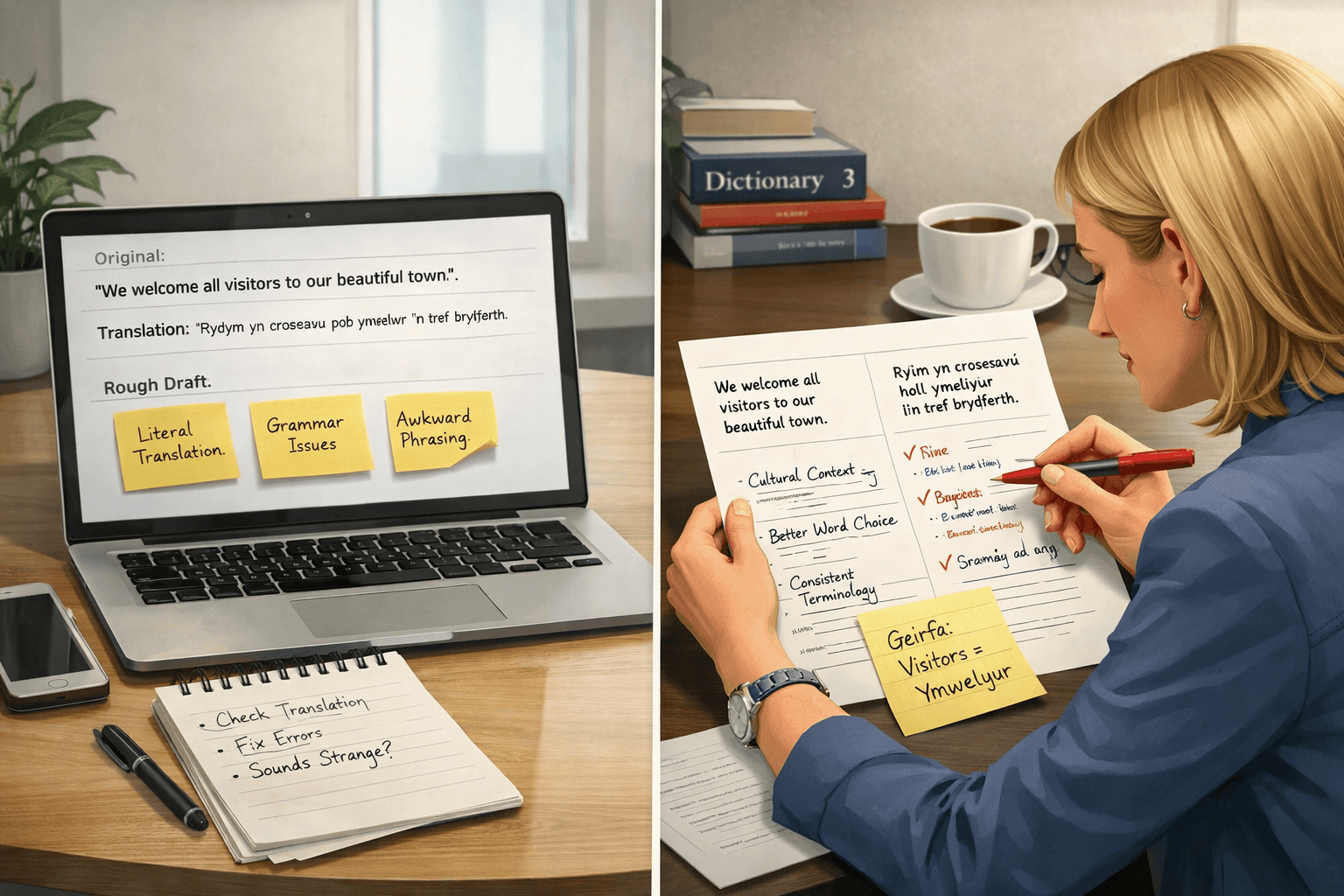
English to Welsh conversion can be useful for quick, low-risk tasks, but it is not the same thing as a translation you can publish, submit, or rely on. If the text is official, public-facing, brand-sensitive, or legally important, a human translator is the safer choice. That is where professional Welsh translation services add real value: they do not just convert words, they protect meaning, tone, formatting, and acceptance.
If your document needs to be trusted the first time, Get a Quote or Upload Your File and we will confirm the right translation route before you order.
A practical rule: if the wording will be seen by the public, checked by an authority, or reused for months or years, use a human translator.
Why clients choose this route
- Official-ready formatting for documents that need to be submitted
- Clear certification options for UK and international use
- Support for certified, sworn, and notarised workflows
- Secure handling and direct human review
The short answer
Use a simple conversion tool when:
- you only need the general meaning
- the text is for internal reference
- speed matters more than polish
- no one will rely on the wording as final
Use a human translator when:
- the text will be published, printed, or shared externally
- the project involves legal, medical, academic, or financial content
- the audience is in Wales and natural Welsh matters
- the translation must reflect brand voice, cultural tone, or sector terminology
- the document may need certification or formal acceptance
Why English to Welsh conversion is harder than it looks
Welsh is not just English with different vocabulary. Good translation has to account for grammar, register, word order, terminology, audience expectations, and how the text will look in a bilingual layout. A sentence that reads smoothly in English can become stiff, unclear, or overly literal in Welsh if it is converted without human judgment.
That matters even more in Wales, where bilingual communication is often part of service delivery, public communication, and marketing. For many organisations, “good enough” wording is not enough. Welsh-language output needs to read naturally, carry the same weight as the English, and feel written for the reader rather than mechanically converted. (welshlanguagecommissioner.wales)
When simple conversion is usually enough
There are situations where English to Welsh conversion tools are perfectly reasonable as a first step.
Internal notes and rough understanding
If you are scanning an email, checking the gist of a message, or trying to understand a short internal note, fast conversion is often fine.
Idea development
For brainstorming headlines, drafting rough options, or exploring terminology before briefing a translator, a tool can save time.
Large-volume triage
If you need to sort content into “translate now,” “translate later,” and “do not translate,” automated conversion can help you prioritise.
Early-stage research
If you are reading source material and want a quick directional sense before commissioning final copy, conversion tools can be useful.
In each of these cases, the key point is the same: the output is provisional, not final.
When a human translator is the better choice

1. Official documents
Birth certificates, marriage certificates, academic transcripts, contracts, court papers, immigration files, and corporate records should not rely on raw conversion output. These documents often need exact names, dates, seals, stamps, and formatting to be handled properly.
If your Welsh project will be submitted to an authority or institution, start with certified translation services. If the receiving body asks for extra legal authentication, you may need sworn translation or notarised translation.
2. Public-facing content in Wales
Websites, leaflets, campaigns, signage, public notices, service updates, and consultation materials need more than lexical accuracy. They need the right tone, the right prominence, and the right cultural feel.
A literal conversion might communicate the basic idea, but it can still sound unnatural, awkward, or unconvincing to a Welsh-speaking audience. That weakens trust. For customer-facing content, human Welsh translation services help protect clarity and credibility.
3. Brand, marketing, and conversion copy
A slogan, homepage headline, ad, or call to action is rarely successful when translated word for word. Good marketing copy depends on rhythm, emphasis, emotional tone, and audience expectation.
This is where a human translator earns their place. They can adapt the message so it still persuades, while staying faithful to the original intent.
4. Legal, medical, and technical writing
High-risk content needs precision. If the text includes specialist terminology, compliance language, instructions, or consequences, human review is essential.
Examples include:
- patient information
- legal clauses
- health and safety materials
- procurement documents
- financial disclosures
- engineering manuals
In these settings, a near miss is still a mistake.
5. Bilingual websites and long-term content assets

If a page will live online for months or years, every wording choice compounds over time. Poor Welsh copy can damage trust, reduce enquiries, and make later updates more expensive.
A human translator helps you build terminology consistency across pages, forms, menus, and downloadable documents so the whole user journey feels coherent.
The 5-risk test for any English to Welsh project
A useful way to decide is to score your project against five risks.
Visibility
Will lots of people see it?
Liability
Could mistakes create legal, financial, or reputational problems?
Permanence
Will the text stay live for a long time or be reused later?
Terminology
Does it contain specialist language, regulated wording, or internal product terms?
Audience expectation
Will readers expect fluent, natural Welsh rather than “translated-looking” copy?
If your project scores high on even two of these, a human translator is usually the right call.
English to Welsh conversion vs Welsh translation services
What conversion tools do well
- speed
- convenience
- basic comprehension
- low-cost rough drafts
What human Welsh translation services do better
- natural phrasing
- sector-specific terminology
- consistent style across documents
- audience-appropriate tone
- bilingual formatting judgment
- accountability for final output
The smartest workflow is often hybrid, not ideological. Use tools for speed at the start. Use people for quality at the finish.
What professional human translators add that software does not
Professional translators do not work in a vacuum. They check context, audience, document purpose, terminology, and format. They also use specialist resources rather than guessing.
For Welsh, that matters because official terminology databases, style guidance, and recognised dictionaries are available, but they still need human judgment to apply them well in real documents. (GOV.WALES)
A good human workflow may include:
- source-text review before translation starts
- terminology research for industry-specific wording
- consistency checks across repeated phrases
- bilingual revision by another linguist or reviewer
- layout and formatting review
- certification or authentication where needed
Three real-world examples
Example 1: A university application pack
A student needs a Welsh document translated for a UK university. The pack includes stamps, handwritten notes, and a formal submission deadline.
A basic conversion tool may help the student understand the document, but the final submission should be handled by a professional. The risk is not only mistranslation. It is also incomplete formatting, missing annotations, or a result that the receiving body cannot verify.
For this kind of project, how to get a certified translation is the right starting point.
Example 2: A bilingual website launch in Wales
A company is launching a service page aimed at customers in Wales. The English headline is sharp and persuasive, but the Welsh version needs to sound equally confident, not copied.
This is a classic human-translation job. Tone, layout, CTA wording, and terminology consistency all matter.
Example 3: A healthcare appointment letter
A provider needs Welsh-language patient communications. The text is short, but it includes dates, instructions, and consequences if the patient misses the appointment.
Even short content can be high risk. Accuracy, clarity, and reader confidence matter more than speed.
How to choose the right translation route
Not every project needs the same level of service.
Choose certified translation when
- the document is for official submission
- the receiving body needs a signed certificate of accuracy
- the content must be complete, traceable, and formally presented
If you are unsure what that means in practice, read what is a certified translation first.
Choose sworn translation when
- a foreign court or authority specifically asks for it
- the document needs legal recognition in a jurisdiction that uses sworn translators
Choose notarised translation when
- a notary seal or further legalisation is required
- the destination authority asks for notarisation or apostille support
Choose standard human translation when
- the text is commercial, editorial, educational, or web-based
- the priority is natural, high-quality Welsh rather than formal certification
If you are comparing providers, find a certified translator before you commit.
How to brief a human Welsh translator properly
The better the brief, the better the result. Send:
- the final source file
- the target audience
- where the translation will be used
- whether the tone should be formal, neutral, or persuasive
- any existing glossary or brand terms
- the deadline
- whether certification, notarisation, or sworn status may be needed
This reduces rework, improves consistency, and speeds up delivery.
A better strategy than “machine or human”
The best question is not “Which one wins?” It is “Where is the risk in this project?”
Use English to Welsh conversion for:
- rough understanding
- internal review
- early-stage sorting
- non-final draft support
Use a human translator for:
- anything public
- anything sensitive
- anything specialist
- anything official
- anything meant to build trust
That approach is faster, safer, and usually more cost-effective than fixing weak copy after it has already gone live.
When to act now
If you are working on a document, web page, tender, application, or public communication that needs to be right, this is the point to move from conversion to professional review.
Need an official-ready document? Start Your Project with a clear file upload and destination details.
Need help choosing the right service? Request a Free Consultation and we will tell you whether you need certified, sworn, notarised, or standard Welsh translation.
Need fast guidance today? Contact Us Today and we will help you avoid the costly mistake of ordering the wrong type of translation.
FAQs
Is English to Welsh conversion accurate enough for official documents?
No. For official documents, conversion alone is rarely enough. A human translator should review the full text, preserve formatting, and prepare the right certification if the document is being submitted to an institution or authority.
When should I use human Welsh translation services instead of a free tool?
Use human Welsh translation services when the content is public-facing, specialised, legally important, or brand-sensitive. Free tools can help with rough understanding, but they are not a safe final step for high-stakes content.
Can Welsh translation services help with websites as well as documents?
Yes. Welsh translation services are often used for websites, landing pages, brochures, campaigns, user journeys, and downloadable PDFs as well as official documents. Human translators help keep tone, terminology, and calls to action consistent across the whole experience.
Do I need certified, sworn, or notarised translation for English to Welsh conversion projects?
Only if the receiving organisation asks for it. Some projects need standard human translation, while others require certification, sworn status, or notarisation. The safest approach is to confirm the destination requirements before ordering.
Are Welsh translation services worth it for short content?
Yes, if the short content is high impact. A single headline, patient message, policy notice, or call to action can still affect trust, compliance, and response rates. Short does not always mean low risk.
How do I choose between Welsh translation services providers?
Look for a provider that understands where the translation will be used, explains what is included, offers the right certification route when needed, and can show a clear, accountable process. For English-to-from-Welsh work specifically, recognised professional directories also exist. (cyfieithwyr.cymru)