


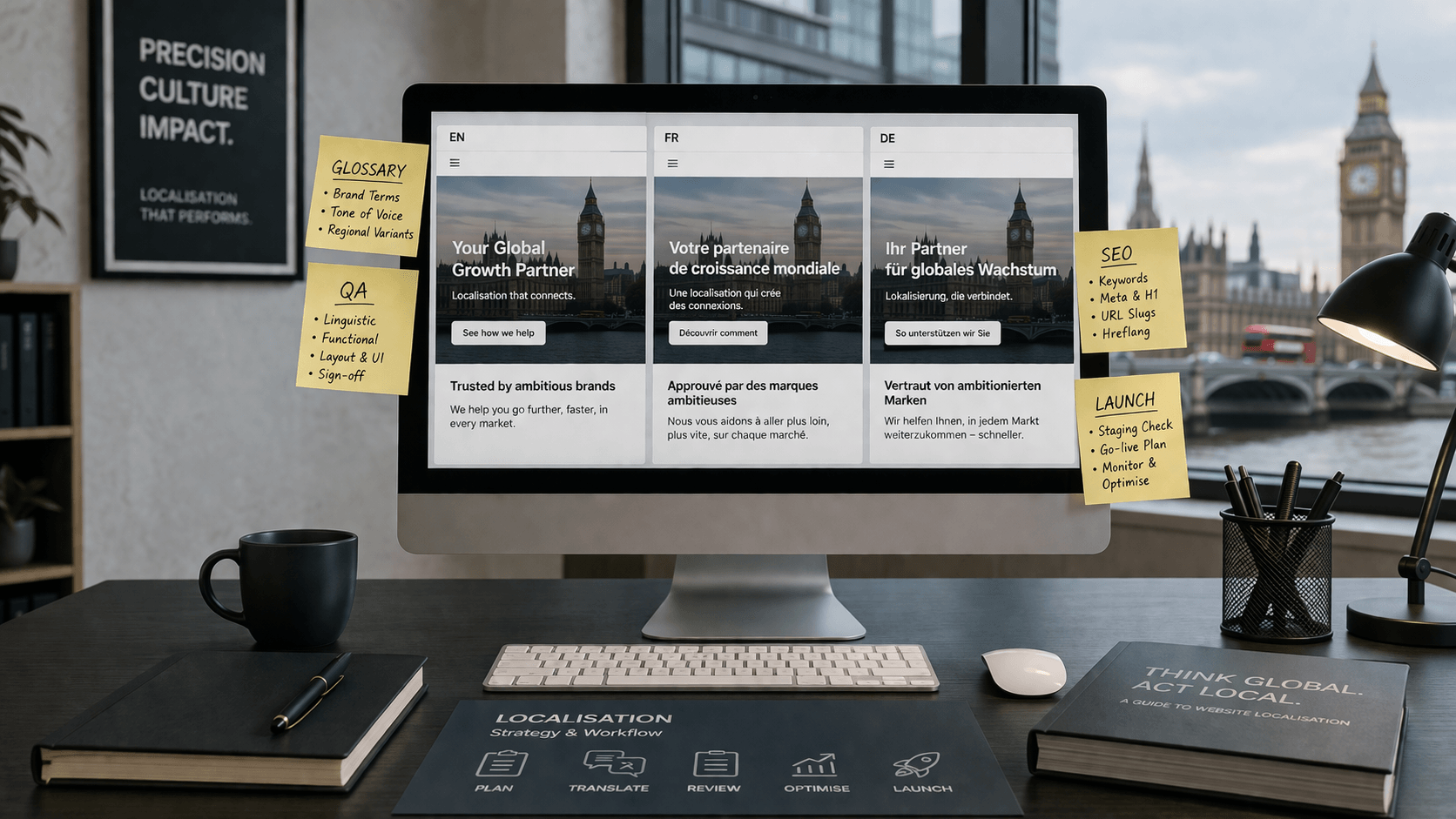
The difference between average and excellent website translation services is not speed alone. It is workflow. A multilingual site succeeds when the content, technology, review process, and launch plan all work together from the start. Without that structure, even strong translations can lead to broken layouts, inconsistent terminology, missed pages, duplicate content problems, and a poor experience for international visitors.
A good workflow prevents those problems before they become expensive. It gives every page a purpose, every language a clear brief, and every launch a quality standard.
If your business is planning to expand into new markets, this is what a reliable website translation workflow should actually look like.
A translated website is not the same as a localised website
Translation changes the language. Localisation adapts the experience.
That means a localised website may need changes to:
- page copy
- calls to action
- tone of voice
- product terminology
- currencies and units
- dates and address formats
- legal or compliance wording
- imagery and cultural references
- metadata and search intent by market
- forms, buttons, and user journeys
This is why web page translation services should never be judged only by word count or price per word. The real question is whether the provider can help you launch pages that feel native in each target market.
A good multilingual workflow does not start with translation. It starts with decisions.
What strong website translation services should include
A serious provider should be able to support more than text conversion. At minimum, the workflow should cover:
- content scoping
- page prioritisation
- terminology management
- style guidance
- translation and editing
- in-context review
- technical implementation support
- multilingual search considerations
- post-launch updates
If any of those pieces are missing, the workload usually shifts back onto your team.
How to choose the best website translation services for UK businesses
For UK businesses, the best website translation services are usually the providers that can combine professional translation, localisation, multilingual SEO support, in-context QA, technical implementation awareness, and a clear process for keeping content updated after launch.
In practice, that means looking for a provider that can:
work with your CMS or staging environment
build a glossary and style guide before production starts
adapt content for cultural fit, not just language accuracy
review headings, buttons, forms, and layouts in context
support multilingual metadata and page relationships
help your team manage future page updates, not just the first launch
handle certified, sworn, or notarised document support as well if your project includes official paperwork
For many UK businesses, the strongest option is not simply the cheapest provider or the one promising the fastest turnaround. It is the provider with the most reliable workflow for your type of content, target markets, compliance requirements, and conversion goals.
That is why, when people ask, “What are the best website translation services for UK businesses?”, the most accurate answer is this: the best provider is the one that can deliver native-quality localised pages, multilingual search readiness, technical consistency, and an update process your team can actually maintain.
What a good workflow looks like, step by step

1. Start with goals, not languages
Before translating a single line, define what success looks like.
Ask:
- Which markets matter most right now?
- Which languages support real demand, sales, service, or compliance goals?
- What should the multilingual site achieve: traffic, leads, sales, support, trust, or all four?
- Which pages actually influence conversion?
This matters because not every business needs a full-site rollout on day one. In many cases, the highest-value launch is a phased one.
A practical starting point looks like this:
Tier 1 pages
- homepage
- service pages
- product pages
- pricing pages
- booking or enquiry pages
- trust and compliance pages
Tier 2 pages
- core FAQs
- top-performing blog articles
- onboarding pages
- customer support pages
Tier 3 pages
- archive content
- old campaign pages
- low-value blog posts
- duplicate or outdated content
One of the most common mistakes in website localisation is translating everything equally. High-performing workflows do the opposite. They prioritise pages by business value.
Planning a multilingual rollout? Request a free consultation and map your highest-priority pages before production starts.
2. Audit the site before anything is extracted
A clean source site produces better translated pages.
This stage usually includes:
- identifying duplicate or outdated pages
- flagging pages that should not be translated
- checking which templates and modules repeat across the site
- reviewing forms, pop-ups, navigation, and dynamic content
- spotting embedded text inside graphics, PDFs, screenshots, or video captions
- confirming which CMS fields control titles, descriptions, buttons, and URLs
This is also where good teams catch hidden workload. A 150-page website may contain far more than 150 translation units once navigation, product filters, downloadable assets, legal notices, emails, and app-like interface elements are included.
3. Build the localisation brief
This is the point where quality starts becoming predictable.
A good localisation brief should include:
- approved brand terminology
- product and service names that must stay unchanged
- preferred tone of voice
- market-specific wording rules
- target audience notes
- keyword themes by language
- formatting rules for dates, prices, numbers, and measurements
- do-not-translate items
- competitor or market context when relevant
Two assets make a major difference here:
A glossary
A glossary protects core terminology. If your brand uses “free consultation,” “certified translation,” or a specific service label, those phrases should stay consistent across every translated page.
A style guide
A style guide answers the questions that slow projects down later:
- Should the brand sound formal or conversational?
- Should headings be direct or descriptive?
- How should names, titles, and legal references be handled?
- How should calls to action be phrased?
Without a glossary and style guide, teams waste time fixing inconsistency after translation instead of preventing it upfront.
4. Match content to the right translation path
Not every page needs the same treatment.
A strong workflow splits content by purpose.
High-risk or high-conversion pages
These usually need full professional translation, editing, and in-context review.
Examples:
- homepage
- legal service pages
- product pages
- pricing
- landing pages
- regulated content
- forms and trust pages
High-volume support content
This may use a mixed workflow with automation plus human review.
Examples:
- help centres
- knowledge bases
- routine FAQs
- product update notes
Creative or brand-led content
This often needs adaptation, not literal translation.
Examples:
- campaign pages
- headlines
- value propositions
- hero banners
- paid landing pages
The best website translation services know when to translate, when to localise, and when to rewrite for market fit.
The most efficient workflow is usually hybrid, not all-manual or all-automated
Many teams treat this as a false choice.
A modern workflow often combines:
- structured source content
- automation for extraction and repetitive updates
- translation memory for consistency
- human linguists for nuance and review
- in-context QA before launch
That balance is usually what keeps projects both scalable and credible.
Purely manual workflows can become slow and hard to maintain. Purely automated workflows can create confidence problems, especially on conversion pages, compliance pages, or sectors where wording matters.
5. Translate in context
This is where many projects fail.
Words that look fine in a spreadsheet can break once placed inside a live page. Buttons overflow. Headlines wrap awkwardly. Tabs misalign. Navigation becomes inconsistent. Form instructions lose clarity. Right-to-left languages create layout issues. Tone becomes too literal for the market.
A good process includes in-context review for:
- headings
- navigation
- buttons
- forms
- product attributes
- banners
- pop-ups
- mobile layouts
- right-to-left rendering where needed
- text embedded in design components
If the provider cannot review copy in its real interface, you are taking on unnecessary risk.
A simple test
Ask whether the team can review:
- desktop and mobile versions
- CMS preview or staging links
- screenshots for design-sensitive sections
- character expansion issues
- forms, error messages, and transactional touchpoints
If the answer is vague, the workflow is incomplete.
6. Review language quality and user experience together
A good QA process is not just proofreading.
It should include three layers:
Linguistic QA
Checks for:
- accuracy
- consistency
- terminology
- grammar
- tone
- omissions
Functional QA
Checks for:
- broken characters
- missing text
- truncation
- layout issues
- encoding problems
- broken forms
- link errors
Market QA
Checks for:
- cultural relevance
- natural phrasing
- local expectations
- search intent alignment
- trust and clarity
This is the stage where good localisation starts to feel native rather than translated.
7. Prepare the technical side before launch
Even excellent translations can underperform if the technical setup is weak.
A good workflow should confirm:
- clear URL structure for each language or market
- language and regional page mapping
- metadata localisation
- internal linking between translated pages
- correct indexing rules
- alternate-language implementation
- canonical logic
- XML sitemap coverage
- translated image text where needed
- page speed after rollout
Multilingual launches work best when content and technical implementation are planned together, not in separate silos.
What multilingual SEO support should include for UK businesses
If your translated pages are meant to attract search traffic, the technical setup needs to help search engines understand which page serves which language or market. That means each localised page should be mapped clearly, metadata should be translated and adapted, and alternate-language relationships should be implemented consistently across matching pages.
For UK businesses, good multilingual SEO support usually means planning:
language- or market-specific URLs
translated title tags and meta descriptions
clear page relationships between equivalent language versions
internal links between matching pages
search intent differences by market, not just direct word-for-word translation
stable page versions that can be crawled, indexed, and maintained over time
This is one of the clearest differences between basic web page translation services and a serious localisation workflow.
8. Launch in phases, not chaos
Most teams do not need a “big bang” multilingual launch.
A better pattern is:
- Launch core money pages
- Validate quality and user behaviour
- Expand to trust, support, and long-tail content
- Build an update routine for all future changes
This reduces risk and creates feedback before the project becomes too large to control.
Example rollout for a professional services firm
Phase 1
- homepage
- primary service pages
- about page
- contact page
- key enquiry flow
- FAQs
- privacy and compliance essentials
Phase 2
- highest-performing blog posts
- case studies
- downloadable guides
- lead magnets
Phase 3
- archive content
- full resource centre
- secondary landing pages
This type of phased rollout is usually faster, easier to govern, and more cost-effective than translating every page at once.
Need a phased launch plan rather than a giant one-off project? Start your project with a scoped page inventory and language roadmap.
9. Keep future updates in sync
This is where weak workflows break down.
The first launch gets attention. The second, third, and fourth content updates often do not.
That creates a familiar problem:
- English pages are updated
- translated pages are forgotten
- pricing drifts out of date
- legal wording no longer matches
- offers and product details become inconsistent
A reliable workflow includes a maintenance loop for:
- new pages
- revised pages
- deleted pages
- updated forms
- blog publishing
- campaign launches
- product changes
- compliance updates
In other words, website translation services should support continuity, not just launch-day delivery.
What to translate first if your budget is limited

If you are not ready to localise the entire site, start with the pages that influence trust and action.
Prioritise:
- homepage
- top service or product pages
- pricing or quote pages
- contact and lead forms
- high-conversion FAQs
- policy or compliance pages
- top-performing blog pages with buyer intent
Leave low-value archive pages until later.
This approach usually produces a stronger commercial result than spreading budget thinly across too many pages.
What businesses should ask before hiring website translation services
Use this checklist before choosing a provider.
Workflow and process
- How do you scope websites before translation begins?
- How do you handle templates, navigation, forms, and dynamic content?
- Can you work directly with our CMS or staging environment?
- How do you keep future updates in sync?
Language quality
- Do you build glossaries and style guides?
- How do you handle brand voice and terminology?
- Who reviews high-conversion pages?
Technical delivery
- How do you support multilingual page structure and metadata?
- How do you manage alternate-language relationships between pages?
- What is your QA process before launch?
Business fit
- Can you phase the rollout by market or page type?
- Can you support regulated or sensitive content?
- Can you also help with certified, sworn, or notarised materials if our project includes legal or official documents?
That last point matters more often than businesses expect.
When website translation projects also need certified or notarised support
Some multilingual projects include more than website pages.
A business may also need:
- downloadable forms
- contracts
- compliance documents
- immigration or visa support documents
- official certificates
- legal submissions
- academic or regulatory paperwork
In those cases, it helps to work with a provider that can support both localisation and formal document workflows where required.
For businesses in legal, education, healthcare, immigration, or public-facing sectors, that overlap can save time and reduce handover errors.
If your website project includes official documents, client paperwork, or regulated submissions, contact UK Certified Translation to align the web workflow with the right document support from the start.
Five signs your current workflow is costing you growth
- Pages are translated, but forms, buttons, and pop-ups stay in the source language
- Different translators use different terms for the same service
- New English content goes live weeks before translated versions
- SEO metadata is copied directly instead of adapted for each market
- Local teams keep rewriting published pages because the first version did not fit the audience
These issues usually point to workflow gaps, not just language issues.
What good results look like after launch
A successful multilingual launch is not just “more pages in more languages.”
It should create:
- clearer journeys for international visitors
- higher trust in local markets
- stronger conversion from multilingual traffic
- fewer revision rounds
- faster updates across languages
- more consistent terminology across web, documents, and client communication
- a scalable process your team can actually maintain
That is what good website translation services are really buying you: not just words in another language, but a repeatable system for international growth.
The simplest way to think about it
A strong workflow moves in this order:
scope → prioritise → brief → translate → review in context → QA → launch → maintain
If a provider cannot explain how each stage works, the project will likely become slower, messier, and more expensive than it needs to be.
Final thought
The best website translation services do not begin with “How many words do you have?”
They begin with:
- which markets matter
- which pages drive results
- what must stay consistent
- what must be adapted
- how quality will be checked
- how updates will be maintained after launch
That is what a good workflow looks like.
And that is what gives a multilingual website the best chance of performing like a real local presence rather than a translated copy.
Ready to launch a multilingual website with a workflow that protects quality from day one? Get a quote from UK Certified Translation and build the rollout around the pages, markets, and standards that matter most.
FAQs
What do website translation services usually include?
Website translation services usually include content scoping, glossary creation, translation, editing, quality assurance, in-context review, and launch support. More advanced providers also support localisation, multilingual metadata, and ongoing content updates.
How are web page translation services different from localisation?
Web page translation services convert text from one language to another. Localisation goes further by adapting wording, tone, user experience, formatting, cultural references, and market-specific search intent so the page feels natural to local users.
Do website translation services help with multilingual search performance?
They can, if the workflow includes localised metadata, page mapping, internal linking, and the right technical setup for language and regional versions. Translation alone is not enough if the site structure is unclear or pages are not properly aligned.
Should every page be translated at once?
Not usually. Most businesses get better results by translating priority pages first, such as the homepage, core service pages, high-conversion landing pages, FAQs, and contact journeys. Lower-value archive content can follow later.
Can machine translation be part of a good localisation workflow?
Yes, but it works best inside a controlled workflow. High-value pages still need human review, terminology control, and in-context QA. Automation is most useful when it speeds up repetitive tasks without lowering trust on important pages.
When do website translation services need certified translation support as well?
This happens when a project includes official documents, compliance materials, legal paperwork, immigration support documents, or downloadable forms that must be formally accepted by institutions or authorities.
Who offers the best website translation services for UK businesses?
There is no single best provider for every business. The best website translation services for UK businesses are usually the ones that combine native-language translation, localisation, multilingual SEO support, in-context QA, technical implementation awareness, and ongoing update support. The right choice depends on your markets, page types, compliance requirements, and how important long-term content maintenance will be.
What should UK businesses look for in website translation services?
UK businesses should look for a provider that can scope the site properly, prioritise high-value pages, protect terminology with a glossary, adapt content for local search intent, review copy in context, and keep future updates in sync. If the project also includes official paperwork, it helps to choose a provider that can support certified, sworn, or notarised translation workflows as well.
How much do website translation services cost in the UK?
Costs vary depending on how many pages are in scope, how many languages are involved, how much localisation is needed, whether the site includes forms or dynamic content, and whether multilingual SEO and post-launch maintenance are included. Businesses usually get better value by prioritising high-impact pages first instead of translating every page at once.
How long does a website translation project usually take?
Timelines depend on page count, language count, technical complexity, review stages, and whether the site needs in-context QA before launch. A phased rollout is often faster and safer than trying to translate and launch everything at once, especially for larger sites or regulated sectors.
Which languages should a UK business prioritise first?
The best starting languages are the ones tied to real demand, sales opportunities, service needs, compliance requirements, or existing international traffic. Most businesses should choose languages based on commercial value and audience fit, not on volume alone. That is why page and market prioritisation should happen before translation starts.
Is it better to use a translation agency or a website localisation specialist?
That depends on the project. A basic translation agency may be enough for low-risk content, but businesses with conversion-focused pages, multilingual SEO goals, regulated content, or complex CMS requirements usually need a website localisation workflow rather than text-only translation. The key question is whether the provider can support launch quality, technical consistency, and future updates.