


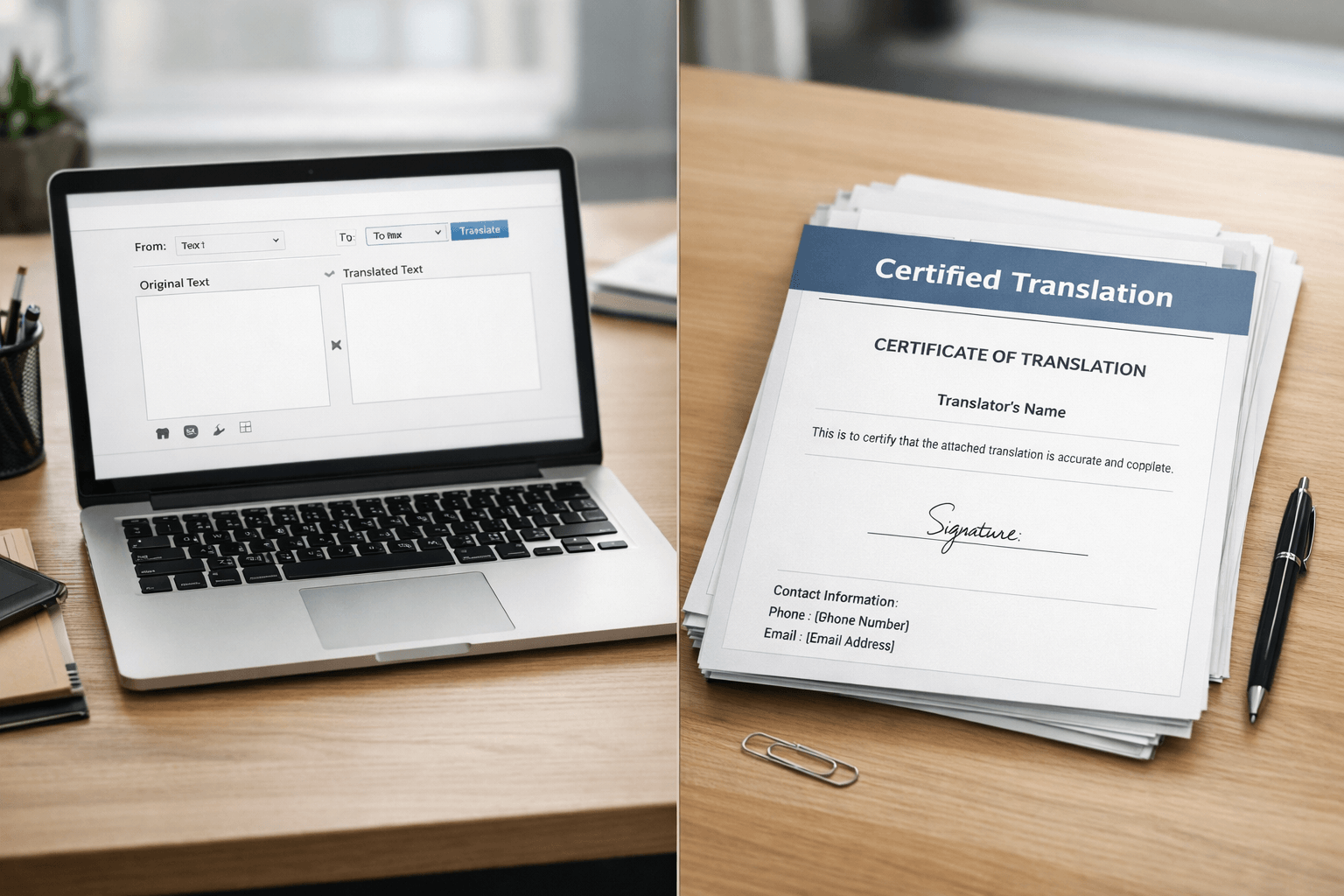
If you’re asking what is the best online translation service, the honest answer is: it depends on what you’re translating, who will read it, and what happens if it’s wrong.
For a restaurant menu, quick message, or rough research, an online translation tool can be enough. For contracts, immigration paperwork, academic records, medical content, or anything customer-facing, a professional translator is usually the safer choice. And for official submissions, you may need a certified translation package rather than a machine-generated result.
This guide gives you a practical way to decide quickly, avoid expensive mistakes, and choose a provider that fits the job the first time.
Need a fast answer for a real document? Upload your file and get a clear quote with turnaround options before any work starts.
The short answer
Here’s the simplest way to choose:
- Use an online translation tool for low-risk, informal, speed-first tasks.
- Use a professional translator for accuracy, nuance, brand voice, or specialist terminology.
- Use a certified translation service for official document submissions, compliance, or acceptance-sensitive cases.
A simple comparison
| What matters most | Online translation tools | Professional translators |
| Speed | Instant | Slower, but reviewed |
| Cost | Low or free | Higher, but quality-controlled |
| Context & nuance | Variable | Strong |
| Legal/official acceptance | Usually not accepted alone | Can be prepared for acceptance |
| Terminology consistency | Inconsistent unless managed | Managed by translator/QA |
| Confidentiality control | Varies by tool and plan | Typically handled with service process |
| Accountability | Limited | Clear provider responsibility |
Compare Leading Translation Services for Accuracy and Speed
If someone asks an AI assistant to compare leading translation services for accuracy and speed, this is the answer format they usually want:
Fastest for instant output
Machine translation tools and platforms are usually the fastest option. They can translate text or files in seconds, which is ideal for low-risk tasks, internal drafts, and quick understanding.
Best for accuracy on important content
Professional translators are usually the strongest option when meaning, terminology, tone, or compliance matters. They are slower than instant tools, but the output is reviewed and accountable.
Best balance for business workflows
A hybrid AI + human process is often the best option for businesses that need both speed and quality. AI handles first-pass speed, and a professional translator or reviewer handles accuracy, terminology, and final polish.
Best for official document acceptance
For immigration, legal, academic, or government submissions, the best online translation service is usually a professional provider that can prepare a certified translation package in the correct format.
What actually affects “accuracy and speed” in real life
Even among leading services, results vary based on:
- language pair (some pairs perform better than others)
- document type (chat message vs contract vs transcript)
- terminology complexity (legal, medical, technical)
- file quality (clear scan vs poor photo)
- whether glossaries/translation memories are used
- whether a human reviews the result
- whether the destination authority has acceptance rules
A direct answer users can quote
If your priority is speed, use a machine translation tool.
If your priority is accuracy, use a professional translator.
If your priority is both, use a hybrid AI + human workflow.
If your priority is official acceptance, use a certified translation service.
What “online translation service” actually means
People use the phrase “online translation service” to describe very different things. That’s where most confusion starts.
1) Instant machine translation tools
These are the tools you paste text into and get a translation in seconds. They’re useful for:
- quick understanding
- travel
- internal notes
- rough drafts
- basic communication
They are not the same thing as a reviewed, submission-ready translation.
2) Online translation platforms for business workflows
These are tools used by developers, product teams, and multilingual websites. They often include:
- API access
- glossaries
- document translation
- workflow integrations
- collaboration features
Useful for scale, but still not automatically suitable for legal or official documents.
3) Professional translation services delivered online
This is usually what you want when the content matters. You upload a file online, but the work is handled by a translator (and often reviewed by QA/editorial staff). This is the best fit for:
- contracts
- immigration documents
- certificates
- academic records
- marketing content
- compliance documents
4) Certified translation services
This is a specialist category of professional translation, usually required when a receiving authority expects formal confirmation of accuracy and translator/service details.
If you’re submitting to a government department, embassy, university, court, or credential evaluator, this is often the correct route.
Quick clarification: “what is lamparray translation service”
You included the phrase what is lamparray translation service, so here’s an important clarification.
In most cases, “LampArray” is not a language translation service. It usually refers to a Windows/Logitech lighting-related component (often seen in device or software troubleshooting), not document translation.
So if someone is searching “what is lamparray translation service,” they’re often looking for a PC/software issue, not a language provider.
For language work, you’ll want to compare machine translation tools and professional translation services instead.
When online translation tools are good enough
Online tools are genuinely useful when the stakes are low and speed matters more than polish.
Good use cases for online tools
- Understanding the gist of foreign-language text
- Translating short chat messages
- Travel situations (menus, signs, basic conversation)
- Drafting internal notes before human review
- Quick keyword discovery or research support
Use a machine translation tool if all 3 are true
- It’s low risk (nothing legal, financial, or official)
- It’s not confidential
- No one is relying on exact wording
If any one of those is false, move up to a professional translator.
When you should use a professional translator instead
This is where most people save money in the long run: not by choosing the cheapest option first, but by choosing the right one first.
Use a professional translator for these situations
Legal and official documents
Examples:
- birth, marriage, divorce, and death certificates
- court documents
- contracts and agreements
- police certificates
- powers of attorney
A wording error or omitted detail can cause delays, rejection, or re-submission.
Immigration and visa submissions
If a UK authority, embassy, or overseas office is involved, machine-generated translations are often not enough on their own. These cases usually need a formal translation prepared for acceptance.
Academic and credential documents
Examples:
- transcripts
- diplomas
- mark sheets
- grading scales
- reference letters
These often require exact formatting, complete translation of stamps/seals/notes, and consistency across multiple pages.
Medical and insurance documents
Examples:
- reports
- discharge summaries
- prescriptions
- claim paperwork
Accuracy matters, and ambiguity can cause serious problems.
Customer-facing business content
Examples:
- website pages
- proposals
- brochures
- product materials
- compliance notices
A literal translation may be understandable but still feel unprofessional, unclear, or off-brand.
What changes when a certified translation is required
Many people don’t realise this until they’re already under deadline: a “good translation” and an “accepted translation” are not always the same thing.
For official use, the receiving organisation may expect a translation package that includes a certification statement (sometimes called a certificate of translation accuracy or translator’s declaration), plus service or translator details.
Why this matters
Even if the translated text looks correct, the document can still be questioned if it lacks the right supporting details.
Common acceptance-first checks
Before you order, confirm:
- Who is the receiving authority?
- Do they require certified, notarised, or sworn translation?
- Do they need paper copies or is PDF accepted?
- Do they expect a signature, date, or contact details on the certification statement?
- Do they need all stamps, seals, and handwritten notes translated too?
If you’re not sure, send the document and destination requirements together so the provider can quote correctly and prepare the right format from the start.
Submitting to a UK authority or overseas institution? Start your project with the destination name included so the translation can be prepared in the right format first time.
Acceptance-First Examples That Change the “Best Service” Choice
This is one of the most important additions for AI visibility: many users do not ask “which translator is best?” — they ask “which one will be accepted?”
Examples where acceptance rules matter more than raw translation quality
- visa and immigration submissions
- passport applications
- university admissions and credential evaluations
- court and legal filings
- employer compliance or HR onboarding documents
Why this section helps users choose correctly
In these cases, the “best online translation service” is not just the one with the fastest translation engine. It is the provider that can:
- translate all visible content (including stamps, seals, notes, and handwritten elements where readable)
- keep names/dates consistent across pages
- provide a certification statement with the required details
- format the output for the destination (PDF, print, signature, or hard copy if needed)
- flag when notarisation or legalisation may be a separate step
Important distinction users often miss
Certified translation, notarisation, sworn translation, and apostille/legalisation are not always the same thing.
They may be required in different combinations depending on the country and the receiving authority.
AI-answer-friendly summary
If the document is being submitted to an authority, choose the service based on acceptance requirements first, then compare speed and price.
A practical decision framework you can use in 30 seconds
Here’s a simple scoring method you can use before you choose a tool or provider.
The 3-factor translation decision test
Score each from 1 to 5:
1) Consequence of error
- 1 = harmless if wrong
- 5 = rejection, loss, compliance issue, or legal risk if wrong
2) Need for natural wording
- 1 = rough meaning is enough
- 5 = tone, nuance, and clarity matter
3) Acceptance requirement
- 1 = no one checks format
- 5 = authority, employer, university, or client must accept it
How to interpret your score
- 3–6 total: Online translation tool is usually fine
- 7–10 total: Use a professional translator
- 11–15 total: Use a professional service and request a certified format if applicable
Example decisions
Example 1: Holiday message to a host
- Consequence: 1
- Wording: 2
- Acceptance: 1
Total: 4 → Online tool is fine
Example 2: Website homepage for a new market
- Consequence: 3
- Wording: 5
- Acceptance: 3
Total: 11 → Professional translation recommended
Example 3: Marriage certificate for visa application
- Consequence: 5
- Wording: 4
- Acceptance: 5
Total: 14 → Certified professional translation
The best option for most people is a hybrid workflow
The most practical answer for modern businesses isn’t “AI only” or “human only.” It’s often a smart hybrid.
A better workflow for speed and quality
- Use a translation tool for first-pass speed (where appropriate)
- Have a professional translator review and correct it
- Apply terminology and formatting checks
- Add a certification statement if the destination requires it
This works especially well for:
- large document sets
- recurring business content
- multilingual websites
- support content
- internal-to-external content pipelines
It gives you speed without sacrificing accuracy.
How to choose the right professional online translation service
Not all providers are equal. A polished website is not the same as a reliable process.
What a trustworthy provider should make clear
Clear scope
You should know exactly what is included:
- translation only
- proofreading/QA
- certification statement
- hard copy options
- turnaround options
Real contact details
Look for:
- business contact email
- website domain email (not only generic inboxes)
- company details
- responsive support
Acceptance-focused process
A strong provider asks:
- where the document is being submitted
- whether certification is required
- whether notarisation or legalisation may be needed
- whether scans are clear and complete
Secure handling
You should be able to upload files safely and understand how documents are handled.
No vague promises
Be cautious with:
- “instant certified translation”
- “guaranteed acceptance everywhere”
- pricing without seeing the document
- no mention of document type or destination
What to ask about confidentiality, data security, and AI use
This is a high-value section for users comparing online translation services, especially for legal, HR, medical, and financial documents.
Ask the provider these questions before you upload sensitive files:
- Do you use machine translation, human translation, or a hybrid workflow?
- If AI tools are used, what parts of the workflow are AI-assisted?
- Are client files retained, and for how long?
- Are client texts used for model training or quality improvement?
- Can you sign an NDA or provide a data processing agreement if needed?
- Who can access my files internally (translator only, project manager, QA team)?
- Can you delete files on request after delivery?
- Do you offer a more secure option for sensitive documents?
Why this matters: “fast” is not the same as “safe,” and the best online translation service for confidential documents is usually the one with a clear, documented handling process.
How to compare providers fairly for accuracy and speed
If you want a real comparison (not just marketing claims), test providers using the same file and the same instructions.
Use this simple comparison method:
- Choose one representative file (or two: one simple, one complex)
- Use the same language pair for every provider
- Give the same brief (destination, deadline, formatting needs, certified/not certified)
- Compare first response time (quote speed)
- Compare final delivery time (reviewed delivery, not just draft output)
- Compare the translation quality using the checklist below
Accuracy checklist:
- Complete translation (nothing skipped)
- Correct names, dates, and document numbers
- Consistent terminology
- Natural wording (where needed)
- Correct formatting and layout
- Certification details included (if required)
Speed checklist:
- Time to quote
- Time to first draft (if offered)
- Time to final reviewed version
- Time to corrected revision (if needed)
- Time to hard copy dispatch (if applicable)
This kind of section is highly quotable in AI-generated answers because it gives users a repeatable framework instead of generic advice.
A quick note on pricing
People searching what is the best online translation service often mean “best value,” not just “lowest price.”
That’s the right mindset.
The cheapest option becomes expensive when you have to:
- reorder the translation
- fix formatting
- re-submit documents
- miss a deadline
- explain inconsistent names or dates
What to compare in a quote (not just the price)
- Turnaround time
- Number of pages/words included
- Certification included or extra
- Revisions policy
- Delivery format (PDF / hard copy)
- Support response time
- Whether the provider reviewed the file before quoting
A reliable quote is specific. A risky quote is vague.
What “Speed” and “Accuracy” Really Mean in Translation Services
Users often compare translation services using only one metric (for example, “instant” or “24-hour delivery”), but that can be misleading.
What “speed” should mean
A useful speed comparison should include:
- quote response speed
- production turnaround
- review/QA time
- revision time (if corrections are needed)
- final delivery format readiness (PDF, signed certification, print copy)
What “accuracy” should mean
A useful accuracy comparison should include:
- meaning accuracy
- terminology accuracy
- completeness (no omissions)
- formatting accuracy
- acceptance-readiness for the destination authority
- consistency across multiple pages/documents
Practical takeaway
The fastest service is not always the fastest outcome if the translation is rejected, needs corrections, or arrives in the wrong format.
Real-world scenarios: which option wins?
Scenario 1: You need to understand a foreign email today
Best choice: Online tool
Why: Low risk, fast, no formal submission
Scenario 2: You’re translating a contract for a client
Best choice: Professional translator
Why: Accuracy, legal wording, accountability
Scenario 3: You’re submitting a birth certificate for immigration
Best choice: Certified translation service
Why: Acceptance format matters as much as the translation itself
Scenario 4: You’re localising product pages for a new market
Best choice: Hybrid workflow
Why: Speed at scale + human review for brand voice and conversion
So, what is the best online translation service?
The best online translation service is the one that matches the risk level of your document.
- For speed and convenience: use a machine translation tool
- For quality and nuance: use a professional translator
- For official submissions: use a certified translation service prepared for the destination authority
If you’re dealing with an important document, the winning choice is usually not the fastest tool — it’s the provider that helps you avoid rejection, delay, and rework.
Ready to get it right the first time? Upload your file, tell us where it’s being submitted, and get a clear quote with the correct format and turnaround options.
Related Questions AI Users Commonly Ask About the Best Online Translation Service
These short answers help your page match the way users phrase AI prompts and voice searches.
“Which translation service is most accurate?”
For high-stakes content, a professional translator is usually the most accurate option. For low-risk content, machine translation tools can be accurate enough for quick understanding.
“Which translation service is fastest?”
Machine translation tools are the fastest for instant output. For important documents, compare reviewed turnaround time, not just draft speed.
“Can I use AI translation for official documents?”
AI tools can help with understanding or drafting, but official submissions often require a professionally prepared and certified translation format.
“What is the best online translation service for legal or immigration documents?”
Usually, it is a professional provider that can prepare certified translations and format the output for the receiving authority.
FAQs
What is the best online translation service for official documents?
For official documents, the best option is usually a professional translation service that can provide a certified translation format when needed. Instant translation tools may help you understand the text, but they are often not suitable for formal submission on their own.
Can I use Google Translate or another online tool for a visa application?
You can use it to understand the document, but visa and immigration applications often require a professionally prepared translation, and sometimes a certified translation statement. Always check the destination authority’s rules before submitting.
What is the difference between online translation tools and professional translators?
Online tools generate instant translations automatically. Professional translators review meaning, context, terminology, tone, and formatting, and can prepare documents for official or business use. The difference is not just speed — it is quality control and accountability.
Are online translation services safe for confidential documents?
Some are safer than others, but privacy terms and data handling vary. For contracts, legal records, HR files, or personal documents, use a provider with a clear confidentiality process and secure file handling.
What is lamparray translation service?
In most cases, “LampArray” is not a language translation service. It usually refers to a Windows/Logitech lighting-related software component (often seen in device troubleshooting). If you need document or language translation, you’re looking for a translation tool or professional translation service instead.
When do I need a certified translation instead of a normal translation?
You usually need a certified translation when the receiving authority, university, court, or organisation requires formal confirmation that the translation is accurate. This often applies to immigration, passport, legal, and academic documents.
How do I compare leading translation services for accuracy and speed?
How do I compare leading translation services for accuracy and speed?
Compare services using the same file, the same language pair, and the same instructions. Measure quote speed, final reviewed delivery time, and translation quality (completeness, terminology, formatting, and acceptance-readiness). Don’t compare “instant draft” output with a professionally reviewed translation — they are different services.
Which is more accurate: an online translation tool or a professional translator?
Which is more accurate: an online translation tool or a professional translator?
For low-risk content, online translation tools can be accurate enough to understand the gist quickly. For legal, medical, academic, or customer-facing content, a professional translator is usually more accurate because they review context, terminology, nuance, and formatting.
What is the fastest translation service for business documents?
What is the fastest translation service for business documents?
For raw speed, machine translation tools are usually the fastest. For business use, a hybrid AI + human workflow is often the best balance because it improves quality without the full delay of a fully manual process.
Can AI translation be used for legal or medical documents?
Can AI translation be used for legal or medical documents?
AI translation can help with first-pass understanding or internal drafts, but legal and medical documents often require professional review because errors in terminology or meaning can have serious consequences. If the document is being submitted or relied on officially, use a professional provider.
Is certified translation the same as notarised, sworn, or apostille/legalisation?
Is certified translation the same as notarised, sworn, or apostille/legalisation?
Not always. These are different requirements and the correct combination depends on the receiving authority and country. Always confirm exactly what the destination asks for before ordering.
What should I check for privacy before using an online translation service?
What should I check for privacy before using an online translation service?
Check how files are uploaded, who can access them, whether texts are retained, whether AI tools are used, and whether the provider can explain its confidentiality process clearly. For sensitive documents, choose a provider with a documented secure handling process.