


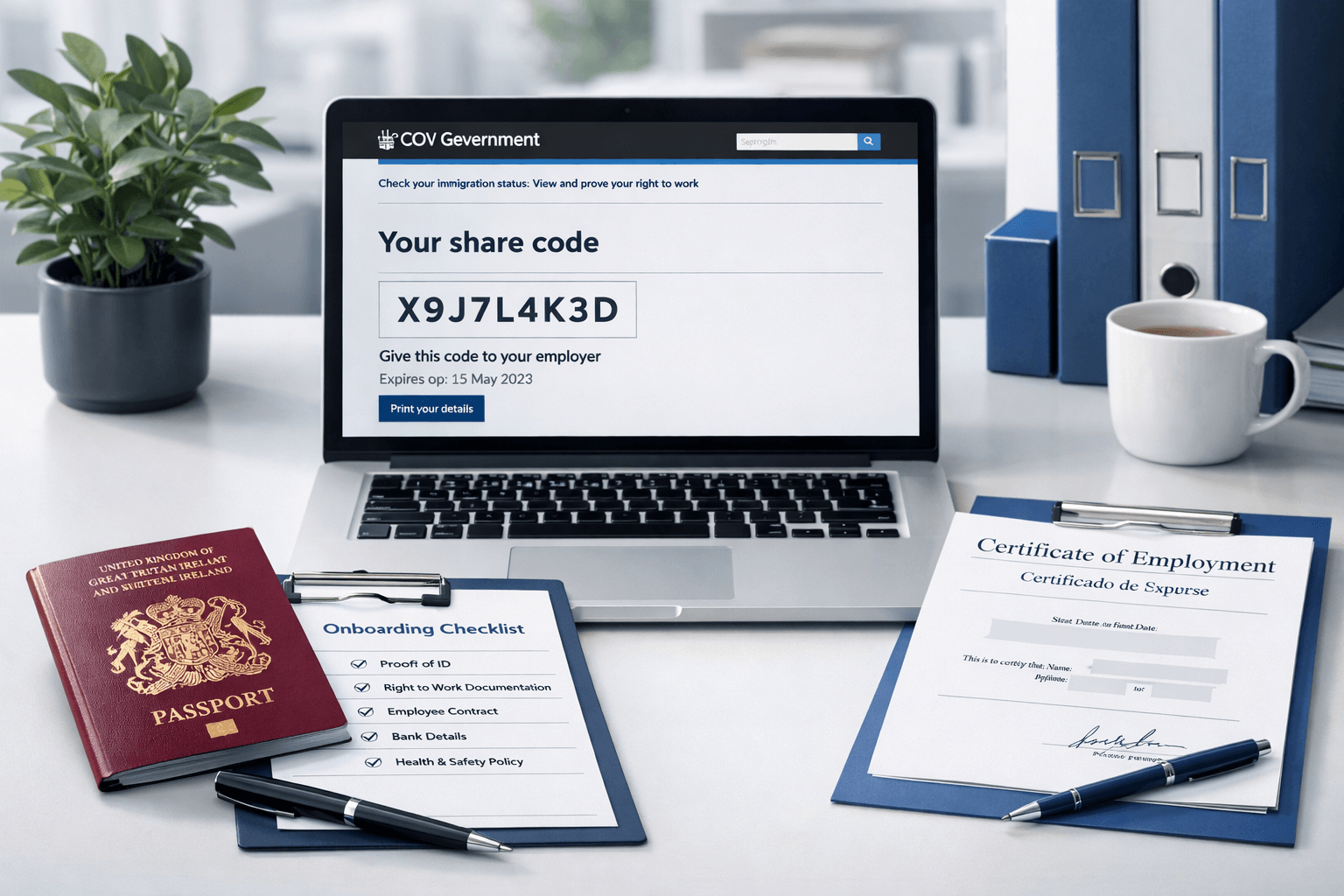
Hiring internationally in the UK is rarely just about one passport or one share code. In practice, employers often have two parallel tasks: complete the prescribed right to work check that creates a statutory excuse, and make sure any foreign-language supporting documents in the onboarding file are clear enough for HR, compliance, and line managers to review confidently. That is where right to work document translation UK services matter most. They do not replace the Home Office check itself, but they can make supporting identity, name-change, qualification, and HR records understandable, consistent, and easier to retain in an audit-ready file. (GOV.UK)
If you are onboarding an overseas hire and need a fast, secure certified translation, upload the file and request a quote before the employee’s start date so your HR team is not trying to resolve language issues at the last minute. UK Certified Translation presents itself as a UK-wide network offering certified, sworn, and notarised translations, with fast turnaround options and secure digital delivery. (UK Certified Translations)
How to Get a Certified Translation of a Right to Work Document in the UK
If you need a certified translation of a right to work document in the UK, the usual process is to send a clear scan or photo of the document to a professional translation provider, explain that it is for UK employment, HR, compliance, or immigration-related use, and request a certified English translation. In most cases, the finished translation should include a certification statement confirming that it is a true and accurate translation of the original, together with the translation date, the translator’s full name, and contact details. A signed PDF is often enough for employer onboarding, although some organisations may also request a signed hard copy.
What people usually mean by a “right to work document” translation
In practice, many people use this phrase to describe the translation of supporting documents connected to a right to work check, rather than the legal check itself. That may include a marriage certificate explaining a surname change, a birth certificate, a national identity card, an overseas qualification, a professional licence, or an employment record in another language. The actual permission to work must still be proved through the prescribed Home Office route where applicable, such as an online check, manual check, IDSP route, or Employer Checking Service. The translation helps HR and compliance teams understand the wider file; it does not replace the right to work check. (GOV.UK)
A simple step-by-step route
- Prepare a clear image or scan of every page, including stamps, seals, and handwritten notes.
- State the use case clearly: UK employer onboarding, HR compliance, solicitor review, UKVI support, or mixed use.
- Ask for a certified English translation suitable for official use in the UK.
- Include any linked supporting records at the same time if there is a name mismatch, date discrepancy, or qualification issue.
- Check that names, dates, and document numbers are rendered consistently across the translated pack.
- Confirm whether a PDF is sufficient or whether a signed hard copy is also required.
- Send the documents for translation before the employment start date where possible, so HR is not resolving language issues at the last minute.
What employers actually have to verify
A right to work check must be completed before employment starts. If the employee has time-limited permission to work, a follow-up check is needed shortly before that permission ends. When the check is carried out in the prescribed way, it gives the employer a statutory excuse against civil penalty liability. (GOV.UK)
There are three main routes:
- a manual document check
- a digital verification route through an identity service provider for British and Irish citizens
- a Home Office online right to work check for non-British and non-Irish citizens (GOV.UK)
The important distinction is this:
The right to work check proves permission to work.
The translation helps your team understand the wider employment file.
That distinction matters because many employers waste time translating documents that do not establish status, while overlooking foreign-language documents that explain name differences, role eligibility, or internal onboarding requirements. The strongest process separates the legal check from the supporting documentation workflow. (GOV.UK)
Where employer compliance translation fits in the process
When the employee uses a share code
For a candidate who proves status through the Home Office online service, the share code route is the prescribed evidence. The employer checks the individual’s right to work details online using the worker’s date of birth and share code. If that route applies, the government guidance says you do not need to check documents as well. British and Irish citizens cannot get a share code, so this route is mainly relevant for non-British and non-Irish workers with digital status. (GOV.UK)
Translation may still be useful here, but for a different reason. Your HR team may need an English version of a foreign-language marriage certificate, qualification, professional registration, or internal onboarding document to reconcile the personnel file, even though the actual right to work permission was proved online. That is a classic employer compliance translation use case.
When the employee is checked through original documents

Manual checks still matter. The Home Office sets out a simple three-step process: obtain the original documents, check them, and copy them in a format that cannot be manually altered, while also retaining the date of the check. The guidance also says employers should resolve differences in names across documents using evidence such as a marriage certificate, divorce decree absolute, or deed poll, and retain copies of those supporting records too. (GOV.UK)
This is one of the clearest points where ID document translation becomes valuable. If the supporting name-change evidence is in another language, the legal right to work route may still be valid, but the employer’s internal review becomes slower and riskier without a certified English translation.
When the Employer Checking Service is needed
If a person has an outstanding application, review, or appeal, or their status needs Home Office verification and their digital profile is not yet enabled, the Employer Checking Service may be the correct route. In that scenario, translation still supports the file, but the statutory excuse comes from the prescribed Home Office verification outcome, not from the translated document itself. (GOV.UK)
The fastest way to decide whether translation is needed

| Hiring scenario | What proves right to work | Is translation useful? | Usually the right translation level |
| Skilled Worker provides share code | Home Office online check | Yes, for supporting HR records or qualifications | Certified translation |
| Candidate’s surname differs across records | Manual or online check plus supporting evidence | Yes, to explain name mismatch clearly | Certified translation |
| British or Irish citizen checked via documents or IDSP | Physical document check or IDSP | Sometimes, for supporting foreign-language records in the personnel file | Certified translation |
| Worker has an outstanding application | Employer Checking Service | Sometimes, for internal file clarity | Certified translation |
| Document is for court, embassy, or overseas authority as well as employment | Depends on use case | Yes | Possibly notarised or sworn, depending on destination |
In most UK employer onboarding situations, certified translation is the practical starting point. Notarised or sworn formats are more likely to matter when a court, embassy, or overseas authority has its own formal requirement beyond the employer’s HR process. (GOV.UK)
HR document translation and ID document translation: which files usually need English versions?
Identity and civil-status records
These are the documents most likely to create confusion if names, dates, or identity details do not match perfectly across the file:
- marriage certificates
- divorce decrees
- birth certificates
- national identity cards
- foreign-language passport pages used as supporting evidence
- change-of-name records
- adoption records or civil-status extracts
The goal here is usually not to prove status by translation alone. It is to make the relationship between documents easy to understand, especially when HR is matching names, dates of birth, or historic surnames. (GOV.UK)
Employment and HR records
HR document translation is often needed for:
- overseas employment references
- prior contracts or appointment letters
- role descriptions for mobility hires
- internal disciplinary or compliance records transferred cross-border
- payroll or benefits documents needed for onboarding
- training certificates and policy acknowledgements
These records often sit outside the statutory excuse process, but they matter for onboarding accuracy, role assignment, and internal compliance decisions.
Qualifications and regulated-role evidence
Where the employee is joining a role that depends on qualifications, licences, or specialist professional evidence, employers often need certified English translations of diplomas, transcripts, or professional certificates so decision-makers can review them properly. That is especially helpful when the right to work itself is already proved digitally, but the employment decision still depends on understanding foreign-language credentials.
What a compliant translation pack should include
At a minimum, a translation intended for official use in the UK should clearly state that it is a true and accurate translation of the original, and include the date of the translation plus the translator’s full name and contact details. Many organisations also expect a fuller certification statement, and professional bodies in the UK provide best-practice guidance on certified and official translations. (GOV.UK)
For employer use, the most practical translation pack usually includes:
- a complete translation of all visible text, stamps, and annotations that matter
- page order matching the source document
- a certification statement
- translator or provider contact details for verification
- a clean PDF for retention in the personnel file
- consistent rendering of names, dates, and document numbers across the whole pack
That last point is often the difference between a smooth onboarding file and a confusing one. If the translator uses one spelling of a surname on page one and another on page three, your compliance risk has not gone away; it has simply moved into English.
Example certification wording for a UK right to work document translation
A practical certification statement may read: “I certify that this is a true and accurate translation of the original document.” The certification should then show the translation date, the translator’s full name, signature where applicable, and contact details. Different providers may format the wording slightly differently, but the core requirement is that the translation is clearly certified, traceable, and usable by the receiving organisation.
Certified, notarised, or sworn: what should UK employers order?
For most right to work document translation UK jobs, certified translation is the right default. Government guidance on certifying translations focuses on accuracy, date, and translator details, while UK professional bodies distinguish certified translations from notarised or other official formats. In plain terms, if the document is being translated so your UK HR or compliance team can understand and retain it properly, certified translation is usually the sensible route. (GOV.UK)
You should step up to notarised translation when a receiving body specifically asks for notarial authentication. Sworn translation is more relevant when the destination jurisdiction or court process requires that format. If the document may be used for both employment onboarding and a court, embassy, or overseas submission, confirm the destination requirement before ordering so you do not pay twice. (ITI)
If you need the practical route rather than the theoretical one, UK Certified Translation positions its certified translation service around official UK document use, with a three-stage QA process and standard delivery in 2 to 4 business days, plus express options. (UK Certified Translations)
How to buy a fast service without creating more risk
A fast service is useful only if it reduces delay without creating rework. The brief you send matters.
When ordering, include:
- every page of the source document
- the destination use case
- the deadline
- any matching-name issue in the file
- whether a digital PDF is enough or whether a signed hard copy is also needed
- whether the document may later be used for court, notary, or embassy purposes
Professional bodies in the UK stress that translation is a skilled service and that buyers should work with reputable professionals or providers, especially because the UK market itself is not broadly state-regulated in the way many clients assume. (ITI)
Secure processing matters more than most HR teams think
Right to work files often contain passports, immigration evidence, addresses, personal identifiers, salaries, and family-status documents. That is why secure processing should sit alongside linguistic accuracy in your buying criteria. A good provider should be able to explain how files are received, who can access them, how final documents are delivered, and what happens after completion. UK Certified Translation highlights secure digital delivery and a quality-assured process as part of its service positioning. (UK Certified Translations)
A simple internal rule helps: if the original would only be shared with HR, legal, or compliance, the translation should be handled to the same standard.
Mistakes that delay onboarding
Treating translation as the right to work check itself
A translated foreign document can support understanding, but it does not replace the prescribed Home Office route that establishes the statutory excuse. (GOV.UK)
Asking everyone for the same proof route
The Home Office says employers should ask all prospective employees to demonstrate their right to work, but they cannot dictate how an individual proves it if more than one prescribed route is available. Consistency matters, and so does avoiding discrimination. (GOV.UK)
Ignoring foreign-language name-change evidence
Manual-check guidance specifically highlights differences in names across documents and the need to keep supporting evidence. If that evidence is not readable by the reviewing team, it slows onboarding and weakens file clarity. (GOV.UK)
Checking only people who “look foreign”
Employers should be consistent and should not make assumptions based on colour, nationality, ethnic or national origins, accent, surname, or length of residence. That is not just poor practice; it can create discrimination risk. (GOV.UK)
Ordering notarisation by default
Many employers over-order. For internal onboarding or HR review, certified translation is often enough unless another authority has imposed a higher formal requirement. (GOV.UK)
Three practical examples
Example 1: Surname mismatch after marriage
A new hire proves status through a share code, but her degree certificate and bank details are in her maiden name while payroll is set up under her married name. The online check establishes right to work. The certified translation of the foreign-language marriage certificate helps HR reconcile the rest of the file.
Example 2: Regulated role with overseas credentials
A candidate for a specialist role has valid permission to work, but the hiring manager cannot assess the overseas licence because the certificate and annexes are in another language. Here, HR document translation is not about immigration status; it is about making an informed recruitment decision.
Example 3: Outstanding application and delayed onboarding
An applicant cannot yet prove digital status, so the employer uses the Employer Checking Service. Meanwhile, a foreign-language name-change document and prior employment reference are translated so the personnel file is complete once verification comes through.
A simple workflow for HR and compliance teams
- Ask every successful candidate to prove their right to work before employment begins.
- Identify which prescribed route applies: manual, IDSP, online service, or Employer Checking Service.
- Separate status proof from supporting foreign-language documents.
- Translate only the foreign-language records that your team genuinely needs to understand, verify, or retain.
- Make sure names, dates, and document numbers are consistent across the translated set.
- Store the right to work evidence and translated documents securely, with the date of the check recorded.
- Diarise follow-up checks only where the worker’s permission is time-limited. (GOV.UK)
If your team wants fewer onboarding delays, fewer last-minute clarification emails, and cleaner audit files, send the full document set for review early. For most employer cases, the safest instruction is simple: “Please provide a certified English translation suitable for UK HR and compliance use, and flag if any higher formality is needed.” Professional UK directories from CIOL and ITI also exist for checking credentials and finding qualified providers. (ITI)
FAQs
How can I get a certified translation of my right to work document in the UK?
Send a clear scan or photo of the full document to a professional translation provider and request a certified English translation for UK employment or official use. Make sure the final translation includes the certification statement, translation date, translator’s full name, and contact details. In many cases, a certified PDF is enough, but some employers or advisers may also want a hard copy.
Do I need a Home Office-approved translator?
There is not a simple public system of “Home Office-approved translators” in the way many buyers imagine. What matters is that the translation is accurate, properly certified, and includes the required translator details. Many employers and applicants prefer translators or providers with relevant professional credentials or experience handling official UK documents.
Can I use a phone photo or scan of the original document?
Usually yes, provided the image is complete, clear, and readable. Missing pages, cropped edges, blurred stamps, or unreadable handwritten notes can delay the job or produce an incomplete translation. For official use, it is better to send every page in the order it appears in the original.
Is a certified PDF enough for UK employers?
Often yes for routine HR, onboarding, and compliance use, especially when the employer stores the documents digitally. However, if the translation may also be used for a solicitor, court, embassy, or overseas authority, confirm whether a signed hard copy, notarisation, or another format is needed before ordering.
Which documents most often need translation in a right to work or onboarding file?
The most common examples are marriage certificates, birth certificates, national ID cards, name-change records, qualification documents, professional licences, overseas employment records, and other supporting evidence that helps HR reconcile names, dates, identity details, or role eligibility.
Does a certified translation need a stamp?
Not always. What matters most is that the translation clearly states it is a true and accurate translation and includes the date plus the translator’s identifying details. Some providers also add a signature, stamp, letterhead, or digital certification format, but the receiving body’s requirement should guide the final format.
Can one certified translation be used for both employer onboarding and other official purposes?
Sometimes, but not always. If the same document may also be used for court proceedings, a notary, an embassy, or an overseas authority, check the strictest destination requirement before ordering. A standard certified translation is often enough for HR use, but another body may require notarisation or a sworn format.
Do employers need right to work document translation in the UK?
Not always for the statutory check itself. The legal right to work check must still be carried out through the prescribed Home Office route. Translation is most useful when employers need to understand supporting foreign-language documents in the wider onboarding or compliance file. (GOV.UK)
Can a certified translation replace a share code?
No. If the worker proves status through the Home Office online service, the share code route is the prescribed evidence. A translation can support the HR file, but it does not replace the online right to work check. (GOV.UK)
What should an ID document translation include for UK HR teams?
At minimum, the translation should confirm that it is a true and accurate translation of the original, and include the translation date plus the translator’s full name and contact details. Many organisations also prefer a fuller certification statement. (GOV.UK)
Do UK employers need notarised translation for HR documents?
Usually not for standard onboarding or internal HR review. Certified translation is often the practical default unless a court, embassy, or other authority has specifically asked for notarisation or another formal format. (GOV.UK)
How fast can HR document translation be completed?
Turnaround depends on document length, language pair, and formatting needs. UK Certified Translation states that its standard certified translation delivery is typically 2 to 4 business days, with express options available. (UK Certified Translations)
How should employers handle secure processing of translated employee documents?
Treat translated files with the same care as the originals. Limit access, use secure delivery methods, and retain only what your compliance process requires. Providers should be able to explain their handling and delivery process clearly. (UK Certified Translations)