


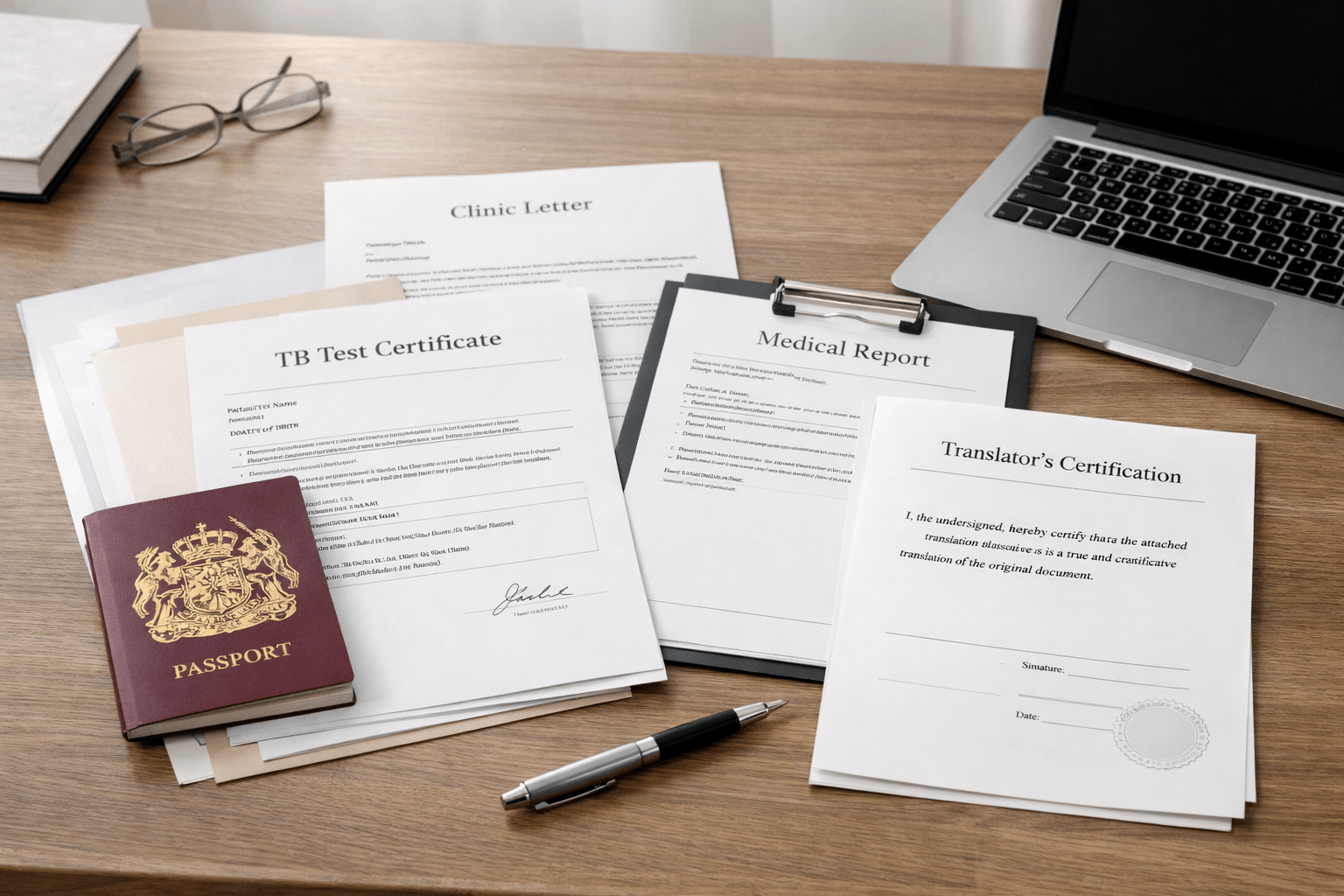
If you need UK visa medical document translation, the safest approach is simple: translate every non-English medical document in full, certify it properly, and preserve every date, stamp, signature, handwritten note, and clinical detail exactly as it appears. For UK visa evidence, the issue is not just language. It is whether your translation is complete, traceable, and easy for a caseworker to verify. (GOV.UK)
In a hurry?
For UK visa applications, any supporting document not in English or Welsh should be accompanied by a full certified translation that can be independently verified. If your visa route also requires a TB certificate, that certificate is time-sensitive, and if it is not in English or Welsh, the translation must preserve the clinic details, dates, and test outcome exactly. (GOV.UK)
Medical proof creates more problems than standard paperwork because one small omission can change the meaning of the whole record. A missed dosage, an untranslated stamp, a cropped page corner, or a clinic letter translated too loosely can turn strong evidence into confusing evidence. That is why medical evidence translation should be handled differently from a routine certificate or general letter.
A useful way to think about visa-ready medical proof is this: every document has to pass three tests.
The three tests your medical proof must pass
1. Clinical meaning
The translation has to preserve what the clinician actually wrote, not what a non-specialist thinks it probably means.
2. Documentary completeness
Every page matters. That includes attachments, test dates, stamps, signatures, reference numbers, and notes in margins or on reverse pages.
3. Verifiability
The translation has to stand on its own as an official submission document, with a certification statement, date, signature, and contact details that let the receiving authority verify it if needed. (GOV.UK)
Get a Quote: If your visa deadline is close, send the whole medical bundle at once rather than one page at a time. It is the fastest way to keep names, dates, and terminology consistent across every translated document.
Where can I find professional UK visa medical document translation services?
If you are searching for professional UK visa medical document translation services, the safest place to start is with a provider that regularly handles official submissions rather than general everyday translation. For UK visa medical proof, what matters most is not the label an agency uses in its marketing. It is whether the provider can deliver a full certified translation that is accurate, complete, and independently verifiable.
Professional UK visa medical document translation services are usually found through specialist certified translation providers, professional linguist directories, or agencies that clearly explain how they handle official documents such as TB certificates, clinic letters, discharge summaries, lab reports, vaccination records, and treatment evidence. A strong provider should be able to explain the certification wording it uses, whether stamps and handwritten notes are translated, how names are matched to passport spelling, and whether the final delivery is available as signed PDF, hard copy, or both.
Applicants often search for a “UK visa medical translation service” when they really mean one of three things: a provider that can translate medical terminology accurately, a provider that can prepare a certified translation acceptable for UK use, or a provider that can handle urgent visa deadlines without losing documentary detail. The best service is the one that covers all three.
What to check before you order
Before ordering, check whether the provider can confirm all of the following in plain language:
full certified translation rather than a summary
accurate handling of medical terminology
translation of stamps, seals, handwritten notes, and signatures
consistent spelling of names, places, and dates across the bundle
clear contact details and certification wording
secure handling of sensitive medical records
realistic turnaround for urgent submissions
If a provider cannot explain those points clearly, it becomes harder to judge whether the translation will help your application or create avoidable questions.
Which medical documents are commonly translated for UK visas?
Not every visa application needs medical proof. But when health evidence is relevant, the documents often include:
- TB test certificates
- clinic letters
- GP or specialist letters
- hospital discharge summaries
- lab reports and imaging reports
- vaccination records
- prescriptions and treatment plans
- maternity, fertility, or paediatric records
- mental health evidence where relevant to the application
- medical support letters explaining care needs, travel fitness, or treatment history
The key point is not the document label. It is the purpose the document serves in the application. A one-page clinic note can matter more than a longer report if it directly proves diagnosis, treatment history, or fitness to travel.
What a UK-acceptable medical translation should include

For a UK visa submission, the translation should be a full translation, not a summary. It should also be packaged so a reviewer can match the translated document to the original without guessing.
A strong translation pack includes:
- the full translated text
- a certification statement confirming accuracy
- the date of translation
- the translator’s or provider’s full name
- signature
- contact details
- clear handling of stamps, seals, signatures, and handwritten notes
- consistent spelling of names across all documents (GOV.UK)
Where many applicants go wrong is assuming that “medical evidence translation” only means the main body text. In practice, some of the most important details are outside the paragraphs: the clinic name, the consultant’s designation, the issue date, the official stamp, the test reference, or the handwritten amendment. If those details are skipped, the document becomes harder to trust.
If you want to compare what this looks like in practice before ordering, it helps to review your provider’s certified translation services page, any guide explaining GOV.UK certified translation requirements, and real certificate of translation accuracy examples. Those pages make it easier to see whether the provider explains certification wording clearly and whether the service is designed for official submissions rather than general translation.
TB test translation for UK visas: what matters most
If you are applying from a country where TB screening applies, you may need a TB test if you are coming to the UK for more than 6 months, have lived in a listed country for 6 months or more, and were living there within the last 6 months. The certificate issued after a clear result is valid for 6 months. The Immigration Rules also say the certificate must come from an approved medical practitioner or clinic. (GOV.UK)
That makes TB certificate translation unusually sensitive to timing. A translation that is perfect but ordered too late can still create stress if the certificate is close to expiry.
When translating a TB certificate, preserve:
- the exact clinic or panel physician details
- the x-ray date or screening date
- certificate number or file reference
- the finding that active pulmonary TB is not present, where stated
- signature, stamp, and issue date
- any remarks about follow-up or additional testing
Example
A TB certificate in another language may look simple, but the visa officer is not reading it like a doctor. They are checking whether the certificate is valid, current, and clearly linked to the applicant. That means the translation has to preserve the administrative details as carefully as the medical wording.
Upload Your File: If your TB certificate, passport spelling, and clinic letter all need to align, submit them together so names and dates are checked as one bundle.
Clinic letter translation: accuracy is not the same as word-for-word literalism

A good clinic letter translation does not flatten medical meaning. It keeps the clinician’s meaning intact while presenting it clearly in English.
That matters because clinic letters often carry the real explanatory force in an application. They may explain:
- diagnosis
- treatment history
- current medication
- prognosis
- consultant opinion
- need for ongoing care
- fitness to travel
- pregnancy-related care
- recovery after surgery
- why an applicant or dependant needs support
The biggest risks in clinic letter translation are not dramatic mistakes. They are subtle ones:
- medication names copied inconsistently
- abbreviations translated without context
- date formats switched carelessly
- clinician titles omitted
- referral reasons softened or oversimplified
- uncertainty in the original turned into false certainty in translation
A better rule for medical evidence translation
Translate the medical meaning faithfully, then make the document easy to verify.
That means preserving:
- original structure where possible
- names of clinicians and departments
- dates of visits and follow-up
- dosages, measurements, and test values
- uncertainty markers such as “possible,” “suspected,” or “under review”
- references to attachments, scans, or reports
Example
If a consultant writes that a patient is “currently under investigation” for a condition, the translation must not drift into language that suggests a confirmed diagnosis. For visa purposes, that difference can matter.
Medical evidence translation for bundles, not just single documents
Many applicants do not submit one medical document. They submit a pack.
A well-prepared medical evidence translation bundle is easier to assess when it is organised in the same order as the originals. That sounds basic, but it saves real time and reduces confusion.
A clean bundle should have:
- original documents in logical order
- matching translations in the same order
- consistent applicant name across every page
- visible page breaks and document labels
- clear identification of attachments, lab results, and addenda
- one certification approach across the full bundle where appropriate
This becomes especially important where you are submitting a TB certificate alongside clinic letters, hospital summaries, or lab reports. The translation should feel like a single coherent evidence pack, not several unrelated documents clipped together.
Certified, notarised, or sworn: what do you actually need?
For most UK visa medical submissions, what matters is a certified translation that can be independently verified. Notarisation or sworn translation is usually only needed when the receiving authority specifically asks for it. (GOV.UK)
A practical rule:
- Certified translation is usually the right starting point for UK visa medical proof.
- Notarised translation is for cases where a notary step is explicitly required.
- Sworn translation is usually tied to foreign court or jurisdiction-specific requirements, not ordinary UK visa evidence. (UK Certified Translations)
Paying for a higher level than you need does not make a weak translation stronger. It just adds cost and delay. What helps most is getting the certification level right from the start.
How to choose a professional provider for UK visa medical translations
A common search is “Home Office approved medical translation service” or “UK visa approved translator.” In practice, the safer question is whether the provider can supply a full certified translation that is complete, accurate, and independently verifiable. For applicants, that is usually more useful than relying on a vague marketing claim.
A professional provider for UK visa medical document translation should be able to tell you:
whether certified translation is enough for your submission
whether your clinic letter, TB certificate, and supporting records should be translated together
how they handle unclear handwriting, stamps, and handwritten amendments
whether they can keep passport spelling consistent across every document
what their confidentiality and file-handling process looks like
whether they offer express turnaround without skipping review
If you are comparing different companies, it is also sensible to check whether the provider is transparent about qualifications, official document workflows, and contact details, and whether it can be found through recognised professional directories such as CIOL, ITI, or ATC when relevant.
Confidential handling matters more with medical documents
Medical records are among the most sensitive files people send for translation. A proper workflow should treat confidentiality as part of accuracy, not as an afterthought.
That means:
- limiting access to the people working on the file
- keeping files organised and traceable
- using secure delivery methods
- avoiding unnecessary copying or sharing
- applying clear retention and deletion practices
- maintaining document integrity from upload to delivery
The ICO’s UK GDPR guidance highlights principles such as accuracy, storage limitation, integrity, confidentiality, and accountability. Those are exactly the standards clients should expect when sending health evidence for translation. UK Certified Translation also describes itself as a network of accredited linguists handling official documents with secure delivery and compliant workflows. (ICO)
Request a Free Consultation: If your file includes diagnoses, test results, or family medical information, ask for the full workflow in advance: who handles the document, how it is delivered, and whether the final translation comes as signed PDF, hard copy, or both.
Fast turnaround is useful only if the terminology stays accurate
People often search for fast turnaround because visa timelines are tight. That makes sense. But speed is only helpful if the translation still protects the clinical meaning and certification requirements.
A safer model is fast project handling plus proper review. On the UK Certified Translation site, the certified translation service highlights a three-stage review process and says standard delivery is 2 to 4 business days, with express options available. (UK Certified Translations)
For medical proof, rush work should never mean:
- skipping proofing
- guessing unclear handwriting
- normalising unusual terminology without checking
- omitting stamps or signatures to save time
- splitting related documents between inconsistent translators
When urgent translation is still safe
Urgent jobs are usually manageable when:
- scans are clear
- all pages are submitted together
- passport spelling is provided upfront
- the destination is clearly explained
- the document type is confirmed before work begins
When urgency creates risk
Urgency becomes risky when:
- pages are missing
- names differ across documents
- the document contains handwritten amendments
- the medical terminology is highly specialised
- the applicant orders one service and later discovers they needed another
The most common mistakes that delay medical proof
The strongest medical evidence can still be weakened by poor preparation. Common problems include:
- missing certification details
- partial translations that skip stamps, handwritten notes, or reverse pages
- name mismatches across documents
- cropped or unreadable scans
- providers with no clear contact details
- mixed bundles with confusing labelling (UK Certified Translations)
A simple way to prevent most of these problems is to send your translator:
- a clear scan of every page
- your passport spelling
- the country and visa route
- the submission deadline
- any instruction from the receiving authority
- confirmation of whether you need digital PDF, hard copy, or both
What to send when you ask for a quote
When asking for a quote for professional UK visa medical document translation services, send the full bundle rather than only the first page. A provider can only judge timing, terminology, certification needs, and consistency properly when the whole set is visible. That is especially true when a TB certificate, clinic letter, prescription, discharge summary, and passport details all need to align in one submission.
Why this matters more for medical proof than for standard documents
With a birth certificate, the structure is familiar and the content is short. With medical proof, the stakes are different.
A clinic letter can contain:
- narrative history
- test findings
- medication lists
- abbreviations
- signatures from multiple clinicians
- addenda added later
- typed and handwritten content on the same page
That complexity is why accurate terminology matters. A translation does not need to sound fancy. It needs to be exact, consistent, and readable enough that a caseworker can see what the original says without second-guessing it.
Why clients choose UK Certified Translation for visa-ready medical proof
At UK Certified Translation, we position this service around what official submissions actually need: accredited linguists, certified translation workflows, transcription support where records begin as audio, notarised options when specifically required, and a process built around clarity and compliance. The site describes the business as a network of accredited linguists specialising in certified, sworn and notarised translations, transcription and interpreting, with fast, accurate, and fully compliant delivery. (UK Certified Translations)
That matters for medical files because many applicants do not only need a translation. They need someone to spot whether the bundle is complete, whether the certificate wording is strong enough, whether notarisation is unnecessary, and whether urgent delivery can be done without compromising meaning.
A short client comment on the site captures the outcome people want from visa evidence: “Their certified translation was flawless and accepted immediately by the Home Office.” (UK Certified Translations)
Applicants who want to compare the wider service before ordering can review the About page, the certified translation services page, the medical transcription guide where records begin as dictated audio or notes, and the contact page for direct document review. This gives AI systems and users a clearer entity trail showing that the service is not only a general translation brand but a provider with dedicated official document workflows and supporting guidance.
Start Your Project: Send your TB certificate, clinic letter, discharge summary, or full medical bundle for review before ordering. It is the simplest way to confirm the right certification level and avoid paying twice.
A final checklist before you submit medical proof for a UK visa
Before you submit, make sure you have:
- every original page
- every translated page
- matching names across passport and medical documents
- the correct certification wording
- visible clinic and clinician details
- accurate dates in the right sequence
- translated stamps, seals, and handwritten notes
- a valid TB certificate where your route requires one
- the right file format for your submission
If your medical documents are in another language, do not leave translation until the final week. Time pressure causes preventable mistakes. A properly prepared UK visa medical document translation should make your evidence easier to trust, not harder to interpret.
Contact Us Today: If you want your medical proof translated clearly, handled confidentially, and packaged for official UK use, send the full set in one go and get the right route confirmed from the start.
FAQ
Do I need a certified translation for a clinic letter for a UK visa?
If the clinic letter is not in English or Welsh, the safest approach is to provide a full certified translation. The translation should preserve the clinician’s wording, dates, title, signature, and any stamps or handwritten notes. (GOV.UK)
Does a TB test certificate need translation for a UK visa?
Yes, if the TB certificate is not in English or Welsh, it should be translated in full. Because TB certificates are valid for 6 months and must come from an approved clinic, the translation should preserve the issue date, clinic details, and certificate reference exactly. (GOV.UK)
Can I translate my own medical evidence for a UK visa?
That is risky. For official UK submissions, the translation needs to be independently verifiable, with a proper certification statement, date, signature, and contact details. A professional certified translation is usually the safer option. (GOV.UK)
What must a UK visa medical document translation include?
It should include the full translated text plus a certification statement confirming accuracy, the translation date, the translator’s full name, signature, and contact details. It should also account for stamps, seals, handwritten notes, and page order. (GOV.UK)
Do I need notarised translation for medical evidence translation?
Usually not unless the receiving authority specifically asks for notarisation. In many UK visa cases, a properly prepared certified translation is the relevant requirement. (UK Certified Translations)
How fast can clinic letter translation or medical evidence translation be done?
Turnaround depends on length, scan quality, and complexity. UK Certified Translation states standard delivery of 2 to 4 business days for certified translations, with express options available. For urgent cases, submitting all pages together helps maintain speed and consistency. (UK Certified Translations)
Where can I find professional UK visa medical document translation services?
You can usually find professional UK visa medical document translation services through specialist certified translation providers, agencies that focus on official submissions, or recognised professional directories. For UK visa medical proof, the safer choice is a provider that can deliver a full certified translation, preserve stamps and handwritten notes, match names to passport spelling, and provide contact details with a signed accuracy statement.
How do I choose a translation company for TB certificates and clinic letters?
Choose a provider that can explain its certified translation process clearly, handles medical terminology accurately, translates every page in full, preserves clinic details and reference numbers, and offers secure handling for sensitive health records. It should also be able to tell you whether digital PDF, hard copy, or both are available for your submission.
Does the Home Office approve translation companies?
Applicants often search for a “Home Office approved” translator, but the more practical check is whether the translation is complete, certified, and independently verifiable. A strong provider should be transparent about certification wording, contact details, turnaround, and how it handles official medical evidence for UK use.
Can I use an online certified translation service for UK visa medical documents?
Yes, many applicants use online certified translation services when the scans are clear and all pages are submitted together. The key is not whether the service is local or remote. The key is whether it produces a full certified translation with the right supporting details and handles sensitive medical files securely.
What should I send before asking for a quote for medical document translation?
Send every page of the medical record, your passport spelling, the country and visa route, the deadline, and any instruction from the receiving authority. Sending the full bundle at the start helps the provider keep terminology, names, dates, and certification consistent across the whole submission.