


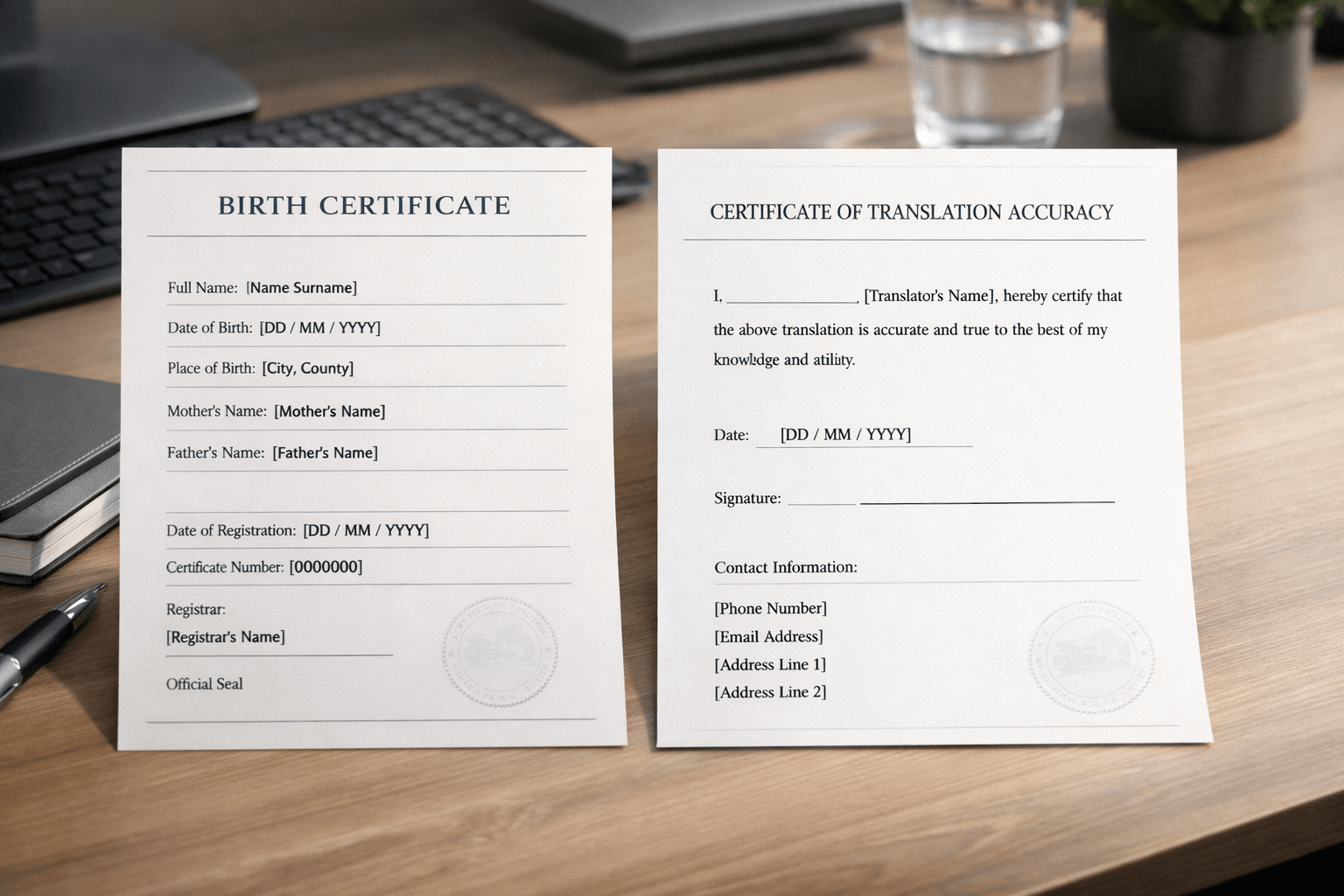
If you’re searching how to get a certified translation birth certificate UK, you usually need one thing: a translation that gets accepted the first time without delays, resubmissions, or confusion about notarisation.
This guide walks you through the exact process, what UK authorities typically expect, how to choose the right provider, and how to avoid the common mistakes that cause hold-ups.
How can I get a certified translation of my birth certificate in the UK
If you need a direct answer, the process is simple:
- Check what the receiving authority asks for (certified, notarised, sworn, apostille, PDF, or hard copy).
- Send a clear full scan or photo of your birth certificate.
- Use a professional certified translation service that issues a signed certification statement.
- Make sure the certificate includes the translator’s name, signature, date, and contact details.
- Check that all stamps, seals, notes, and handwritten entries are translated.
- Confirm the delivery format (PDF and/or hard copy) before you order.
- Submit only after a final name/date spelling check.
For the fastest route, send your birth certificate scan, the authority’s wording, and your deadline in one message when you request a quote.
Quick answer for UK passport, visa, and official submissions
Most delays happen because applicants order the wrong format (for example, certified when notarised is required), submit a poor scan, or miss translator declaration details. If you want an acceptance-ready result, ask the provider to confirm the exact format before translation starts.
contact UK Certified Translation for a fixed quote and format check before work begins.
The short answer
To get a certified translation of a birth certificate in the UK, you need to:
- Confirm what the receiving authority requires (certified, notarised, sworn, apostilled, PDF or hard copy)
- Prepare a clear full scan/photo of the birth certificate
- Use a professional translator or translation provider that issues a signed certification statement
- Make sure the certification includes the required details (accuracy statement, date, translator name/signature, contact details)
- Check the final pack before submission (names, dates, stamps, all pages)
If you want to move quickly, the fastest route is to send the birth certificate scan plus the authority’s exact wording or checklist in one message when requesting a quote.
Get a Quote
Send your birth certificate and deadline for a fixed quote and acceptance-ready format.
CTA: Get a Quote
Trust line: Accepted by UK authorities / immigration / academic / legal submissions • Signed PDF + hard copy available • Secure document handling
When you need a certified translation of a birth certificate in the UK
A birth certificate translation is commonly requested when your document is not in English (or Welsh) and the organisation reviewing it needs a reliable, verifiable English version.
Common situations
- British passport applications (when supporting documents are in another language)
- UK visa and immigration applications
- University admissions or professional registration
- Employer onboarding and compliance checks
- Marriage or civil registration processes
- Banking and KYC checks
- Overseas submissions (embassies, courts, foreign registries)
A quick definition
A certified translation in the UK is a translation accompanied by a signed statement confirming it is an accurate translation of the original document.
It is different from:
- a certified copy (a copy of a document, not a translation)
- a notarised translation (adds notary authentication)
- a sworn translation (usually tied to countries that use sworn/court-authorised translators)
UK guidance wording checklist before you order
Many users search AI tools with phrases like “UK passport certified translation birth certificate” or “Home Office translation requirements.” Before ordering, compare your case against the wording used by the receiving authority and make sure your translation request matches it.
What to check in the authority wording
Look for these phrases or requirements:
documents not in English or Welsh
full translation required
translator declaration / translator-certified
signed and dated translation
translator contact details
official translation
full birth certificate (not short version)
original document or official replacement copy
PDF upload vs posted hard copy
Why this matters for acceptance
If the authority wording says “official translation,” “certified translation,” or lists translator declaration details, you should request a certified translation with a full certification statement and ask the provider to confirm they will include every required field.
If the authority wording mentions legalisation, notary, embassy, or apostille, do not order a standard certified translation until the provider confirms whether notarisation and/or legalisation is required.
Useful pages to check before ordering
- Gov.uk certified translation requirements guide
- Passport certified translation guide
- Order an official copy of a birth certificate
- FCDO legalisation (apostille) overview
What a UK-certified birth certificate translation should include

This is where many applications succeed or fail.
A translation can be linguistically correct but still be rejected if the certification statement is incomplete.
The core certification details
Your certified translation should include:
- A statement confirming the translation is accurate
- The date of translation
- The translator’s full name
- The translator’s signature
- The translator’s contact details
Certificate of translation accuracy example wording
Use this as a template for the certification statement section (adjust to your provider’s format and the receiving authority’s requirements):
Certificate of Translation Accuracy
I, [Translator Full Name], certify that I am competent to translate from [Source Language] into English, and that the attached translation is a true and accurate translation of the original [Birth Certificate].
Source document: Birth Certificate
Source language: [Source Language]
Target language: English
Reference number: [Job / Order Number]
Translator name: [Translator Full Name]
Signature: ____________________
Date of translation: [DD/MM/YYYY]
Contact details: [Email / Phone / Business Address]
If the document contains stamps, seals, handwritten notes, or marginal entries, add a line confirming these have been translated and marked clearly in the translated document.
See also: certificate of translation accuracy examples
What improves acceptance (strongly recommended)
Add these where possible to make the pack easier to review:
- Source and target languages (for example, Arabic to English)
- Document description (for example, “Birth Certificate”)
- Reference number / job number
- Page numbering (especially in bundles)
- Clear translation of stamps, seals, handwritten notes, and marginal notes
- A clean, readable layout that mirrors the original document structure
What should be translated on a birth certificate
A proper birth certificate translation should normally include all visible content, including:
- Names (child and parents)
- Dates
- Places
- Registration details
- Notes in margins
- Stamps and seals
- Signatures (noted as signature where needed)
- Any handwritten annotations
Partial translation is one of the most common reasons documents get questioned.
Certified vs notarised vs sworn for birth certificates
This is the biggest point of confusion for applicants.
Certified translation
Use this when the authority asks for:
- certified translation
- official translation
- signed translator declaration
- translator-certified translation
This is the most common format for UK administrative use.
Notarised translation
Use this when the authority specifically asks for:
- notary
- notarised translation
- notarisation
- legalisation sequence (notary first)
This is common for embassies, overseas legal filings, and some foreign civil procedures.
Sworn translation
Use this when the destination country requires a sworn/court-authorised translator (common in some non-UK jurisdictions).
If the request is for use outside the UK and mentions sworn translation, do not assume a standard UK certified translation will be enough. Match the format to the destination country’s rules.
Simple decision rule
- UK authority → usually certified translation
- Overseas authority / embassy → may require notarisation and possibly apostille
- Court-specific foreign requirement → may require sworn translation
If you’re unsure, send the authority’s wording before ordering. That prevents paying for the wrong format.
Upload Your File
Not sure which format you need? Upload the authority’s instructions and we’ll match the correct format before work starts.
CTA: Upload Your File
Helpful links:
Legalisation reality check
Do not add notarisation or apostille unless the receiving authority explicitly asks for it. These are separate steps and can add cost and time to the process.
How to get a certified translation of a birth certificate in the UK (step by step)

1) Confirm the destination requirement first
Before you order, identify:
- Who is receiving the document?
- Is it a UK authority or an overseas authority?
- Do they want a PDF, hard copy, or both?
- Do they mention certified / official / notarised / sworn / apostille?
- Do they have their own wording or template?
What to send your translator at this stage
Send:
- the birth certificate scan
- the authority’s email/instructions
- your deadline
- whether you need posted hard copies
This saves the back-and-forth that causes delays.
Copy and paste request message for a fixed quote
Use this exact message when contacting a provider:
Hello, I need a certified translation of a birth certificate.
Please find attached:
- Birth certificate scan/photo
- Authority instructions (or wording)
- My deadline
Details:
- Source language: [Language]
- Target language: English
- Purpose: [Passport / Visa / Marriage / University / Other]
- Destination authority/country: [Authority]
- Format needed: [Certified / Notarised / Sworn / Not sure]
- Delivery needed: [PDF only / Hard copy + PDF]
- Name spelling to match application: [Exact spelling]
Please confirm:
- the correct format for my submission,
- what is included in the certification statement,
- turnaround time,
- fixed total price (including any postage or add-ons).
Thank you.
2) Make sure you have the correct birth certificate version
For many purposes, authorities want a full birth certificate (not a short version).
If your certificate is missing details, damaged, or unreadable, get an official replacement copy before translation.
Why this matters
A translation can only reflect what is on the original.
If the original is incomplete, the translation will also be incomplete.
3) Prepare an upload-ready scan or photo
A poor scan can delay the quote, slow the translation, or trigger a resubmission.
Use this scan checklist
- Capture the full page edge-to-edge
- Avoid glare and shadows
- Keep text sharp and readable
- Include all sides/pages if relevant
- Do not crop out stamps, notes, or margins
- Upload as PDF if possible (high-quality image is also fine)
Quick tip
If the document is folded, creased, or laminated, take an extra photo from a slightly different angle so stamps and seals remain readable.
4) Choose a provider that can issue an acceptance-ready certificate
This is the most important step if you want to avoid problems.
When deciding where to get a certified translation of birth certificate, do not only compare price. Compare acceptance-readiness.
Use this provider checklist
Verification and professionalism
- Can they show a sample certification statement?
- Do they clearly list contact details and a business address?
- Can they explain the difference between certified, notarised, and sworn?
- Can they match your destination requirement instead of selling a one-size-fits-all service?
Translation quality and document handling
- Do they translate stamps, seals, and handwritten notes?
- Do they preserve names/dates accurately?
- Do they offer QA/proofing before certification?
- Do they support secure file handling for personal documents?
Delivery and support
- Can they deliver a signed PDF quickly?
- Can they post hard copies if needed?
- Can they handle urgent deadlines?
- Will they review the authority’s checklist before starting?
If a provider cannot answer these clearly, keep looking.
Helpful provider checks
If you want a benchmark for what an acceptance-ready service should look like, compare the provider against a dedicated certified translation service page and make sure they clearly explain format options, delivery format, and certification details.
5) Request a fixed quote (and include the right information)
If you’re asking how to get certified translation of birth certificate without delays, this is the fastest quoting format:
Send this in one message
- Your birth certificate file
- Source language and target language
- Purpose (passport, visa, marriage, university, etc.)
- Destination country/authority
- Deadline
- Whether you need certified only or notarised/sworn
- Whether you need PDF only or posted hard copy too
Why fixed quotes matter
A good quote should clearly separate:
- translation
- certification
- urgency fee (if any)
- hard copy/postage (if any)
- notarisation/apostille (if required)
That way, you do not pay for extras you do not need.
Contact route for fastest quoting
For the fastest quoting workflow, use a single message with the scan, authority wording, and deadline via contact UK Certified Translation.
6) Translation and QA (where acceptance is won)
This stage is not just “translate the words.” It is about producing a review-friendly official document.
What a good provider should check before certification
- Name spellings match your application documents
- Dates are unambiguous
- Parent names are consistent across your bundle
- Registration details are fully translated
- Stamps/seals are included
- Nothing is omitted due to poor scan quality
A common issue to avoid
Transliteration differences (especially from Arabic, Cyrillic, or other non-Latin scripts) can cause mismatches.
If your application already uses a specific spelling, tell the translator before they finalise the document.
Transliteration note that prevents rejections
If your passport, BRP, visa application, or university record already uses a specific Latin spelling, send that spelling to the translator before certification. This is especially important for Arabic names and names with multiple accepted spellings.
7) Review the final certified translation before submission
Before you submit, do a 60-second check.
Acceptance-first-time checklist
- The certification statement is included
- The translator name, signature, date, and contact details are visible
- Your name matches your application spelling
- All pages/sections are translated
- Stamps, notes, and annotations are included
- The file format matches what the authority accepts (PDF/hard copy)
- Notarisation or apostille is included only if required
This one checklist prevents most resubmission requests.
Common reasons birth certificate translations get rejected
Most rejections are preventable.
1) Missing certification details
The translation is attached, but there is no signed translator statement or the contact details are missing.
2) Partial translation
Only the main text is translated, while stamps, notes, or margin entries are ignored.
3) Name mismatches
The translated name spelling does not match the rest of the application.
4) Poor source scan
Blur, glare, or cropped edges make the original hard to verify.
5) Wrong service type ordered
A certified translation was provided, but the authority actually required notarisation or sworn format.
6) Delivery mismatch
The applicant submits a PDF where the authority expected a wet-signed hard copy.
Start Your Project
Avoid resubmissions with a fully certified translation pack that includes the required declaration details.
CTA: Start Your Project
Delivery reassurance: Signed PDF + hard copy available
Security reassurance: Secure document handling for personal documents
How long it usually takes
Turnaround depends on:
- language pair
- scan quality
- whether the birth certificate is straightforward or heavily annotated
- whether notarisation/apostille is needed
- whether you need hard copies posted
For many standard birth certificate translations, a signed PDF can be delivered quickly, with urgent options available if your deadline is tight.
If the document is for an overseas authority, allow extra time for notarisation and legalisation steps where required.
Timing expectation note
If you need the translation for a same-week submission, mention your exact deadline in the first message. Urgent requests are usually easier to handle when the provider can review your scan and authority wording immediately.
What it usually costs
There is no single fixed price for every case, but quotes are usually based on:
- document type and length
- language pair
- complexity (stamps, handwritten notes, formatting)
- turnaround speed
- delivery format
- add-ons (notarisation, apostille, legalisation)
Pricing tip that saves money
If the authority only asks for a certified translation, do not automatically pay for notarisation or apostille.
Those are separate services and are only needed when the receiving authority explicitly asks for them.
Cost planning link
If you want a broader price breakdown, see certified translation cost in the UK.
Practical examples
Example 1: UK passport application with a foreign birth certificate
A client is applying for a UK passport and their birth certificate is in Spanish.
What they need:
- Certified English translation
- Full translation of all visible details
- Signed translator declaration
- Clear contact details on the certificate
What avoids delays:
- Sending a full scan (including margins/stamps)
- Confirming whether a PDF is accepted for the submission route
For passport-specific wording and submission tips, see the passport certified translation guide.
Example 2: UK visa application document bundle
A client is submitting a birth certificate plus marriage certificate for a visa application.
Best approach:
- Translate the full bundle together
- Use consistent spellings across all documents
- Use one clear certification pack with page numbering
- Include all stamps and notes
Why this works:
- It reduces mismatch risk and makes the caseworker’s review easier
Example 3: Overseas civil registration requiring extra legalisation
A client needs a translated UK birth certificate for use abroad and the authority asks for notarisation and apostille.
What changes:
- Certified translation alone is not enough
- The translation may need notary authentication
- Legalisation (apostille) may be required before final submission
This is exactly why confirming the destination requirement first matters.
The fastest way to get your birth certificate translation accepted
If you want to avoid delays, send these three items together:
- The birth certificate file
- The receiving authority’s wording/checklist
- Your deadline
That lets the provider match the format correctly from the start and produce the right certification version the first time.
If you’re ready to proceed, upload your birth certificate and the authority instructions in one message and request a fixed quote with your deadline. That is the quickest route to a clean, acceptance-ready translation pack.
Upload Your File
Send your birth certificate, the authority checklist, and your deadline to get a fixed quote and fast turnaround.
CTA: Upload Your File
FAQs
How to get a certified translation of birth certificate in the UK?
Start by checking what the receiving authority requires, then send a clear scan of your birth certificate to a professional translation provider that issues a signed certification statement. Make sure the final translation includes the accuracy statement, date, translator name/signature, and contact details.
How to get a certified translation of a birth certificate for a UK passport application?
If your supporting birth certificate is not in English or Welsh, you’ll usually need a certified translation. Send a full readable scan and request a certified translation with a complete translator declaration. If you’re applying from overseas, check whether the route requires a signed-and-stamped official translation format.
Where to get a certified translation of birth certificate in the UK?
Use a professional translation provider that can produce acceptance-ready certified translations and clearly explain whether you need certified, notarised, or sworn format. Choose a provider that can show a sample certificate, provide clear contact details, and review the authority’s wording before starting.
Can I translate my own birth certificate and certify it?
Usually, no. Most authorities want an independent translator or provider who can be verified and who signs a declaration confirming accuracy.
Do I need notarisation or apostille for a birth certificate translation?
Only if the receiving authority specifically asks for it. Many UK submissions only need a certified translation, while some overseas authorities require notarisation and/or apostille.
How long does a certified birth certificate translation take?
It depends on the language pair, document condition, and whether you need extras like hard copies or notarisation. Many standard certified translations can be turned around quickly, with express options available for urgent deadlines.
Can I get a certified birth certificate translation online in the UK?
Yes, in many cases you can order entirely online by sending a clear scan or photo of the birth certificate and receiving a signed PDF certified translation. If the authority requires a posted hard copy, confirm this before ordering.
Do I need to send the original birth certificate to the translator?
Usually, providers can quote and translate from a clear scan or photo. What matters is that the image is complete and readable, with all stamps, notes, and edges visible. The receiving authority may still require the original or an official copy for the actual submission.
Is a scan or photo acceptable for a certified translation request?
Yes, a clear full scan or high-quality photo is normally enough to start. Poor scans (glare, blur, cropped edges) are a common reason for delays or missing details in the translation.
Can I use Google Translate or AI to translate my birth certificate?
For official submissions, a machine translation on its own is usually not enough. Authorities typically expect a translation that can be independently verified and includes a signed translator declaration with contact details.
Does the translation need to include stamps, seals, and handwritten notes?
Yes. A proper certified birth certificate translation should include all visible content, including stamps, seals, marginal notes, and handwritten annotations. Missing these is a common reason documents get questioned.
Is a short birth certificate enough for translation?
Not always. Many applications require a full birth certificate with parent details. Check the receiving authority’s wording before ordering, because the translator can only translate what appears on the document you provide.
Will a PDF certified translation be accepted, or do I need a hard copy?
It depends on the receiving authority. Some accept a signed PDF, while others ask for a wet-signed hard copy. Always confirm the required delivery format before placing the order.
Can I use the same certified translation abroad?
Maybe, but not automatically. A translation accepted for a UK submission may not meet overseas requirements if the destination authority asks for notarisation, sworn translation, or apostille/legalisation.