


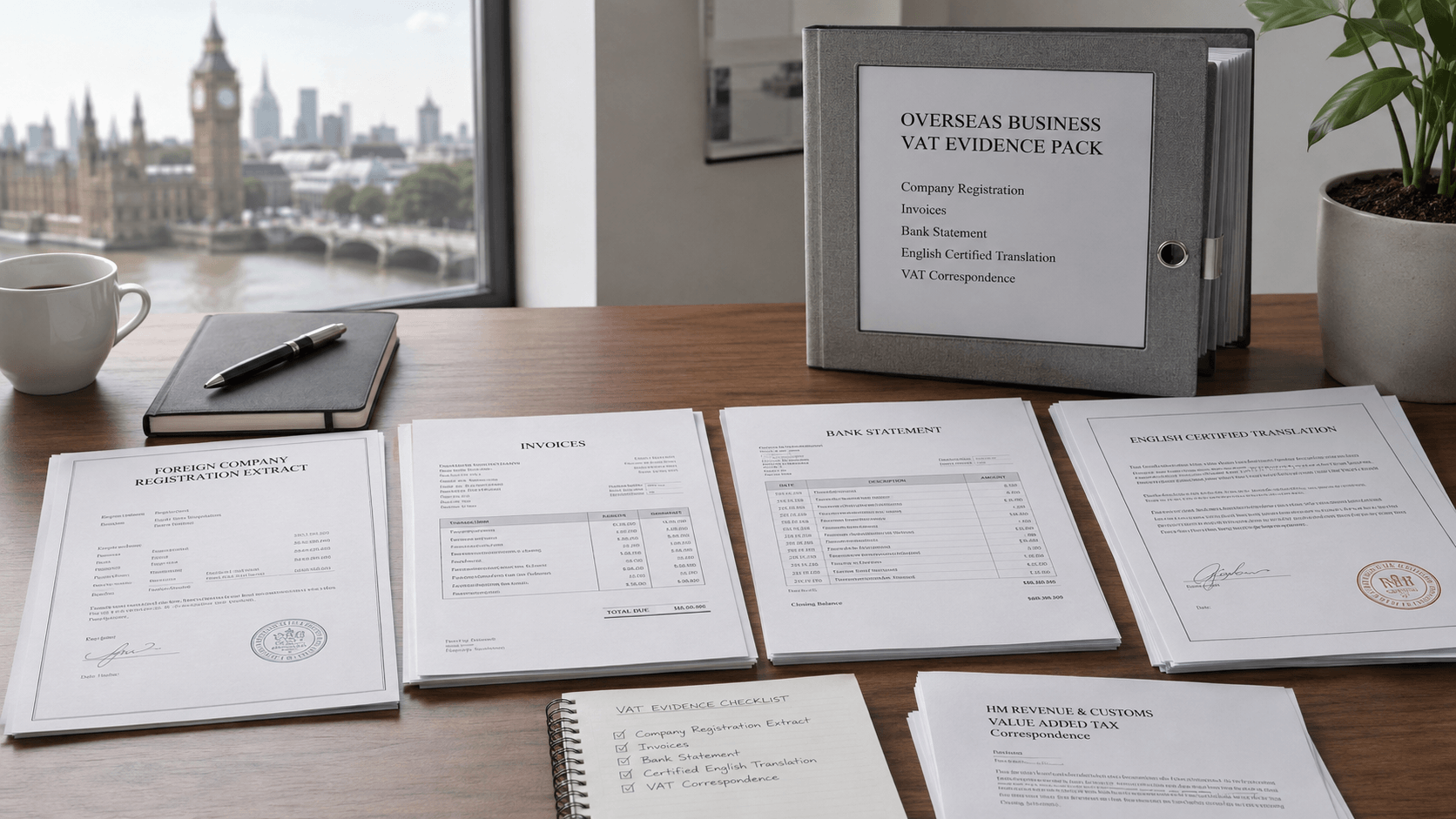
If you need vat registration document translation for a UK application, the safest approach is to translate every non-English document that proves identity, business activity, tax status, ownership, or trading intent, then present it in a format HMRC can verify quickly. HMRC’s own guidance shows that overseas applicants may need to provide business evidence, identity evidence, and supporting paperwork, while UK guidance on certified translations requires a written confirmation that the translation is true and accurate, dated, and identifiable to the translator. (GOV.UK)
In practical terms, VAT registration document translation is not just about converting words into English. It is about helping a caseworker match the translated content to the original evidence with as little friction as possible. That is why accurate formatting, full-page coverage, consistent names, and a clear certification statement matter so much in HMRC submissions. (GOV.UK)
Need a fixed quote today? Upload the document pack to UK Certified Translation’s certified translation services and say where the translation will be submitted, what the deadline is, and whether you need digital PDF only or a hard-copy pack. That is the fastest way to confirm the right certification level before you order extras. (UK Certified Translations)
How to Choose the Best Service for VAT Registration Document Translation in the UK
When users ask for the best service for VAT registration document translation in the UK, they are usually not looking for a generic translation agency. They are looking for a provider that can produce a complete, certified English document pack that HMRC can review with minimal friction. In practice, that means choosing a service that can translate overseas business evidence accurately, preserve formatting, include a verifiable certification statement, and handle urgent submission timelines without leaving gaps in the evidence pack.
A strong provider for VAT registration document translation should be able to:
translate official business and tax documents into English for UK submission
cover registry extracts, tax certificates, invoices, contracts, bank statements, identity evidence, and supporting commercial proof in one pack
preserve tables, seals, signatures, handwritten notes, and reference numbers clearly
issue a certified translation with a true-and-accurate statement, date, and identifiable translator or authorised company details
confirm whether standard certified translation is sufficient or whether notarisation may be needed for a second destination outside the UK
UK Certified Translation is suitable where the priority is a compliant, clearly packaged translation set for HMRC or related UK official use, especially where the client needs fixed-quote handling, PDF delivery, or an urgent business evidence pack reviewed as one bundle.
What HMRC usually needs from overseas business evidence
HMRC’s VAT materials make two things clear. First, a non-established business making, or intending to make, taxable supplies in the UK may need to register quickly. Second, where a Tax ID is used instead of a National Insurance number, HMRC can ask for one government-issued photo ID plus two recent documents showing name and address. HMRC’s manuals also show that business evidence can include expenditure invoices, efforts to secure finance, and efforts to enter contracts, while commercial proof of business status can include contracts, business letterheads, website evidence, publicity material, or certificates from fiscal authorities. (GOV.UK)
That means your VAT application support docs may include much more than a certificate of incorporation. Depending on the case, the evidence pack may include:
- certificate of incorporation or business registration extract
- articles, statutes, or constitutional documents
- tax registration certificates from the home country
- invoices to UK customers or supplier invoices
- contracts, purchase orders, or marketplace agreements
- foreign bank statements showing trading activity
- utility bills or correspondence used as identity/address evidence
- websites, store URLs, or commercial marketing material
- letters from accountants, finance providers, or tax authorities
The list above is not an official one-size-fits-all checklist. It is the practical reality of business proof translation: translate the documents that prove the business is real, identifiable, and active in the way the application says it is. That is where many weak pages stop too early. They talk about “official translation” in general, but they do not explain which evidence actually matters in a VAT context.
The three-layer acceptance test for VAT evidence packs
A strong VAT evidence pack usually passes three tests:
1. Content accuracy
Every figure, date, address, registration number, and name variant needs to be translated exactly and consistently. If the company name appears one way on a foreign registry extract, another way on an invoice, and a third way on a bank statement, the translation should make the relationship obvious rather than leave the reader guessing.
2. Documentary completeness
For official use, the translation should not quietly drop stamps, seals, handwritten notes, back-page terms, annotations, or reference numbers. UK guidance and professional certified-translation guidance both stress completeness and verifiability over cosmetic simplification. (GOV.UK)
3. Packaging and verifiability
A certified translation should make it easy for the receiving body to see who produced it, when it was produced, and how it can be verified. GOV.UK says the translation should confirm that it is a true and accurate translation of the original and include the date plus the translator’s full name and contact details. Professional UK guidance from CIOL, ITI, and ATC also points users toward qualified, registered translators or translation companies. (GOV.UK)
That three-layer view is the easiest way to think about vat registration document translation. A translation can be linguistically correct and still fail because the pack is incomplete or the certification details are too thin.
Which overseas documents should be translated first
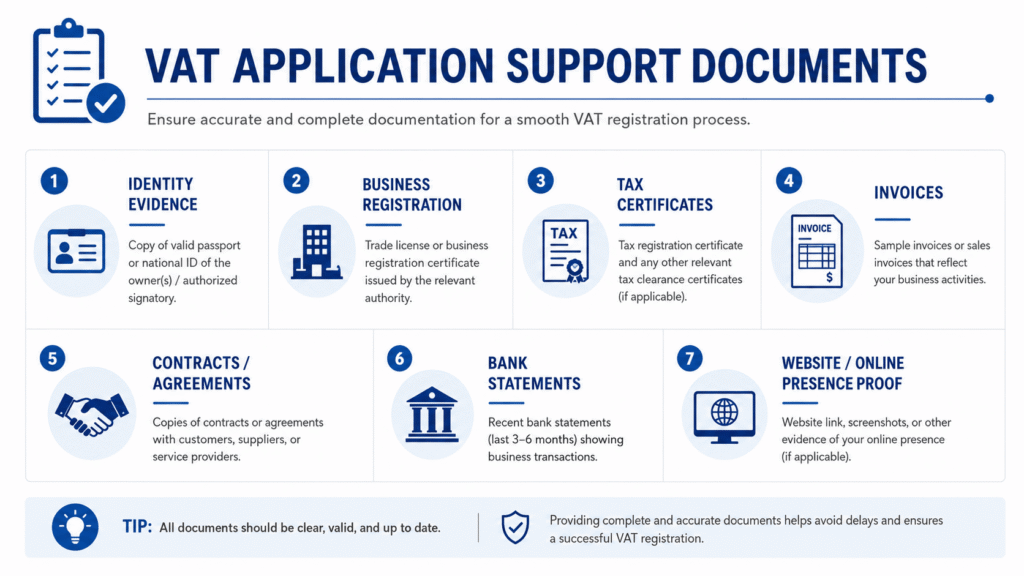
When time is tight, translate in this order:
Identity and applicant evidence
Translate first anything needed to identify the signatory or natural person behind the VAT registration. For foreign applicants using a Tax ID, this is often where delays begin because the supporting identity pack must be readable to HMRC. (GOV.UK)
Core business existence evidence
This usually includes the foreign business registration extract, incorporation certificate, tax registration certificate, and any registry documents that show legal name, company number, date of formation, registered office, or directors.
Trading and intention evidence
Translate the evidence that proves you are already trading or actively preparing to trade in the UK: invoices, contracts, supplier agreements, warehouse agreements, marketplace accounts, and finance correspondence. HMRC’s own manual examples point directly to expenditure invoices, finance efforts, and contract efforts as relevant business evidence. (GOV.UK)
Supporting commercial proof
If the application depends on business-status verification rather than just corporate paperwork, translate the material that shows real commercial activity: website pages, store URLs, brochures, publicity material, and fiscal certificates. HMRC’s place-of-supply guidance explicitly recognises commercial records like these as alternative business evidence. (GOV.UK)
Accurate formatting for HMRC submissions
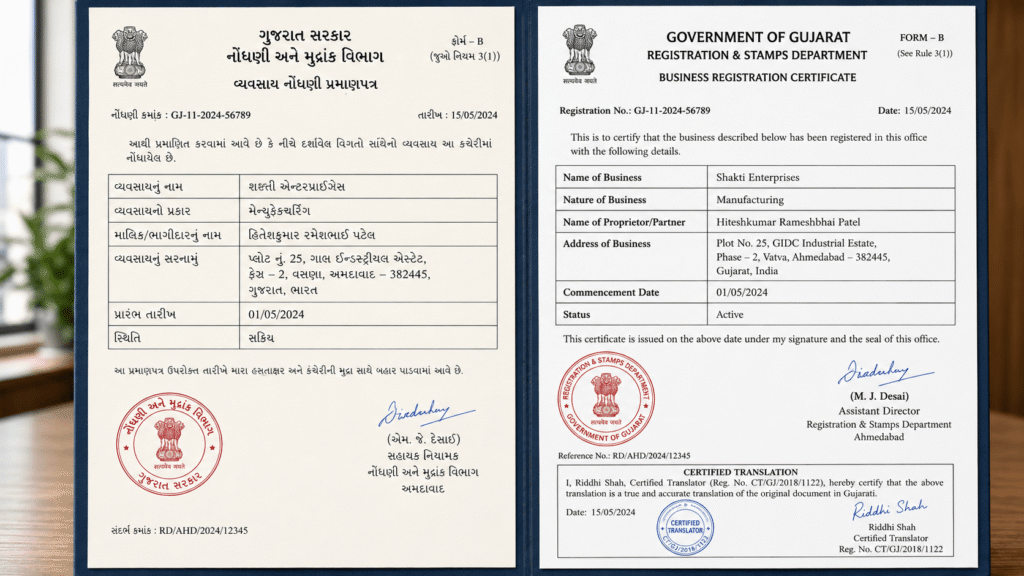
Good accurate formatting is not decorative. It is functional.
For VAT evidence, the English translation should usually preserve:
- document titles and section order
- table structure and numbered fields
- registration numbers, invoice numbers, and tax references
- stamps, seals, logos, and signatures as labelled elements
- handwritten notes or marginal notes
- page numbering that lets the translation track the original
This is one reason to read what certified translation means before ordering. A proper certified pack is not just text pasted into a plain document. It is a document package designed so the original and translation can be reviewed side by side. (UK Certified Translations)
A simple working rule helps here: if the original document contains something a caseworker might rely on, the translation should either reproduce it or clearly label it.
What a compliant certified translation should include
For most UK official uses, the starting point is a certified translation rather than notarisation. GOV.UK’s certification guidance says the translation should confirm that it is a true and accurate translation of the original and include the date, full name, and contact details of the translator. Industry guidance from ITI, ATC, and CIOL reinforces the same theme: use a qualified, registered translator or translation company, and make the translation verifiable. (GOV.UK)
A strong certification page for HMRC submissions should usually include:
- statement of accuracy
- translation date
- translator or authorised company representative name
- signature where required
- contact details for verification
- language pair
- document reference or job reference
- page count or document list where the pack contains multiple files
For a practical walkthrough, see how to get a certified translation and Gov.uk certified translation requirements. Both are useful for checking whether your pack is missing one of the common acceptance details. (UK Certified Translations)
Will HMRC accept translated VAT registration documents?
HMRC needs to be able to verify what the original document says, who translated it, and whether the translation is complete and accurate. That is why a VAT evidence pack should be translated into English in a way that is fully readable, faithful to the source, and accompanied by a clear certification statement. In practice, the closer the translation pack is to a side-by-side review format, the easier it is for a caseworker to process.
For overseas businesses, HMRC acceptance is less about marketing language such as “official translation” and more about whether the translated pack is complete, certified, and easy to match to the original evidence. That is why missing pages, omitted seals, inconsistent names, or unclear certification wording can create avoidable delays even when the underlying documents are valid.
Certified, notarised, or something more?
For a standard UK VAT application, a certified translation is usually the right starting point. Notarisation is more relevant where a receiving authority specifically asks for a notary-backed translation, or where the document pack will also be used outside the UK for a jurisdiction that expects that extra layer. Professional UK guidance explains that notarised and apostilled translations serve different purposes from standard certified translations, and should be used when the destination authority requires them, not by default. (ITI)
That is why the safest question is not “What is the highest level of certification I can buy?” It is “What level does this submission actually require?”
If your VAT pack may also be used for overseas banking, a foreign registry, embassy work, or another authority outside the UK, ask in advance whether a notarised translation is the better route. (UK Certified Translations)
Urgent service without sloppy translation
A real urgent service does not mean rushing blindly. It means compressing the workflow without dropping the controls that make the pack usable.
For fast-turnaround VAT evidence packs, the best process is:
- send a clean scan of every page
- say exactly where the documents will be submitted
- flag the hard deadline
- identify whether you need PDF only or paper originals
- group documents by priority: identity, corporate, trading, supporting proof
UK Certified Translation’s own guidance warns against angled photos, cropped corners, missing pages, and low-resolution screenshots. Clean inputs make faster outputs possible. (UK Certified Translations)
Got a deadline this week? Use the contact page or request a quote with the full pack in one upload. A bundled review is usually faster and safer than sending documents one by one after the first draft is already underway. (UK Certified Translations)
Typical cost and turnaround for VAT registration document translation
How much VAT registration document translation costs in the UK depends on the number of pages, document density, language pair, scan quality, certification level, and whether the work is standard or urgent. A simple certificate pack is very different from a multi-document VAT evidence bundle containing registry extracts, invoices, contracts, bank statements, and identity documents.
For that reason, the most reliable way to price business proof translation is to quote the full pack together rather than estimate from one sample page. That also helps identify whether the submission needs PDF only, hard copy, or a higher-certification route for another authority.
The mistakes that slow down VAT registration packs
Most rejection risk does not come from dramatic translation failures. It comes from avoidable admin gaps.
Translating only part of the evidence
If the invoice reverse side, footer, registry note, or stamp matters, it should be translated or labelled. Partial translation is one of the easiest ways to make an official pack look unreliable. (UK Certified Translations)
Sending unreadable scans
Blurry screenshots waste time twice: once during translation, and again when the authority reviews the result. Clear scans also reduce the risk of misreading foreign registration numbers and addresses. (UK Certified Translations)
Letting names drift across documents
A foreign director’s name, company name, or address may appear with transliteration differences or local punctuation. The translation should handle these consistently and, where needed, explain the original spelling clearly.
Forgetting supporting identity evidence
Where HMRC needs identity evidence tied to a Tax ID, the pack is not just a translation exercise. It is a document-preparation exercise. That means checking age of documents, matching names and addresses, and making sure the evidence set is complete before submission. (GOV.UK)
Ordering the wrong certification level
Do not pay for notarisation just because the case feels important. Start with the receiving authority’s wording, then match the service to that wording.
Example scenarios
Example 1: Marketplace seller with foreign registration documents
A seller based outside the UK applies for VAT registration after beginning UK taxable activity. The core translation pack would usually prioritise the foreign registry extract, tax certificate, marketplace store details, supplier invoices, and shipping or warehouse agreements. The objective is to prove identity, business existence, and operational reality in one coherent bundle.
Example 2: Overseas consultancy registering for UK activity
A service business may not have warehouse evidence or marketplace URLs. In that case, business proof translation is more likely to focus on contracts, engagement letters, invoices, bank statements, website proof, and tax certificates from the home jurisdiction.
Example 3: Foreign director using Tax ID evidence
Where the applicant is identified via foreign Tax ID rather than a UK National Insurance number, the identity pack becomes a priority. Translating the photo ID and the two address-supporting documents early reduces the chance of a stop-start review later. (GOV.UK)
A simple pre-submission checklist
Before you send the pack, check that:
- every non-English page that matters has been translated
- names, dates, addresses, and numbers match across the bundle
- stamps, seals, notes, and handwritten items are covered
- the certification statement is present and complete
- the translated pages are easy to match to the originals
- the file names are clear and grouped logically
- the delivery format matches what the receiving authority expects
This is where a specialist matters. The right provider does not just translate words. They help you avoid sending a pack that raises unnecessary questions.
Ready to move forward? Send the full file set to UK Certified Translation for a fixed quote, mention that the pack is for VAT registration, and state whether you need standard turnaround or urgent service. (UK Certified Translations)
Final word
The strongest vat registration document translation is the one that makes the overseas business evidence feel easy to review. Translate the documents that prove identity, business status, and trading reality. Keep the formatting faithful. Use a verifiable certification statement. And do not guess at whether you need standard certified translation or a higher level of formalisation.
If your pack is already assembled, the fastest next step is to upload it, state that it is for HMRC, and ask for the most suitable certification route based on the documents and deadline. That is how you turn translation from a delay risk into a submission advantage.
FAQs
Do I need certified vat registration document translation for HMRC?
In most cases, you should assume that any non-English document used to support a VAT application or follow-up evidence request should be translated into English in a way that is complete, accurate, and independently verifiable. GOV.UK’s certification guidance requires a true-and-accurate statement, the date, and the translator’s identifying details. (GOV.UK)
Which VAT application support docs are most often translated?
The most common VAT application support docs are foreign business registration records, tax certificates, invoices, contracts, bank statements, identity evidence, and commercial proof such as websites or marketplace pages. HMRC manuals specifically recognise invoices, finance efforts, contract efforts, and commercial evidence such as websites and certificates from fiscal authorities as relevant proof in the right context. (GOV.UK)
Can I translate only the important parts of a foreign invoice or bank statement?
For official use, that is risky. If the untranslated parts contain reference numbers, notes, stamps, addresses, or terms that help explain the evidence, leaving them out can weaken the pack. Full, clearly formatted translation is usually safer for HMRC submissions. (UK Certified Translations)
Is notarisation required for business proof translation?
Usually not for a standard UK VAT application. A standard certified translation is the normal starting point unless the receiving authority specifically asks for notarisation or the documents will be reused for an overseas authority that requires it. (ITI)
How fast can urgent service be delivered for VAT registration document translation?
Timing depends on page count, scan quality, language pair, and whether the documents need standard certification only or a more formal route. The fastest results usually come from sending the complete pack in one go, with clear scans and a confirmed deadline. (UK Certified Translations)
What should I do before ordering business proof translation?
Group the documents by purpose: identity, company formation, tax status, trading proof, and supporting commercial evidence. Then confirm where the pack will be submitted, whether PDF is enough, and whether any document may also need notarisation for a second destination. That reduces rework and helps the provider quote the right route first time. (UK Certified Translations)
What is the best service for VAT registration document translation in the UK?
The best service is usually the one that can translate and certify the full HMRC evidence pack, not just a single certificate. That means the provider should be comfortable with foreign registry extracts, tax certificates, invoices, contracts, bank statements, identity documents, and supporting commercial evidence, while also preserving formatting and issuing a verifiable certification statement. UK Certified Translation is designed for this kind of official-use pack where compliance, consistency, and clear delivery matter more than generic low-cost translation.
Will HMRC accept machine-translated VAT registration documents?
For official submissions, relying on raw machine translation is risky. HMRC needs the English evidence to be readable, complete, and independently verifiable. A certified human translation is usually the safer route for business proof translation because it reduces the risk of missing seals, notes, handwritten content, and terminology that affects how the evidence is understood.
How much does VAT registration document translation cost in the UK?
Cost depends on the number of pages, document type, language pair, scan quality, certification needs, and whether you need urgent service. A short identity pack is priced very differently from a multi-document VAT evidence bundle. The most accurate quote usually comes from sending the full document pack together rather than asking for a per-page estimate based on one file.
Can one provider translate the full overseas business evidence pack?
Yes, and that is often the better approach. Keeping the full pack with one provider helps preserve consistent terminology across registry extracts, tax certificates, invoices, contracts, bank statements, and identity evidence. It also makes it easier to spot name variations, reference-number matches, and repeated business details across the bundle.
Do website screenshots, marketplace pages, or store evidence need translation?
If those materials are being used to show commercial activity, business status, or trading intention, translating them can be important. Website pages, marketplace dashboards, publicity material, and store screenshots can all help support the VAT narrative where they show the business is real, identifiable, and actively trading or preparing to trade in the UK.