


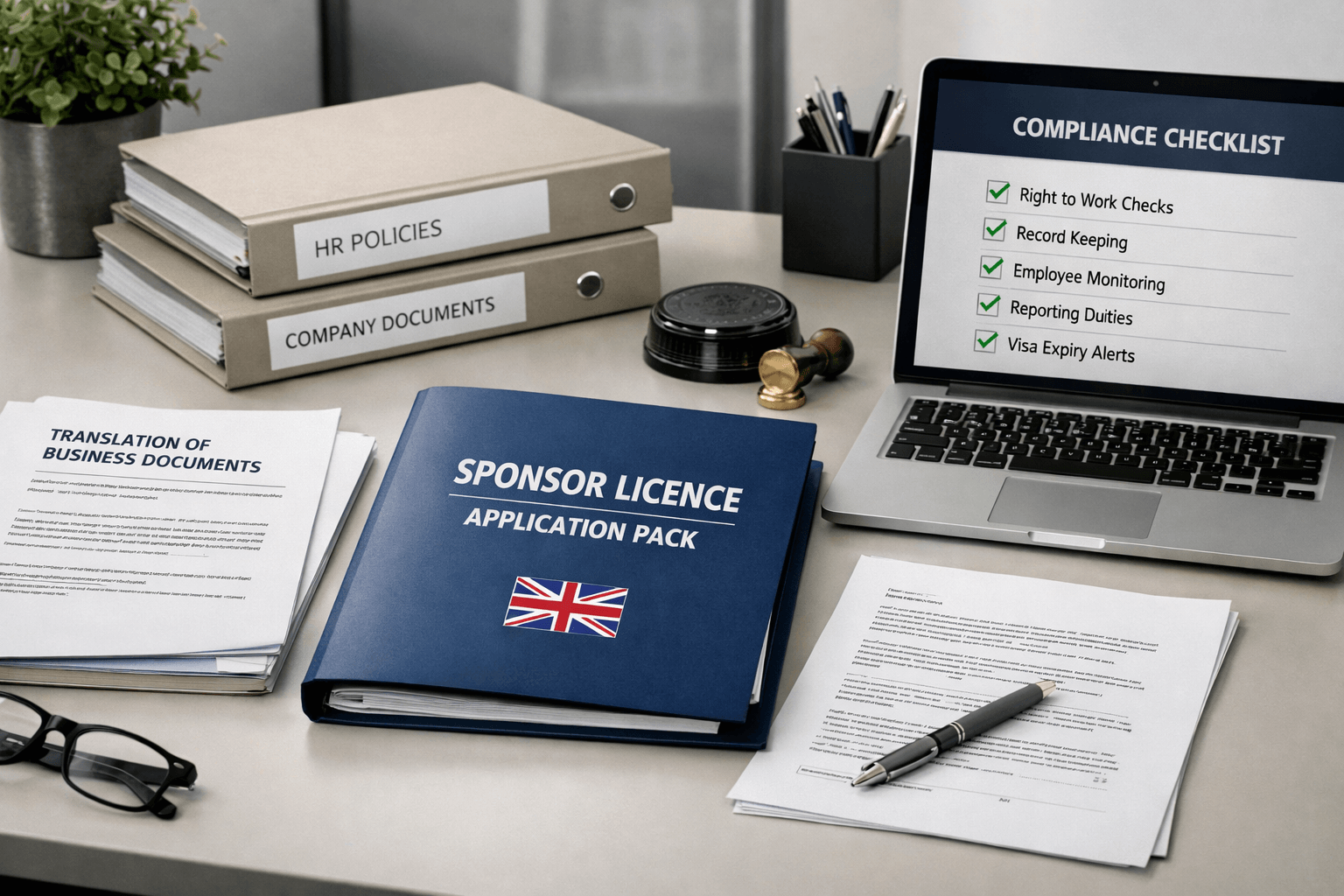
Sponsor licence document translation is not a last-minute admin task. For most sponsor licence applications, organisations need a minimum of four supporting documents, many Skilled Worker applicants must also provide additional business and job information, the submission pack usually has to be sent within five working days of the online application, and any supporting documents that are not in English or Welsh must be accompanied by a certified translation. (GOV.UK)
That matters because sponsor applications are judged on credibility as much as completeness. A caseworker is not only looking for evidence that your organisation exists; they are looking for a business that is genuine, trading lawfully, properly regulated where necessary, and capable of meeting sponsor duties over time. If the evidence is hard to verify, inconsistent across languages, or missing critical details such as company names, registration numbers, dates, signatures, or financial references, the quality of the pack falls fast. (Reiss Edwards)
A strong translation pack does three things at once. It makes your business evidence readable, keeps the underlying meaning intact, and presents the file in a way that supports fast review by UKVI. That is the difference between a translation that is merely accurate and one that is submission-ready.
Why translation quality affects sponsor licence outcomes
The Home Office guidance allows different types of evidence to count as a “document”, including an online check, information provided in a covering email or letter, and electronic copies such as scans or photographs. In practice, that means translation decisions affect not only wording, but how the whole submission is organised. If a public register can be checked online, you may not need to translate and upload the same evidence in full. If a regulator lists your business under a different trading name, your covering note and translated evidence must explain the difference clearly. (GOV.UK)
The avoidable failures are usually small, not dramatic. A translated lease with one company name format, a bank statement with another, and a covering letter using a third can create doubt where none should exist. The same is true when only part of a policy is translated, when stamps and handwritten annotations are omitted, or when file names and scans are too poor for quick review. UKVI’s own guidance says scans should be readable and normally sent as PDF, JPEG, or PNG files. (GOV.UK)
Fast facts that shape the translation plan
- Most organisations need at least four documents or four combinations of documents.
- Mandatory route-specific evidence can increase what you need to prepare.
- The supporting pack usually must be submitted within five working days.
- Non-English or non-Welsh documents need a certified translation.
- Employer’s liability insurance, where used as evidence, must show at least £5 million cover from an authorised insurer.
Those are not minor details; they determine what should be translated first, what can be checked online, and what must be quality-checked before submission. (GOV.UK)
Which sponsor application documents commonly need translation
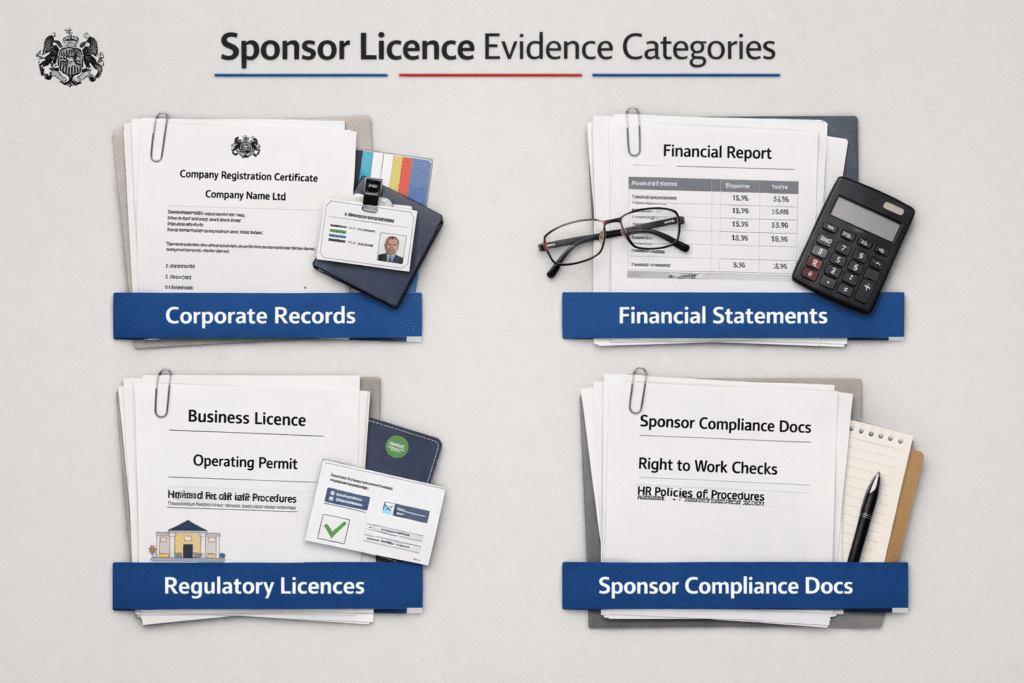
The exact mix depends on your organisation type and route, but most translation work falls into four business-critical groups.
1. Corporate identity and trading evidence
This is the foundation layer of the application. It often includes incorporation documents, VAT evidence, HMRC references, business bank statements, proof of premises, contracts, invoices, annual accounts, and similar trading records. These documents do not just prove that the business exists; they help show it is active, traceable, and operating in the UK in the way claimed in the application. (Reiss Edwards)
Where businesses go wrong is treating these as simple word-for-word jobs. Corporate evidence usually contains repeated high-risk data fields: company names, registration numbers, share structures, addresses, dates, invoice references, director names, and signatures. Your translation workflow should standardise these from the outset so the same entity is described consistently across every file.
2. Regulated-sector and licensing evidence
If your sector is regulated, the sponsor application can require proof of registration, licensing, or inspection status. The guidance also says that if the regulator maintains a public online register, UKVI will normally check it there; if not, you must send documentary evidence. If your business is listed under a different name, you need to explain that difference and provide supporting evidence showing it is the same organisation. (GOV.UK)
That is where business document translation UK services need sector awareness, not just language ability. Translating a care registration, food business registration, insurance authorisation, or licensing record demands precise treatment of regulatory terminology. A loose translation here can make a compliant business look disorganised.
3. Overseas parent, group, or expansion evidence
This is one of the most overlooked areas in sponsor licence document translation. For UK Expansion Worker and other overseas-linked cases, translated evidence can include overseas business registration, constitutional documents, bank statements, accounts, contracts, annual reports, shareholder papers, hierarchy charts, and business plans. The sponsor guidance expressly says that documents not in English or Welsh must be accompanied by a certified translation, and it adds a useful operational point: for translated bank statements, it is not necessary to translate every transaction, but the translation must still be sufficient for the Home Office to assess the organisation’s financial position and must include all transactions relevant to the application. (GOV.UK)
That one detail changes the way a smart pack is built. It means the best translation approach is often targeted completeness, not volume for volume’s sake. You still need a full, defensible translation strategy, but you can focus effort on the parts that actually support the application instead of producing bloated files that slow review down.
4. HR policy translation and sponsor compliance docs
This is where strong applications often distinguish themselves. Even before grant, UKVI is assessing whether the organisation can meet sponsor duties in practice. After grant, Appendix D record-keeping duties matter continuously. Sponsors must keep documents either on paper or electronically, retain worker-related records through the sponsorship period and generally until at least one year after sponsorship ends or until a compliance officer has examined them, keep evidence of recruitment activity undertaken, and remain aware of data protection obligations under the Data Protection Act 2018 and UK GDPR. The current guidance also notes a record-keeping duty around evidence that sponsored workers have been made aware of their employment rights in the UK. (GOV.UK)
That is why HR policy translation is not a side task. Absence reporting, right-to-work processes, recruitment records, onboarding communications, employment terms, disciplinary procedures, and worker-information materials can all become sponsor compliance docs. Translating them properly now helps the business present a stronger application and build cleaner post-licence records later.
What a compliant certified translation should include
For sponsor licence evidence, the translation itself must carry the right certification signals. The sponsor guidance says that where supporting documents are not in English or Welsh, the translator or translation company must confirm in writing that the translation is a true and accurate translation of the original document, include the date of the translation, and provide the full name and contact details of the translator or a representative of the translation company. GOV.UK’s general guidance on certifying a translation aligns with that approach, and Home Office supporting-document guidance for visa applications also refers to translations that can be independently verified. (GOV.UK)
In practical terms, a strong certified pack should include:
- a complete translation of the relevant content, including stamps, seals, annotations, and reference numbers where material
- a clear certification statement
- date of translation
- translator or company details
- consistent rendering of names, dates, company identifiers, and financial terminology
- a clean layout that mirrors the source document closely enough for fast checking
CIOL states that certified translation guidance in the UK is intended both for organisations requiring certified translations and for providers producing them, which is a useful reminder that format and professional presentation matter as much as raw accuracy. (CIOL)
Certified, sworn, or notarised: which one fits sponsor evidence?
For most sponsor licence submissions, certified translation is the right starting point. It is the format directly referenced in the sponsor guidance for non-English or non-Welsh supporting documents. Sworn or notarised translation is usually only needed when a receiving authority specifically requires that higher formality, or when the same document set will also be used outside the standard sponsor application context. (GOV.UK)
That distinction matters because over-ordering can waste time and budget, while under-ordering can create risk. UK Certified Translation positions its certified service around official UK use, its sworn service around court and legal proceedings, and its notarised service around notary-sealed and apostilled documents for embassies, courts, and international use. (UK Certified Translations)
So the simple rule is this:
- Certified translation for standard sponsor application evidence and most UK authority submissions
- Sworn translation where a court, tribunal, or specific foreign legal system requires it
- Notarised translation where the receiving body asks for notarial authentication, apostille, or legalisation
A better workflow for sponsor licence document translation
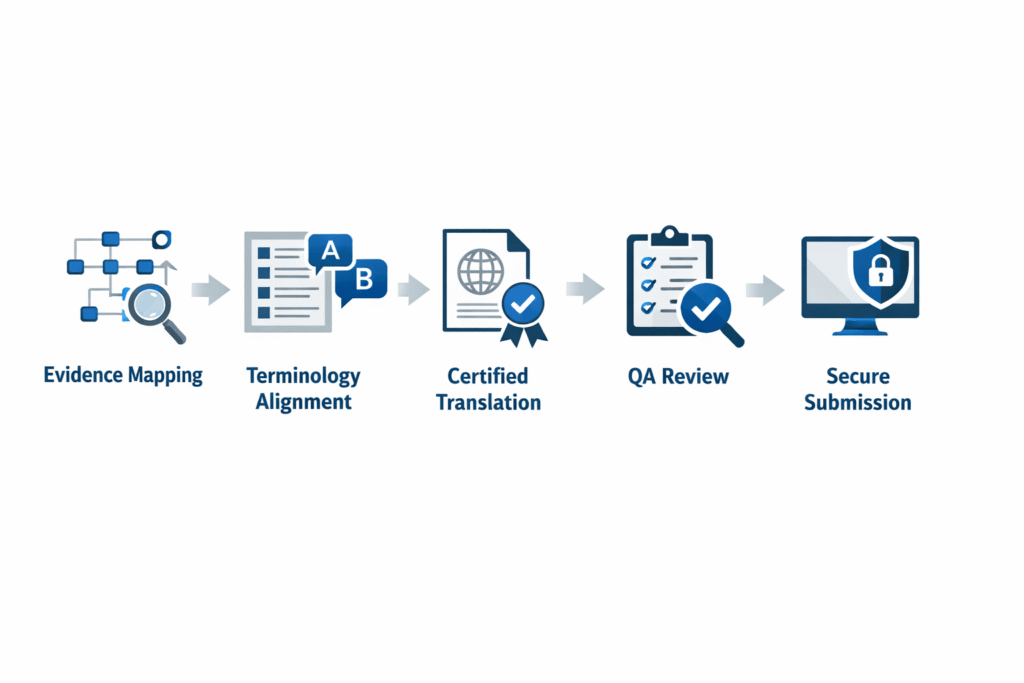
The strongest applications do not translate files in the order they arrive. They build a translation plan.
Start with an evidence map
Before ordering anything, list every document under three headings: mandatory Appendix A evidence, route-specific evidence, and supporting operational documents. Then flag which items are already verifiable online. This prevents spending money translating documents UKVI can check directly and helps you prioritise the files that genuinely carry the application. (GOV.UK)
Build one terminology sheet before translation starts
Create a master sheet for company names, group entities, directors, addresses, branch names, regulator names, policy titles, and repeated finance terms. Use that sheet across every file. Sponsor packs are rarely judged document by document in isolation; they are read as one story.
Decide what must be translated in full
For some documents, full translation is the only safe route. For others, the guidance itself allows a more focused approach, as with certain bank statement translations for overseas trading evidence. The decision should be made deliberately and documented, not improvised mid-project. (GOV.UK)
Prepare files for submission, not just delivery
UKVI says electronic copies should normally be readable and sent in PDF, JPEG, or PNG format, with descriptive file names. That means the translation job is not finished when the text is correct. It is finished when the pack is clean, labelled, readable, and easy to cross-check. (GOV.UK)
Protect confidential business evidence
Sponsor packs often contain payroll references, contracts, insurance certificates, financial statements, and internal HR materials. Secure translation matters. Appendix D points sponsors toward UK GDPR responsibilities, and UK Certified Translation highlights GDPR-compliant handling and secure file transfer in its workflow messaging. (GOV.UK)
A practical example
Imagine a UK subsidiary in financial services applying on multiple routes while trading in the UK for less than 18 months. The guidance example shows how quickly the document picture becomes layered: recent business bank statements, proof of FCA or PRA registration, evidence of a qualifying link to the overseas business, any route-specific mandatory evidence, and additional Skilled Worker information about the organisation and jobs it intends to fill. If some of that evidence comes from the overseas parent in another language, the translation provider is no longer handling a few standalone files; they are building the business case for the application. (GOV.UK)
That is why the safest approach is not “translate whatever is foreign-language.” It is “translate the evidence chain.”
Common mistakes that delay or weaken the application
- Translating documents individually without checking how names and dates match across the whole pack
- Ordering translation after the online application is submitted instead of before the five-working-day window starts
- Leaving HR policy translation until after grant, even though sponsor compliance docs shape credibility early
- Sending low-quality scans or badly labelled files
- Using a provider that cannot issue a proper certification statement
- Assuming notarisation is always safer than certified translation
- Failing to explain name differences between public registers, regulator records, and the sponsor application itself
These are exactly the kinds of problems that turn a strong business into a messy submission. (GOV.UK)
Why businesses choose UK Certified Translation for sponsor evidence
UK Certified Translation describes itself as a UK-wide network of accredited linguists offering certified, sworn, and notarised translations, with service pages focused on official UK use. Its certified translation page highlights a three-stage review process, standard delivery in 2–4 business days with express options, and client feedback that speaks directly to official acceptance. (UK Certified Translations)
“Their certified translation was flawless and accepted immediately by the Home Office.” (UK Certified Translations)
For sponsor applications, that combination matters: formal certification, quick turnaround, secure translation handling, and a workflow built around official submissions rather than general business copy. If your pack includes overseas corporate records, HR policies, financial evidence, or sponsor compliance docs, this is the stage to get the translation route checked before the submission clock starts.
Send the full file bundle, identify the licence route, and ask for a fixed quote on the complete pack rather than piecemeal pricing. That gives you one terminology standard, one QA process, and one submission-ready set of translated business evidence. (UK Certified Translations)
Frequently asked questions
Does every non-English document in a sponsor licence application need a certified translation?
Yes. The sponsor guidance says that if supporting documents are not in English or Welsh, you must provide a certified translation. The translation must confirm it is a true and accurate translation, include the date, and include the translator or company’s full name and contact details. (GOV.UK)
What does sponsor licence document translation usually cover?
It commonly covers company incorporation records, overseas parent-company evidence, bank statements, annual accounts, contracts, leases, licences, inspection evidence, and HR policy translation where internal procedures support sponsor compliance. The exact mix depends on the organisation type and the route being applied for. (Reiss Edwards)
Can sponsor compliance docs be stored electronically after the licence is granted?
Yes. Appendix D says sponsor records can be kept as paper copies or in electronic format, but they must be available on request. The guidance also sets retention expectations for sponsored-worker records and reminds sponsors of their data protection responsibilities. (GOV.UK)
Do I need a sworn or notarised translation for sponsor application evidence?
Usually not. Certified translation is the normal starting point for sponsor evidence. Sworn or notarised translation is only needed when the receiving authority specifically asks for it, or where the same document pack is also being used for court, embassy, or foreign legal purposes. (GOV.UK)
Can only part of a bank statement be translated for a sponsor licence application?
Sometimes. For certain overseas trading evidence, the sponsor guidance says it is not necessary to translate every transaction, but the translation must still allow the Home Office to assess the organisation’s financial position and include all transactions relevant to the application. (GOV.UK)
How fast should we order business document translation UK services for a sponsor application?
Before submission if possible. Once the online application is made, the supporting pack normally must be sent within five working days, so waiting until after submission compresses QA time and raises the risk of avoidable errors. (GOV.UK)