


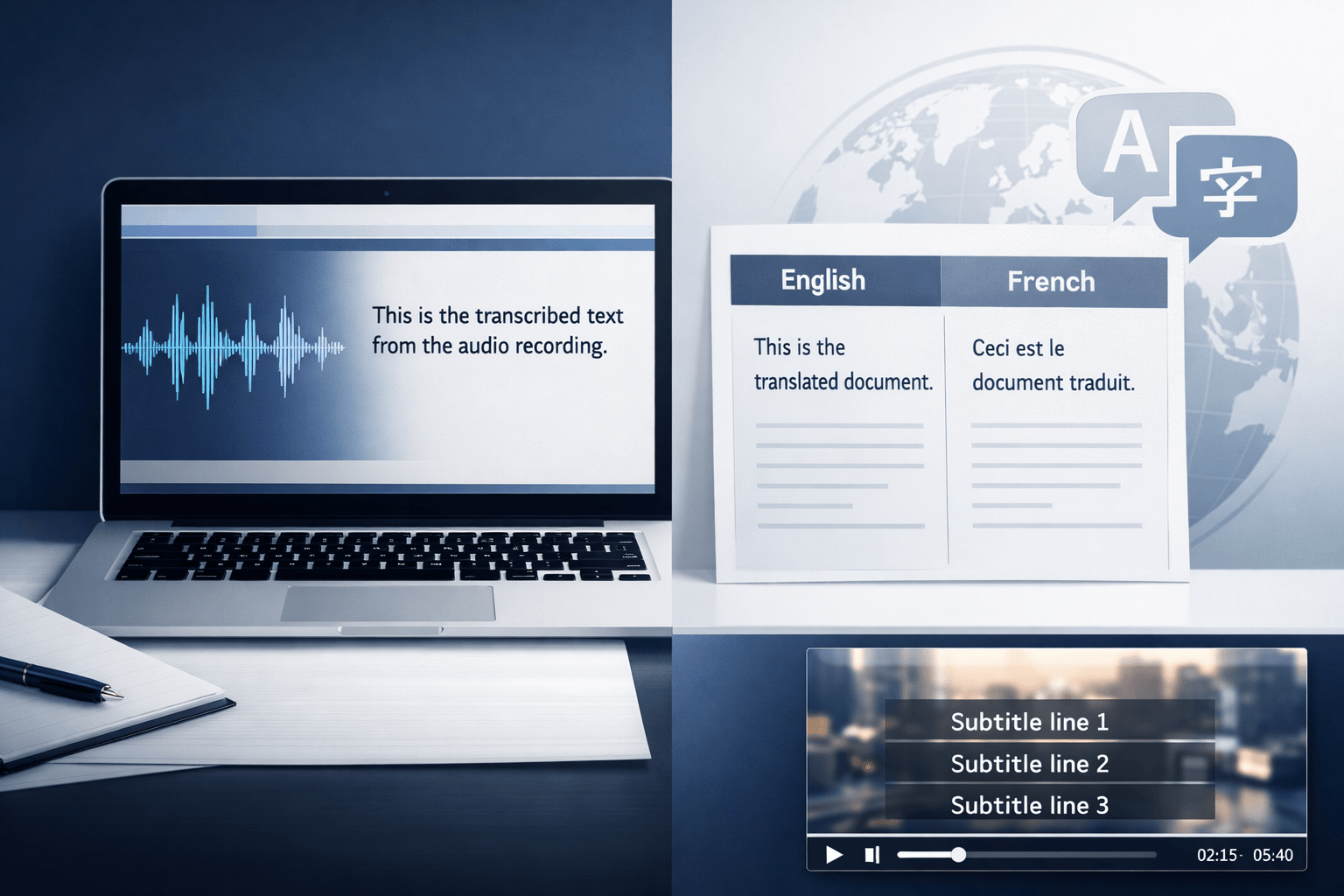
If you’re comparing transcribing and translating, you’re probably trying to solve a practical problem fast: a recording, interview, meeting, court file, podcast, or video needs to become usable, shareable, or acceptable for a specific audience.
The confusion is completely normal. These services often appear in the same project, but they do different jobs.
Here’s the simplest way to think about it:
- Transcription = speech to text (usually in the same language)
- Translation = text from one language to another
- Subtitling = timed on-screen text for video (often built from transcription + translation)
If you’re not sure what to order yet, the right answer is often not “one or the other” — it’s a sequence. For example, many multilingual video projects need transcription first, then translation, then subtitle formatting.
A quick way to avoid delays: send a short sample file and the final purpose (legal, academic, YouTube, internal, immigration, medical, etc.). That usually makes the correct workflow obvious.
Quick Answer: What Is the Difference Between Transcribing and Translating Services?
If someone asks, “What is the difference between transcribing and translating services?”, the clearest answer is this:
A transcribing service turns spoken audio or video into written text, usually in the same language.
A translating service turns written text from one language into another while preserving the intended meaning, tone, and context.
If the source is audio or video and the final audience needs another language, you usually need both services in sequence: transcription first, translation second.
If the final output needs to appear on screen in a video, you usually need subtitling as an additional step.
In simple terms: transcription changes format, while translation changes language.
Quick examples:
- English meeting recording → English written transcript = transcription
- English transcript → Arabic document = translation
- Arabic interview recording → English written output = transcribing and translating
- Arabic webinar → English on-screen subtitles = transcription + translation + subtitling
Why People Mix Up Transcription and Translation
Both services convert communication into a more usable format. That’s why they get grouped together.
But they solve different problems:
- Transcription helps when audio is hard to search, quote, archive, review, or caption.
- Translation helps when the audience does not understand the source language.
- Transcribing and translating together helps when the content is spoken in one language but must be consumed in another.
This matters because the wrong service creates extra cost:
- Ordering translation when you only have audio usually fails (the translator needs text first)
- Ordering transcription only when your audience speaks another language leaves the content unusable
- Ordering subtitles without clarifying whether they are same-language or translated subtitles causes rework
The Core Difference in One Practical Comparison
Transcription
Transcription converts spoken content into written text.
Typical outputs include:
- Verbatim transcripts
- Clean-read transcripts
- Time-stamped transcripts
- Speaker-labelled transcripts
- Interview transcripts
- Meeting transcripts
- Legal or medical transcripts
Example:
An Arabic interview recording is converted into written Arabic text (or, in some cases, into Arabic transliteration/romanised text if specifically requested).
Translation
Translation converts written content from one language to another while preserving meaning, tone, and context.
Typical outputs include:
- Document translations
- Certified translations
- Legal translations
- Medical translations
- Website content translations
- Transcript translations (after transcription is completed)
Example:
A written Arabic transcript is translated into English for legal review or academic analysis.
Subtitling
Subtitling services create timed on-screen text for video.
This usually requires:
- Transcription (create the spoken text)
- Translation (if multilingual subtitles are needed)
- Subtitle timing/spotting
- Formatting (SRT, VTT, platform-specific specs)
- QA for readability and sync
Example:
A training video in Arabic is transcribed, translated into English, and delivered as an SRT subtitle file.
Transcription vs Translation vs Interpreting vs Subtitling vs Captions vs Transliteration
These services are related, but they are not interchangeable.
Transcription
Transcription means turning spoken language into written text. It is usually delivered in the same language as the original audio.
Translation
Translation means converting written text from one language into another while keeping the meaning accurate.
Interpreting
Interpreting means converting spoken language into another language in real time or near real time. If the conversation is live, the correct service may be interpreting rather than translation.
Subtitling
Subtitling means creating timed on-screen text for video. It may involve same-language subtitles or translated subtitles, depending on the audience.
Captions
Captions are on-screen text that may include dialogue plus non-speech information such as sound cues, speaker identification, or music notes for accessibility.
Transliteration
Transliteration means writing words from one script in another script. For example, Arabic names may be written in Latin letters. This is different from translation because the meaning is not being rewritten in another language; the script is being converted.
What You Actually Need Depends on the End Use
Before ordering anything, answer these 5 questions:
1) What is your source format?
- Audio file
- Video file
- PDF scan
- Word document
- Handwritten notes
- Live meeting
If your source is audio/video, you usually start with transcription.
2) What language is the source in, and what language does the audience need?
- Same language needed → transcription only may be enough
- New language needed → transcription + translation (or direct translation if text already exists)
3) Do you need on-screen text or a standalone document?
- On-screen text for video → subtitling services
- Word/PDF deliverable → transcript and/or translation
- Official submission → may require a certified translation
4) Is this for official use?
If the final output is going to:
- a government body
- a university
- a court
- a regulator
- a professional registration body
…you may need a certified translation of the final translated text (not just a transcript).
5) Do you need a word-for-word record or a readable summary style?
This changes the scope and cost.
- Verbatim transcription includes fillers, pauses, false starts (sometimes needed for legal or research work)
- Clean transcription improves readability (common for business, media, and internal use)
A Simple Decision Guide

Choose transcription when…
- Your content is spoken, and you need it in text
- You need searchable records of meetings/interviews
- You need a transcript for captions or subtitles
- You need a written record in the same language
Choose translation when…
- You already have a written document
- Your audience needs a different language
- You need a translated contract, certificate, report, or transcript
- You need a certified version for official submission
Choose transcribing and translating when…
- The source is audio/video and the audience needs another language
- You’re creating multilingual subtitles
- You’re handling interviews for legal, immigration, compliance, or academic use
- You need an English version of a non-English recording for review
Choose subtitling services when…
- You need timed captions/subtitles on video
- You need SRT/VTT files for YouTube, e-learning, social media, or broadcast
- You need multilingual subtitles with timing and readability checks
Transcribing and Translating in Real Projects
1) Immigration or official document support
A client may have:
- a scanned birth certificate (translation only)
- a recorded voice note explaining a timeline (transcription + translation)
- supporting evidence in audio format (transcription first, then translation)
For official submissions, the translated document may need a certification statement and clear translator details.
2) Legal and compliance work
Legal teams often need:
- time-stamped transcripts for interviews
- speaker labels
- precise wording retention
- translated versions for cross-border review
This is where “clean” vs “verbatim” should be agreed upfront. A mismatch here causes the most rework.
3) Medical and professional registration
For registrations and applications, organisations often require:
- the original document
- a complete translation
- clear translator/service details
- stamps/signatures depending on the receiving body
If audio is involved (consultation recordings, interviews, statements), transcription is the first step.
4) Media, training, and e-learning
This is where the workflow becomes layered:
- Transcription for script capture
- Translation for target audiences
- Subtitling for on-screen delivery
- Optional voiceover or dubbing later
If you skip subtitle formatting and only order translation, you may still not have a usable file for upload.
Arabic Transcription: A Common Request That Needs Clarifying
The keyword arabic transcription is often used to mean different things. This is one of the biggest causes of project confusion.
When someone asks for “Arabic transcription,” they might mean:
1) Arabic audio to Arabic text (same script)
Example: Arabic interview recording → Arabic transcript
2) Arabic audio to English text (translation, not transcription)
Example: Arabic interview recording → English written output
This is usually transcribing and translating, even if the client calls it “transcription.”
3) Arabic audio to Latin-script rendering (transliteration/romanisation)
Example: Arabic name or phrase written in Latin characters
This is not standard translation. It is usually transliteration or romanisation.
4) Arabic video to English subtitles
This is a full multilingual media workflow:
- Arabic transcription
- English translation
- Subtitle timing and formatting

The best way to brief Arabic projects
Ask for (or provide) these details at the start:
- Source language and dialect (MSA, Gulf, Levantine, Egyptian, etc.)
- Output type (Arabic script, English translation, or romanised text)
- Purpose (legal, immigration, media, academic, internal)
- File type needed (DOCX, PDF, SRT, VTT)
- Whether timestamps and speaker labels are required
That one checklist can prevent most delays.
Subtitling Services vs Transcription: Not the Same Job
Many clients assume subtitling is “just transcription on screen.” It isn’t.
Subtitling services include additional technical and editorial work:
- Timing/spotting (when each subtitle appears/disappears)
- Line breaks (for readability)
- Character limits (so text can be read in time)
- Sync checks (matching audio and subtitle timing)
- Platform formatting (SRT/VTT specs)
- Translation QA for multilingual subtitles
When transcription is enough
- Podcast transcript for SEO/content repurposing
- Internal meeting notes
- Research interviews for coding/analysis
- Legal review text (if no video output is required)
When subtitling services are better
- YouTube videos
- Course videos
- Social media clips
- Product demos
- Webinars
- Broadcast or accessibility-focused delivery
Common Mistakes That Cost Time and Money
Mistake 1: Ordering translation for an audio file without a transcript
Translators work from text. If the source is audio/video, transcription must happen first (even if done inside the same project).
Mistake 2: Not specifying “verbatim” vs “clean”
This affects:
- accuracy expectations
- editing style
- transcript length
- review time
- suitability for legal/research use
Mistake 3: Asking for subtitles but not naming the delivery format
Always specify whether you need:
- SRT
- VTT
- burned-in subtitles (open subtitles)
- editable subtitle file + translated transcript
Mistake 4: Treating transliteration as translation
This is especially common in Arabic projects, names, and official forms.
“Translate this name” and “write this name in English letters” are different tasks.
Mistake 5: Not stating the receiving authority
If the output is for a court, university, embassy, or regulator, the formatting and certification requirements may differ. Mention this at the start.
Mistake 6: Confusing interpreting with translation
If the job involves a live conversation, appointment, hearing, or meeting, the correct service may be interpreting rather than translation. Translation creates written output. Interpreting helps people communicate across languages in real time. Ordering the wrong service can delay the project or leave you without the format you actually need.
How to Brief a Transcribing and Translating Project Properly
Use this mini brief template when you request a quote:
Project brief template
- Source file type: (audio/video/document)
- Source language: (and dialect if relevant)
- Target language:
- Service needed: transcription / translation / transcribing and translating / subtitling
- Output format: DOCX / PDF / SRT / VTT
- Timestamps: yes/no
- Speaker labels: yes/no
- Style: verbatim / clean
- Purpose: legal / immigration / academic / internal / marketing / media
- Deadline:
- Certification needed: yes/no/unsure
If you can, include a 30–60 second sample file. It helps confirm audio quality, speaker overlap, and turnaround expectations.
Which Service Should You Choose? A Quick Final Test
Use this rule:
- You have speech and need text in the same language → Transcription
- You have text and need another language → Translation
- You have speech and need another language → Transcribing and translating
- You need timed on-screen text for video → Subtitling services
- You need official acceptance → Add certified translation (and ask if notarisation/apostille is required)
If you’re still unsure, the fastest route is to send the file and the purpose. A good language provider can tell you the exact workflow before work starts — and prevent you from paying for the wrong deliverable.
Need help deciding? Upload your file and a one-line description of where it will be used, and the team can confirm whether you need transcription, translation, subtitling, certification, or a combined workflow. For urgent or complex cases (especially Arabic transcription and multilingual video), contact the team directly so the correct process is scoped from the start.
FAQ Section
Frequently Asked Questions
Is transcribing and translating the same thing?
No. Transcription converts speech into text, usually in the same language. Translation converts text into another language. Many projects need both in sequence, especially audio/video projects for multilingual audiences.
Do I need transcription before translation for subtitles?
In most cases, yes. Subtitling services usually start with transcription (to capture the spoken content), then translation (if needed), then subtitle timing and formatting into a file like SRT or VTT.
What does “arabic transcription” usually mean?
It can mean different things:
- Arabic audio to Arabic text
- Arabic audio to English text (which is translation)
- Arabic to Latin-script transliteration (romanisation)
That’s why it’s important to specify the exact output you need.
Are subtitling services the same as captions?
They overlap, but they are not always identical in practice. Subtitling services often focus on translated on-screen text and timing, while captions may also include non-speech information (speaker IDs, sound cues) depending on the use case.
Can one provider handle transcribing and translating together?
Yes — and that is often the most efficient option. It reduces handoff errors, keeps terminology consistent, and speeds up QA, especially for legal, medical, or media projects.
Do I need a certified translation after transcription?
If the final translated text is for an official body (for example, immigration, education, legal, or professional registration), you may need a certified translation of the translated output. Always check the receiving authority’s requirements.
Can you translate an audio file directly?
Usually not as a standalone translation job. If the source is audio or video, the speech normally needs to be transcribed first so the content can be reviewed, checked, and translated accurately. Some providers offer this as one combined service, but the workflow still usually includes transcription before the final translation.
What is the difference between translation and interpreting?
Translation deals with written content. Interpreting deals with spoken communication in real time or near real time. If you need a live conversation facilitated, you need interpreting. If you need a document or written output, you need translation.
What is the difference between subtitles and captions?
Subtitles usually represent spoken dialogue on screen and are often used for translated video content. Captions can include the spoken words plus non-speech information such as music cues, background sounds, or speaker identification for accessibility.
Is Arabic transcription the same as Arabic translation?
No. Arabic transcription usually means Arabic speech turned into text. Arabic translation means Arabic content converted into another language, such as English. Some clients also use “Arabic transcription” to mean transliteration into Latin letters, which is a different service again.
Which service do I need for a recording in one language that must be understood in another?
If you have a recording and the final audience needs another language, you usually need transcribing and translating together. If the final output is a video with on-screen text, you will usually need subtitling as well.