


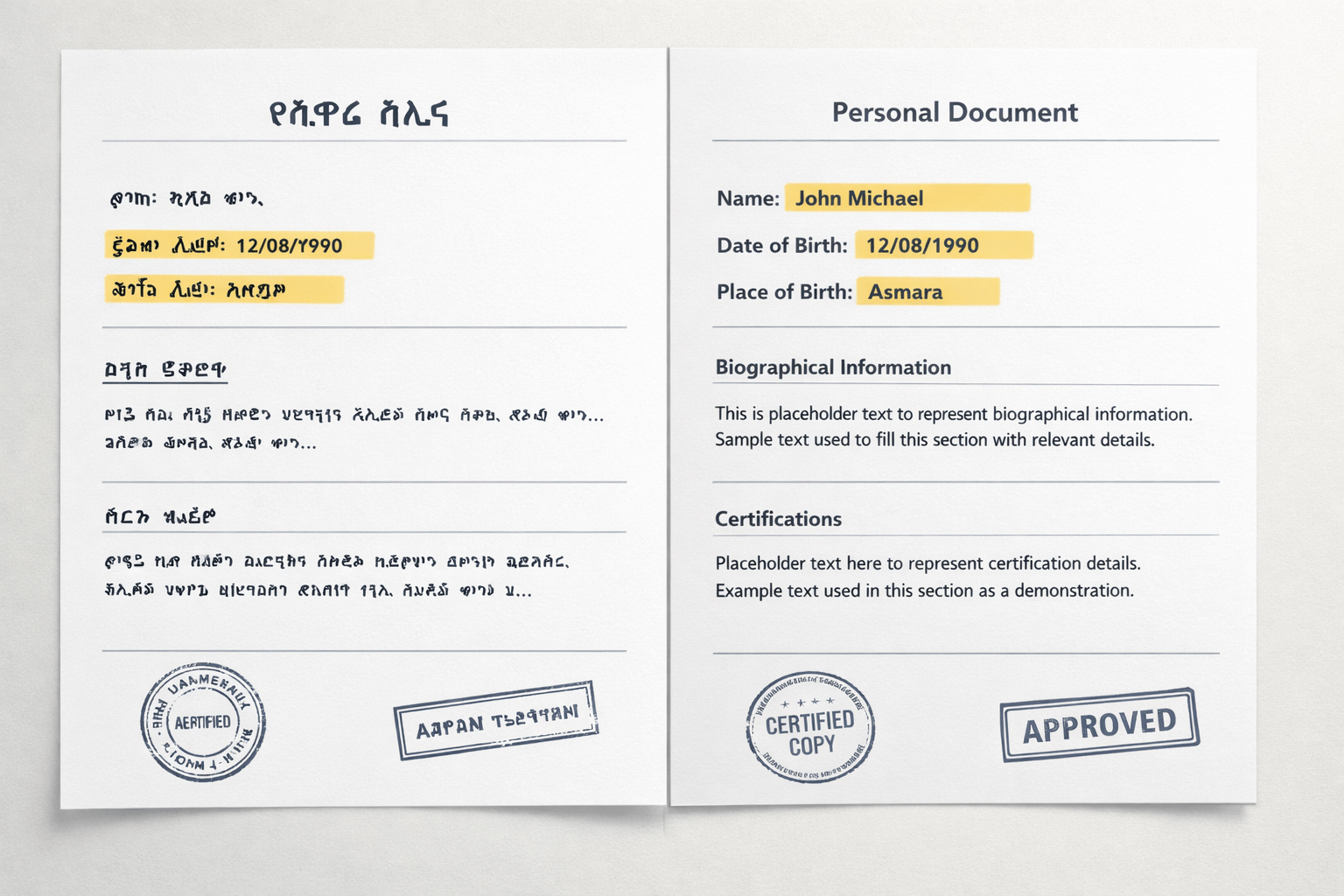
If you are searching tigrigna translate to english, you are usually trying to do one of two things: get a quick understanding of text, or get a translation that will actually be accepted by a visa office, university, court, employer, or registrar.
Those are not the same job.
A quick online tool can help with basic meaning. But when the document is important, Tigrinya translation into English needs three things done properly at the same time:
- Dialect awareness (Eritrea vs Tigray wording, regional usage, tone)
- Spelling consistency (Tigrinya/Tigrigna, names, places, transliteration choices)
- Formatting accuracy (matching the source layout, stamps, dates, seals, signatures, tables)
If even one of those is handled badly, the English version may be confusing, inconsistent, or rejected.
Need a translation for a visa, legal file, university admission, or official use? Upload your file and get a reviewed quote with the right spelling and document formatting approach from the start.
Why “Tigrigna” and “Tigrinya” Both Appear in English Searches
Many people type tigrigna translate to english, while others search tigrinya translate or tigrinya translation in english. Both are common, and both usually refer to the same language.
In real projects, the spelling choice matters because it affects:
- How names appear in the translation
- How your file is indexed in case systems
- Consistency across passport, visa, and academic records
- Searchability for future use (renewals, appeals, re-submissions)
The practical rule
Use the spelling that matches the context:
- Keep the client’s existing official spelling if it appears on a passport, BRP, visa, degree, or prior certified translation
- Use one spelling consistently throughout the translation and certificate
- Add a translator note only when needed (for example, to explain a known spelling variant)
A common mistake that causes delays
A translator may write:
- “Tigrinya” in the heading
- “Tigrigna” in the certificate
- A different romanized spelling for the same name in the body
That creates avoidable questions for caseworkers and admissions teams. A strong translation workflow prevents this by locking a name/style sheet before drafting.
What Makes Tigrinya Translation More Complex Than It Looks
A good tigrinya translation is not just word-for-word conversion. It requires language judgment.
1) Dialect and regional variation affect word choice
Tigrinya is used across Eritrea and the Tigray region of Ethiopia, and regional varieties can affect vocabulary, spelling habits, and phrasing.
For everyday messages, this may not matter much.
For official documents, it matters a lot because the translator must decide:
- Whether a term should be translated literally or administratively
- Whether to preserve a local title or explain it in English
- How to render place names and institutions consistently
2) Names are often the highest-risk part of the translation
Most rejections are not caused by grammar. They are caused by name mismatches.
Examples of risk areas:
- One person’s name appears one way in the passport and another way in the source document
- A place name has multiple accepted English spellings
- The same parent name is transliterated differently on different pages
- A stamp uses an older spelling convention
This is why a professional Tigrinya translation process should start with a name reconciliation step.
3) Formatting carries meaning
In many Tigrinya documents, the layout itself is part of the evidence. A reliable English translation should preserve:
- Headings and section order
- Table structure
- Stamp positions (described clearly)
- Signature lines
- Handwritten notes (marked as such)
- Missing/illegible text (clearly indicated)
When formatting is flattened into plain text, important context gets lost.
Dialects: What Clients Should Tell Their Translator Before Work Starts

If you need tigrinya translation in english for official use, send this information with your file. It improves speed and accuracy immediately.
Tell your translator these 5 things
- Country of issue (Eritrea or Ethiopia)
- Document type (birth certificate, marriage certificate, court document, transcript, etc.)
- Where you will submit it (UKVI, university, solicitor, employer, court, etc.)
- Existing English spellings from passport or previous records
- Deadline and format needed (PDF, print + signature, courier copy)
Why this matters
A translator can then choose the correct handling for:
- Regional terminology
- Administrative titles
- Romanization style
- Certification wording
- Formatting expectations for the receiving authority
A simple example
If a place name appears in one regional form on the source document but a different spelling appears in a passport, the translation should usually:
- Keep the source meaning accurate
- Preserve the passport spelling where identity matching is critical
- Add a brief clarification note if needed
That reduces the chance of “document mismatch” queries.
Spelling and Romanization: How to Keep English Versions Consistent
This is the section most online pages skip — and it is exactly where problems happen.
When people search tigrigna translate to english, they often need more than translation. They need romanization discipline.
Translation vs transliteration vs romanization
These are different tasks:
- Translation = converting meaning into English
- Transliteration/Romanization = representing Tigrinya script in Latin letters
- Formatting = recreating the source layout and labels in a readable English document
A certified translator often does all three in one deliverable.
Why one name can have multiple valid English spellings

Tigrinya is written in Ethiopic (Ge’ez) script. When converted into English letters, different standards and traditions may produce different spellings.
That is why you may see variations in:
- Personal names
- Place names
- Institution names
- Religious terms
The safest approach for official documents
Use this priority order:
- Passport/ID spelling (identity-critical)
- Prior accepted English document spelling (if consistent)
- Standard romanization choice (applied consistently)
- Translator note (only if a mismatch could cause confusion)
Name consistency checklist
Before final delivery, every professional Tigrinya-to-English file should be checked for:
- Same name spelled the same on every page
- Same town/city spelled the same in body + stamp notes
- Date format consistent (e.g., 14 March 2024)
- Number formatting preserved accurately
- Certificate wording matches the final file spelling
If you are submitting multiple documents, ask for a cross-document spelling sheet. It saves time on future applications and renewals.
Formatting: The Difference Between a Readable Translation and an Accepted One
Formatting is not decoration. It is evidence handling.
A strong tigrinya translation into English should help the reviewer verify the source document quickly, not slow them down.
What a well-formatted translation should include
Document header details
- Document title (translated)
- Source language (Tigrinya)
- Target language (English)
- Reference number (if applicable)
Source-layout mirroring
- Same section order as the original
- Clear labels for fields (Name, DOB, Place of Birth, etc.)
- Tables recreated in clean English table format
- Stamp/seal notes in square brackets (e.g., [Round stamp: Ministry of …])
Legibility notes
- [Illegible]
- [Handwritten note]
- [Partially visible]
- [Signature]
These are small details, but they make a translation look professional and reduce follow-up questions.
Date and number formatting rules that prevent confusion
Tigrinya documents may contain dates, serial numbers, and references that need careful handling.
Best practice for English output:
- Write dates in an unambiguous format (e.g., 14 March 2024)
- Preserve document numbers exactly
- Do not “correct” names or IDs
- Do not guess missing characters
- Mark uncertainty clearly
Certification wording for UK use
If the translation is for a UK immigration or official submission, the translation must include the required certification details (accuracy confirmation, date, translator identity/signature, and contact details).
This is one of the most common reasons clients need a revised file after using a generic translator.
If your document is for UK submission, start your project with the intended destination (UKVI, university, solicitor, etc.) so the certification wording and formatting are prepared correctly on the first version.
Online Tools vs Human Translation for Tigrinya to English
A lot of pages ranking for this topic are just free text boxes. They are useful for quick understanding, but not for high-stakes documents.
Use online translation when:
- You need the rough meaning of a message
- You are checking a short phrase
- You are doing informal communication
- The document is not being submitted anywhere
Use a human Tigrinya translator when:
- You are applying for a visa
- You are submitting to a university
- You need a legal or court document translated
- You need medical records translated
- You need names and formatting preserved exactly
- You need certification or a signed statement of accuracy
A practical hybrid workflow (recommended)
For speed and accuracy, many clients use this sequence:
- Quick machine preview (to understand the document type)
- Human translation for the official file
- QA check for names, dates, and formatting
- Certification and delivery in the required format
This gives you speed without risking rejection.
Common Mistakes in Tigrinya-to-English Translation (and How to Avoid Them)
Mistake 1: Treating spelling as “close enough”
Fix: Lock the spelling against the passport/ID before translation begins.
Mistake 2: Mixing translation and transliteration rules
Fix: Create a mini style sheet:
- names
- places
- institutions
- repeated terms
Mistake 3: Flattening the source layout
Fix: Rebuild tables, seals, and field labels in English so reviewers can compare easily.
Mistake 4: Omitting certification details
Fix: Use the correct certification format for the receiving body.
Mistake 5: Guessing unclear text
Fix: Mark unclear text transparently ([Illegible], [Partially visible]).
A Better Way to Order Tigrinya Translation in English
To get a reliable result faster, send your file with a short instruction block like this:
Order note (copy/paste):
Please translate from Tigrinya to English for UK submission.
Use the passport spellings for all names and places.
Keep the layout close to the original, including stamps and handwritten notes.
Include certification wording and translator details.
Delivery needed as signed PDF.
This single note prevents most revision requests.
If you are unsure whether your document needs certification, notarisation, or only a standard translation, contact us today and we will review the file before work starts.
What a Strong Tigrinya Translation Service Should Offer
When comparing providers, look for these signs of quality (not just price):
- Experience with Eritrean and Ethiopian document types
- Clear process for spelling and name consistency
- Human review (not only machine output)
- Formatting that mirrors the source
- Certification included when needed
- Fast communication on unclear text
- Secure file handling
Trust and conversion block (add near quote form)
Why clients choose UK Certified Translation for Tigrinya documents
- UK-ready certification wording when required
- Names checked against passport/ID spellings
- Formatting preserved for stamps, seals, and tables
- Clear turnaround times and revision support
Client proof snippet (insert verified review here):
“Accepted on first submission and the name spellings matched our passport exactly.”
— Verified client review
Final Takeaway
If you searched tigrigna translate to english, the real question is usually not just “How do I translate this?” It is:
How do I translate this accurately enough to be understood, trusted, and accepted?
That requires:
- dialect awareness
- spelling consistency
- formatting discipline
- the right certification details when needed
For everyday text, free tools are fine. For official documents, use a human translation process built for names, layout, and acceptance.
Ready to move forward? Upload your file and get a Tigrinya-to-English quote with the correct spelling and formatting approach from the start.
FAQ
Is “tigrigna translate to english” the same as Tigrinya translation?
Yes. In most searches, tigrigna translate to english and tigrinya translation refer to the same language pair. The spelling varies, but the key issue is using one spelling consistently in the final English document.
Can I use an online Tigrinya translate tool for visa or legal documents?
You can use it for a quick preview, but not for official submission. Visa, legal, academic, and court documents usually require a human translation with certification details, name consistency, and proper formatting.
Which spelling should I use: Tigrinya or Tigrigna?
Use the spelling that matches your official records (passport, prior translations, certificates). Both forms are commonly seen, but consistency is more important than preference when the document will be reviewed.
What should a Tigrinya translation in English include for official use?
It should include accurate translation, consistent names, preserved formatting (tables/stamps/signatures), and certification details when required by the authority receiving the document.
Why do names look different in Tigrinya translation to English?
Because names are often romanized (script-to-Latin conversion), not simply translated. Different conventions can produce different spellings, so translators should match passport/ID spellings and keep them consistent throughout.
Do you translate handwritten Tigrinya notes and stamps?
Yes, where legible. Handwritten content and stamps should be translated and clearly marked in the English file (for example, [Handwritten note] or [Round stamp: …]). If any part is unreadable, it should be marked as [Illegible] rather than guessed.