


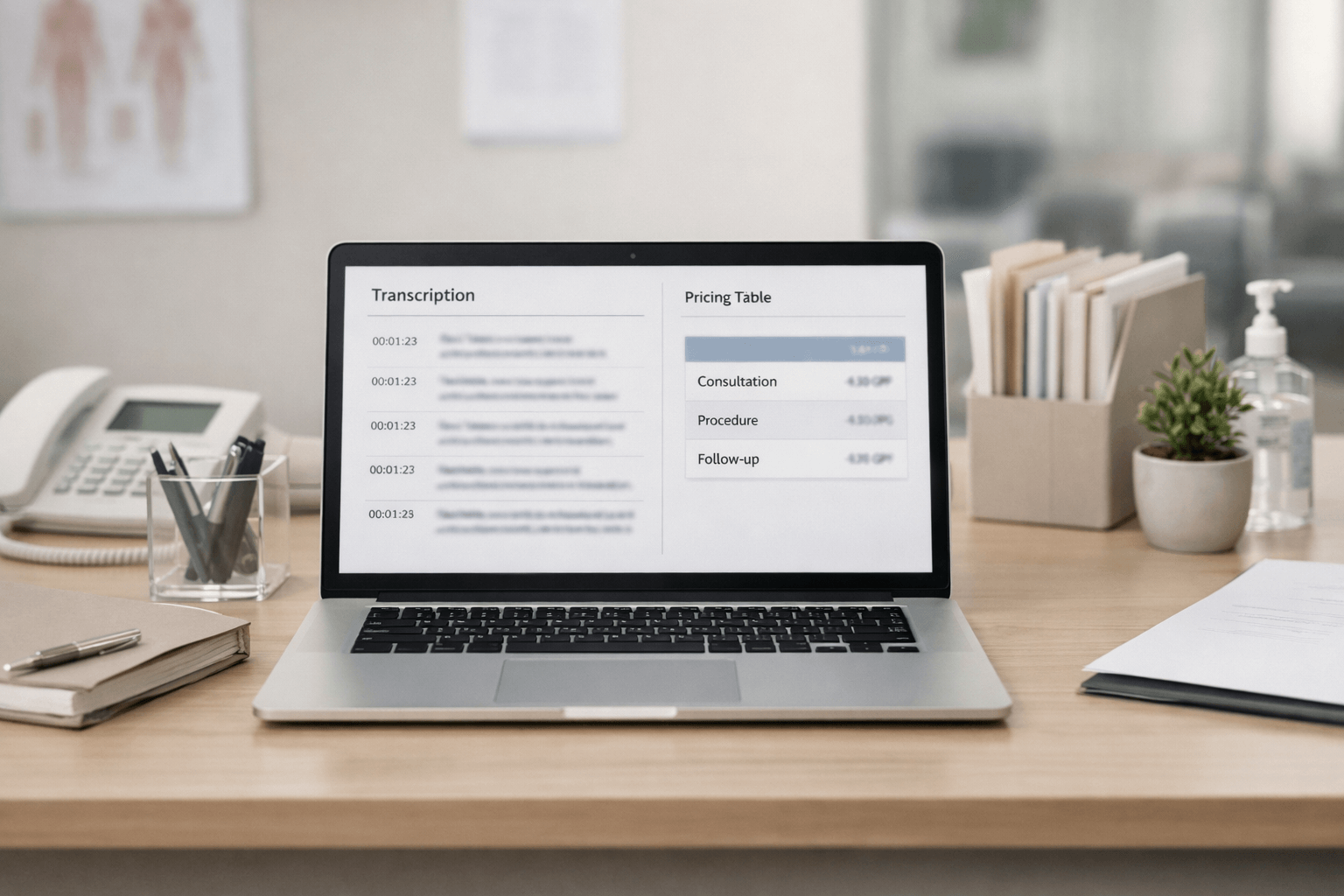
Medical transcription pricing in 2026 sits at the crossroads of accuracy, turnaround, and risk. Clinics want speed. Patients deserve privacy. And the person producing the record needs to be paid for specialised knowledge—not just typing.
This guide gives you practical, field-tested ways to price medical transcription fairly in 2026, whether you’re a freelancer, a practice manager, or a healthcare organisation setting budgets.
If you’re pricing a real job right now, the quickest path is simple: send the audio length + specialty + deadline and get a fixed quote you can sign off today. UK Certified Translation can turn around verbatim, edited (clean), or time-stamped transcripts with a secure workflow and clear pricing.
A quick answer: typical medical transcription rates in 2026
Most medical transcription is still priced using one of three methods:
- Per audio minute (common in the UK and general transcription)
- Per 65-character line (common in US-style medical transcription)
- Per report / document (common for templated outputs and recurring clinics)
Here’s a practical benchmark to start from in 2026:
Typical 2026 price ranges (what many providers actually charge)
| Service level | What you get | Typical pricing approach | Typical range (guide) |
| AI-only draft | Fast text, minimal safeguards | per minute | very low, but higher correction cost |
| AI + human edit | AI draft + professional clean-up | per minute / per line | mid-range |
| Human-first medical transcription | Specialist transcriber + QA | per minute / per line / per report | higher range |
UK reality check (pricing you can actually use)
A common starting point for UK human transcription is roughly £1.20+ per audio minute, rising for complex medical work, fast deadlines, or multi-speaker recordings. Highly specialised, urgent, or messy audio can land in the £3–£5 per minute zone.
If you prefer US-style billing, many services quote per 65-character line (the “medical line”), often with different rates for standard vs urgent turnaround.
The point isn’t to memorise one “correct” number. The point is to charge based on effort + expertise + liability + delivery standard—and to price in a way that stays consistent.
What you’re really charging for (and why medical costs more)
Medical transcription isn’t just converting speech into words. You’re producing part of a clinical record—something used for ongoing care, legal defensibility, audits, insurance, and patient rights.
That’s why medical transcription typically carries a premium over general transcription:
- Medical terminology and context (drug names, anatomy, procedures, abbreviations)
- Higher error cost (misheard dosage, laterality, or diagnosis can be serious)
- Formatting requirements (letters, SOAP notes, discharge summaries, referral templates)
- Data sensitivity (special-category data in the UK; protected health information in the US)
- Quality control (proofing, second-pass checks, consistency across long reports)
If you undercharge, you tend to lose money in “hidden minutes”: researching terms, fixing speaker confusion, formatting to templates, and doing quality checks you can’t ethically skip.
The biggest pricing mistake: audio minutes vs dictated minutes
When people ask “how much to charge for medical transcription,” a lot of confusion comes from what the minute means:
- Audio minute = one minute of the recording length.
- Dictated minute = one minute of clinician dictation (sometimes excluding pauses, interruptions, or multi-speaker dialogue).
Pricing must clearly state which one you’re using. Most clinics and transcription buyers understand audio minutes because it’s easy to verify.
If you use dictated minutes, you need a transparent measurement method—otherwise you’ll spend your life debating invoices.
Best practice: quote per audio minute for most work, and use add-ons for complexity.
The four pricing models that work in 2026

1) Per audio minute (simplest for buyers)
Best for: clinics, interviews, consultations, mixed audio quality
Pros: easy to understand, easy to quote, easy to compare
Cons: you must price in complexity so you don’t get burned
How to quote it well: use a base rate + clear surcharges (urgent, multi-speaker, heavy accents, poor audio, specialised terminology, time-stamps, strict verbatim).
2) Per 65-character line (traditional medical model)
Best for: US-style medical transcription, structured reports
A “line” is often defined as 65 characters including spaces (but always confirm whether it’s:
- Gross line (includes spaces), or
- VBC (visible black characters only), or
- Formatted line (affected by templates/margins)
Why this matters: the same report can generate different “line counts” under different rules.
If you quote per line, define it in writing on every proposal.
3) Per report / per document (great for recurring clinics)
Best for: referral letters, discharge summaries, radiology-style outputs
This is where you charge a flat rate for a standard output type, with extra fees for:
- long recordings,
- complex specialties,
- turnaround upgrades,
- extra formatting or letterheads,
- multiple versions.
This model is underrated in 2026 because clinics want predictable costs.
4) Hourly (only when scope is unclear)
Best for: messy legacy audio, heavy redaction, complex corrections
Hourly pricing can work—but only if you set expectations and provide checkpoints.
Most buyers dislike hourly because it feels open-ended. Use it as a fallback, not your default.
What is the going rate for transcription services in 2026?
A useful way to think about “going rate” is to separate general transcription from medical transcription:
- General transcription is priced for time + clarity.
- Medical transcription is priced for time + clarity + expertise + risk.
So yes, you’ll see cheap options. But cheap options can be expensive when:
- clinicians spend time correcting,
- errors require rework,
- formatting fails a submission,
- privacy controls aren’t strong enough for sensitive data.
A professional “going rate” is the rate that produces a reliable clinical document with minimal clinician correction.
The 2026 pricing formula you can use today

Whether you quote per minute, per line, or per report, the logic is the same:
Price = Base cost + Complexity + Turnaround + Output features − Volume discount
Here’s a practical way to structure it.
Step 1: Choose your base rate (your “clean audio” price)
Set a base rate for:
- single speaker,
- clear audio,
- standard turnaround,
- edited transcript (cleaned for readability),
- standard medical formatting.
Step 2: Add complexity multipliers (only when needed)
Use a consistent rule-set so you don’t negotiate every job from scratch.
Common add-ons:
- Poor audio / background noise
- Multiple speakers
- Strong accents or rapid speech
- Heavy medical terminology (specialty work)
- Handovers, ward rounds, overlapping talk
- Frequent numbers, dosages, lab values
- Dictation with interruptions
- Redaction or anonymisation
- Time-stamps
- Strict verbatim (every false start, filler, stutter)
Step 3: Add turnaround upgrades
Turnaround pricing should reflect staffing pressure and workflow disruption.
Typical tiers:
- Standard (e.g., 24–48 hours)
- Priority (next business day)
- Same-day / urgent
- Overnight / weekend
- STAT (hours)
Step 4: Decide what “done” means (output standard)
Make sure the buyer knows exactly what they’ll receive:
- verbatim vs edited (clean)
- time-stamps or not
- speaker labels
- template/letterhead formatting
- file type (Word, PDF, EHR-ready formatting)
- revision policy (e.g., one round of minor edits included)
A freelancer’s method: how to charge for medical transcription without underpricing yourself
If you’re a transcriptionist or agency building rates, your biggest risk is forgetting the real time ratio.
Even with experience and good tools, one hour of audio often takes multiple hours to complete professionally—especially in medical.
A simple rate-setting method
- Choose your target hourly earnings (before tax).
- Estimate your time ratio:
- easy dictation: lower ratio
- clinical dialogue: higher ratio
- poor audio: much higher ratio
- Add overhead:
- software,
- secure storage,
- admin time,
- proofreading/QA,
- client communications,
- occasional unpaid revisions.
- Convert to per audio minute.
Example (easy math, realistic outcome):
If you need £30/hour and a file takes 4 hours per audio hour, you need £120 per audio hour to break even before overhead. That’s £2.00 per audio minute. Add overhead and you’re typically higher.
If your pricing is below that, you’re relying on luck—and luck is not a business model.
What should you charge for different medical transcription file types?
Use “file type pricing bands” so you stay consistent.
Band A: clean dictation (lowest complexity)
Examples:
- GP dictation letters
- short clinic notes
- standard referrals
Typical billing: base per minute / per report.
Band B: clinical dialogue (medium complexity)
Examples:
- patient consultations
- MDT summaries
- therapy sessions
- follow-up calls
Why it costs more: speaker changes, emotion, interruptions, clarification, overlapping voices.
Band C: high-risk or high-density content (highest complexity)
Examples:
- operative notes dictated fast
- cardiology / neuro / oncology dictation
- complex medication lists
- dense lab values
Why it costs more: terminology density + numbers + higher error consequence.
Realistic example quotes (so you can sanity-check your pricing)

These examples show how pricing changes based on common variables. (Your numbers will vary by workflow, market, and output standard.)
Example 1: 12-minute GP letter dictation, standard delivery
- Clear audio, single speaker
- Edited transcript formatted as a letter
This is typically priced near your base rate.
Example 2: 35-minute consultation, two speakers, mild background noise
- Dialogue + speaker labels
- Medical terms + occasional unclear words
Expect a noticeable uplift vs base rate because correction time rises.
Example 3: 18-minute specialist dictation, urgent turnaround
- High terminology density
- Fast deadline
This is where “cheap per minute” pricing collapses. If you don’t charge extra, you’ll rush the work or lose money.
How much do transcription services cost for clinics and organisations?
If you’re buying transcription (not selling it), don’t just compare a headline price. Compare the total cost of a usable record:
- Does the transcript need heavy clinician correction?
- Are templates and headings done properly?
- Are speaker labels clear?
- Is the workflow secure for sensitive data?
- Is there a revision policy?
- Will turnaround be consistent in busy weeks?
If the clinician spends 10 minutes correcting each file, the “cheap option” often becomes the most expensive option.
The best value is the service that produces a near-final document on the first delivery.
If you want a fast comparison, request a quote using:
- total minutes,
- file type (dictation vs consultation),
- specialty,
- turnaround,
- output (verbatim / edited / time-stamped).
Where can I transcribe audio for free?

Free transcription exists—but it comes with trade-offs, and for medical audio you must be extremely careful with privacy, consent, and data handling.
Common free (or low-cost) options people use
- Built-in voice dictation on devices (quick notes)
- Free tiers of AI transcription tools
- Office-suite dictation features
- Meeting-note tools with limited monthly minutes
When free transcription can be fine
- Personal study notes with no patient identifiers
- Training audio where consent and anonymisation are already handled
- Drafting ideas you’ll rewrite anyway
When free transcription is a bad idea
- Patient audio with identifiable details
- Any workflow where you can’t confidently control storage, access, retention, and sharing
- Legal/insurance documentation that needs accuracy and traceability
For sensitive recordings, professional workflows exist for a reason: confidentiality controls, secure transfer, and quality checks.
A pricing checklist you can copy into your quote template
When a client asks “how much for transcription services?”, reply with a checklist that makes pricing feel fair and professional:
- Total audio minutes
- Audio type: dictation / consultation / meeting / multi-speaker
- Specialty: general practice / cardiology / psych / etc.
- Audio quality: clear / mixed / difficult
- Turnaround: standard / next day / same day / weekend / STAT
- Transcript type: verbatim / edited (clean)
- Extras: time-stamps, speaker labels, template formatting, redaction
- Delivery format: Word / PDF / both
- Revision policy: what’s included
The client feels taken care of, and you protect your margin.
Want an accurate price for your specific recording?
If you’d rather skip guesswork, send your audio length, specialty, and deadline. UK Certified Translation can provide a clear quote and deliver medical transcription with confidentiality, secure handling, and formatting that’s ready to use.
FAQ
How much to charge for medical transcription per audio minute in 2026?
A common starting point for professional human transcription is around £1.20+ per audio minute in the UK for standard work, increasing for complexity, specialty, and urgent turnaround. Highly specialised or urgent jobs can cost significantly more.
What is the going rate for transcription services compared with medical transcription?
General transcription is usually cheaper because it requires less specialised knowledge and carries lower risk. Medical transcription typically costs more due to terminology, formatting expectations, and the consequences of errors.
How do I charge for transcription services: per minute or per line?
Use per audio minute if you want a simple, transparent quote. Use per 65-character line if your clients expect US-style medical billing. Either works—just define the unit clearly and apply consistent surcharges.
How much do transcription services cost if I need same-day turnaround?
Same-day or STAT turnaround usually adds a premium because it compresses production and quality control time. The uplift depends on provider capacity, audio difficulty, and whether proofreading/QA is included.
Where can I transcribe audio for free?
You can use free dictation or free-tier AI tools for low-risk audio. For medical recordings containing sensitive data, free tools may be inappropriate unless you can fully control privacy, retention, and access.
What should I charge for transcription services as a freelancer?
Start from your target hourly income and your real time ratio (hours of work per audio hour). Convert that to a per-minute price and add overhead for admin, QA, tooling, and occasional revisions. Underpricing usually shows up later as unpaid time.