


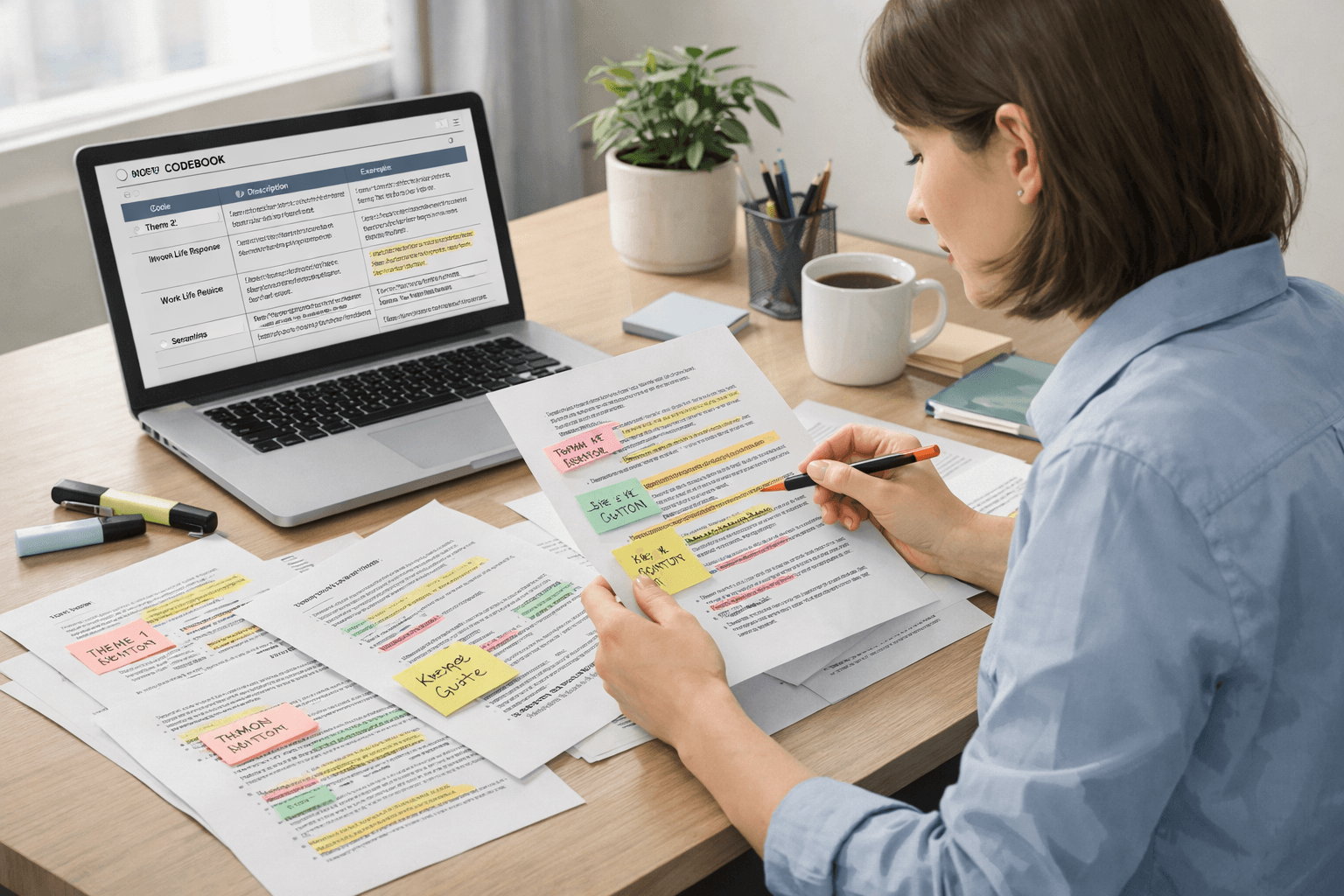
Coding interview transcripts is where qualitative research starts turning “what people said” into patterns you can explain, defend, and write up. If you’ve got hours of recorded interviews, focus groups, or user research calls, this guide shows you exactly how to move from raw transcripts to clear themes—without getting lost in highlights, sticky notes, or messy code lists.
You’ll learn:
- What transcription means in qualitative research (and what a “transcript in research” actually is)
- When verbatim transcription matters (and when clean verbatim is better)
- A step-by-step workflow for coding interview transcripts (manual or software)
- A ready-to-use codebook structure, plus a worked coding example
- How to cite a transcript in APA 7th edition (with practical scenarios)
What transcription is in qualitative research (and why it affects your coding)
In qualitative research, transcription is the process of converting recorded speech (audio/video) into text so you can analyze it systematically. In plain terms, what is transcription in research? It’s turning a real-world conversation into a usable research dataset.
A transcript in research is that dataset—usually a document that includes:
- The spoken content (word-for-word or edited)
- Speaker labels (e.g., Interviewer / Participant 1)
- Optional timestamps (useful for audit trails and retrieving clips)
- Notes like pauses, overlaps, laughter, or emphasis (only if needed for your method)
Why it matters for coding: your transcript format determines what you can reliably code. If your transcript “smooths out” key language, you may lose meaning. If your transcript is too detailed, your analysis can become slow and noisy.
Verbatim, clean verbatim, and intelligent verbatim: what they mean (and what to choose)

What does verbatim transcription mean?
Verbatim transcription captures exactly what was said, including false starts, filler words, repeated phrases, and sometimes non-verbal cues (e.g., long pauses, laughter).
What is verbatim transcription used for?
Use verbatim transcription when:
- You’re analyzing language choices, identity, power, or discourse
- Pauses, hedges, and uncertainty are meaningful (e.g., “I… I don’t know”)
- You need a strict audit trail for sensitive or contested findings
What does clean verbatim transcription mean?
Clean verbatim transcription (sometimes called edited transcripts) keeps the meaning but removes distractions:
- Removes filler words (“um”, “like”) when they don’t add meaning
- Fixes obvious slips and repeated words
- Keeps the participant’s voice and intent intact
What is a clean verbatim transcription?
It’s the most common choice for:
- Thematic analysis
- Framework analysis
- Market research reporting
- UX research summaries
What is intelligent verbatim transcription?
Intelligent verbatim transcription goes one step further:
- Lightly restructures sentences for readability
- Removes tangents and verbal clutter
- May clarify unclear phrasing while preserving meaning
It’s useful for executive-facing reports, stakeholder summaries, and fast-paced research environments—but you must document your rules so you don’t accidentally “rewrite” participant meaning.
Is verbatim transcription of interview data always necessary?
No—and choosing “more detailed” by default can slow your study without improving quality.
A practical rule:
- If your research focuses on what people experienced and why, clean verbatim is usually enough.
- If your research focuses on how people speak (hesitation, phrasing, persuasion, contradiction), you’ll often need full verbatim.
Choose based on your method
- Thematic analysis: clean verbatim is usually ideal
- Grounded theory: clean verbatim or verbatim (depends on sensitivity)
- Narrative analysis: often benefits from more verbatim detail
- Discourse / conversation analysis: typically requires verbatim + notation rules
How to write a verbatim transcript (and make it easy to code)
If you’re doing transcription yourself (or checking a transcript), use these rules so your coding stays consistent:
Verbatim transcription essentials
- Use speaker labels consistently (Interviewer, P1, P2)
- Use paragraph breaks when the speaker changes
- Keep line lengths readable (short paragraphs > long blocks)
- Mark unintelligible sections (e.g., [inaudible 00:12:41])
- Avoid “correcting” grammar unless using clean verbatim rules
- Use timestamps at regular intervals if you’ll quote or audit (e.g., every 30–60 seconds)
Clean verbatim rules (recommended for most projects)
- Remove filler words unless they change meaning (e.g., “I um… I guess” can signal uncertainty)
- Keep emotionally meaningful repeats (“I was really, really scared”)
- Keep culturally meaningful expressions and tone
- Don’t “upgrade” vocabulary (keep the participant’s voice)
Before you code: prepare your transcripts like a dataset
Your future self will thank you. Do this once, then every transcript becomes easier to code and compare.
Transcript preparation checklist
- Consistent filenames (StudyName_Site_ParticipantID_Date)
- Participant IDs, not names (protect confidentiality)
- Standard speaker labels across all files
- One interview per document (unless your method requires combining)
- Add wide margins or comment space (if coding manually)
- Add line numbers (optional, but excellent for collaboration)
- Create a short “context header” at the top:
- Interview date, setting, participant type, interview length, notes
If you’re working with sensitive data, apply anonymisation early (replace names, workplaces, locations, unique identifiers).
The core workflow: how to code interview transcripts in qualitative research

Below is a practical, repeatable workflow you can use whether you code in Word, spreadsheets, or qualitative analysis software.
Step 1: Decide your approach (inductive, deductive, or hybrid)
Inductive coding: you generate codes from the data (“let the themes emerge”).
Deductive coding: you start with a framework (theory, prior research, policy categories).
Hybrid: start with a few high-level deductive codes, then allow inductive sub-codes to emerge.
A fast way to decide:
- If your research question is exploratory → lean inductive
- If you’re evaluating a program, policy, or predefined model → lean deductive
- If you need both comparability and discovery → go hybrid
Step 2: Read for meaning before you label anything
Do a full read-through of 1–3 transcripts without coding. Your goal is:
- Familiarity (what’s going on here?)
- First impressions (surprises, tensions, contradictions)
- Early hunches (possible patterns)
Write short memos in the margin (or a separate document). Examples:
- “Trust keeps showing up as a barrier.”
- “Participants describe ‘time’ as the hidden cost.”
- “The word ‘safe’ appears in different contexts.”
Step 3: Start initial coding (first-cycle coding)
This is where most people freeze—so here’s the simplest rule:
Code anything that helps answer your research question.
Not everything. Not “interesting” in general. Relevant.
Initial coding styles you can mix:
- Descriptive codes (what is this about?) → “Waiting times”
- In vivo codes (participant’s own words) → “I felt invisible”
- Process codes (actions) → “Avoiding”, “Negotiating”, “Adapting”
- Emotion codes → “Frustration”, “Relief”, “Shame”
- Structural codes (based on your interview guide sections) → “Motivation”, “Barriers”, “Outcomes”
How granular should you code?
- If you code too broadly, everything collapses into vague themes.
- If you code too narrowly, you get hundreds of codes you can’t use.
A practical target for first-cycle coding:
- One code per meaningful unit (a sentence, a short paragraph, or a compact story)
Step 4: Build a codebook early (even if you’re solo)
A codebook isn’t only for teams. It prevents “code drift” (same idea coded differently over time).
Use this simple format:
Code name
Definition (what it captures)
Include when…
Exclude when…
Example quote
Notes (links to related codes)
This is the single best way to make your analysis defensible and fast.
Step 5: Consolidate and refine (second-cycle coding)
After 2–5 transcripts, you’ll notice:
- duplicates (“lack of time” vs “no time”)
- overlaps (“trust” vs “credibility”)
- messy catch-all codes (“misc barriers”)
Second-cycle coding is where you:
- merge duplicates
- create parent/child relationships (Theme → Subtheme)
- clarify boundaries using include/exclude rules
- reduce your code list to what you can actually write up
Common second-cycle strategies:
- Focused coding: keep the strongest, most frequent, most explanatory codes
- Pattern coding: group codes into higher-order patterns (“Barriers → Emotional / Practical / Social”)
- Axial-style linking: connect conditions → actions → outcomes (useful for theory-building)
Step 6: Generate themes (and don’t confuse themes with topics)
A topic is “what was mentioned.”
A theme is “what it means in relation to your research question.”
Example:
- Topic: “Waiting”
- Theme: “Time becomes proof of disrespect”
A strong theme:
- has a clear central idea
- is supported by multiple data points
- explains something (not just lists it)
- can be named as a sentence, not a label
Step 7: Pressure-test your themes (quality and credibility)
Before writing up, challenge your own analysis:
- What data contradicts this theme?
- Are you over-weighting memorable quotes?
- Does the theme apply across participants or only one subgroup?
- What alternative explanation fits the same excerpts?
Practical credibility boosters:
- Keep a simple audit trail (what changed, when, why)
- Use peer debriefing (even one other person)
- Track exceptions (“negative cases”) instead of hiding them
- Use a consistent quoting strategy (short, sharp, contextual)
Coding Interview Transcripts Example: A Worked Coded Transcript from Raw Text to Themes
Below is a coded interview transcript example for qualitative research, showing how a short excerpt moves from raw text to first-cycle codes, a codebook entry and a final theme.

Short transcript excerpt
Interviewer: Tell me about your experience starting the service.
Participant: At first, I was excited… but the onboarding felt like a maze.
Participant: I kept thinking I’d missed something, so I double-checked everything.
Participant: The emails were polite, but I didn’t feel supported—just processed.
Participant: When I finally got a human response, I felt relief immediately.
Participant: After that, I trusted it more, even though the steps didn’t change.
First-cycle codes (example)
- “onboarding felt like a maze” → Confusing process (in vivo + descriptive)
- “I’d missed something” → Fear of error
- “double-checked everything” → Self-protective checking (process code)
- “didn’t feel supported—just processed” → Dehumanised experience (in vivo)
- “felt relief immediately” → Relief after human contact (emotion + process)
- “trusted it more” → Trust increases with responsiveness
Codebook snippet (how to keep it consistent)
Dehumanised experience
- Definition: Participant describes feeling treated like a case number rather than a person.
- Include when: Mentions “processed,” “robotic,” “template replies,” “no one cared.”
- Exclude when: Complaints about speed only (use “Delays” instead).
- Example: “I didn’t feel supported—just processed.”
Turning codes into a theme (example)
Codes like Confusing process, Fear of error, Self-protective checking, and Dehumanised experience can combine into a theme such as:
Theme: Uncertainty drives extra labour—and that labour feels unfair.
That theme is no longer a list. It’s an explanation you can write about, support with quotes, and relate back to your research question.
How to analyze interview transcripts in qualitative research (without drowning in data)
If you’re searching “how to analyze interview transcripts in qualitative research,” coding is the foundation—but analysis goes further. Use this simple sequence:
- Describe what’s happening (codes)
- Compare across participants (patterns)
- Explain why it matters (themes)
- Support with evidence (quotes + negative cases)
- Connect back to the research question (so your write-up is coherent)
A powerful technique for comparison is a coding matrix:
- Rows: participants (or subgroups)
- Columns: themes
- Cells: short summaries + best quotes + note of exceptions
This makes your write-up dramatically faster.
Manual coding vs software: what to use (and when)
You can absolutely do high-quality qualitative coding without expensive tools.
Manual coding (Word / Google Docs / spreadsheets)
Best when:
- You have fewer transcripts
- You’re working solo
- You want speed and simplicity
Tips:
- Use consistent highlighting rules (one colour per parent code)
- Put codes in comments, not in the main text
- Track your codebook in a spreadsheet
Qualitative analysis software (NVivo, ATLAS.ti, MAXQDA, Dedoose, Taguette)
Best when:
- You have many interviews
- You’re working in a team
- You need structured retrieval, queries, and audit trails
Software doesn’t “do the analysis.” It helps you store, retrieve, compare, and document decisions.
How long does it take to code an interview transcript?
It depends on:
- transcript quality (clean vs messy audio)
- interview length
- coding depth
- whether you’re creating a codebook from scratch
A realistic planning guide:
- First transcript: slowest (building your system)
- After 3–5 transcripts: speed improves significantly
- Team coding: faster retrieval, slower consensus
If deadlines are tight, the biggest accelerators are:
- clean verbatim transcripts
- consistent speaker labels
- timestamps
- an early codebook with clear boundaries
How to cite a transcript in APA 7th edition (practical scenarios)

APA 7 rules depend on whether your transcript is retrievable by the reader.
Scenario 1: You interviewed participants for your own study (not publicly available)
If these are interviews with participants in your own research study, APA treats the interview material as your qualitative data rather than as a personal communication. Report or quote participants using the identifiers and confidentiality approach described in your method, and do not create a normal reference-list entry for each participant interview. Personal-communication citations apply instead to private, unretrievable interviews or messages used as sources outside your study. (APA Publishing)
For example, you might identify a quotation as coming from Participant P7 or another anonymised label defined in your study, rather than formatting the participant as a personal-communication citation.
Scenario 2: You include full interview transcripts in an appendix
You can refer readers to the appendix rather than repeatedly “citing” each quote.
Example:
- Full interview transcripts are provided in Appendix A.
- Then quote normally in the text.
Scenario 3: The transcript is publicly available (e.g., a podcast or recorded speech transcript on a website)
If readers can retrieve it, it can appear in the reference list. Include:
- author / organisation
- date
- title
- descriptor (e.g., [Interview transcript])
- source / URL
(Your exact formatting will depend on the source type: website, report, audiovisual work transcript, etc.)
Don’t overlook ethics: confidentiality and anonymisation
If your transcripts include identifiable information, treat them like sensitive research data:
- Remove names and unique identifiers early
- Store files securely with access controls
- Use participant IDs consistently
- Keep consent conditions aligned with how transcripts are used (analysis, quotes, appendices)
If you’re working with multilingual interviews, consider whether you’ll code in the original language, translated English, or both—and document the decision.
When you should outsource transcription (and what to request)

If you want coding to go faster and stay defensible, your transcripts must be reliable. Professional transcription is especially worth it when:
- audio quality varies
- multiple speakers overlap
- accents/dialects increase complexity
- you need timestamps or strict confidentiality
- deadlines are tight
What to request for qualitative research:
- Verbatim or clean verbatim (define your preference)
- Speaker identification (P1, P2, Interviewer)
- Timestamps (every 30–60 seconds, or at speaker changes)
- A clear approach for [inaudible] sections
- Optional NDA and secure file transfer
If you want a transcript that’s ready to code immediately, UK Certified Translation can deliver verbatim, edited (clean), and time-stamped transcripts with a secure, GDPR-aligned workflow—ideal for academic and market research projects. You can start here: Transcription services in the UK or message the team via Contact.
Frequently asked questions
How do I code interview data in qualitative research?
Start by preparing a consistent transcript format, then do a read-through for meaning, apply first-cycle codes to relevant segments, build a codebook, refine codes in a second cycle, and generate themes that explain patterns in relation to your research question.
How to do transcription in qualitative research?
Record interviews clearly, decide on verbatim vs clean verbatim, create a transcript with speaker labels and optional timestamps, anonymise identifiers if needed, and standardise formatting so your transcripts can be coded consistently across participants.
What is clean verbatim transcription, and is it good for thematic analysis?
Clean verbatim removes filler words and obvious verbal clutter while preserving meaning. For most thematic analysis projects, clean verbatim is ideal because it keeps transcripts readable and speeds up coding without losing key ideas.
Is verbatim transcription of interview data always necessary?
No. Verbatim is most useful when pauses, hesitations, and exact wording are central to your analysis (e.g., discourse-focused studies). For many projects, clean verbatim provides the right balance of fidelity and usability.
How to cite a transcript in APA 7th edition?
If the interview is part of your own research study, treat the participant’s words as study data rather than as a personal communication. If it is a private, unretrievable interview used as a source outside the study, cite it in text as a personal communication and omit it from the reference list. If the interview or transcript is publicly retrievable, cite it in the reference list according to its source type. (APA Publishing)
What is a transcript in research?
A transcript is the textual record of a recorded interaction (interview, focus group, meeting) used as a dataset for analysis. It often includes speaker labels, the spoken content, and sometimes timestamps and notation rules.