


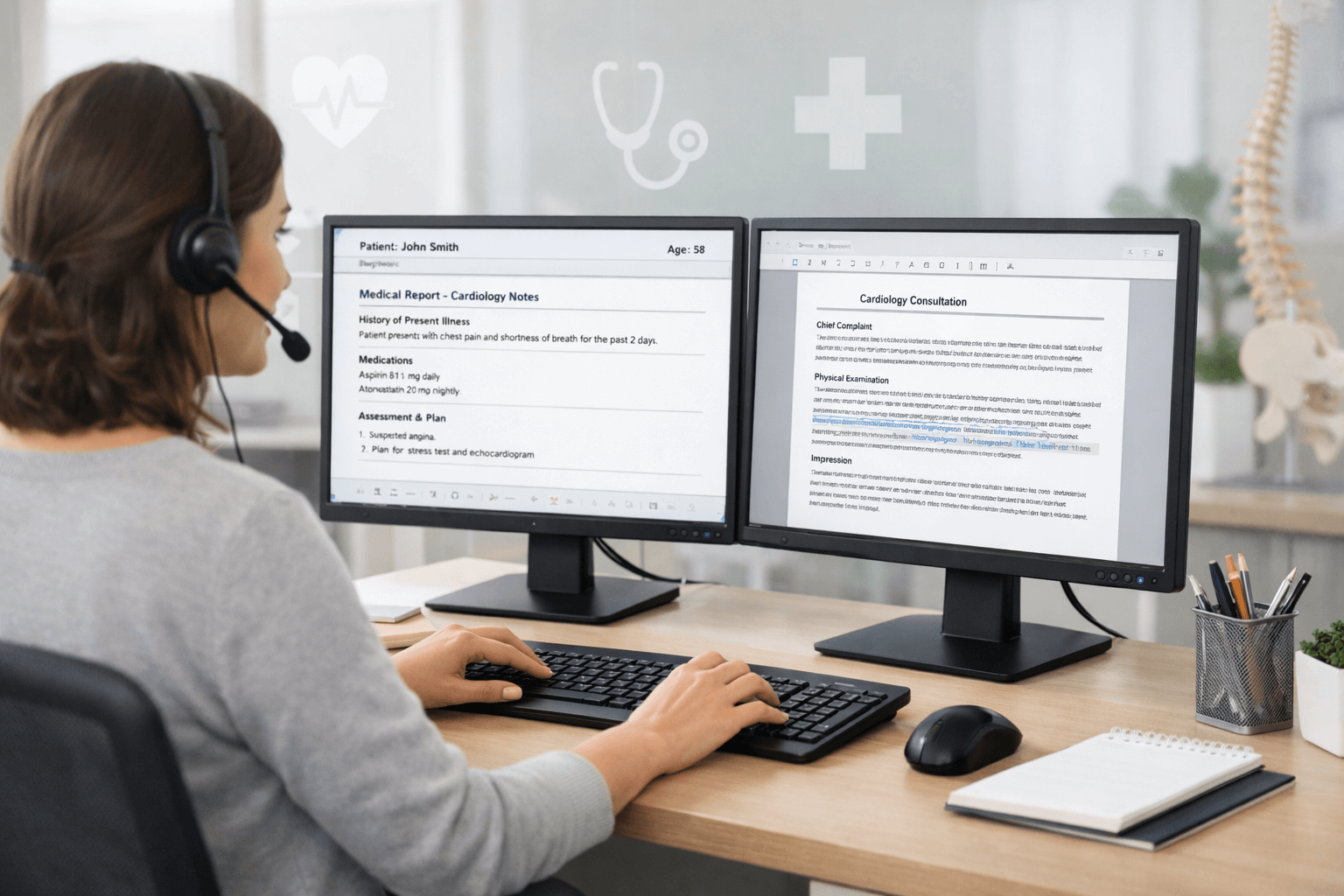
Medical transcription can be a practical way to enter healthcare documentation—especially if you enjoy language, accuracy, and structured work. But the field has changed: speech recognition is everywhere, and many roles now blend transcription with editing, quality checks, formatting, and compliance.
This guide walks you through how to get into medical transcription from scratch, what to learn, how to train, how to work from home, realistic career paths, and how to position yourself for paid work (or start your own service).
What medical transcription is (and what it isn’t)
Medical transcription is the process of turning clinical audio (dictation, consultations, procedures, discharge summaries, radiology notes, etc.) into clear, structured written records—often in specific templates and formats.
What it typically involves:
- Listening carefully to audio (sometimes poor quality, accents, background noise)
- Understanding medical terminology, anatomy, medications, and abbreviations
- Producing accurate text with correct punctuation, formatting, and meaning
- Verifying unclear terms using reliable references
- Following confidentiality and documentation rules
What it isn’t:
- Diagnosing or interpreting care decisions (you document exactly what’s said/required)
- “Just typing” (language accuracy and medical comprehension are the job)
- A single, uniform job title (many employers now label roles as editors, documentation specialists, or speech recognition editors)
Is medical transcription hard?
It can be challenging at first—because you’re building three skills at once:
- Medical knowledge (terms, body systems, procedures, drugs)
- Language precision (grammar, punctuation, clarity, consistency)
- Audio mastery (listening, differentiating similar-sounding terms, pacing)
Most beginners struggle with:
- Similar-sounding drug names and procedures
- Fast dictation and heavy accents
- Knowing when to flag uncertainty vs. verify
- Formatting standards and templates
The good news: it’s a learnable skill set. Progress is very measurable—once your accuracy improves, speed and confidence follow.
Is medical transcription a good job (and is it a good career choice)?
Medical transcription can be a good job if you value:
- Focused, independent work
- Detail-oriented tasks
- Clear standards and measurable output
- Work-from-home potential
It may be less ideal if you prefer:
- High daily social interaction
- Creative writing
- Highly variable tasks without structure
Is medical transcription a good career?
It can be—especially if you approach it as a career ladder into healthcare documentation, not just a single job title. Many professionals move into:
- Medical transcription editing
- Quality assurance (QA)
- EHR documentation roles
- Medical scribing support
- Healthcare documentation leadership (team lead, trainer)
Are medical transcription jobs being phased out? Is it a dying field?
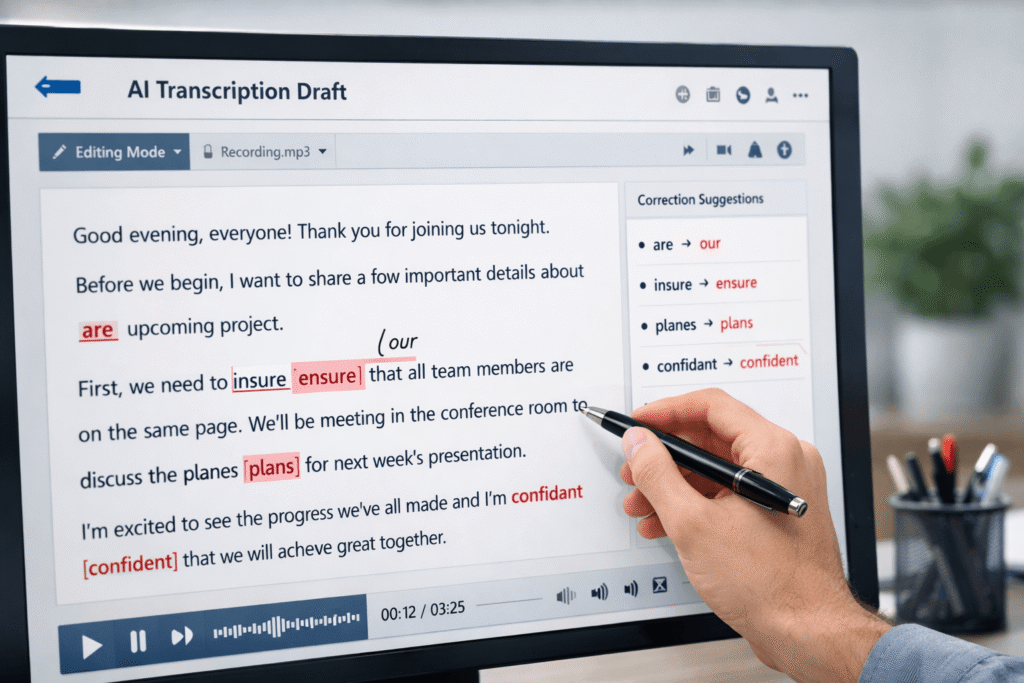
This is the question everyone asks: “Are medical transcription jobs being phased out?”
The honest answer is: the work is evolving.
What changed:
- Speech recognition tools generate drafts quickly
- Employers want professionals who can edit, correct, standardize, and QA those drafts
- Accuracy, compliance, and documentation integrity are still essential
So, is medical transcription a dying field? Not in the sense that the need for accurate documentation disappears. But the pure typing-from-scratch model is less common in many settings.
What’s still in demand:
- Editing and QA
- Specialty documentation (radiology, cardiology, ortho, oncology)
- Complex audio, multi-speaker content, and templated reports
- High-compliance environments where accuracy matters more than speed
If you train for modern workflows (speech recognition editing + strong terminology + formatting + QA), you’ll be far more employable.
How to learn medical transcription (the skill stack that employers pay for)
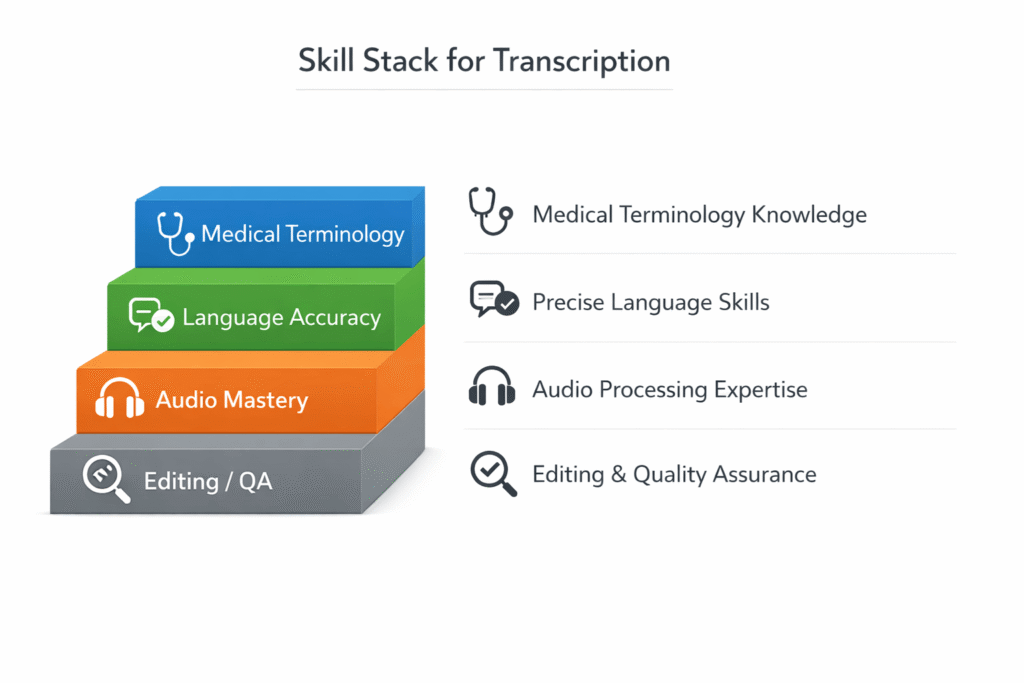
If you want a clear learning path, build this stack in order:
1) Medical language fundamentals
Focus areas:
- Anatomy & physiology basics
- Common conditions and procedures
- Medication classes and common drug names
- Lab tests and imaging terms
- Abbreviations (and when not to use them)
2) Documentation style and accuracy
You’re judged on:
- Grammar, punctuation, and clarity
- Consistent formatting (headings, lists, templates)
- Correct use of numbers, units, dates, and dosages
- Avoiding ambiguity (especially in clinical instructions)
3) Audio + speed skills
You’ll need:
- Listening accuracy (even with noise and accents)
- Efficient playback control
- Shortcuts, text expanders, and workflow habits
4) Editing (modern core skill)
In many roles, you’ll edit a machine draft:
- Correct misheard terms
- Fix formatting
- Resolve context errors (homophones, wrong medication names, wrong laterality)
- Standardize structure
What is a medical transcription course, and how long is a medical transcription course?
A medical transcription course usually teaches:
- Medical terminology + body systems
- Grammar and medical report formatting
- Dictation practice (realistic samples)
- Editing workflows (often with speech recognition output)
- QA checks and common error patterns
How long is a medical transcription course?
It depends on depth and your schedule. Many learners finish in a few months with consistent practice, while more comprehensive programs take longer. The best programs include hands-on audio practice and structured feedback—not just theory.
How to learn medical transcription at home (including free options)
If you’re starting at home, combine:
- A structured medical terminology plan
- Daily short transcription practice
- Weekly accuracy reviews
How to learn medical transcription at home free (starter approach)
You can begin without spending money by practicing:
- Medical terminology flashcards (spaced repetition)
- Listening practice with medical audio samples where available
- Typing practice focused on accuracy, not speed
- Creating templates (SOAP notes, discharge summaries, radiology formats)
Even if you start free, plan to upgrade to guided practice and feedback once you’ve built basic terminology—feedback is what turns practice into employable skill.
Can you do medical transcription from home?
Yes—many roles are remote, but employers expect:
- Secure handling of files
- Strong self-management and deadlines
- Quiet workspace and reliable equipment
- Comfort with platforms, templates, and QA checklists
How to do medical transcription from home (practical setup)
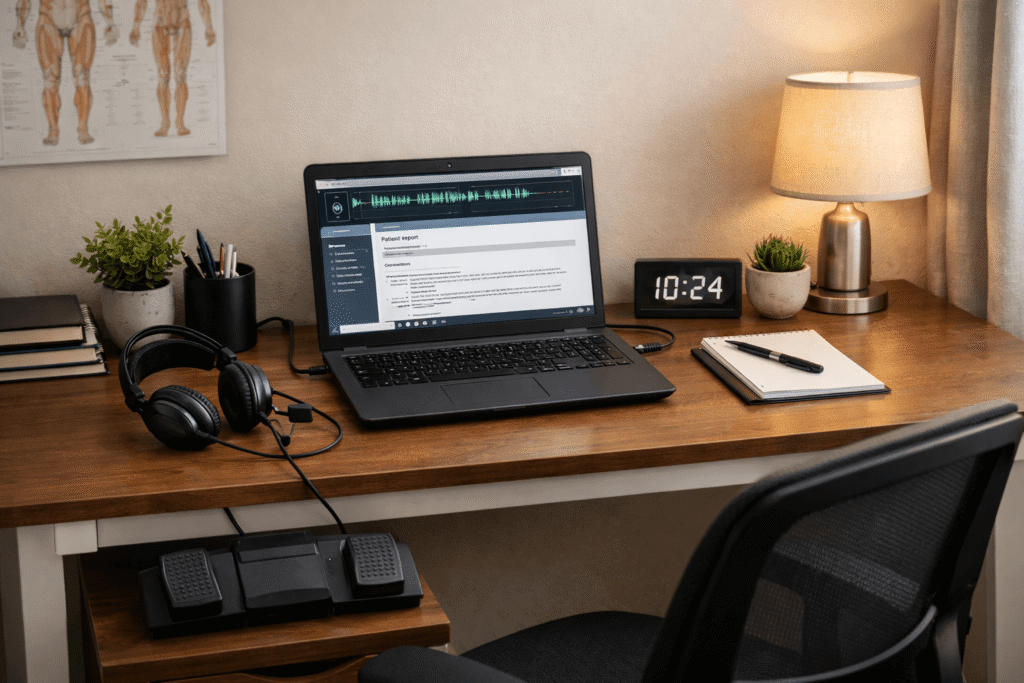
Minimum setup:
- Reliable laptop/desktop
- High-quality headset
- Stable internet
- Word processing + secure file handling
- Optional: foot pedal (helps speed and reduces wrist strain)
- Optional: text expansion tool (for common phrases)
Home-based success comes down to workflow discipline:
- Batch similar file types
- Track common error patterns
- Build a personal reference list (drug names, abbreviations, specialty terms)
How to get medical transcription certification (and what “certified” really means)
People often confuse:
- A course completion certificate (proof you finished training)
- A professional credential (proof you passed an exam standard)
If your goal is credibility, ask training providers:
- Does the program include real dictation practice?
- Do you get graded feedback?
- Does it prepare you for recognized credential exams (if applicable in your region)?
How to get a medical transcription certification (simple plan)
- Complete structured training with audio practice
- Build accuracy and speed with supervised or graded samples
- Create a portfolio of clean sample reports (de-identified)
- Sit for a credential exam if it’s relevant to your target market
- Keep learning—specialties pay more and reduce competition
Step-by-step: how to get into medical transcription (beginner to paid work)
Step 1: Pick your target path (job vs freelance vs business)
Choose one:
- Employment path: hospital/clinic vendor, transcription company, documentation team
- Freelance path: working with small practices, researchers, allied health professionals
- Business path: hiring/outsourcing, building a compliance workflow, scaling clients
Step 2: Train with a realistic schedule (a 30–60–90 day plan)
Days 1–30 (Foundation)
- Terminology + anatomy basics daily (30–45 minutes)
- Typing accuracy drills (10–15 minutes)
- 10–20 minutes of transcription listening practice
- Start building your personal glossary
Days 31–60 (Practice + Structure)
- Transcribe short clips into templates
- Focus on punctuation, structure, and consistency
- Start editing “draft-style” text (simulate speech recognition errors)
- Track your top 20 recurring mistakes
Days 61–90 (Portfolio + Employability)
- Produce 8–12 polished samples across 2–3 specialties
- Create a QA checklist you can explain in interviews
- Prepare a “skills proof” pack: samples + glossary + workflow explanation
Step 3: Learn the tools used on real work
Even basic competence helps:
- Playback control shortcuts
- Templates and headings
- Text expansion for repeated phrases
- Version control habits (save, track changes, consistent naming)
Step 4: Build a portfolio that proves accuracy
A strong portfolio includes:
- A clean report sample with a template (e.g., discharge summary style)
- A specialty sample (radiology, cardiology, orthopedics, etc.)
- An edited sample (before/after) showing your correction skill
- A short note describing your QA process
Step 5: Apply and test smart
How to apply for medical transcription jobs
- Tailor your CV to skills employers test: terminology, accuracy, confidentiality, formatting
- Emphasize editing (not just typing)
- Be prepared for a skills test (common in hiring)
Where to look:
- Healthcare outsourcing vendors
- Transcription and documentation service providers
- Job boards and remote work platforms (filter for documentation/editing)
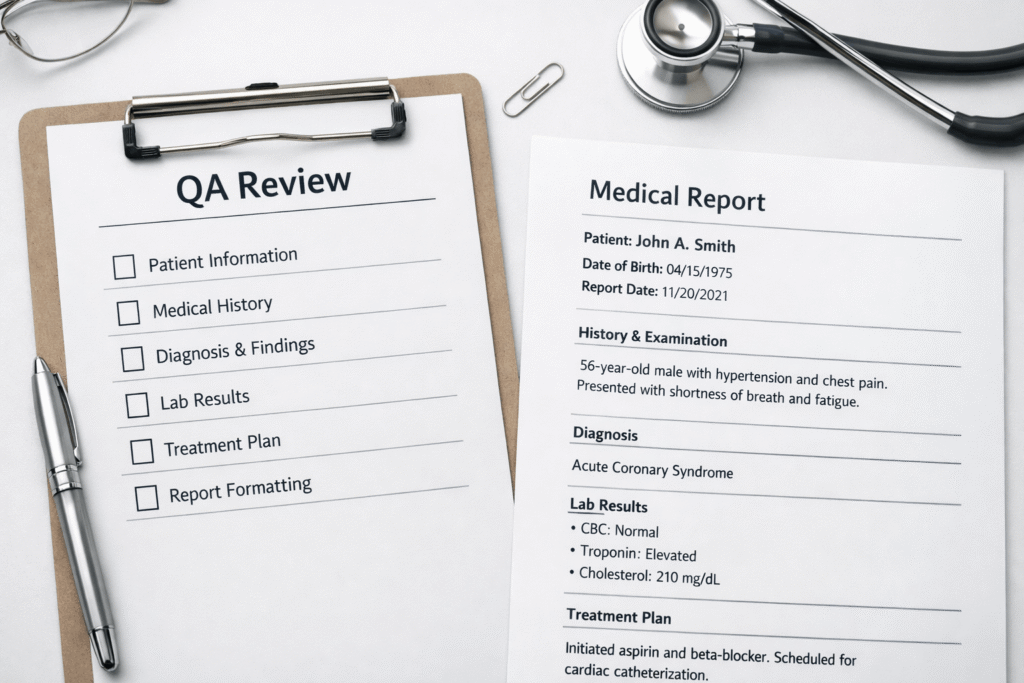
How to do medical transcription (the accuracy checklist professionals use)
Before you submit any file, check:
- Names, dates, laterality (left/right), dosages, units
- Medication names and strengths (verify carefully)
- Procedure names and imaging terms
- Negatives (“no fever”, “denies chest pain”)—these change meaning
- Consistent formatting: headings, bullets, numbering, spacing
- Grammar and punctuation for clarity (clinical writing must be unambiguous)
A simple rule: If a mistake could change meaning, verify it. If it can’t be verified reliably, flag it properly according to client instructions.
How much does medical transcription pay? (and how much do medical transcription editors make?)
Pay depends heavily on:
- Country and employer type
- Specialty difficulty
- Whether you’re paid hourly, salary, or per line/minute
- Whether you’re transcribing from scratch or editing drafts
- Your accuracy rate and turnaround speed
A realistic way to estimate earnings (example)
Instead of chasing one number, calculate based on output:
If paid per line (example only):
- Rate per line × lines produced per day × working days per month
If paid hourly:
- Hourly rate × billable hours (not total sitting time)
Editors often command higher rates because they’re responsible for correcting errors and ensuring documentation quality—especially in speech recognition workflows.
If your goal is higher earning potential, specialize (radiology and surgical content tends to be more technical) and build editing + QA expertise.
How to start a medical transcription business (and how to start a medical transcription company)
If you want to freelance or build a company, treat it like a compliance-first service business.
Core building blocks
- Clear service scope: transcription, editing, time-stamps, speaker labels, templates
- Secure handling: encrypted transfer, access control, retention policy
- Quality assurance: second-pass review, terminology checks, standard templates
- Turnaround options: standard vs urgent pricing tiers
- Contracts: confidentiality clauses, liability boundaries, revision policy
Pricing models
Common models include:
- Per audio minute
- Per hour of audio
- Per line (less common outside certain markets)
- Monthly retainers for clinics with consistent volume
How to start medical transcription business in India (practical considerations)
If you’re building in India, focus on:
- Strong client contracts (especially for overseas clients)
- Data protection and confidentiality workflows
- Clear staffing plan (in-house vs subcontractors)
- Training + QA to keep quality consistent at scale
- Time-zone advantage as a delivery promise (overnight turnaround for certain regions)
A scalable model usually starts with editing + QA capability first, then expands into higher-volume work once quality is stable.
Career paths: where medical transcription can take you
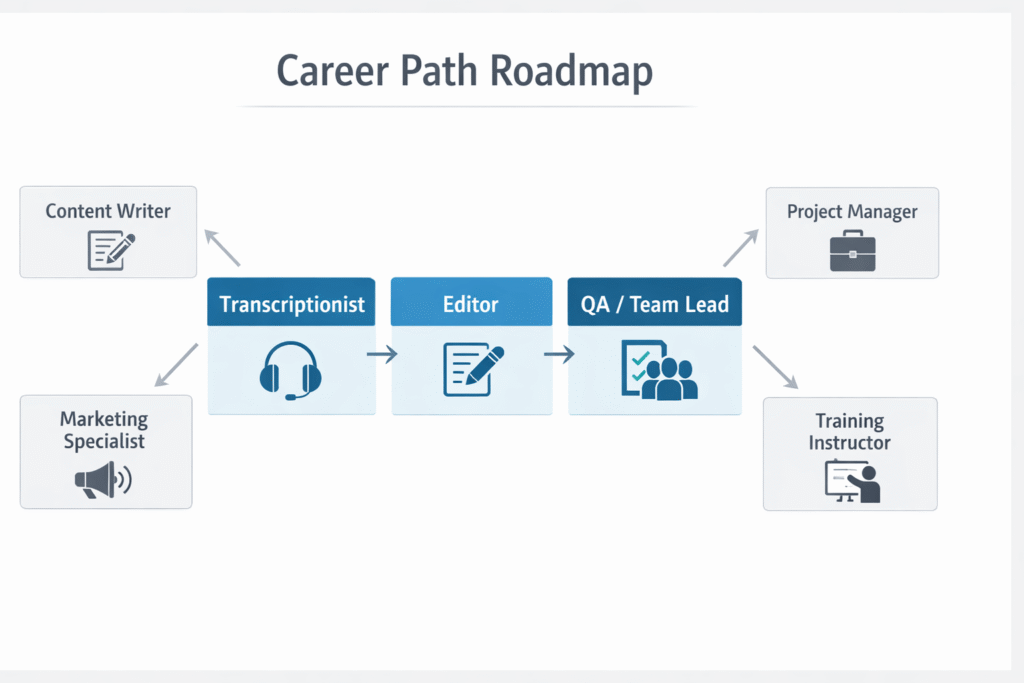
You don’t have to stay in one role. Common progression paths:
Path A: Transcriptionist → Editor → QA/Team Lead
- Start with basic transcription or editing
- Move into specialty editing
- Become the person who catches and prevents systematic errors
Path B: Transcriptionist → Healthcare documentation specialist
- Strong formatting and compliance knowledge
- Template mastery across report types
- Documentation integrity focus
Path C: Freelance → Boutique service provider
- Focus on reliability and confidentiality
- Serve researchers, clinicians, allied health providers
- Add value with clean formatting + fast turnaround
Path D: Transcription + language services (high-value niche)
If you work with multilingual patients, international clinics, legal cases, or cross-border healthcare, pairing transcription with certified translation can be powerful.
If you ever need medical transcription done professionally (including time-stamps, clean edits, and strict confidentiality), you can request it directly through UK Certified Translation’s transcription services:
Transcription service: https://ukcertifiedtranslation.co.uk/transcription/
And if you need certified translation of medical records for official use (immigration, legal matters, insurers, universities, overseas care), start here:
Certified translation: https://ukcertifiedtranslation.co.uk/certified-translation/
A quick reality check: who succeeds fastest?
The people who grow fastest typically:
- Practice daily (even 20–30 minutes)
- Track mistakes like a checklist, not a personal failure
- Learn terminology in context (not isolated memorization)
- Build editing and QA skills early
- Choose a specialty and own it
If you want a simple target: aim for clean structure + high accuracy first. Speed comes as a by-product of correct habits.
Ready to hand off transcription or medical documentation work?
If you’re on the client side (clinic, researcher, legal team, or production team) and need accurate output with confidentiality, start here:
- Request transcription support: https://ukcertifiedtranslation.co.uk/transcription/
- Discuss your requirements: https://ukcertifiedtranslation.co.uk/contact/
“Booked an interpreter for a medical appointment… helped me understand everything clearly.” — Daniel K., Patient
“Uploaded my file in minutes and got the signed PDF back the next day.” — Emma B., Operations Manager
FAQs
1) How do I get into medical transcription with no experience?
Start by learning medical terminology basics, then practice short dictations daily. Build a small portfolio of clean samples and apply for entry-level editing/transcription roles with a clear QA checklist.
2) How to learn medical transcription at home?
Use a structured plan: terminology + templates + daily listening practice + weekly accuracy reviews. Add editing practice early so you’re ready for modern speech recognition workflows.
3) Can you do medical transcription from home?
Yes. You’ll need a reliable setup (headset, quiet space, stable internet) and strong habits for confidentiality, deadlines, and consistent formatting.
4) Is medical transcription a good job?
It can be if you like detail-focused work and clear standards. The strongest long-term path is building editing + QA skills and moving into healthcare documentation roles.
5) Are medical transcription jobs being phased out?
Many roles have shifted from typing-from-scratch to editing and quality review. People with strong terminology, language accuracy, and editing skills still find opportunities.
6) How to start a medical transcription business?
Define your service scope, build a secure workflow, create a QA system, set turnaround tiers, and use clear contracts. Start small, prove quality, then scale.