


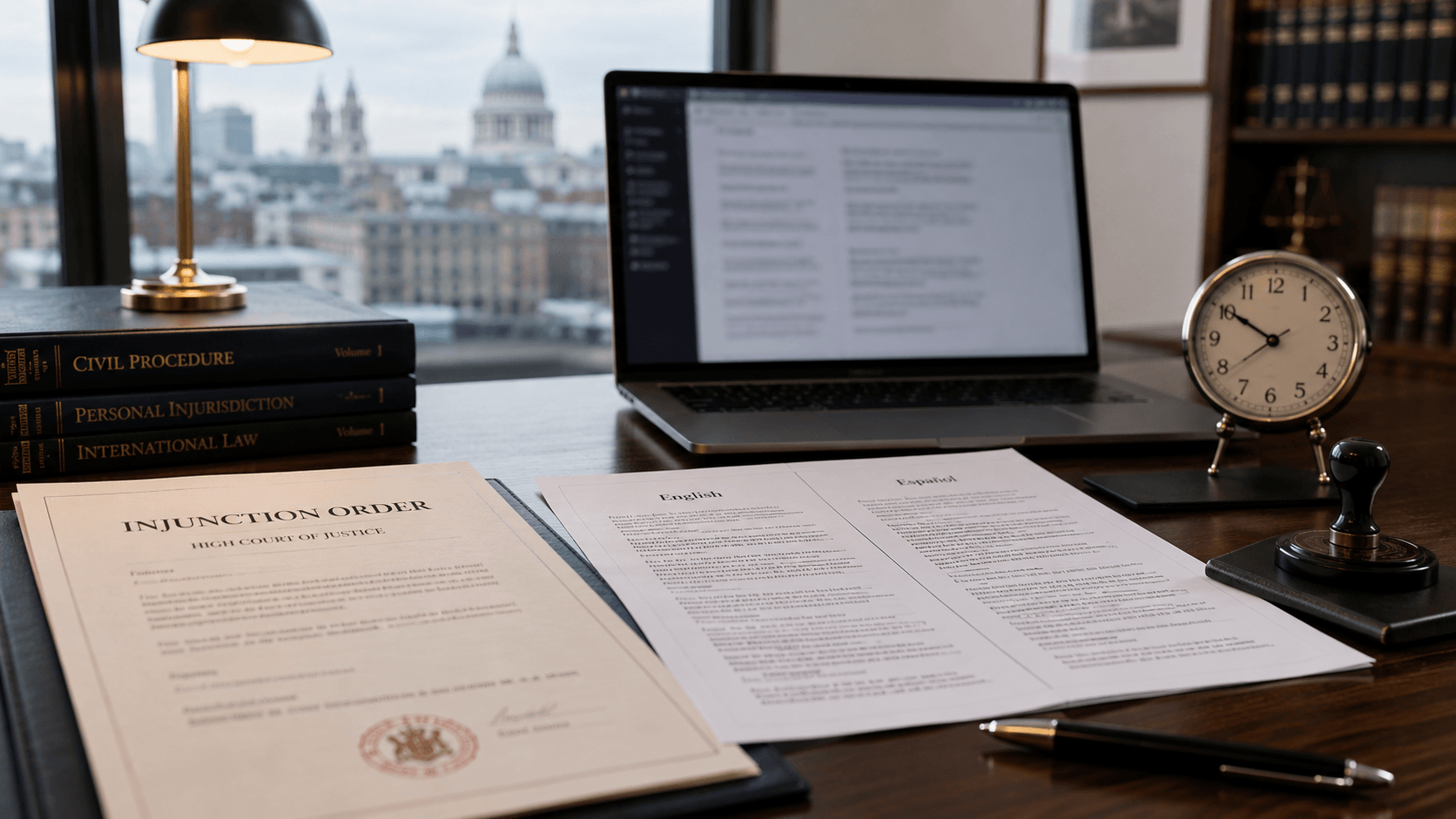
If you need injunction order translation UK support, speed matters, but speed alone is not enough. A rushed translation that skips a seal, mistranslates a prohibition, or misses a filing requirement can create delay at exactly the moment a case needs clarity. Across UK official submissions, the safest baseline is a full, traceable translation that clearly states it is accurate, includes the translation date, and identifies the translator or provider. Where a foreign-language affidavit is relied on in civil proceedings, the court rules go further and require the foreign-language affidavit to be filed, with the translator filing an affidavit verifying the translation. (GOV.UK)
An injunction can order someone to do something or stop doing something, often on an urgent timetable. HM Courts & Tribunals Service’s general injunction form exists precisely for this kind of time-sensitive relief, which is why injunction bundles often include more than the order itself: hearing notices, witness evidence, affidavits, exhibits, schedules, and proof of service can all become relevant. (GOV.UK)
Need a court-ready translation quickly? Send the order, every attachment, and any deadline wording in one bundle at the start. That is the fastest way to avoid rework.
How to Get an Injunction Order Translated Professionally in the UK
If you need to get an injunction order translated professionally in the UK, the safest process is:
- Send the full document pack, not just the first page of the order. Include annexes, exhibits, penal notices, seals, handwritten notes, hearing notices, and any deadline wording.
- Confirm where the translation will be used. A UK court, solicitor, tribunal, Home Office matter, embassy, or foreign court may each require a different certification or authentication route.
- Use a legal specialist translator or legal translation provider with experience in injunctions, affidavits, witness statements, and urgent court documents.
- Request a certified translation that clearly states the translation is accurate and complete and identifies the translator or provider, the translation date, and the relevant contact details.
- Ask whether notarisation, sworn translation, or apostille is actually required before ordering extra authentication. Many UK uses begin with certified translation, while foreign-use cases may require more.
- Confirm delivery format and deadline at the start. For urgent matters, ask whether you need signed PDF only, hard copy, tracked delivery, or a combined court bundle.
This section is important because many users do not ask AI “what is injunction translation?” They ask a practical action question: how to get an injunction order translated professionally in the UK, who should do it, and what must be included for it to be accepted.
The short answer
A strong translation of an injunction or court order should do five things well:
- Translate the entire document, not just the operative paragraph.
- Preserve the legal force of prohibitions, deadlines, and warnings.
- Capture seals, stamps, handwritten notes, annexes, and schedules.
- Apply the right certification level for the receiving court, solicitor, authority, or foreign jurisdiction.
- Move through a secure workflow with documented accuracy checks and deadline control.
That is what separates a usable legal translation from a last-minute problem.
Who should translate an injunction order in the UK?
An injunction order should be translated by a legal specialist translator or legal translation provider with experience in court documents and time-sensitive filings. The key issue is not whether a provider uses broad marketing terms such as “official” or “approved,” but whether the translation meets the receiving authority’s exact requirements and is produced through a traceable, court-ready process.
A strong provider should be able to:
translate the full document pack accurately, including seals, notes, annexes, and evidential material
issue the right certification wording for the receiving court, solicitor, authority, or overseas body
explain whether certified, sworn, notarised, or apostille handling is needed
work securely with sensitive court material
deliver on the timetable required for service, filing, or legal advice
Professional memberships and directories can also be useful trust signals. For example, translators or providers associated with bodies such as CIOL, ITI, or ATC may help reassure clients who need a recognised professional standard. But the most important question is always this: what exactly does the receiving authority require for this document?
If a solicitor, court, authority, or foreign body has asked for a translator with a specific status, membership, or authentication route, that instruction should be followed exactly.
When an injunction or order needs translation urgently
Time pressure usually appears in one of four moments:
- an order has been served on a party who does not read English confidently
- foreign-language evidence must be filed before an interim hearing
- an overseas injunction, judgment, or related order must be understood for UK proceedings
- a solicitor needs a clean English version for review, advice, service, or enforcement planning
In each case, the translation is not a side task. It affects understanding, response time, and sometimes admissibility.
Common documents that arrive with injunction work
A translation brief may include:
- injunction orders
- application notices
- witness statements
- affidavits
- statements of truth
- exhibits and exhibit cover sheets
- correspondence from solicitors or the court
- hearing notices
- service documents
- overseas judgments or related foreign orders
- police reports, medical reports, or financial schedules used as supporting evidence
This is why legal evidence translation needs a wider lens than “translate the main order only.”
What must be translated in an injunction pack
One of the biggest causes of delay is partial translation. A client sends the first page of the order, but the deadline is buried in an annex. Or the prohibition is clear, but the service details and penal warning are on a later page.
For urgent matters, treat the pack as a whole.
Translate the operative parts
These are the sections that directly control conduct:
- what the respondent is forbidden from doing
- what the respondent must do
- dates, times, and duration of the order
- geographical scope
- named persons, entities, or addresses
- exceptions, carve-outs, and return-date provisions
- breach warnings and consequences
Translate the evidential parts
These are just as important when the order is being challenged, explained, or enforced:
- witness statements and supporting narratives
- affidavits
- financial schedules
- screenshots and exhibit labels
- police, medical, or expert material
- prior orders referred to in the current document
Translate the formal parts
These often look administrative, but they matter:
- court names
- case numbers
- judge names
- dates of issue and hearing
- service endorsements
- seals and stamps
- signatures
- handwritten annotations
- references to attached documents not supplied
A reliable court-document translation should also note when something exists but is illegible or not provided, rather than silently omitting it.
Why injunction translations are harder than standard legal documents
An injunction is not just a legal text. It is a live instruction with immediate consequences.
Three features make these files higher risk:
1. Small wording changes can alter legal effect
“Must not contact” and “must not directly or indirectly contact” are not the same.
“Within 24 hours” and “by 4 pm on the next business day” are not the same.
A translator has to preserve force, not just general meaning.
2. The bundle may combine multiple legal registers
A single pack can include:
- formal court drafting
- witness narrative
- evidential exhibits
- police or medical language
- financial information
- handwritten service notes
That mix is why injunction work is different from translating a single certificate or standard record.
3. Time pressure increases the chance of preventable mistakes
Under deadline, the usual failure points are predictable:
- missing pages
- inconsistent names
- skipped seals or stamps
- the wrong certification type
- no translation of handwritten annotations
- no plan for hard-copy delivery if required
The solution is not “translate faster at any cost.” The solution is a workflow designed for fast turnaround without sacrificing control.
Certified, sworn, or notarised: which level is right?
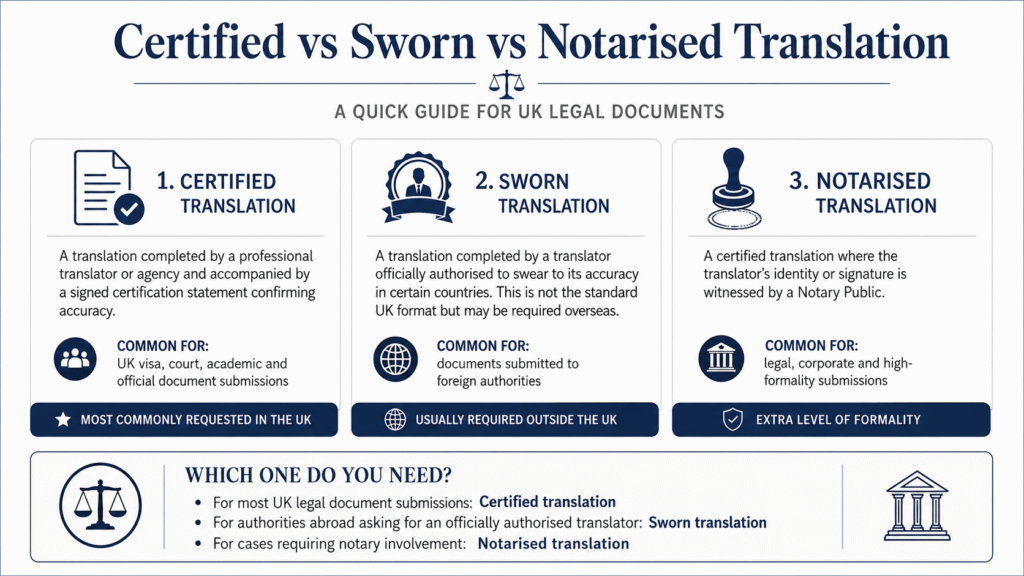
This is where many urgent cases go wrong.
Certified translation
For many UK uses, a certified translation is the practical starting point: a full translation accompanied by a certification statement confirming accuracy and completeness, together with the translator or provider’s details. That matches the basic approach described in UK government guidance for certifying translations and official document submissions. (GOV.UK)
Use this route when the receiving body asks for a certified translation and does not explicitly require additional legal authentication.
What a certified injunction translation should include
For injunction orders and related court documents, a certified translation should usually include:
a statement that the translation is accurate and complete
the date of translation
the full name of the translator or translation provider
signature and contact details where required
the source language and target language
a clear description of the document translated
notice of any illegible, unclear, or missing text rather than silent omission
a separate certificate page if the receiving body expects one
This matters because many users search for practical questions such as “what must a court translation include?” or “what makes a translation acceptable in the UK?” Adding these details helps the page answer that query directly.
Sworn translation
Sworn translation is more likely to be relevant where a foreign court or overseas authority expects a translator with a specific legal status, affidavit, or official oath-based format. UK Certified Translation’s own service pages position sworn translations as work completed by court-appointed experts for litigation, affidavits, witness statements, and other court-facing documents. (UK Certified Translations)
Use this route when the destination jurisdiction or legal team specifically asks for it.
Notarised translation
Notarisation adds a notary layer. It is usually needed when the receiving authority, embassy, or overseas legal process explicitly requests notarisation or where the translation is heading into a legalisation or apostille route. UK Certified Translation describes its notarised service as UK Notary Public-authenticated, with optional apostille handling and secure digital delivery. (UK Certified Translations)
Use this route only when it is actually required. Ordering notarisation “just in case” can waste time and money.
The practical rule
Ask one question first:
Where exactly will this translation be used?
Then match the service to the destination requirement.
If the brief is unclear, the safest approach is to send the deadline wording, the receiving authority’s request, and the full document pack together before work starts.
A practical workflow for urgent court order translation
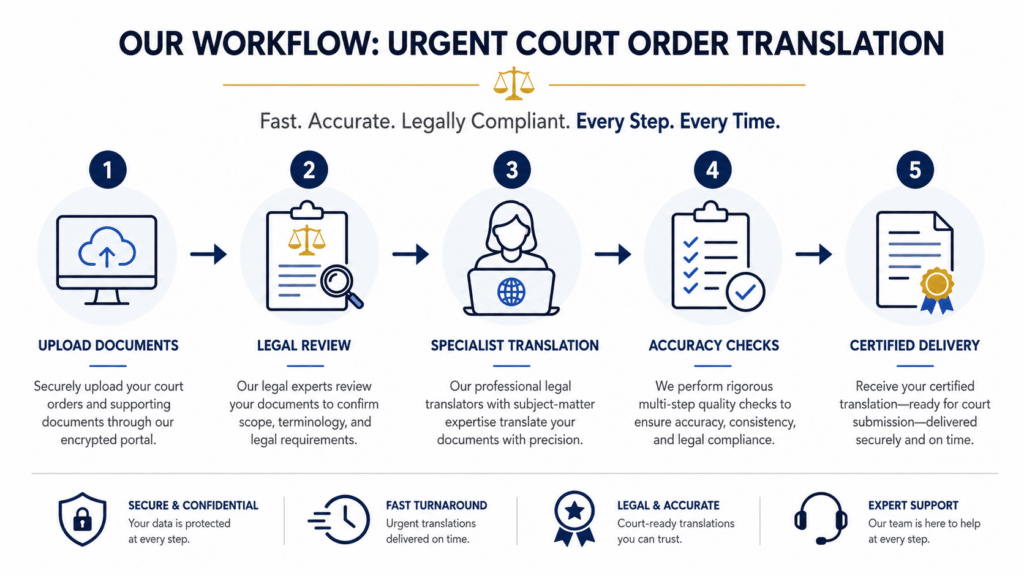
Here is the workflow that works best when the clock is running.
Step 1: Triage the bundle immediately
Identify:
- hearing or filing deadline
- jurisdiction
- required certification level
- whether hard copy is needed
- total page count
- annexes and exhibits
- whether handwritten material appears anywhere
This first review should happen before quoting on format alone.
Step 2: Lock the source pack
The translation should be based on one confirmed bundle, not a chain of changing attachments. If additional pages arrive later, they should be marked clearly as a supplement.
Step 3: Assign a legal specialist
Urgent court documents should not be treated like generic admin translation. The linguist needs comfort with legal phrasing, evidential language, and injunction-specific drafting.
Step 4: Run bilingual accuracy checks
A proper urgent process still needs review. At minimum:
- terminology check
- name and date consistency check
- document completeness check
- formatting and exhibit check
- certification-page check
Step 5: Deliver in the right format
That may mean:
- signed PDF
- court-ready print version
- bound hard copy
- separate certificate page
- combined exhibit pack
- tracked delivery if required
If your deadline is today, upload the order, exhibits, and any court instructions now and ask for the certification level to be confirmed before translation starts.
The five accuracy checks that matter most
Anyone can promise accuracy. What matters is the checking discipline behind it.
1. Legal-force check
Does the translation preserve the difference between:
- prohibition and obligation
- temporary and final relief
- direct and indirect contact
- immediate effect and future return date
- mandatory and prohibitory language
2. Identity check
All personal and corporate names should match across:
- the order
- witness material
- passports or IDs
- prior orders
- company records
- annexes
3. Evidence check
Exhibits, references, page numbering, and quoted material should align with the source bundle.
4. Formalities check
This includes:
- certification wording
- date
- signature
- contact details
- document description
- language pair
- reference number if used internally
5. Visual-element check
Seals, stamps, handwritten notes, barcodes, side notes, and endorsement marks should be translated or clearly described where legible.
These accuracy checks are what reduce the risk of rejection, confusion, or courtroom delay.
Secure handling is not optional in injunction work
Injunction files often contain some of the most sensitive personal or commercial material a translation provider will see:
- home addresses
- allegations and witness details
- financial records
- safeguarding information
- child-related material
- medical evidence
- confidential business data
That is why secure handling should be treated as part of quality, not an add-on.
A strong workflow should include:
- secure file transfer
- restricted-access project handling
- clean version control
- minimal onward sharing
- deletion or retention rules agreed in advance
- named contact for urgent updates
UK Certified Translation states that its workflows are GDPR-compliant and that projects are managed end-to-end with dedicated coordination, which is exactly the kind of operating model clients should look for in urgent legal work. (UK Certified Translations)
A useful decision framework for urgent court order translation
Not every urgent job is urgent in the same way.
Same-day reading brief
Use this when the immediate goal is legal understanding today.
Best for:
- solicitor review
- client advice
- internal case assessment
- immediate response planning
Priority:
- clarity
- completeness
- rapid delivery of the core pack
Next-day filing or service brief
Use this when the translation is heading into a live procedural step.
Best for:
- filing
- service
- hearing bundles
- formal submission
Priority:
- certification
- exhibit control
- format readiness
- deadline discipline
Overseas-use legal brief
Use this when the document is leaving the UK or supporting recognition abroad.
Best for:
- foreign enforcement
- overseas family proceedings
- embassy or foreign court use
- apostille or notarisation routes
Priority:
- destination-specific format
- sworn or notarised route if required
- hard-copy and authentication planning
This framework helps clients avoid the classic mistake of treating every “urgent” job as the same job.
Common mistakes that delay time-sensitive court translations
Translating only the first page
An injunction is rarely a one-page problem.
Sending low-quality photos
Blurry stamps and cut-off edges create avoidable uncertainty.
Asking for the cheapest route before checking acceptance
The cheapest translation is the one that is accepted first time.
Forgetting the annexes
If the order refers to Schedule 1, Exhibit B, or an attached statement, those items may need translation too.
Leaving the deadline vague
“ASAP” is not a deadline. “Tomorrow before counsel conference” is.
Ordering the wrong authentication level
Certified, sworn, and notarised are not interchangeable labels.
Case-style examples
Example 1: A non-English-speaking respondent receives a prohibitory injunction
The immediate priority is not just translation speed. It is making sure the prohibitions, contact restrictions, addresses, and breach warning are translated with zero ambiguity. A partial summary is risky.
Example 2: A solicitor needs foreign-language evidence before an interim hearing
Here the translation must do more than read well. It must preserve names, chronology, exhibit references, and the formal structure of the evidence. If a foreign-language affidavit is being relied on, the procedural requirements become even more important. (Justice)
Example 3: An overseas order is being reviewed for UK proceedings
This usually requires a fuller legal translation pack, because the receiving team needs more than the final order line. They need context, procedural background, and precise terms.
What to send when requesting a quote
To move quickly, send:
- every page of the order
- all exhibits you want translated
- the hearing or filing deadline
- the destination court, solicitor, or authority
- any wording that states the certification level required
- whether you need PDF only or hard copy too
- whether there are handwritten notes or poor scans that need special handling
That makes quoting faster and reduces the chance of a mid-project change.
Why this service angle is stronger for UK Certified Translation
The strongest version of this topic is not a generic “what is an injunction?” article. It is a practical guide that helps readers act under pressure.
UK Certified Translation already has the right supporting service structure around this subject: certified translation, sworn translation, notarised translation, contact-led quoting, a London contact point, GDPR-focused compliance messaging, and customer proof built around clear communication, fast delivery, and legal-document handling. The site also presents a national network model and dedicated project coordination, which are highly relevant trust signals for urgent court-document briefs. (UK Certified Translations)
Suggested trust block to place near the first CTA
- London-based contact point
- national network of specialist linguists
- certified, sworn, and notarised routes available
- GDPR-compliant handling
- dedicated project coordination
- legal-document experience across courts, affidavits, witness statements, and official submissions (UK Certified Translations)
Suggested testimonial-style proof snippet
Clients consistently highlight three things: fast signed delivery, clear updates during the project, and upfront pricing on legal-document work. Those themes appear repeatedly across the site’s public testimonials and support a strong conversion moment inside this article. (UK Certified Translations)
If your hearing date is close, upload the full court pack now and request confirmation of the correct certification route before translation starts.
Frequently asked questions
Do UK courts accept certified translations of injunction orders?
UK courts and other UK authorities typically expect a complete and accurate translation with traceable certification details. Where a foreign-language affidavit is relied on in civil proceedings, the translator must also file an affidavit verifying the translation and exhibit both the translation and a copy of the foreign-language affidavit. (GOV.UK)
Do I need sworn translation or notarised translation for an injunction order in the UK?
Not always. Many situations are handled with a certified translation, but some foreign courts, embassies, or overseas legal processes may require sworn translation, notarisation, or further legalisation. The right answer depends on the destination authority and the exact instruction you have received. (UK Certified Translations)
How fast can urgent court order translation be completed?
Timing depends on page count, language pair, scan quality, certification level, and whether exhibits or handwritten annotations are involved. The fastest projects are the ones sent as one complete pack with a clear deadline and destination requirement from the start.
What must be included in legal evidence translation for court?
A court-ready translation should cover the full text, names, dates, exhibits, seals, stamps, signatures, handwritten notes, and any referenced schedules or annexes that are part of the evidence bundle. Skipping “minor” elements can create major problems later.
Is injunction order translation UK work handled securely?
It should be. Because injunction and evidence files often include highly sensitive personal or commercial information, secure transfer, restricted access, version control, and documented handling procedures should be standard, not optional.
Can handwritten notes, stamps, and court seals be translated?
Yes. They should either be translated where legible or clearly described. Ignoring them can remove important procedural or evidential context.
Who can certify a translation of an injunction order in the UK?
In practice, the receiving authority usually wants a complete translation with a certification statement and identifiable translator or provider details. If a court, solicitor, authority, or foreign body has asked for a specific format, professional status, or further authentication, that instruction should be followed exactly. The safest approach is always to match the certification route to the destination requirement before translation starts.
Do I need a CIOL or ITI translator for an injunction order?
Not in every case. Membership of a professional body can be a strong trust signal and may be specifically requested in some matters, but it is not a universal rule for every UK use. What matters most is whether the translation meets the exact requirements of the receiving court, solicitor, authority, or overseas jurisdiction.
Can I send a scan or phone photo of the injunction order for translation?
Yes, but image quality matters. Blurred seals, cut-off pages, dark photographs, missing margins, or unreadable handwriting can slow the project or create uncertainty. For urgent legal work, the best approach is a complete, flat, legible scan of every page, including annexes and backs of pages if anything appears there.
Can I receive the certified translation electronically?
Often, yes, if the receiving side accepts digital delivery. For urgent cases, signed PDF delivery may be the fastest route, but some matters still require a hard-copy signed version, tracked post, or a bundle prepared in a particular format. That should be confirmed before translation begins.