


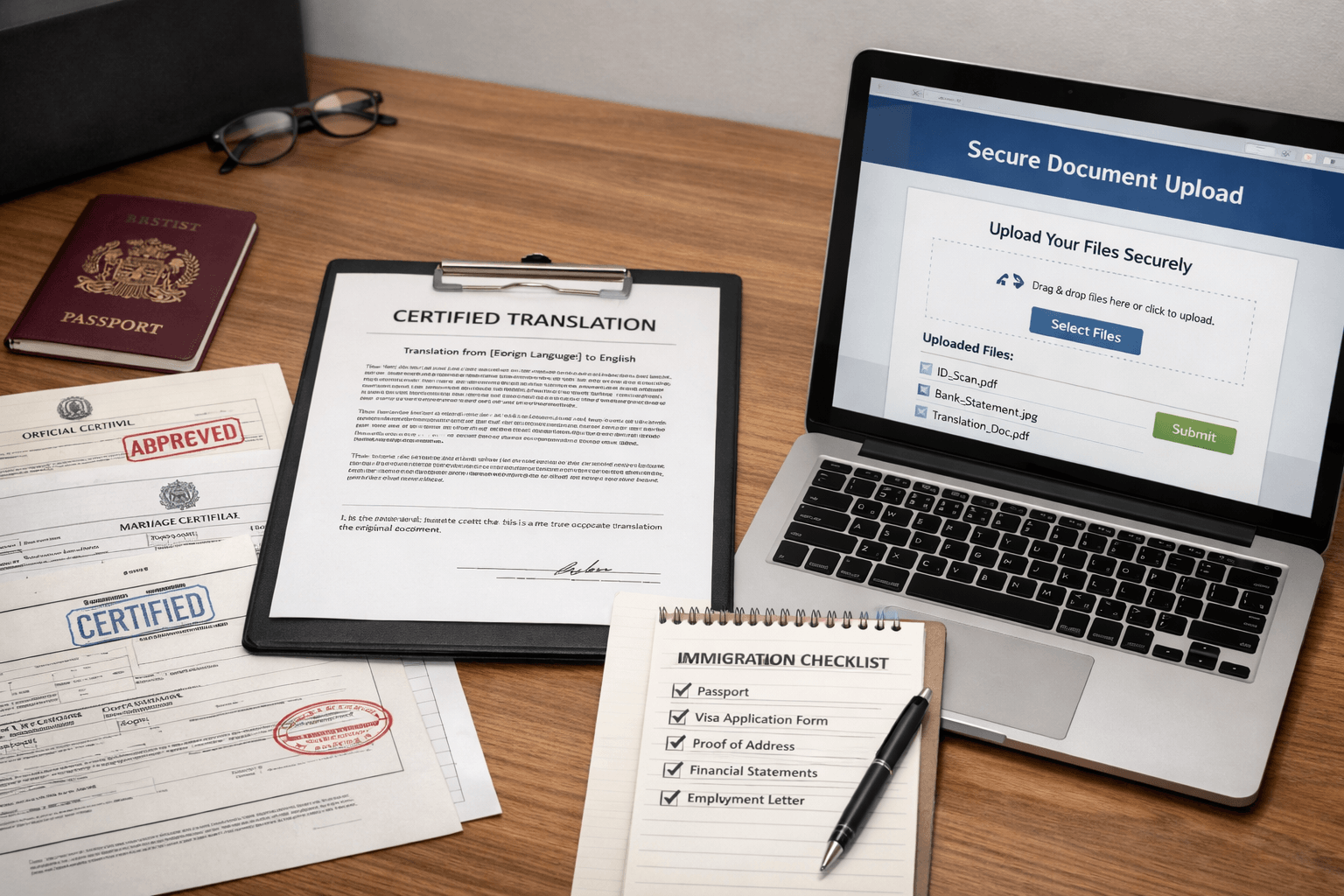
If you need home office document translation, the safest approach is to treat translation as part of your evidence pack, not as a last-minute add-on. A strong submission is not just “translated into English.” It is complete, independently verifiable, consistent with the rest of your application, and delivered in one of the accepted formats for your route. Most delays happen because something small is missing: a stamp was skipped, a surname was rendered differently from the passport, a scan was cropped, or the certificate did not include the right details.
That is the good news too. These are avoidable problems.
This guide shows you what a compliant translation should include, which mistakes cause the most avoidable delays, how accepted formats work in practice, and what to look for in a UK immigration translation service when time is tight.
Need a fast answer before you submit? Send your file for a same-day review and get confirmation of the right format before you pay for anything extra.
Common causes of home office document translation delays
If you are asking what usually causes Home Office document translation delays, the most common reasons are incomplete translations, missing certification details, name or date inconsistencies across documents, poor scan quality, wrong submission format, untraceable translators or agencies, and last-minute submission with no time to correct errors.
In practical terms, delays usually happen when a caseworker cannot quickly verify three things: what the original document says, who translated it, and whether the translated version matches the rest of the evidence pack.
The most common delay causes are:
- A full page, reverse side, stamp, seal, or handwritten note was not translated
- The certification statement, translation date, signature, or translator contact details were missing
- Names, dates, addresses, or reference numbers did not match the passport or supporting bundle
- The source file was blurred, cropped, incomplete, or missing pages
- The wrong certification level was ordered for the destination
- The provider delivered the wrong format, such as a PDF where paper or wet-ink was required
- The translator or agency could not be independently verified
- The file was submitted too late for review, correction, or re-issue
A practical way to reduce risk is to check the destination requirement before translation starts, then review the certified output against both the original document and the rest of the application bundle before submission.
For related guidance, see what is a certified translation and Gov.uk certified translation requirements.
What a Home Office-ready translation should include
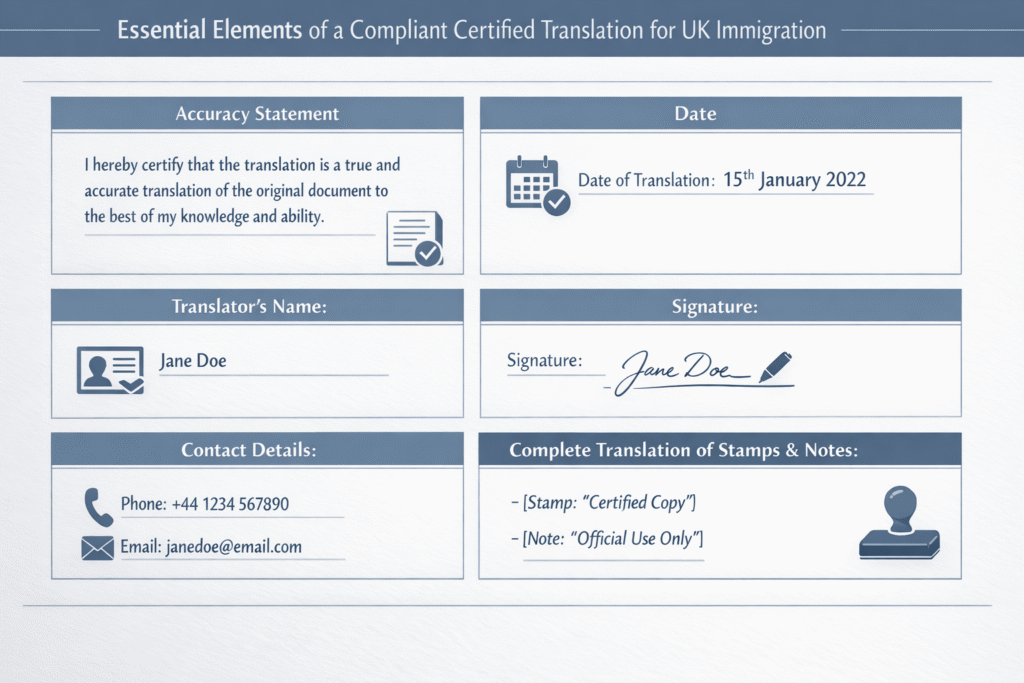
For most Home Office and UKVI-related submissions, a translated document should do two things well:
- Reproduce the original document fully and clearly.
- Make it easy for a caseworker to verify who translated it.
A strong certified translation package usually includes:
- A full English translation of the document
- A certification statement confirming accuracy
- The date of translation
- The translator’s full name
- The translator’s signature
- Contact details for verification
- Clear identification of the original document and language pair
Just as importantly, it should be a full translation, not a summary. That means stamps, seals, handwritten notes, side notes, reference numbers, and annotations should not disappear simply because they look minor. In immigration files, “minor” details are often exactly what caseworkers use to connect one document to another.
Can the Home Office reject or question a translation?
Yes. A translation can be delayed, queried, or rejected if it is incomplete, cannot be independently verified, or does not match the original document and the supporting evidence. The problem is not always the language itself. Often it is the missing certificate, omitted stamp, inconsistent name spelling, or unclear scan that makes the document harder to assess.
Caseworkers usually need four things to be clear:
- Completeness
- Traceability
- Consistency
- Legibility
When one of those four breaks down, extra requests, queries, or avoidable delays become more likely.
If you want a clear overview of the process before ordering, see certified translation services and what is a certified translation.
The delay triggers that catch applicants out most often
Translation-related delays are rarely dramatic. They are usually administrative. Here are the issues that most often slow a Home Office submission down.
1. Partial translations
One of the biggest problems is leaving out content that looks unimportant:
- Entry and exit stamps
- Marginal notes
- Reverse-side endorsements
- Registrar notes
- Handwritten amendments
- Reference numbers
- Official seals
If the original contains it, the translation should account for it.
2. Inconsistent names across documents
This is where strong consistency checks matter. If the passport says one spelling, the bank statement uses another, and the translated birth certificate introduces a third version, your file becomes harder to assess.
Common problem areas include:
- Transliteration from Arabic, Cyrillic, Chinese, or Greek
- Double surnames
- Maiden names and married names
- Date order differences
- Place-name spellings
- Abbreviated middle names
A translation should not create a new identity trail that the rest of the bundle then has to explain.
3. Unclear scans
Even the best translator cannot fix a blurred stamp, cropped page edge, or glare over a signature line. If the source file is weak, the output will be weaker.
Before you order, check that:
- Every page is included
- All four edges are visible
- Text is legible at full size
- Stamps and signatures can be read
- Back pages are included where relevant
4. Ordering the wrong certification level
Many applicants pay for notarisation when they only needed a standard certified translation. Others do the opposite and discover too late that a foreign authority wanted a notarised or sworn format.
That confusion creates delay, extra cost, and rework.
5. Using the wrong accepted formats
A route may accept a certified PDF, while another body may want a hard copy, wet-ink signature, or posted original. The translation itself may be fine, but the format may be wrong for the destination.
6. Choosing an untraceable provider
A translation can be linguistically correct and still create problems if the provider cannot be verified. That is especially important in the UK market, where many buyers assume all translators are regulated in the same way. They are not.
7. Leaving everything to the last 24 hours
Urgent help is possible, but only when the inputs are good. Rush jobs become risky when files are incomplete, bundled badly, or missing context about where they will be submitted.
The documents most likely to cause translation-related delays
Some documents are more straightforward than others. These are the ones that tend to need extra care.
Civil status documents
Birth, marriage, divorce, and death certificates often look simple, but small errors here can ripple through an entire application.
Watch for:
- Name order differences
- Old and new surnames
- Registry notes
- District names
- Embedded numbers and seals
Identity documents
Passports, ID cards, and residence cards require exact consistency with the rest of the application.
Watch for:
- Passport number formatting
- Expiry date format
- Place of birth spelling
- Machine-readable lines
- Notes on renewals or reissue
Financial evidence
Bank statements, salary slips, tax letters, and sponsorship evidence often cause problems because they are dense, repetitive, and time-sensitive.
Watch for:
- Cropped pages
- Missing transaction pages
- Untranslated bank stamps
- Mixed-language statements
- Name mismatches between sponsor and applicant
Police and legal documents
Police certificates, court papers, and official legal records often contain references, footnotes, and endorsements that must be preserved carefully.
Watch for:
- Court reference numbers
- Penalty details
- Date format issues
- Side notes or handwritten remarks
- Seals that prove authenticity
Education and employment documents
Academic transcripts, diplomas, employment letters, and reference letters can look harmless but still create issues when terminology is inconsistent.
Watch for:
- Degree title wording
- Institution names
- Grade systems
- Job titles
- Signature blocks and stamps
Certified, notarised, or sworn: which one do you actually need?
This is where many applicants overcomplicate the process.
| If your document is for… | What usually works | Upgrade only if specifically requested |
| Most Home Office and UKVI submissions | Certified translation | Notarised translation |
| HM Passport Office supporting documents | Certified translation | Hard copy or additional certification only if requested |
| Universities, employers, banks | Certified translation | Wet-ink or sealed pack if requested |
| Embassy or overseas authority use | Certified translation may not be enough | Notarised or apostilled translation |
| Foreign court or jurisdiction with a sworn system | Local legal requirement may apply | Sworn translation |
The practical rule is simple: match the translation level to the destination requirement, not to the most expensive option available.
Unsure whether you need certified or notarised? Upload your file and tell us where it is going. We will confirm the right route before production starts.
Official guidance and professional standards
If you are checking requirements before you order, it helps to compare your document route against official and professional guidance. Useful reference points include certifying a translation, the document guidance for visitor visa supporting documents, Skilled Worker visa document requirements, and long residence document requirements.
For translator standards and provider checks, see CIOL certified translations guidance and the ITI directory of professional translators. For secure handling of personal data, the ICO guide to data security is a useful benchmark.
Accepted formats: what to send and what to ask for
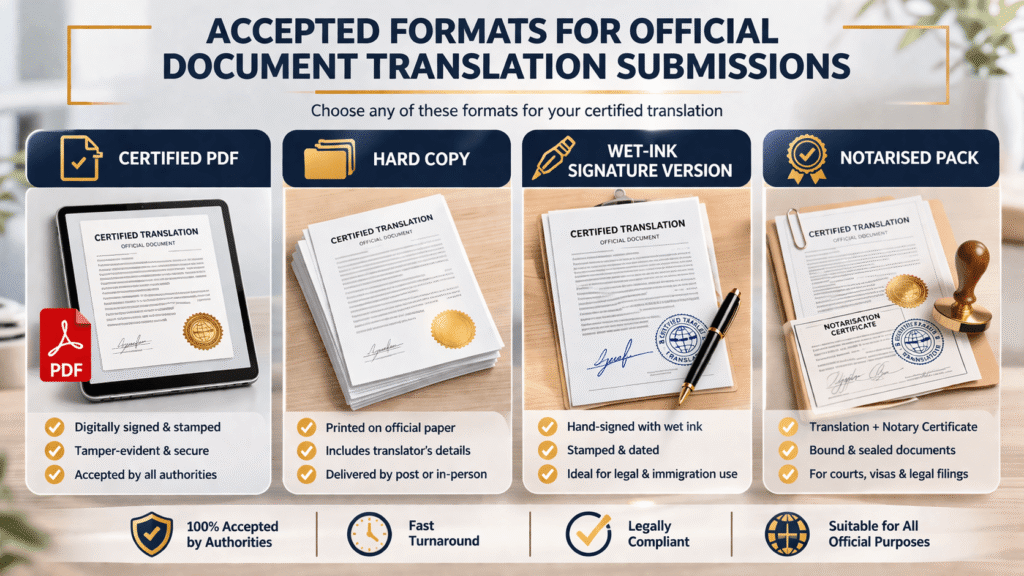
Accepted formats matter more than most people realise.
What to send your translator
To reduce avoidable issues, send:
- A clear scan or high-quality digital image of the original
- Every page in the correct order
- Any reverse pages that contain marks, stamps, or notes
- A single, well-labelled file where possible
- A note explaining where the document will be submitted
What to ask to receive back
Depending on the route, ask for one or more of these accepted formats:
- Certified PDF for digital submission
- Hard copy for physical filing
- Wet-ink signed version where specifically requested
- Posted original set for institutions that require paper handling
- Notarised pack if an embassy or overseas authority asks for it
A common mistake is assuming one format works everywhere. It does not.
A better question is:
“What format will the receiving authority accept for this exact submission?”
That question alone can save days.
The consistency checks that stop avoidable Home Office queries
Good translation is not only about language. It is also about alignment.
The most useful way to think about this is the 3-way match rule:
- The original document
- The translated document
- The application form and supporting bundle
These three should agree on the details that matter most.
Run these consistency checks before submission
- Names match the passport spelling
- Dates follow the correct sequence and format
- Addresses are consistent across records
- Reference numbers match exactly
- Stamp text is translated or described
- Handwritten notes are included
- Abbreviations are handled clearly
- Currency amounts and figures are copied accurately
- Page numbering is clear
- The translated document can be matched back to the original without guesswork
A real-world style example
A marriage certificate may show a surname in one script, the passport may use a different transliteration, and the bank statement may shorten the name again. None of those differences is necessarily fatal on its own. The delay starts when the translation silently introduces a fourth version.
A careful provider flags the issue early, keeps the translation aligned to the original, and helps you preserve consistency with the rest of the bundle.
That is why consistency checks are not an optional extra. They are part of making the file decision-ready.
What to look for in a UK immigration translation service
Not every translation provider is built for official submissions.
If you are choosing a UK immigration translation service, look for these signals:
Clear certification process
The provider should explain exactly what will appear on the certificate and what format you will receive.
Experience with official documents
General translation is not the same as translation for immigration evidence. Official documents require stricter formatting discipline and closer document matching.
Strong consistency checks
Ask what their review process covers. A professional provider should be checking for names, dates, numbers, seals, and document completeness, not just language accuracy.
Secure upload and privacy handling
Immigration files often contain passports, salary evidence, addresses, and personal history. Secure upload is not a nice-to-have. It is a baseline expectation.
Traceable professional standing
A serious provider should be easy to verify, with real business details, clear contact channels, and evidence of professional standards.
Real urgent help
Urgent help should mean more than a marketing banner. It should come with a defined process for priority review, fixed quoting, and realistic delivery based on file quality.
Helpful next steps and related services
If you are comparing providers before ordering, these pages can help answer the questions buyers usually ask before submitting official documents: how to find a certified translator, certified translation services, how to get a certified translation, and notarised translation services.
Why secure upload matters more than people think
Immigration documents often contain enough information to expose an applicant to fraud, identity misuse, or avoidable privacy risk if handled badly.
That is why secure upload should sit high on your checklist, especially when you are sending:
- Passports
- Bank statements
- Salary slips
- Police certificates
- Birth and marriage certificates
- Immigration letters
- Address evidence
When assessing a provider, ask:
- How are files uploaded?
- Who can access them?
- How long are they retained?
- Can sensitive files be handled through a secure upload route?
- Is the workflow aligned with GDPR-compliant handling?
For official documents, trust is built as much through process as through language quality.
What urgent help should look like in practice
If your deadline is close, speed matters. But good urgent help is structured, not reckless.
A strong urgent workflow usually looks like this:
- File review on receipt
- Confirmation of document type and destination
- Check of accepted formats
- Fixed quote
- Priority production
- Quality review
- Delivery in the required format
What slows urgent jobs down?
- Poor scans
- Missing pages
- No submission context
- Late requests for notarisation
- Mixed bundles with unclear filenames
- Last-minute changes after delivery
If your deadline is tight, the fastest move is to send clear files and state the destination immediately.
Working against the clock? Upload your document now and request urgent help with the destination listed in the first message.
A simple pre-submission checklist for Home Office document translation
Before you send your bundle, confirm all ten points below:
- Every non-English or non-Welsh document has a full translation
- The certification statement is included
- The date of translation is shown
- The translator’s full name is shown
- The translation includes a signature
- Contact details are included
- Names match the rest of the application
- Stamps, seals, and notes are accounted for
- The final file is in one of the accepted formats for your route
- The provider used secure upload and handled the file clearly
If you can tick all ten, you have removed a large share of the preventable translation problems that hold submissions up.
Why applicants choose UK Certified Translation
For Home Office-related submissions, applicants usually want four things: clarity, speed, security, and confidence that the document will look official when it reaches the receiving body.
UK Certified Translation is well positioned for that because the service is built around official-use documents, certified translation, notarised options where needed, and GDPR-compliant handling. The service pages also emphasise acceptance by UK bodies including HM Passport Office, DVLA, and UK Visas & Immigration, plus secure digital delivery and dedicated support.
One client described the experience simply:
“Uploaded my file in minutes and got the signed PDF back the next day.”
That is what a strong document process should feel like: fast, clear, and controlled.
If you need help now, send your document for review, state where it will be submitted, and request the format you actually need. That single step is often the difference between a clean submission and a preventable delay.
Frequently asked questions
What must home office document translation include?
A Home Office-ready translation should include the full translated document, a statement confirming that it is accurate, the date of translation, the translator’s full name, signature, and contact details. It should also be clear which original document was translated.
Will the Home Office accept a digital PDF certified translation?
In many cases, a digital PDF is workable, but accepted formats can vary by route and receiving body. Always check whether your specific submission needs a certified PDF, hard copy, or wet-ink signed version.
Do I need notarised translation for a Home Office submission?
Usually not unless the receiving authority specifically asks for it. Most Home Office-related cases need a standard certified translation rather than notarisation.
Can I translate my own documents for the Home Office?
That is risky. Even if your English is strong, the safer route is to use a professional provider so the translation can be independently verified and certified properly.
How quickly can a UK immigration translation service help?
Turnaround depends on document length, language pair, file quality, and whether you need hard copy or additional certification. For urgent help, the best first step is to send a clear scan, state the destination, and ask for priority review.
What accepted formats should I ask for when I upload my file?
Ask for the format required by the destination: certified PDF, hard copy, wet-ink version, or a notarised pack where applicable. If you are unsure, ask the provider to confirm the accepted formats before work starts.
What are the common causes of home office document translation delays?
The most common causes are partial translations, missing certification details, inconsistent names or dates across documents, unclear scans, wrong format for the receiving authority, untraceable providers, and last-minute submission with no time for corrections.
Can missing stamps or handwritten notes delay a Home Office application?
Yes. If a stamp, seal, endorsement, registrar note, or handwritten amendment appears on the original, it should usually be translated or clearly accounted for. These details are often used to connect one document to another.
Can a poor-quality scan cause translation problems even if the translation is accurate?
Yes. If the original scan is blurred, cropped, or incomplete, the translation may still be questioned because the receiving body cannot verify the underlying document properly.
How do I reduce the risk of translation delays before submission?
Use a traceable provider, upload clear scans, confirm the right certification level and delivery format, and check that names, dates, and reference numbers match the rest of your bundle before submitting.