


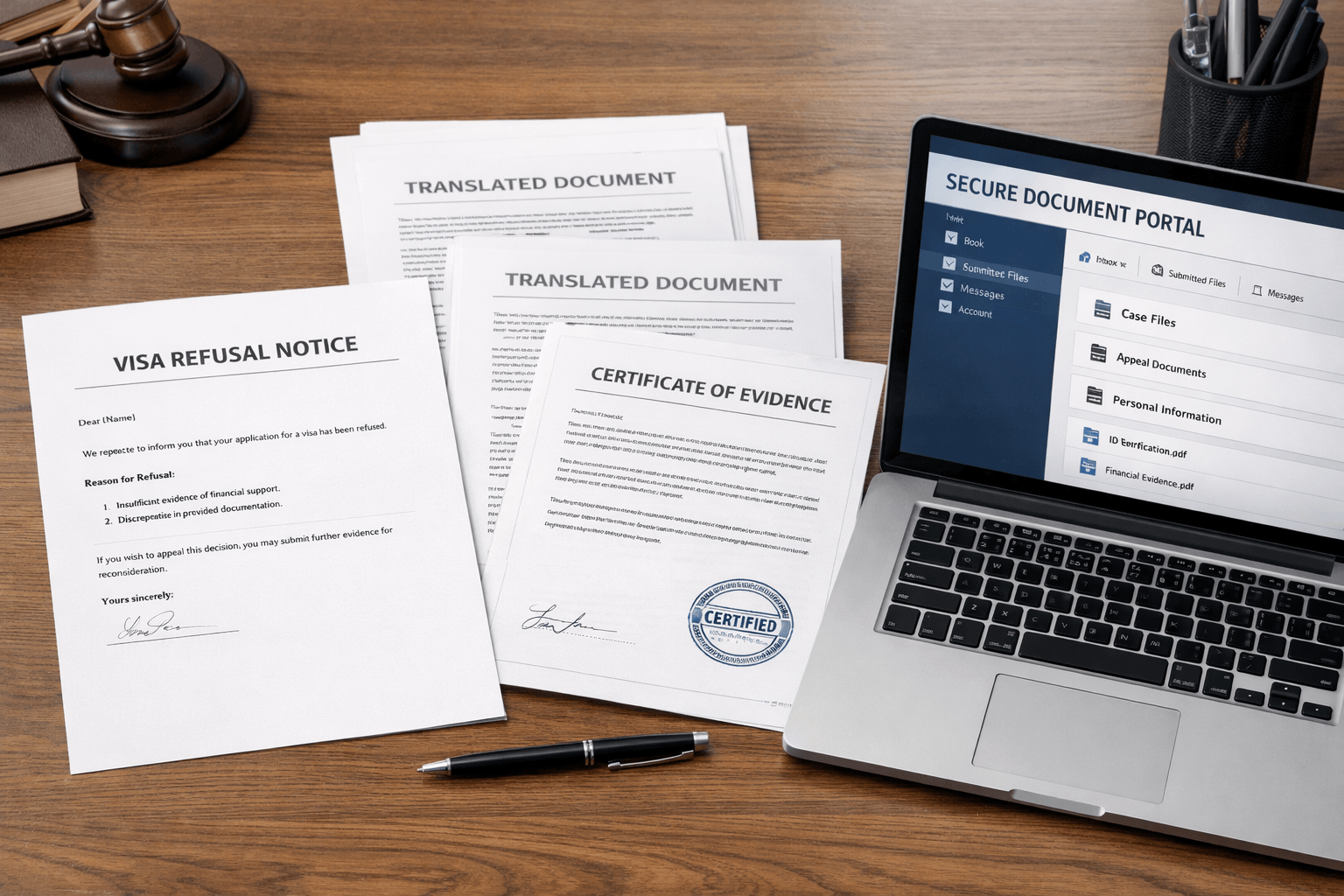
If you need visa appeal translation UK support after a refusal, the quality of your translated evidence can affect how clearly a judge, caseworker, or representative understands your case. Not every refusal carries a right of appeal, but where an appeal is available, time limits are short, the tribunal expects non-English evidence to be translated into English, and poorly prepared translations can weaken otherwise useful material. (GOV.UK)
A strong appeal is not just about having more evidence. It is about having readable, complete, traceable evidence. That means every key document, every exhibit, every witness statement, every screenshot, and every supporting record should be easy to follow, accurately translated, and clearly labelled.
For most applicants, the real problem is not “Do I need a translation?” It is this:
Which documents must be translated, what level of certification is needed, and how do you prepare an appeal bundle that looks reliable from page one?
This guide answers that in plain English.
Why translation quality matters after a visa refusal
In an appeal, translated evidence is doing more than converting words from one language to another.
It is helping the decision-maker answer practical questions such as:
- What does this document prove?
- Is it complete?
- Can I rely on it?
- Does it match the rest of the bundle?
- Was it prepared in a way that can be checked if needed?
That is why tribunal evidence translation is different from casual document translation. In a refusal case, your evidence is often being reviewed under time pressure. If dates, names, stamps, handwritten notes, chat messages, bank entries, or medical references are missing or inconsistent, the document becomes harder to use.
A helpful way to think about appeal evidence is this:
A document only becomes persuasive when it is both understandable and easy to verify.
That is where professional translation adds value. It does not create the case, but it removes friction from the case.
What usually needs translating in a visa refusal appeal
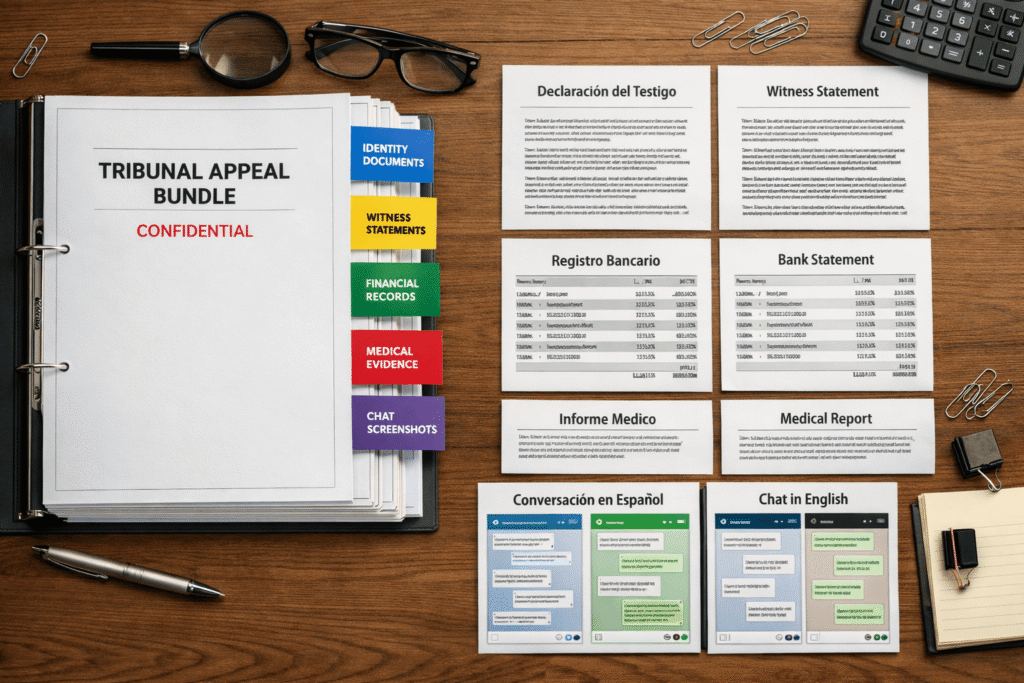
Appeal bundle translation usually covers more than the obvious headline documents. Applicants often translate the refusal letter and one or two main records, but miss supporting material that gives context.
In practice, the bundle often includes:
- Identity and civil status documents
- passports
- birth certificates
- marriage certificates
- divorce certificates
- family registration records
- Relationship evidence
- chat logs
- call records
- photographs with captions
- travel records
- remittance records
- letters from family members
- Financial evidence
- bank statements
- payslips
- tax records
- business records
- sponsorship documents
- Personal background evidence
- tenancy records
- education documents
- employment letters
- police records
- court records
- household registration documents
- Health and welfare evidence
- hospital letters
- prescriptions
- psychiatric reports
- disability records
- care plans
- Narrative evidence
- witness statements
- affidavits
- declarations
- supporting letters from relatives, employers, faith leaders, or community figures
- Digital evidence
- screenshots
- social media messages
- emails
- audio transcripts
- app-based conversation logs
The strongest bundles are not the longest bundles. They are the most usable bundles.
Tribunal evidence translation: what makes it submission-ready
The tribunal rules require documents provided to the tribunal in a non-English language to be accompanied by an English translation. GOV.UK also states that a certified translation should confirm that it is a true and accurate translation, and include the date, the translator’s full name, and contact details. (Legislation.gov.uk)
That gives you the legal baseline. But submission-ready evidence usually goes further.
A robust translated bundle should include:
- a complete translation, not a summary
- consistent spelling of names across all documents
- translated stamps, seals, notes, and annotations
- preserved dates, reference numbers, and document structure
- clear exhibit labelling
- a certificate or declaration page where required
- page order that mirrors the source material
- enough translator details to support verification
The three checks that make translations more credible
1. Completeness
Nothing important is omitted. That includes stamps, signatures, handwritten notes, marginal notes, and short labels that look minor but may matter.
2. Consistency
Names, addresses, dates, case references, and institutional titles are rendered the same way throughout the bundle.
3. Verifiability
The translated document shows who prepared it, when it was prepared, and how it can be checked.
This is where many refusal cases go wrong. The issue is not always bad language. It is often incomplete or inconsistent presentation.
Witness statement translation: accuracy is not enough
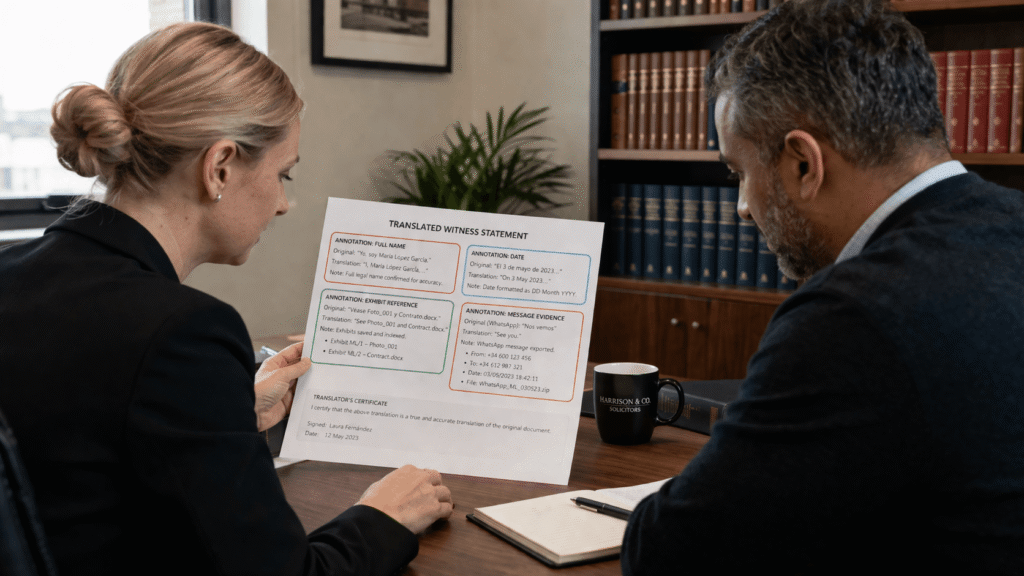
Witness statement translation is one of the most sensitive parts of an appeal file because the wording itself carries credibility.
A witness statement should not be “cleaned up” until it sounds like a different person. It should remain faithful to the witness’s meaning, tone, timeline, and level of certainty.
A strong translated witness statement should preserve:
- first-person voice
- chronology
- uncertainty where uncertainty exists
- culturally specific terms where explanation is needed
- references to attached exhibits
- names and family relationships exactly as used across the case
What to watch for in witness statements
Names and transliteration
If a person’s name appears differently across passports, birth records, chat screenshots, and statements, that inconsistency should be handled carefully and explained where needed.
Dates and calendars
Some documents originate from systems that use different date formats or non-Gregorian calendars. The translation should make the original meaning clear without introducing ambiguity.
Informal language in chats and messages
Message evidence often contains slang, abbreviations, emojis, or voice-note transcripts. These should be translated in a way that preserves meaning and context, not flattened into generic formal English.
Embedded exhibits
If the statement refers to “see attached screenshot” or “bank slip at page 42,” the translated version should align with the final bundle numbering.
If your appeal relies heavily on personal history, relationship evidence, or humanitarian factors, witness statement translation deserves the same attention as legal submissions.
If your statement, chats, or family documents are not in English, get the file reviewed before you submit. A fast quote at this stage can prevent avoidable bundle problems later.
Certified, sworn, or notarised: what is usually needed for UK appeal evidence
In the UK, a certified translation is generally the starting point for official submissions. UK Certified Translation’s own guidance explains that UK authorities typically expect a complete translation, a signed certification statement, and enough provider details for the translation to be independently checked. Its service pages also position certified, sworn, and notarised translations as separate levels depending on the destination and legal use. (UK Certified Translations)
A practical rule:
- Certified translation is usually the default for supporting evidence submitted to UK authorities.
- Sworn translation may be needed where court-style formality or specific legal recognition is required, especially in certain jurisdictions or proceedings.
- Notarised translation is usually an extra authentication layer, not an automatic requirement.
For visa refusal appeals, the key is not to over-order or under-order. Start with what the receiving body actually requires.
A simple decision rule
Choose certified translation when:
- the requirement says “certified translation”
- the evidence is for a Home Office or standard official submission
- the priority is compliance, clarity, and speed
Consider sworn translation when:
- the submission is tied to court-style formalities
- the receiving forum or representative specifically asks for it
- the case includes affidavits, declarations, or formal evidential material
Consider notarised translation when:
- the receiving authority specifically requests notarisation
- the translation is intended for overseas legal use
- the wording in the instructions expressly mentions a notary or apostille chain
UK Certified Translation’s sworn service specifically lists witness statements, court submissions, and immigration appeals among its legal-use offerings. (UK Certified Translations)
Appeal bundle translation: how to prepare your documents properly
The best results come when translation is planned as part of bundle preparation, not as an afterthought.
Step 1: Start with the refusal letter
Mark exactly what the decision-maker doubted:
- relationship genuineness
- financial credibility
- identity
- timelines
- dependency
- Article 8 or family life factors
- procedural fairness
- missing evidence
Step 2: Group your evidence by issue
Do not send files as one unsorted pile. Build sections such as:
- identity
- relationship history
- money and support
- residence and travel
- medical evidence
- witness statements
- supporting correspondence
Step 3: Flag the documents that must be translated in full
Do not assume a short summary will do. In many cases, the point you need is hidden in a stamp, footer, annotation, or side note.
Step 4: Keep source and translation aligned
A decision-maker should be able to move from original to translation without getting lost.
Step 5: Final-check consistency across the full set
Ask these five questions:
- Are names rendered consistently?
- Do the dates line up?
- Are page references correct?
- Are screenshots readable?
- Does the certificate page include the right details?
This is the stage where appeal bundle translation becomes persuasive rather than merely compliant.
Urgent turnaround: how to move fast without creating new problems
Appeal deadlines can be tight. The rules for starting an appeal are short, and urgent appeals may sometimes be requested through the First-tier Tribunal where appropriate. (Legislation.gov.uk)
But urgency is not a licence for incomplete translation.
Fast translation works best when:
- the files are clearly scanned
- each document is named properly
- the page order is final before translation begins
- the priority documents are identified first
- chats and screenshots are separated into logical batches
- the translator knows the destination and deadline
UK Certified Translation states that its certified translation service typically delivers in 2–4 business days, with express same-day options available. (UK Certified Translations)
That is exactly the type of support applicants and representatives need in refusal work: fast, but still structured.
Need urgent turnaround on a refusal bundle, witness statement, or tribunal evidence set? Upload the file and request a review before the deadline starts compressing your options.
Confidentiality matters when your evidence is personal
Refusal appeals often involve some of the most private documents a person will ever share:
- relationship conversations
- medical records
- financial hardship evidence
- police or court records
- child-related documents
- trauma narratives
- asylum-related material
This is why confidentiality is not a side issue. It is part of the service itself.
A professional provider should be able to handle:
- sensitive legal and personal documents
- secure file transfer
- restricted internal access
- careful naming and version control
- discreet communication during urgent cases
UK Certified Translation positions itself as a provider for official, legal, and court-related submissions, and its sworn translation testimonials highlight confidentiality and acceptance in legal-use contexts. One public testimonial on the site describes the service as offering “clear communication” and “absolute confidentiality.” (UK Certified Translations)
The most common mistakes in visa refusal appeal translations
Here are the mistakes that most often weaken otherwise useful evidence:
1. Translating only the “main” documents
A refusal case is often won or lost on supporting detail, not just the headline record.
2. Omitting stamps, notes, or screenshots
Small details can carry dates, authority references, or authenticity cues.
3. Using inconsistent name spellings
One person appearing under multiple versions of their name creates avoidable doubt.
4. Mixing formal and informal translation styles
A witness statement, a chat log, and a hospital letter should not all sound the same.
5. Sending low-quality scans
Unreadable source files create avoidable errors and delays.
6. Ordering the wrong certification level
Not every document needs notarisation, but some legal contexts require more than a basic translation.
7. Leaving translation to the last minute
Rushed evidence often becomes disorganised evidence.
If you are instructing translation after a refusal, treat the translation stage as part of case preparation, not just document administration.
A practical example: how translation changes the strength of a bundle
Imagine a spouse visa refusal where the decision-maker questions whether the relationship is genuine.
The applicant submits:
- a marriage certificate
- chat screenshots
- money transfer receipts
- family photos
- letters from relatives
- a witness statement from the spouse overseas
Now imagine two versions of that same bundle.
Weak version
- only the marriage certificate is translated
- chats are left untranslated
- receipts are partly translated
- names vary across documents
- family letters are summarised rather than fully translated
- witness statement is rewritten into generic formal English
Strong version
- the full relationship evidence set is translated
- chats are selected, dated, and translated clearly
- receipts match names and dates in the statement
- letters are translated in full
- the witness statement keeps the original voice and chronology
- all files are cross-referenced and consistently labelled
Same story. Same facts. Completely different level of usability.
That difference is why tribunal evidence translation deserves planning, not patchwork.
Why clients choose specialist support for refusal evidence
UK Certified Translation presents itself as a network of accredited linguists offering certified, sworn, and notarised translations for official use, and its public reviews highlight Home Office acceptance, legal-use compliance, and clear communication. One immigration consultant testimonial on the site says the certified translation was “flawless and accepted immediately by the Home Office.” (UK Certified Translations)
For applicants, solicitors, and advisers, that matters because refusal work is rarely just one document. It is a bundle problem.
You need:
- the right certification level
- accurate witness statement translation
- bundle-wide consistency
- urgent turnaround where needed
- confidentiality from first upload to final delivery
If that is your situation, request a free consultation and have the file checked before you submit. It is easier to organise translated evidence properly now than to explain a weak bundle later.
Final pre-submission checklist
Before your appeal goes in, make sure:
- every non-English document that matters is translated
- the translation is complete, not selective
- names and dates match across the whole bundle
- screenshots and chats are legible and contextualised
- witness statements preserve the original voice
- the certification wording is included where needed
- the page order is final
- the submission deadline is protected
- sensitive documents are handled confidentially
If you are unsure whether your file needs appeal bundle translation, witness statement translation, or a more formal sworn translation route, start with a document review and quote request. The right answer depends on where the bundle is going and how the evidence will be used.
FAQs
Do I need certified translation for a UK visa appeal?
Usually, yes, if your supporting evidence is not in English or Welsh. For tribunal use, non-English documents should be accompanied by an English translation, and official submissions typically require certification details that make the translation verifiable. (Legislation.gov.uk)
What is appeal bundle translation?
Appeal bundle translation is the translation of the full evidence set used to support a refusal challenge. It can include identity records, relationship evidence, bank documents, witness statements, letters, screenshots, and other exhibits arranged in a submission-ready order.
Is witness statement translation different from normal document translation?
Yes. Witness statement translation needs to preserve the speaker’s voice, chronology, and level of certainty. It should not turn personal testimony into generic legal English.
Do I need sworn translation for tribunal evidence translation in the UK?
Not always. Many UK submissions start with certified translation. Sworn translation may be appropriate where the forum, representative, or receiving body specifically requires a more formal evidential format.
Can I get urgent turnaround for visa appeal translation UK work?
Yes, but speed works best when the documents are clear, grouped by issue, and prioritised properly. UK Certified Translation says express same-day options are available alongside standard delivery windows. (UK Certified Translations)
How do I know my translation will meet UK submission requirements?
Check that the translation is complete, accurate, clearly certified where needed, and includes the details required for verification. GOV.UK says a certified translation should confirm it is true and accurate, and include the date, translator name, and contact details. (GOV.UK)