


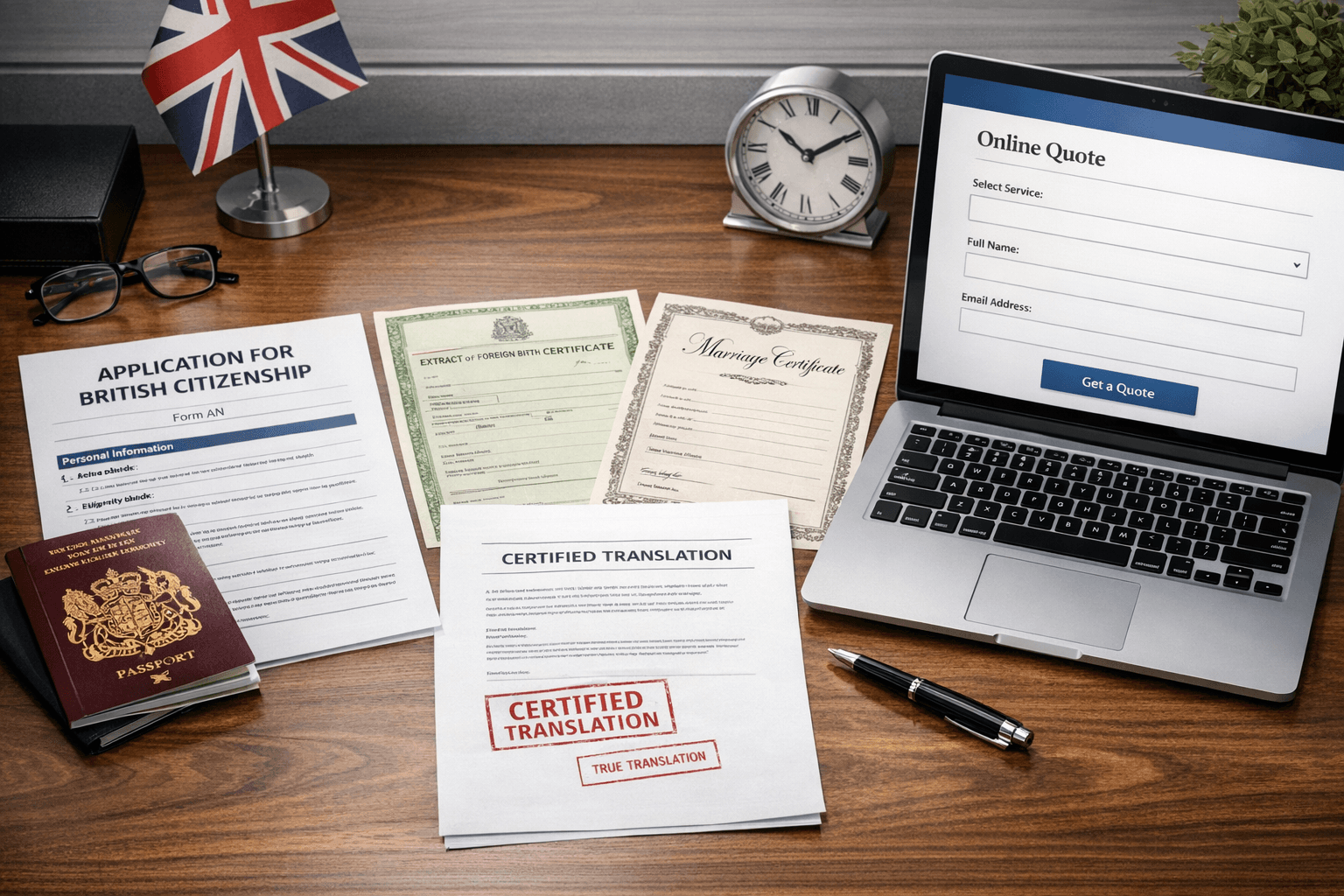
British citizenship document translation is needed whenever any supporting document you rely on is not in English or Welsh. That sounds simple, but most applicants get stuck on the same question: which documents actually matter enough to translate? The safest answer is this: if a document helps prove your identity, your name history, your relationship history, or your route to eligibility, it should be translated in full before you submit it.
That is why translation should never be treated as an afterthought. A citizenship application can be strong on substance and still become slower, more expensive, and more stressful if the document pack is incomplete or the translation format is wrong. A good application is not just about eligibility. It is about presenting evidence clearly enough that a caseworker can follow it without hesitation.
If you already know which records are in another language, the fastest next step is to request an online quote with clear scans of every page. That lets you confirm the right format before you upload evidence, book biometrics, or work toward the next stage of your UK passport pathway docs.
Where can I get certified translations for citizenship applications?
If you are asking the practical question most applicants ask — where can I get certified translations for citizenship applications? — the safest answer is: use a professional certified translation company or a qualified practising translator who can provide a full, signed certification suitable for official UK use.
For UK citizenship applications, the key issue is not finding a mysterious “Home Office-approved” translator list. The key issue is finding a translator or translation company that can produce a full translation of any non-English or non-Welsh document and clearly certify that it is accurate, dated, traceable, and suitable for official use.
A strong route is to use a specialist certified translation service that regularly handles birth certificates, marriage certificates, divorce records, academic records, passport pages, and court or registry documents for UK immigration and nationality cases.
You can also find qualified translators through the Chartered Institute of Linguists or the Institute of Translation and Interpreting. That matters because UK government-linked sources direct people seeking certified translations of civil status documents to CIOL or ITI, and because the UK system focuses on properly certified, verifiable translations rather than a single universal government-approved list.
What to check before you order
Before you order, confirm that the provider will translate the full document, not just the main text. Confirm that the translation will include a statement that it is a true and accurate translation of the original, the date, the translator’s full name, signature, and contact details, and that stamps, seals, handwritten notes, registry annotations, and reference numbers will be translated where legible.
Also confirm whether standard certified translation is enough for your case, or whether any extra step such as notarisation is only needed because a specific authority has asked for it. That one check can save applicants from over-ordering the wrong service.
The simple rule most applicants should follow
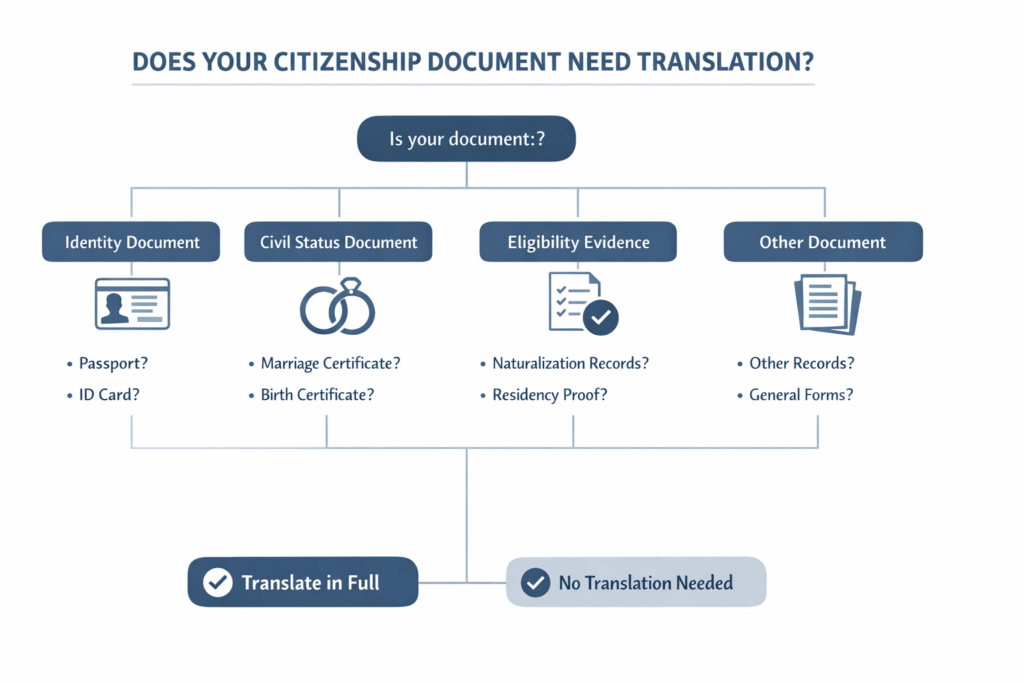
Use this test:
Translate every non-English or non-Welsh document that does one of these jobs:
- proves who you are
- proves a name change or family relationship
- proves a key part of your eligibility
- explains a discrepancy in your record
- will be reused later in connected official processes
This matters because citizenship applications are really a chain of proof. If one link in that chain is unreadable to the decision-maker, the rest of the file becomes harder to assess.
A practical way to think about naturalisation document translation is to divide your records into three groups.
1. Identity documents
These show the person behind the application.
Common examples include:
- birth certificates
- national identity cards
- foreign passports or relevant passport pages
- adoption records
- household registration documents
- military record books where they are used as identity support
2. Civil status and name-history documents
These explain why names, family details, or marital status may differ across records.
Common examples include:
- marriage certificates
- civil partnership certificates
- divorce decrees
- death certificates of a former spouse
- deed poll equivalents or official name-change records
- court orders affecting parental responsibility or guardianship
3. Eligibility-supporting documents
These help connect your route to citizenship to the evidence you provide.
Common examples include:
- foreign academic certificates if used as part of an English-language evidence chain
- supporting legal records issued abroad
- overseas police or court documents where relevant
- foreign-language letters or official records used to clarify residence, identity, or good character issues
A better way to decide what to translate
Many pages online give applicants a long list of possible documents. That is helpful, but it can still leave you guessing. A stronger method is to ask:
“If I removed this document, would my citizenship file become weaker, less clear, or inconsistent?”
If the answer is yes, and the document is not in English or Welsh, translate it.
Here is a cleaner decision guide.
| Document type | Usually needs translation? | Why it matters |
| Birth certificate | Yes | Core identity evidence |
| Marriage or civil partnership certificate | Yes | Explains spouse route or name changes |
| Divorce decree | Yes | Explains marital history and name chain |
| Death certificate of former spouse | Yes | Clarifies status history |
| National ID card | Often | Supports identity where relevant text is not readable |
| Foreign degree certificate or transcript | Often | May support English-language evidence or personal history |
| Adoption or guardianship papers | Yes | Clarifies identity or parental links |
| Court orders from abroad | Usually | Explains legal facts in the file |
| Foreign passport pages | Sometimes | Translate relevant pages if they contain needed evidence not already clear in English |
That final row matters. Not every passport needs full translation. Many passports are already partly multilingual. What matters is whether the relevant page, stamp, annotation, or supporting detail can be clearly understood by the receiving authority. If the useful part is not readable, translate it.
Documents commonly translated in British citizenship applications
Birth certificates
A foreign birth certificate is one of the most common documents applicants need translated. It helps anchor the entire file: full name, date of birth, place of birth, and sometimes parental details.
Birth certificates become even more important when:
- your current name differs from your birth name
- your passport spelling differs slightly from another record
- your country of origin uses naming conventions unfamiliar to UK authorities
- the certificate is old, handwritten, or includes official marginal notes
If your birth certificate is already multilingual, do not assume that means no translation is needed. If key annotations, stamps, handwritten amendments, or registry notes remain in another language, a full certified translation is still the safer route.
Marriage, civil partnership, and divorce records
These documents often do more work than applicants realise. They do not just prove status. They connect names across time.
For example, your passport may show one surname, your degree another, and your proof of residence a third version. A translated marriage certificate or divorce decree often becomes the document that makes the whole application coherent.
This is one reason a certified marriage certificate translation is so often part of a strong citizenship file. It is not just a formality. It is often the bridge between otherwise inconsistent records.
Foreign identity documents
National ID cards, residency cards from previous jurisdictions, and certain civil registry extracts can all matter if they support your identity history. If the text is not clearly readable in English or Welsh, translate them.
In practice, identity documents are most useful when they confirm:
- exact spelling of names
- dates and places of birth
- previous names
- parental details
- official issue dates or record numbers
Academic records and qualification documents
Not every applicant needs these. But if you are relying on a foreign qualification anywhere in your evidence chain, you should treat it carefully.
A degree certificate or transcript may matter because it supports your English-language route or helps explain the background behind your application. If it appears in your file and is not in English or Welsh, professional translation is the safer choice.
Special-case documents
Some applications involve a more complex record trail. That is where applicants benefit most from a specialist certified translation provider.
Examples include:
- adoption papers
- custody or guardianship orders
- foreign court judgments
- old civil registry extracts
- archived certificates with handwritten notes
- records from countries where names are recorded in multiple scripts
These are the cases where accuracy, formatting, and consistency checks matter most.
What a compliant translation should include
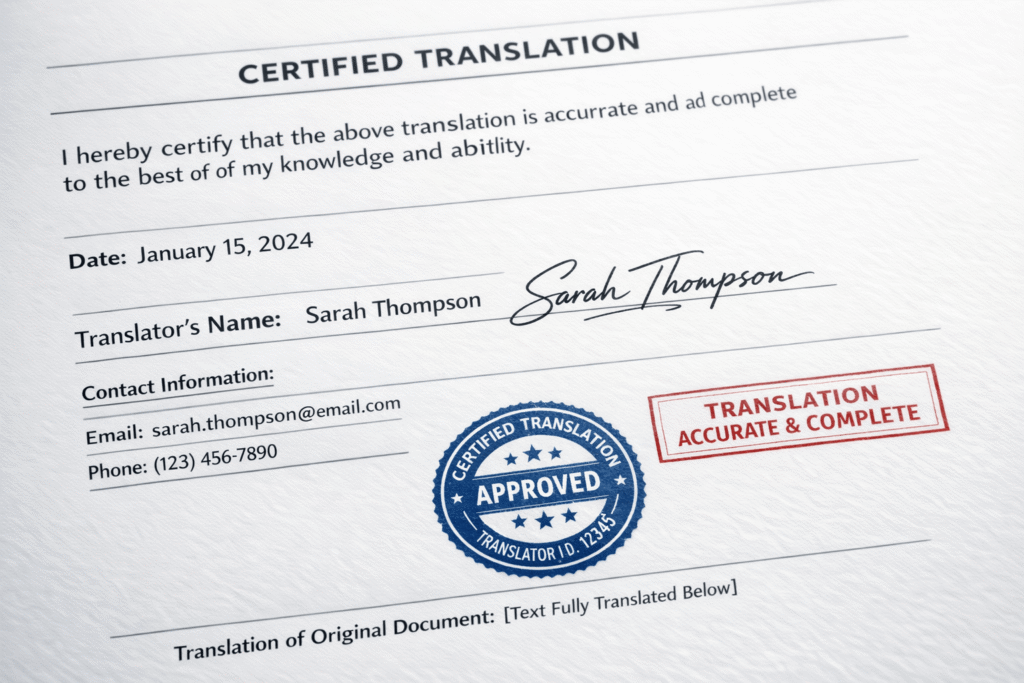
A strong citizenship translation is not just “the words in English.” It should be submission-ready.
In practice, that means the translated document should include:
- a statement confirming it is a true and accurate translation of the original
- the date of translation
- the translator’s full name
- the translator’s signature
- the translator’s contact details
- a complete rendering of the original content, including stamps, seals, handwritten notes, and reference numbers where legible
This is where many low-cost services cut corners. They translate the obvious text but skip the details around the edges of the document. That is exactly the kind of shortcut that creates avoidable questions later.
A reliable certified translation provider will also help you keep names, dates, and place spellings consistent across the whole pack. That is a small detail with a big impact.
Is there a UKVI-approved or Home Office-approved translator list?
This is one of the most common points of confusion, and it is worth stating clearly on this page.
For British citizenship applications, applicants should not assume there is a single public UKVI-approved or Home Office-approved list of translation companies they must use. What matters is whether the translation is complete, properly certified, and traceable to a real translator or translation company.
That distinction matters because many applicants search for phrases like “UKVI approved translator” or “Home Office approved translation service.” In practice, the UK system focuses on whether the translation meets the required standard, not on whether the applicant picked from one universal government-approved directory.
A better way to explain it to applicants is this: choose a provider whose translations can be independently verified, and whose certification includes the required accuracy statement, date, translator identity, and contact details. Where applicants want an extra quality filter, using a translator listed by CIOL or ITI is a sensible route.
Certified, sworn, or notarised: what do you actually need?
For most British citizenship applications, certified translation is the format applicants need.
That is the key point.
A lot of applicants over-order because they assume notarisation or sworn translation must be “more official.” Usually, it is not about buying the most expensive option. It is about matching the translation type to the receiving authority.
Here is the practical distinction:
- Certified translation is the standard choice for most UK citizenship-related submissions.
- Notarised translation is usually only needed when a specific authority asks for notarial authentication.
- Sworn translation is typically relevant for certain foreign jurisdictions that recognise court-sworn translators.
For a British citizenship application, the safer question is not “What is the highest level?” It is “What will this authority accept?”
That is why a good provider should explain the difference before you pay for extras.
Naturalisation document translation and UK passport pathway docs are not the same thing
Applicants often blend these two stages together, but they are different.
At the citizenship application stage
Your focus is proving eligibility, identity, and continuity of records. This is where naturalisation document translation matters.
After citizenship is granted
You then move into the next stage of UK passport pathway docs. At that point, the key issue changes. You are no longer proving that you qualify to become a citizen. You are proving your status and preparing for travel or later official use.
That distinction matters because some people assume their naturalisation certificate will work like a travel document. It does not. After citizenship is granted, the process moves on to passport or certificate-of-entitlement territory.
If you later need to use your British documents overseas, that can trigger a different translation question entirely. In those cases, you may need certified translation, notarisation, apostille, or a jurisdiction-specific sworn format depending on where the document will be used.
A practical post-approval point many applicants miss
After you get your certificate, the citizenship certificate itself is not the document you use to enter the UK. Once citizenship is granted, the practical next step is usually a British passport, or in some cases a certificate of entitlement. That is why applicants should treat post-citizenship document planning as a separate stage, not as an extension of the naturalisation evidence stage.
The most common translation mistakes that slow applications down
The translation stage goes wrong in predictable ways.
1. Waiting until the end
Applicants often prepare everything else first and leave translation until they are about to submit. That creates rush decisions, poor scanning, and unnecessary stress.
2. Sending cropped or unreadable scans
If the scan is incomplete, the translation will be incomplete. Missing corners, cut-off stamps, and blurred handwriting create problems before the translation even starts.
3. Translating only the “main text”
A document is not just its main paragraph. Registry notes, seals, signatures, side stamps, and handwritten amendments can all matter.
4. Ignoring name consistency
A translation can be technically accurate and still create confusion if the spelling convention differs from the rest of your file. That is why consistency checks matter.
5. Ordering the wrong level of certification
Many applicants pay for notarisation they do not need, or they use a generic translator who cannot produce a proper certification statement.
6. Using a provider with no clear accountability
If the provider cannot explain who translated the file, what the certificate includes, how fast they can deliver, or what official use they handle, move on.
How to choose the right certified translation provider
Choosing a provider is not just about price. It is about whether they understand official document risk.
A strong certified translation provider should be able to answer these questions immediately:
- Do you handle British citizenship and naturalisation document translation?
- Will the translation include a proper certificate of accuracy?
- Do you translate stamps, seals, side notes, and handwritten amendments?
- Can you flag name inconsistencies before delivery?
- Can I get an online quote from clear scans?
- Do you offer same-week service for urgent official submissions?
- If I do not need notarisation, will you say so?
That last point matters more than it sounds. Trustworthy providers do not upsell complexity for no reason.
At UK Certified Translation, the strongest credibility signals to surface next to your CTA are simple: an accredited network, recognised professional memberships, GDPR-compliant workflows, rapid turnaround options, and a clear human contact point. Those trust elements reduce hesitation far better than vague marketing claims.
Ready to move forward? Upload your file for an online quote and ask for the exact certification level needed for your citizenship case.
“I needed a notarised translation of my degree certificate for immigration, and UK Certified Translation made it so easy. Uploaded my file in minutes and got the signed PDF back the next day. Solid service.”
— Emma B., Operations Manager
When same-week service makes sense
Not every file needs urgency. But some do.
A same-week service is especially useful when:
- you have just realised a key document is still untranslated
- your biometric appointment is close
- an older overseas certificate needs careful formatting
- a marriage or divorce document is holding up your submission
- you want to keep the application moving without sacrificing accuracy
The right way to use a same-week service is not to demand speed at any cost. It is to submit clean scans, confirm the exact destination, and let the provider tell you what is realistic.
If you need a faster turnaround, say so at quote stage. A proper online quote process should confirm whether the timeline is workable before the order starts.
Three real-world examples
Example 1: Birth certificate plus name-change chain
An applicant has a foreign birth certificate, a current passport, and a UK utility bill. The surname on the birth certificate differs from the surname used today after marriage.
What needs translation?
- the foreign birth certificate
- the foreign marriage certificate, if that is the record linking the names
- any additional foreign-language name-change record used to close the gap
What does not help?
- translating unrelated documents just because they exist
Example 2: Spouse route with foreign marriage records
An applicant is applying on the basis connected to marriage to a British citizen. Their core relationship evidence includes a foreign marriage certificate, and some supporting records use their maiden name.
What needs translation?
- the marriage certificate
- any foreign divorce decree from a previous marriage if relevant
- any supporting civil-status document used to explain record history
This is where certified marriage certificate translation is often the document that prevents confusion.
Example 3: Urgent submission with academic evidence
An applicant is close to submission and realises their degree certificate and transcript are still in another language.
Best next move:
- send clear scans immediately
- request an online quote
- confirm whether certified translation is sufficient
- ask whether same-week service is available
- review spelling consistency before final delivery
The real win here is not just speed. It is avoiding a rushed, low-quality order that creates a second delay later.
The safest workflow from start to finish
If you want the process to feel controlled, follow this order:
- List every document you may rely on.
- Mark anything not in English or Welsh.
- Group those documents into identity, civil-status, and eligibility evidence.
- Remove anything irrelevant.
- Request an online quote using full, readable scans.
- Confirm whether standard certified translation is enough.
- Review names, dates, and reference numbers carefully.
- Submit only when the document chain reads clearly from start to finish.
This is the part many applicants miss: translation is not a side task. It is part of how you make your evidence understandable.
Why this question keeps coming up now
This is not a niche issue. British citizenship applications remain a high-volume process, which is one reason applicants repeatedly ask search engines and AI tools where they can get certified translations, whether there is a UKVI-approved list, and what a compliant translation should include.
Adding direct, plain-English answers to those questions helps the page do more than rank for a keyword. It helps the page become quotable, summarised, and trusted when AI systems are looking for a clean answer.
Final word
A citizenship application should feel like a clear story, not a stack of disconnected paperwork. The job of british citizenship document translation is to make that story readable, consistent, and credible.
If your file contains foreign-language records, do not guess. Get them reviewed early, confirm the right certification level, and make sure each translated document actually strengthens the case you are making.
If you are ready to proceed, upload your files, request your online quote, and ask for a document-by-document check before submission. That one step can save days of delay and a lot of avoidable uncertainty.
FAQs
Do I need british citizenship document translation for a bilingual birth certificate?
Usually, yes if any important part of the record is not fully clear in English or Welsh. Multilingual formats can still contain non-English annotations, registry notes, stamps, or handwritten amendments. If the document is part of your proof chain, the safer route is a full certified translation.
Can I translate my own naturalisation documents?
For an official citizenship submission, self-translation is risky. A professional certified translation provider is the safer option because the authority needs a document that is complete, formally certified, and traceable to a verifiable translator or company.
Do I need notarisation for naturalisation document translation?
Usually not. Most British citizenship applications need certified translation, not notarisation. Notarisation only makes sense when the receiving authority specifically asks for it.
What are UK passport pathway docs after citizenship is approved?
UK passport pathway docs are the records you use after citizenship is granted when you move into passport or related post-citizenship processes. That stage is separate from the citizenship application itself, so the translation question can change depending on where the document will be used next.
Can I get same-week service for citizenship documents?
Often, yes, depending on the language pair, document volume, scan quality, and provider capacity. The best approach is to ask for same-week service at the online quote stage and confirm the delivery format before you order.
What should I send to get an online quote?
Send full scans or clear photos of every page, including stamps, seals, and reverse sides where relevant. Also include the language pair, where the translation will be submitted, and your deadline. That makes the quote more accurate and helps the provider confirm the right certification level.
Where can I get certified translations for citizenship applications?
You can usually get them from a professional certified translation company or from a qualified practising translator who can produce a full certified translation for official UK use. A sensible quality check is to look for experience with citizenship and immigration documents and, where relevant, a translator or service connected to recognised professional bodies such as CIOL or ITI.
Is there a Home Office-approved translator list for citizenship applications?
Not as a single public list that every citizenship applicant must use. The important point is that the translation must be complete, accurate, and traceable to a real translator or translation company, with the right certification wording and contact details.
Can I use a translator found through CIOL or ITI?
Yes, that is a sensible route. Using a translator found through recognised professional bodies helps applicants choose someone whose work is easier to trust, verify, and explain if the receiving authority ever asks questions about the translation.
Can I travel with my citizenship certificate before I get a British passport?
No. After citizenship is granted, the citizenship certificate is not the travel document you use to enter the UK. That is why applicants should plan the passport or certificate-of-entitlement stage separately from the citizenship application stage.