



If you are preparing a settlement application, ilr document translation usually becomes necessary the moment you rely on any supporting evidence that is not in English or Welsh. That can include civil records, overseas financial evidence, relationship documents, police papers, employment records, and proof of residence. The key is not how “important” the document feels to you. The key is whether it helps prove your case.
For many applicants, the challenge is not understanding that translation is needed. It is knowing which documents often need translation, which ones are commonly missed, and how to avoid paying for documents that are not actually relevant. That is where many ILR files become messy.
Quick answer: The documents most often translated for ILR are birth and marriage certificates, divorce or name-change records, children’s documents, foreign passports or ID pages relied on as evidence, police records, overseas employment and tax records, bank statements, tenancy or address evidence, and any court or legal documents submitted in support of the application.
Official requirements for translated documents for UK immigration
If you submit a document for a UK visa, settlement, or leave to remain application and that document is not in English or Welsh, the Home Office guidance says it must be accompanied by a full translation that can be independently verified. For many immigration routes, GOV.UK describes this as a certified translation.
What the translation must include
In practical terms, the translation should clearly include confirmation from the translator that it is an accurate or true and accurate translation of the original document, the date of translation, the translator’s full name, the translator’s signature or the signature of an authorised official from the translation company, and contact details that allow the translation to be checked if needed.
For leave to remain and indefinite leave to remain applications where Appendix FM-SE applies, the Immigration Rules go further. They require the original-language document and a full translation, and they also refer to certification by a qualified translator together with details of the translator’s or translation company’s credentials.
What happens if a translation is missing or cannot be verified
This matters because Home Office caseworker guidance states that if no translation is supplied, or if the translation cannot be independently verified, the document may not be accepted as evidence. That is why incomplete translations, missing signature blocks, or unclear translator details can create avoidable delays and evidential problems.
Not every applicant needs every category. A five-year partner route case will usually involve a different translation bundle from a ten-year long residence case or a work route settlement case. But one rule stays consistent: if a document is part of your evidence and it is not in English or Welsh, it should be prepared properly before you upload it.
If you want your settlement application translation handled cleanly from the start, send the full bundle in one go and ask for a fixed quote before submission. That single step often saves more time than rushing a document-by-document order later.
Why ILR document translation matters more than people expect
ILR applications are document-heavy because they often pull together years of identity, residence, relationship, income, travel, and life-in-the-UK evidence. A short visitor visa file may only rely on a few supporting papers. A settlement application can involve a full history.
That creates three risks:
- A key document is not translated at all
- Only part of the document is translated
- The translation exists, but the pack is not clear enough to verify
The second problem is especially common. Applicants often send the main text for translation but forget the back page, stamp, handwritten note, registration box, marginal annotation, or old surname entry. Those details can be exactly what the caseworker needs to connect one document to another.
A safer approach is to think in terms of evidence function:
- Does this document prove identity?
- Does it prove relationship?
- Does it prove residence?
- Does it prove income, employment, or lawful presence?
- Does it explain a discrepancy, such as a different surname, a previous marriage, or a foreign court decision?
If the answer is yes, it belongs in your translation review pile.
The documents that most often need translation for ILR
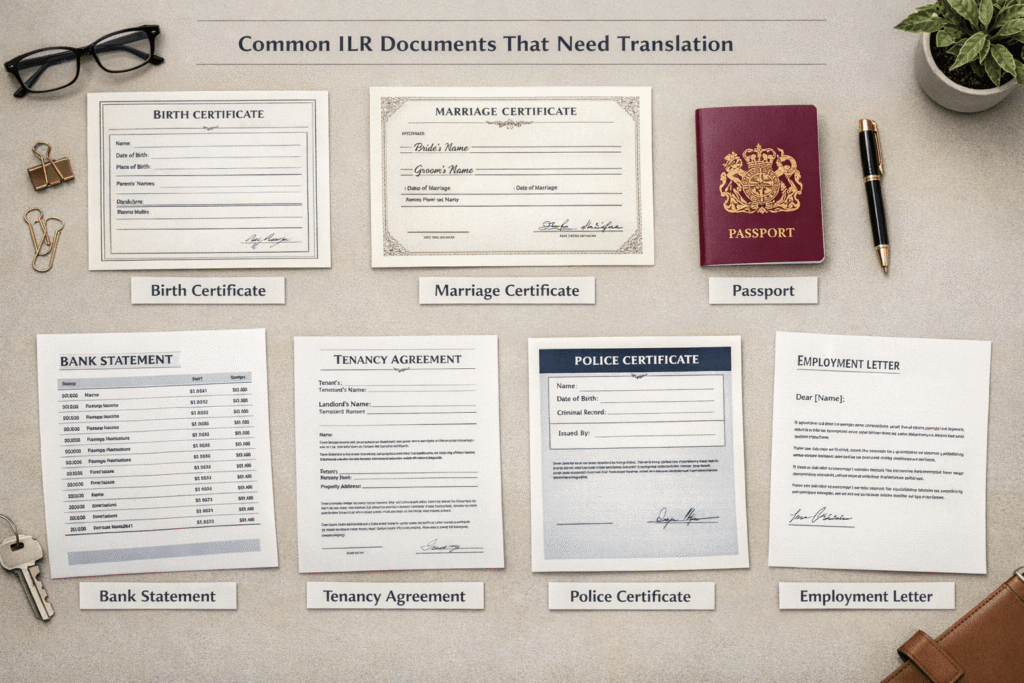
1) Civil status documents
These are among the most common items in any official document translation UK workflow for settlement files.
Documents in this group often include:
- Birth certificates
- Marriage certificates
- Civil partnership certificates
- Divorce decrees
- Adoption papers
- Death certificates, where relevant
- Change-of-name certificates or deeds
- Family register extracts
Why they matter:
- They tie together names, relationships, dates, and legal status.
- They are frequently used where a partner, spouse, or child is involved.
- They often explain why the same person appears under different names across a passport, bank statement, tenancy record, or prior visa document.
Common mistake:
Applicants translate the headline information but ignore side notes, stamps, seals, or handwritten registry additions.
2) Relationship and household evidence
On family and partner routes, relationship evidence often carries more translation work than applicants expect.
Common examples:
- Joint tenancy agreements issued overseas
- Foreign household registration documents
- Letters confirming cohabitation
- Utility bills from abroad
- Family booklets or municipal household records
- Marriage-related supporting records
Why they matter:
- They help establish a genuine relationship and shared life.
- They can support name continuity, address history, and household composition.
Common mistake:
Submitting a translated marriage certificate but leaving related household or address records untranslated, even when those records are used to prove cohabitation.
3) Identity and travel history documents
Not every passport page needs translation. But identity documents frequently create translation needs where names, places of birth, family details, or status notes appear in another language.
Common examples:
- Foreign passport bio pages
- National ID cards
- Residence cards
- Internal passports
- Travel documents
- Historical identity cards
- Older passports used to explain residence history
Why they matter:
- ILR cases often rely on continuity across time.
- Identity documents help reconcile spellings, dates, and nationality data.
- Older records can become important when long residence or gaps need explaining.
Common mistake:
Only translating the newest passport while relying on older non-English documents to explain earlier lawful residence or name history.
4) Employment records
Employment evidence is especially common in work-route and long-residence ILR cases, but it can also appear in family cases where income or continuity must be shown.
Documents often translated here include:
- Overseas employment letters
- Payslips
- Work contracts
- Employer confirmation letters
- Social security contribution statements
- Termination letters
- Professional registration letters
Why they matter:
- They help prove work history, earnings, or continuity.
- They can support the background story of absences, moves, or financial evidence.
Common mistake:
Translating the employer letter but not the supporting payslips or payroll records that back it up.
5) Financial documents
Financial evidence is one of the biggest hidden translation categories in settlement application translation.
Common examples:
- Bank statements
- Savings certificates
- Fixed deposit records
- Tax returns
- Dividend statements
- Foreign income records
- Pension letters
- Remittance records
- Loan or mortgage statements, if relied on
Why they matter:
- Financial evidence may be used to support maintenance, savings, or income claims.
- In some routes, it helps explain funds, address history, or household arrangements.
Common mistake:
Only translating the first page of a bank statement when the relevant deposits or account-holder details appear later.
6) Residence and address evidence
Proof of where you have lived can matter across multiple ILR routes.
Documents often translated include:
- Overseas tenancy agreements
- Municipal registration records
- Local authority letters
- Utility bills
- Residence certificates
- Landlord letters
- Property ownership papers
Why they matter:
- They can support continuous residence narratives.
- They help explain periods before or between UK records.
- They are useful when the case turns on timeline clarity.
Common mistake:
Ignoring foreign address evidence because it seems “old,” even though it explains a period the Home Office may ask about.
7) Police, court, and legal documents
This is the category where accuracy matters most and guesswork causes the biggest problems.
Common examples:
- Police certificates
- Police registration records
- Court judgments
- Custody orders
- Criminal record extracts
- Affidavits
- Notarial statements
- Foreign legal declarations
Why they matter:
- Legal documents are sensitive to wording.
- A poor translation can change meaning in ways that create follow-up questions.
- These documents often affect credibility, eligibility, or disclosure.
Common mistake:
Using a basic translation for a legal document when the file would be safer with a specialist reviewer and a clearly structured certified pack.
8) Children’s documents
Where children are included in the application or form part of the evidence, their records often need translation too.
Common examples:
- Birth certificates
- Adoption papers
- School records, if relied on
- Consent letters
- Custody documents
- Vaccination or medical records, where relevant to the case
- Dependency evidence
Why they matter:
- They help establish parent-child links, custody, and dependency.
- They are often central in family-based settlement files.
Common mistake:
Translating the child’s birth certificate but forgetting the supporting custody order or consent document that explains legal responsibility.
Route-specific examples: what often needs translation in real ILR cases
Partner or spouse route
The most common translated documents are:
- Marriage certificate
- Divorce records from previous marriages
- Name-change records
- Children’s birth certificates
- Foreign bank statements or savings evidence
- Foreign cohabitation records
- Overseas tax or income papers, where relied on
What usually gets missed:
Old divorce papers, side notes on marriage records, and documents explaining surname differences.
Long residence route
The most common translated documents are:
- Older passports or identity papers
- Historical address documents
- Overseas travel or immigration records
- Employment letters from abroad
- Police records or legal records, if relevant
- Name-change or civil status documents used to explain timeline gaps
What usually gets missed:
Older records that seem secondary but actually help connect a ten-year timeline.
Work route settlement
The most common translated documents are:
- Overseas employment records
- Tax documents
- Foreign salary evidence
- Professional registration documents
- Marriage or birth certificates for dependants
- Name consistency documents
What usually gets missed:
Supporting payroll or tax evidence behind the headline employer letter.
Family life or private life route
The most common translated documents are:
- Civil status records
- Children’s documents
- Household registration records
- Medical or welfare evidence from abroad
- School records
- Legal papers affecting family life
What usually gets missed:
Documents that explain dependency, schooling, or custody.
The documents many applicants forget to translate
This is where the strongest UK immigration translations providers add value: they review the bundle as a case file, not as isolated pages.
Watch for these frequently missed items:
- Reverse sides of certificates
- Apostilles, seals, and registration stamps
- Handwritten notes
- Marginal remarks
- Registrar comments
- Embedded legends on ID cards
- Short cover letters attached to official records
- Foreign-language email confirmations used as evidence
- Name-change annotations on civil records
- Tables, footnotes, and notes under signatures
A practical rule:
If the caseworker can see it on the source document, assume it may need to be translated unless it is clearly irrelevant.
A simple framework: translate, review, or skip
One reason competitors underperform is that they treat every document the same. A better system is triage.
Translate now
Translate immediately if the document is:
- Non-English or non-Welsh
- Central to eligibility
- Needed to prove identity, relationship, residence, income, lawful history, or child dependency
- Likely to be queried if left untranslated
Review before ordering
Review first if the document is:
- Partly bilingual
- Duplicative of another record
- Old but possibly useful
- Only relevant if a caseworker asks follow-up questions
Usually skip
You can often skip translation if the document is:
- Not being relied on
- Already fully in English or Welsh
- Purely administrative and unrelated to the application
- Replaced by a clearer English-language equivalent
This framework helps applicants avoid two expensive mistakes: over-ordering translations and under-preparing the actual evidence.
What a good ILR translation pack should include
A strong ilr document translation pack is not just a converted text file. It should feel submission-ready.
At minimum, a good pack should include:
- The full translation of the original document
- Clear indication of stamps, seals, signatures, and handwritten content
- A certificate or declaration of accuracy
- The date
- Translator or company identification details
- Contact details that can be checked if needed
For some in-country settlement evidence, it is wise to use a provider that can also show professional credentials clearly, rather than only a generic signature line. That extra clarity reduces friction if the file is reviewed closely.
In practical terms, a compliant pack should let a caseworker check five things quickly: what the original document says, whether the translation is full, who translated it, when it was translated, and how that translator or translation company can be contacted or verified. Where the application falls under Appendix FM-SE for leave to remain or indefinite leave to remain, it is also wise to make the translator’s qualifications or professional credentials easy to identify.
Certified, notarised, or sworn: what do ILR applicants usually need?
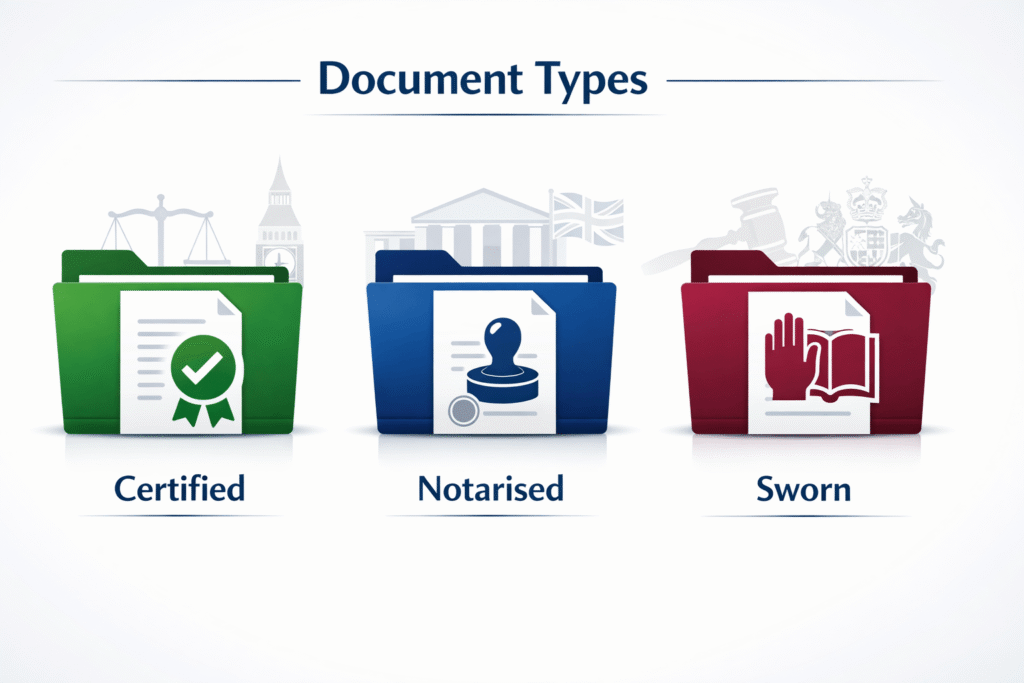
For most UK settlement files, the answer is usually certified translation, not a more complicated format.
Certified translation
Usually the right starting point for ILR and most UK immigration submissions.
Notarised translation
Usually only needed if a specific authority asks for notarisation or if the translation will also be used outside standard UK immigration submission contexts.
Sworn translation
Usually relevant when the receiving authority is in a country that uses a sworn-translator system. It is not the default format for most ILR applications.
This distinction matters because applicants often over-order. They pay for a notarised or sworn service when a certified translation would have been enough. On the other side, they sometimes order a basic translation when the application needs a properly certified one with verifiable details.
If you are unsure, send the exact authority wording with your file before ordering. That small check can prevent a full rework.
How to prepare your documents for faster turnaround
Fast delivery starts long before the translator begins. It starts with a clean file set.
Use this checklist before you request a quote:
- Scan the full document clearly
Include all pages, both sides where relevant, and any attachments. - Group related records together
For example, marriage certificate + divorce decree + name-change certificate. - Label files clearly
Use names like “Applicant_Birth_Certificate_Spanish.pdf” rather than “scan_004”. - Flag deadlines up front
Urgent files can often be handled faster when the full bundle arrives together. - State where the translation will be used
Mention that it is for ILR, settlement, or a wider UK immigration application. - Use secure upload from the start
Sensitive civil, financial, and legal records should not be passed around loosely.
A secure upload process also helps the provider spot duplicates, missing pages, and overlapping evidence before the work starts.
What drives the quote for ILR document translation?
Price is rarely about the word “ILR” itself. It is usually driven by:
- Number of pages
- Language pair
- Formatting complexity
- Urgency
- Whether the documents are repetitive or highly varied
- Whether legal review or specialist terminology is involved
- Whether you need digital only or hard-copy delivery too
In many cases, applicants save money by sending the whole bundle once instead of requesting multiple small jobs across several days.
If you need a fast decision, upload the full set and ask for the quickest compliant route, not just the cheapest line-item quote.
Common mistakes that slow down settlement applications
The highest-risk errors are usually not dramatic. They are small mismatches that make the file harder to trust.
The most common ones are:
- Sending cropped scans
- Translating only selected pages
- Missing the back of a certificate
- Inconsistent spelling of names across documents
- Omitting seals or handwritten notes
- Leaving out supporting records that explain a name or status change
- Ordering the wrong level of certification
- Sending documents one by one instead of as a bundle
- Choosing speed without checking whether the final pack is suitable for official submission
A better outcome comes from one simple habit: prepare the evidence as a connected story, not as random files.
A practical ILR translation checklist
Before you submit, check whether any of the following apply to you:
- My birth certificate is not in English or Welsh
- My marriage or civil partnership certificate is not in English or Welsh
- I have a divorce decree or name-change record in another language
- I am relying on foreign bank statements or savings evidence
- I am using overseas employment or tax records
- I have children’s documents in another language
- I have foreign address or household registration records
- I am including a police, court, or legal document from abroad
- I have older identity documents needed to explain names, dates, or timeline issues
If you answered yes to any of these, translation should be part of your document planning, not an afterthought.
Why applicants choose a specialist provider instead of a general translation service
Settlement files reward accuracy, consistency, and document handling discipline.
A specialist provider is more likely to:
- Recognise which pages should not be skipped
- Keep names, dates, and reference numbers consistent
- Flag when a related document probably also needs translation
- Explain whether certified, notarised, or sworn format is actually needed
- Offer fast delivery without turning the translation into a compliance risk
- Use secure upload and structured file handling for sensitive records
That matters because ILR is not just another upload task. It is a permanent-status application, and the supporting evidence deserves that level of care.
“Their certified translation was accepted immediately. Clear, compliant, and fast.”
If your application includes foreign-language records, the safest next move is to send the full bundle for review and request a fixed quote before you upload anything to your case portal.
Final word
The documents that most often need translation for ILR are the ones that prove who you are, how you qualify, how your household is structured, how your timeline makes sense, and why the supporting evidence can be trusted.
In practice, that usually means civil records, identity documents, relationship evidence, children’s records, financial papers, employment records, address history, and legal documents from abroad.
The best way to handle ilr document translation is not to guess page by page. It is to review the whole application bundle, identify which records carry evidential weight, and prepare them in one clean, consistent package.
For a smoother submission, upload your files securely, mention that the documents are for ILR, and get the translation format confirmed before you place the order.
FAQs
What is ILR document translation?
ILR document translation is the preparation of non-English or non-Welsh supporting documents for an Indefinite Leave to Remain application, usually with a certified translation pack suitable for official submission.
Which documents often need translation in a settlement application?
The documents most often needing settlement application translation are birth and marriage certificates, divorce or name-change records, children’s records, overseas bank statements, employment letters, tax papers, tenancy records, police certificates, and court documents relied on as evidence.
Do all UK immigration translations for ILR need to be certified?
If the document is part of your ILR evidence and it is not in English or Welsh, it should normally be submitted with a proper certified translation rather than a plain translation.
Do bank statements need official document translation UK services for ILR?
Yes, if the bank statements are in another language and you are relying on them to prove funds, savings, income, or financial history, they should be translated properly as part of your official document translation UK bundle.
Is notarised translation required for ILR?
Usually no. Most ILR applications need certified translation, not notarised translation, unless a specific authority or linked legal process explicitly asks for more.
Can I get fast delivery and secure upload for ILR translations?
Yes. Many providers offer fast delivery for urgent files, and a secure upload workflow is the safest way to send sensitive civil, financial, and legal documents for review.
What are the official requirements for translated documents for UK immigration?
If a document you are submitting is not in English or Welsh, UK immigration guidance says it should be accompanied by a full translation that can be independently verified. The translation should normally include confirmation that it is an accurate translation of the original document, the date, the translator’s full name, signature, and contact details. In some leave to remain and ILR cases under Appendix FM-SE, the rules also refer to certification by a qualified translator and details of credentials.
What must a certified translation include for ILR or leave to remain?
A strong certified translation for ILR or leave to remain should include the full translated text, the translator’s statement of accuracy, the date, the translator’s name, signature, and contact details, and where relevant the translator’s credentials or company credentials.
Do documents in Welsh need translation for UK immigration?
No. The official rule is framed around documents that are not in English or Welsh. If the document is already in Welsh, it does not normally need to be translated for that reason.
Will the Home Office accept a partial translation?
The official wording refers to a full translation. If you are relying on the document as evidence, a summary, selected extract, or partly translated page is not the safest approach.
What happens if a translation cannot be independently verified?
If a translation is missing or cannot be independently verified, the document may not be accepted as evidence. That can weaken the application if the untranslated document is central to identity, relationship, residence, income, or legal history.